5 U.S. Cities With the Most Michelin-Starred Restaurants
By
Cynthia Barnes
Read time: 4 minutes
July 18, 2025
Updated: July 18, 2025
5 U.S. Cities With the Most Michelin-Starred Restaurants
Culture •July 18, 2025•Updated: July 18, 2025
By Cynthia Barnes
Author
Cynthia Barnes
Cynthia kicked around the world for a while before landing in Colorado. Her work has appeared in Food & Wine, the Boston Globe, and National Geographic, among others. She loves dives — both scuba and bars — baseball, the Oxford comma, and live music.
In 1889, Eduard and Andre Michelin began making the rubber tires that would later become a household name. In 1900, the French brothers began publishing a pocket-sized guide for motorists, with maps and recommendations, including restaurants and hotels. Today, Michelin is the second-largest tire company in the world, and its guide is the internationally recognized standard of high-quality cuisine. In the U.S., there are more than 18,000 eateries recommended by Michelin across the country, with more than 3,500 earning a star rating. The guide assigns a one-, two-, or (rarely) three-star rating for restaurants it deems worthy. Here are the top five cities in the country for enjoying Michelin-lauded cuisine — along with exciting news for what U.S. cities will be appearing in the Michelin Guide next.
Fans of Hulu’s The Bear know that Chicago has no shortage of great eateries. The city boasts 19 Michelin-starred restaurants, including the contemporary cuisine at Alinea and Smyth, both rated three stars. And while, sadly, there’s not a classic Italian beef joint among the recommendations — we pledge allegiance to Roma’s — you will find several pizza places and two superb Mexican offerings from Chef Rick Bayless on the list of 111 Michelin-recommended restaurants in the Windy City.
4. Washington, D.C.
Credit: Joseph Victor Stefanchik for The Washington Post via Getty Images
The nation’s capital boasts 111 Michelin-recommended restaurants, 25 of which are rated one or two stars by the guide. While none of them has achieved the coveted three stars, two D.C. eateries have earned two stars — Chef José Andrés’ wildly inventive Minibar and the ambitious Japanese-influenced tasting menu at Ryan Ratino’s Jônt. For slurpable ramen that doesn’t require a senator’s salary, head up the stairs (not down!) to the Michelin-recommended Toki Underground.
Credit: Leo Jarzomb/MediaNews Group/ San Gabriel Valley Tribune via Getty Images
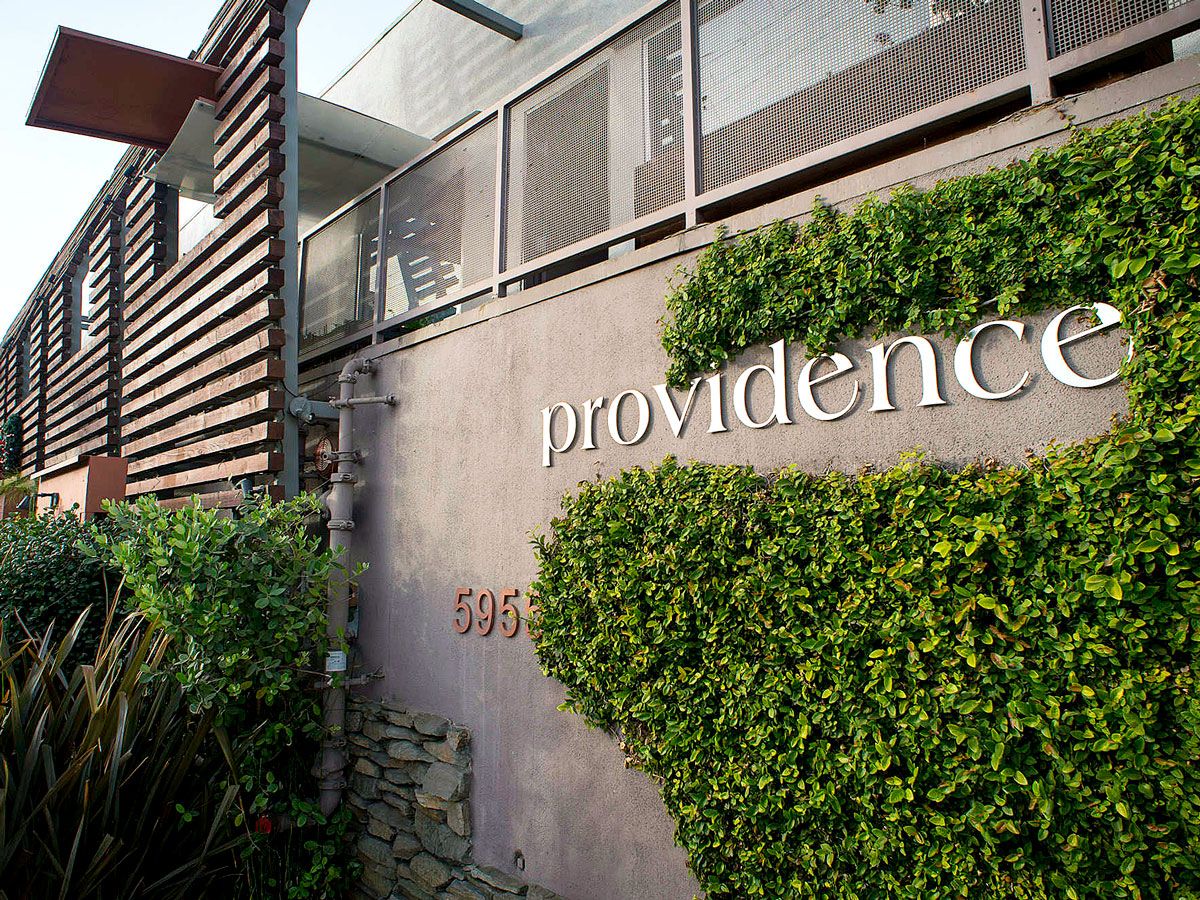
In 2025, Los Angeles got its first three-starred restaurants in the Michelin Guide, which join 25 other starred eateries. Hollywood’s seafood-centric Providence was upgraded from two stars to three, and the multicourse extravaganza at the recently reopened Somni, influenced by Spain’s iconic El Bulli restaurant, debuted on the list with three stars. For those who’d rather not spend $500 for a tasting menu, there are 143 other Michelin-recommended restaurants to try in L.A., too — the steak picado tacos at Guisado’s are less than five bucks.
2. San Francisco, California
Credit: Melina Mara/ The Washington Post via Getty Images
The City by the Bay is no stranger to great food, and it has 157 Michelin-recommended restaurants to prove it, including 30 that boast a star rating. Only three Bay Area restaurants earn three stars, but the Asian fusion at Benu, the French pescatarian at Atelier Crenn, and the contemporary California cuisine at Quince will not disappoint. Less fancy but no less delicious are the Michelin-recommended Ethiopian offerings at Barcote in Oakland and the Burmese home cooking at Oakland’s Teni East Kitchen.
The Big Apple is the big winner when it comes to Michelin-rated eateries, boasting 72 starred restaurants and 363 other Michelin recommendations in the city and surrounding area. Only five New York City restaurants have earned Michelin’s highest three-star distinction.
The oldest is Le Bernardin, Chef Eric Ripert’s salute to French seafood, which opened in 1986. Thomas Keller (of French Laundry fame) followed with Per Se, where diners can choose from two tasting menus, one of which is vegetarian. Vegan restaurant Eleven Madison Park, Japanese eatery Masa, and contemporary Korean favorite Jungsik round out the fab five.
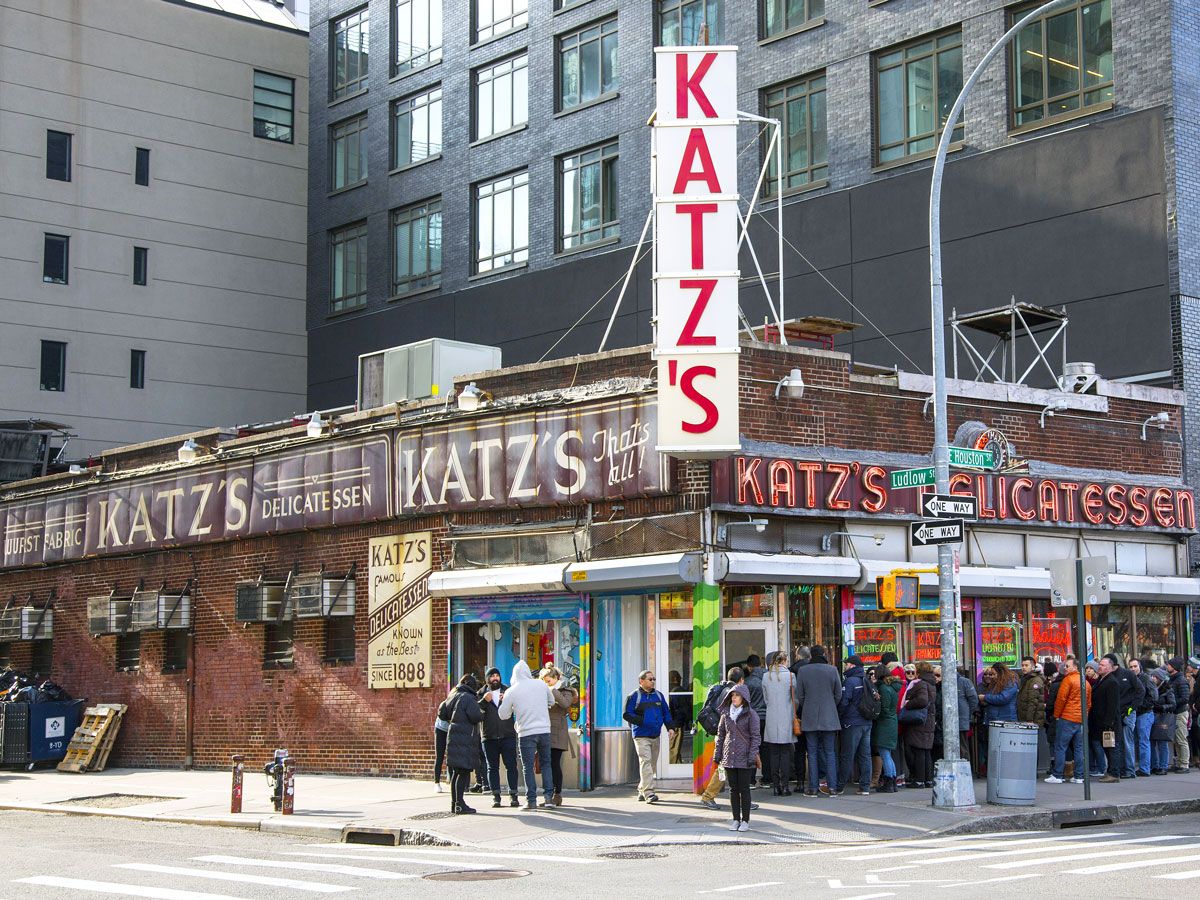
But the list isn’t all fancy — the venerable Katz’s Delicatessen, Kung Fu Little Steamed Buns Ramen, and the diner fare at J.G. Melon also make the guide as recommended restaurants (albeit without star ratings).
Looking for lauded cuisine a little closer to home? Foodies, rejoice: Michelin has been on a serious North American expansion lately, with new guides debuting in 2025 in Québec, Boston, Philadelphia, and the American South — the latter of which will go beyond major urban centers and cover cuisine in Alabama, Louisiana, Mississippi, North Carolina, South Carolina, and Tennessee, as well as recommendations from the preexisting Atlanta guide. Other recent additions include expanded Colorado and Florida state guides, along with a Toronto city guide.
Advertisement
More from our network
Daily Passport is part of Inbox Studio, an email-first media company. *Indicates a third-party property.
Marissa is a cheap airfare aficionado who loves exploring offbeat destinations with her husband. Based in Los Angeles and Joshua Tree, Marissa has been featured in publications such as San Diego Magazine, Palm Springs Life Magazine, 303 Magazine, and Mountain Living.
Renting a car might feel like an intimidating way to explore a new country — especially if you don’t know how to drive stick shift or if you’ll be driving on the left side of the road. Even pumping gas abroad can be an adventure. But there are certain benefits that come with renting a car, from being able to reach offbeat destinations with fewer crowds, to avoiding lugging heavy luggage through train stations and operating on your own schedule. Prepare yourself ahead of your next international trip with these helpful tips for renting a car abroad.
Before you book a vehicle, you should determine if your U.S. driver’s license is enough to get behind the wheel. The country you’re visiting may require an International Driving Permit (IDP), and you run the risk of being turned away at the checkout counter if you don’t have one. Check with the embassy of your destination country before you depart, and if an IDP is required, make plans to obtain one either in person or by mail.
The U.S. Department of State has authorized the American Automobile Association (AAA) and the American Automobile Touring Alliance (AATA) to issue IDPs. Americans with a valid driver’s license must provide a photocopy of their license (by mail) or supply it in person, have two passport-style photos, and pay a $20 fee. The permit will be valid for up to a year — but, importantly, it must be issued within six months of your trip. Also of note: American drivers abroad should always have their U.S. driver’s license and their IDP when operating a vehicle, as the IDP is not valid without the license (and vice versa).
Many U.S. auto insurance policies won’t cover collisions, theft, injuries, or damages abroad, so check with your insurance provider to see if you need additional auto insurance when traveling. Some policies do provide coverage when you drive to Canada and Mexico, but if you’re headed overseas, you may want to purchase insurance from the car rental company.
Before you do, check to see if your travel credit card offers travel insurance that can be used toward rentals. For example, the Chase Sapphire Reserve and Preferred cards and the Capital One Venture X and Venture One cards offer primary coverage for up to 31 days in a foreign country. If you aren’t interested in opening a new travel credit card, buying rental insurance from home ahead of your departure is another option, as many rental companies overseas often will cover only a small amount.
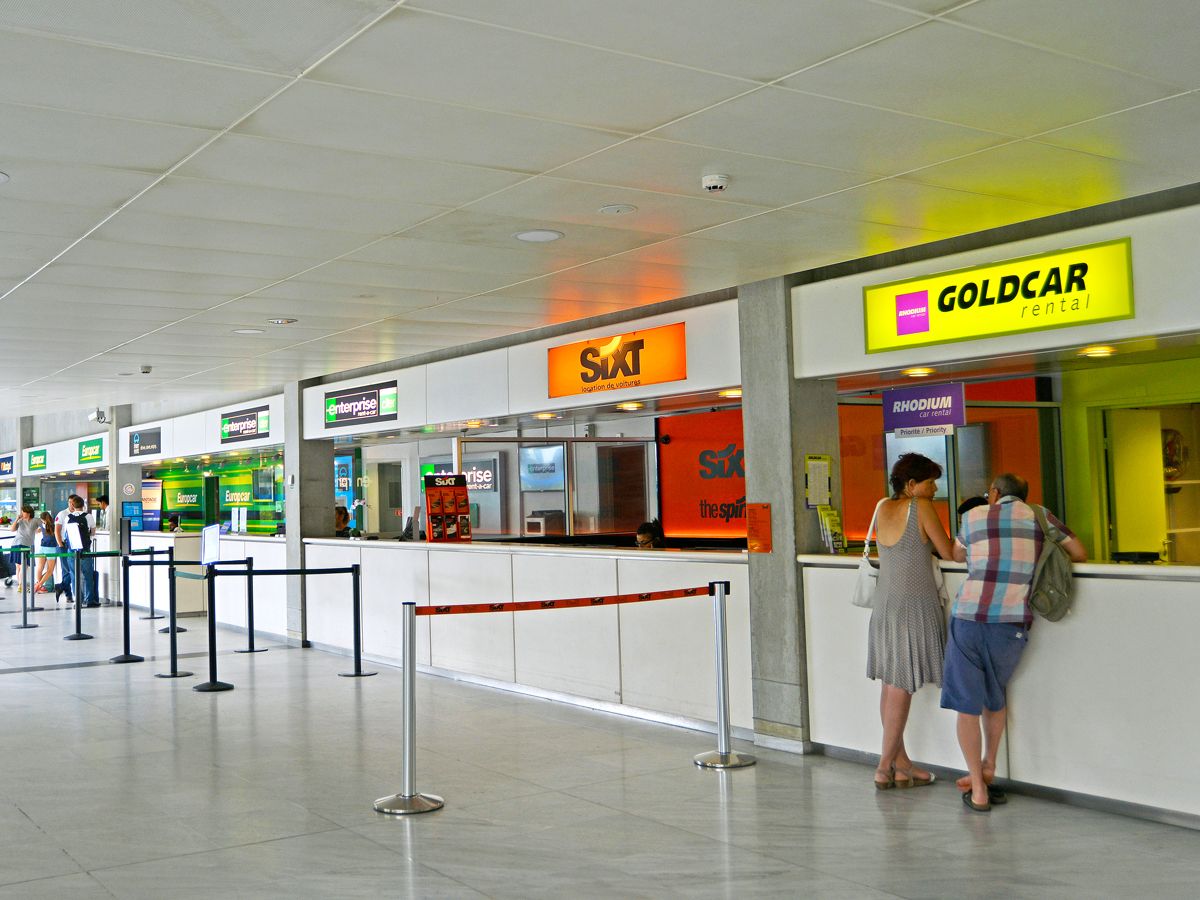
When you’re selecting a rental company, it might feel like an easier decision to select one of the bigger players you’re more familiar with, whether it’s Avis or Hertz, but many local agencies are just as reliable. Plus, they may offer better deals, especially if you plan to use the vehicle for only a day or two.
Europcar and Goldcar are two popular European rental companies, while Locauto offers rentals in Italy. Even with local agencies, reserving a car online is advisable if you are in search of a larger vehicle or are in a hurry to get to your hotel. If you can be flexible and spontaneous, though, some of the best bargains might be just steps from your Greek ferry port or a metro ride away in Paris. Leaving the airport to venture into town could save you a few extra euros, but you may have to be flexible on your pick-up and drop-off times.
If you plan to spend more than a couple of weeks abroad, you may want to book your car rental from the comfort of your own home well in advance, especially if your vacation entails a road trip through multiple countries. One-way reservations will likely incur extra fees, but the cost might be worth it, especially if it’s cheaper to book your return flight from a different city. Major airports in large cities will have more selection in terms of what’s available, but reserving well ahead of your departure can unlock long-term rental discounts.
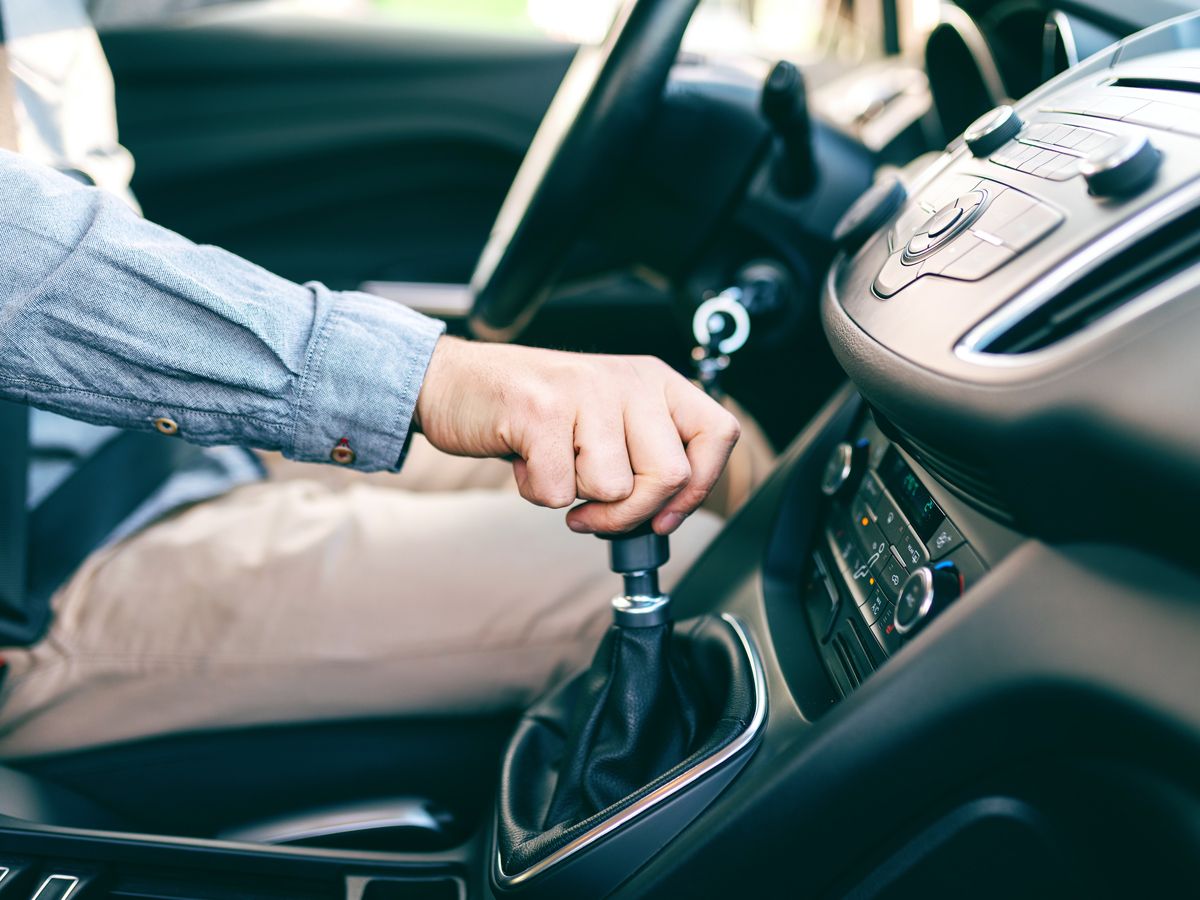
If you are comfortable driving a vehicle with manual transmission, you’re in luck — most manual rental cars are cheaper to rent abroad than those with automatic transmission. However, you should only select this option if you are comfortable driving with a stick shift. If you’re not skilled at driving stick, double-check the car you have booked has automatic transmission. Also be mindful that some vehicles can be “semi-automatic,” which allows the driver to manually select gears, similar to a manual transmission, but without the need to operate a clutch pedal.
Many countries — such as Canada, Germany, France, Spain, and most nations in Central and South America — have road rules similar to the U.S. Still, you should take time to research any potential differences that might get you into trouble. There are several countries that drive on the left side of the road, such as the United Kingdom, Japan, Ireland, Australia, New Zealand, and South Africa.
In some nations, especially in Scandinavia, headlights must be on, even in broad daylight. And when driving on the famous Autobahn in Germany, it’s illegal to stop or pull over on the highway unless it’s an emergency. Meanwhile, you’re not allowed to eat in a car in Cyprus, and it’s considered breaking the law if you accidentally splash a pedestrian with water on a rainy day in Japan. Whether you find the rules unusual (or not), you’ll want to avoid being ticketed or penalized, so make sure you do your homework.
It’s relatively easy to get lost when you’re driving in a foreign country, especially if the traffic signs aren’t in English. Be sure to download GPS apps such as Apple Maps and Google Maps for offline use in case you lose cell reception. It’s also a good idea to have paper maps as well as a pen and notebook in the glove compartment for getting instructions from locals if devices aren’t working.
You’ll want to carry a spare tire, cash, water, and a flashlight in your car, too, and tell friends and family members where you’re headed and provide them with a local embassy phone number in case of emergency. At the end of the day, it’s best to be prepared for any kind of scenario if you’re out on the open road in an unfamiliar country.
Nicole is a writer and researcher with over 15 years of experience seeking out arts, culture, and lifestyle stories in places like remote northern Quebec and the unforgettable streets of Amsterdam. Her work has also appeared in PureWow, Brit + Co, AUX TV, and CBC.
Whether it’s because of remote geography, smaller populations, or simply being overshadowed by their flashier neighbors, some U.S. states see far fewer annual tourists than others. But that doesn’t mean they’re not worth your time — quite the opposite. Check out the 10 least-visited states in the U.S. and why these states often hold surprising appeal.
Even though it doesn’t lead in tourism numbers, Vermont punches above its weight in charm. Known for its small towns, maple syrup, and fiery fall foliage, the Green Mountain State is a favorite for autumn leaf peepers and winter skiers alike. Resorts such as Stowe Mountain and Killington welcome seasonal travelers, while summer offers hikes on the Long Trail (the oldest long-distance hiking trail in the U.S.), swims in Lake Champlain, and road trips through postcard-perfect towns like Woodstock and Middlebury.
Still, Vermont’s rural setting keeps its visitor numbers relatively modest. The state is sparsely populated, with just under 650,000 people living there year-round, and for many, the slower pace is exactly the appeal. There are plenty of scenic drives to explore without crowds and a focus on farm-to-table dining from the many family-owned farms, while the capital, Montpelier, feels almost like a small village, with just 7,900 residents.
Oklahoma tends to fly under the radar when it comes to tourism, but that’s just part of its charm. The state sits at a unique cross-section of American cultures, blending Southern charm, Western heritage, and many Indigenous traditions. Visitors should make sure to explore some of the more than 400 drivable miles of the historic Route 66 in Oklahoma, Tulsa’s Gathering Place park along the Arkansas River, and the poignant National Memorial in Oklahoma City.
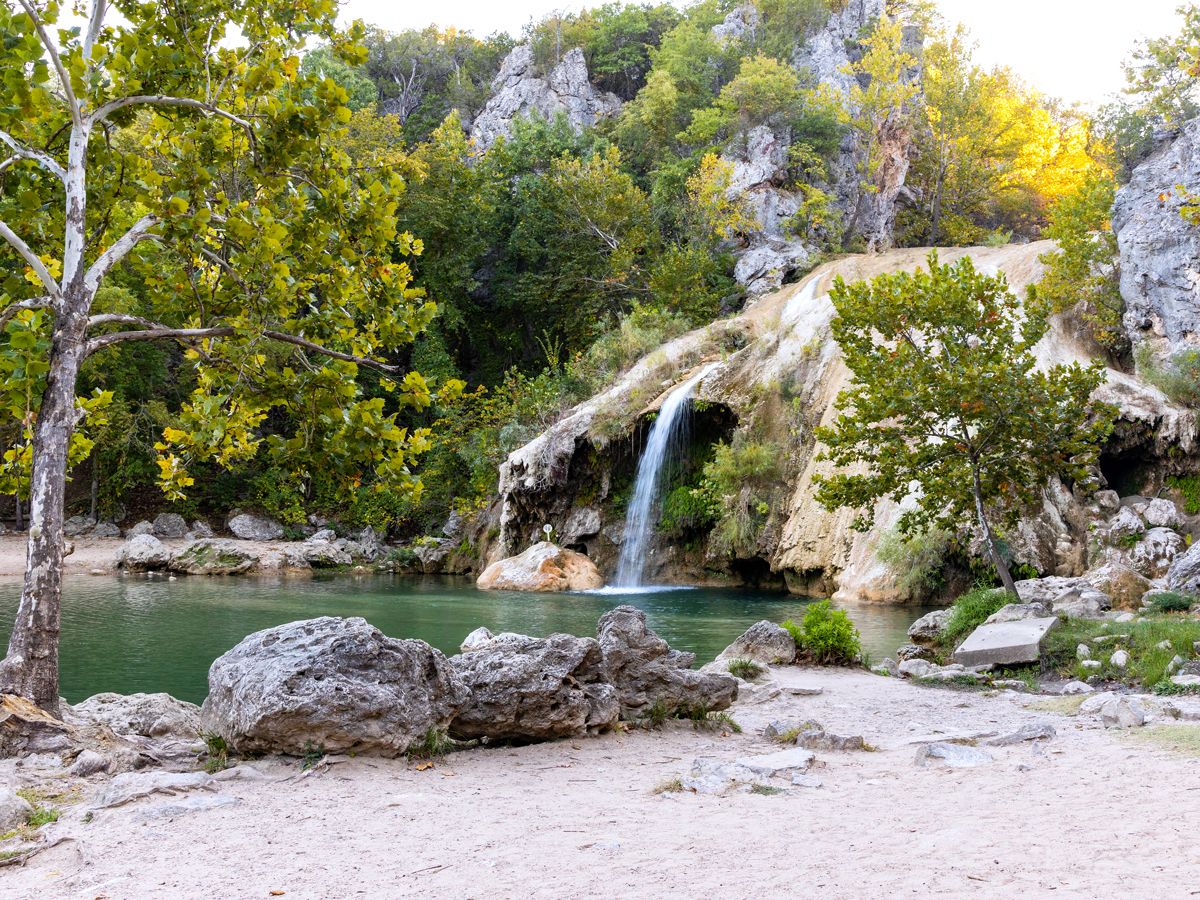
The state is also home to one of the largest Native American populations in the U.S., and cultural centers like the First Americans Museum share the histories of 39 distinct Native American nations in the state. Other museums celebrate Oklahoma’s cowboy and rodeo traditions, as well as hometown folk heroes Woody Guthrie and Bob Dylan at respective Tulsa museums. Outdoor lovers will find unexpected gems, too, including Turner Falls, the state’s largest waterfall, which cascades 77 feet into a natural swimming hole surrounded by rugged hills, caves, and forested trails.
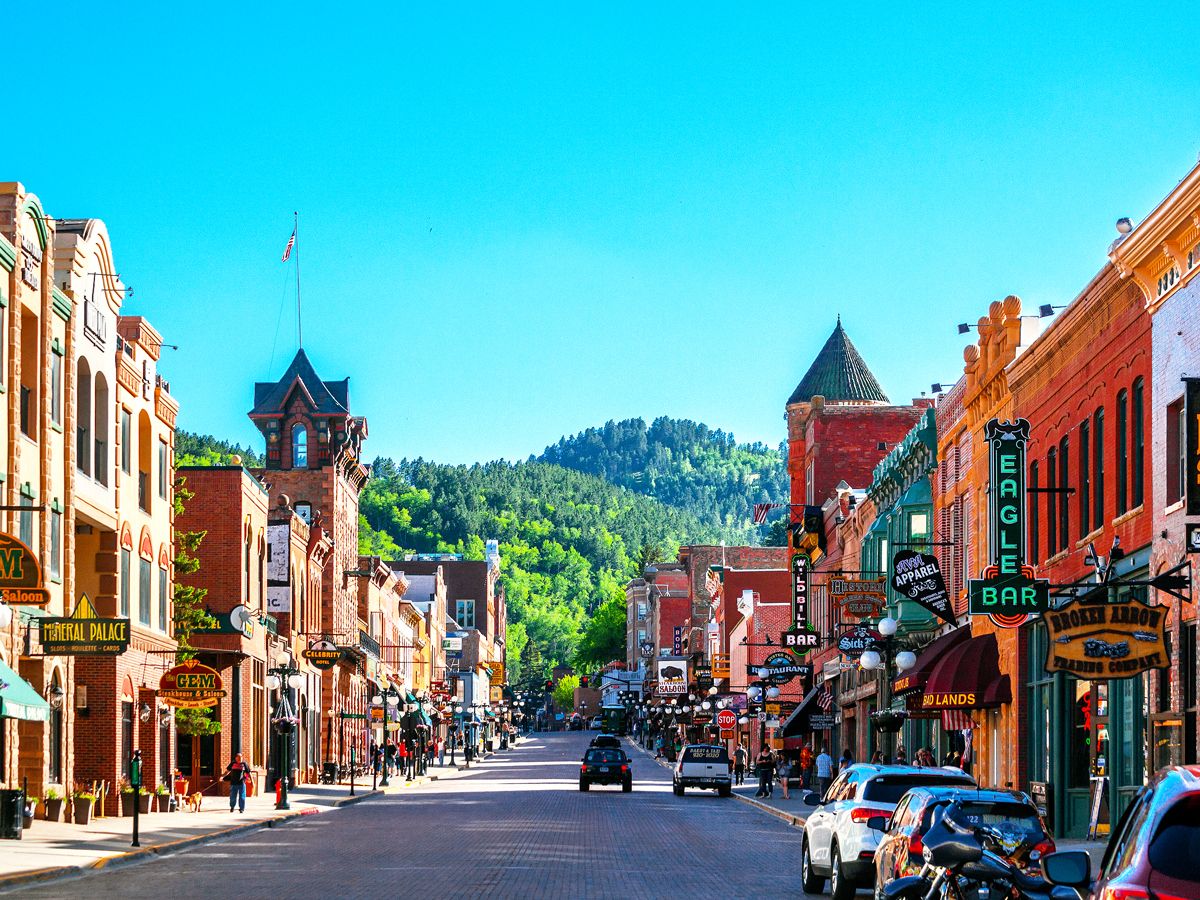
South Dakota is perhaps best known for Mount Rushmore, an iconic American landmark that draws 2 million visitors a year, but there’s much more to see beyond the famous granite faces. The rest of the state’s Black Hills region offers hikes (including the highest point in the state on Black Elk Peak), as well as historic sites such as the preserved Wild West town of Deadwood. Nearby, Badlands National Park is a must-visit for its dramatic landscapes of spires, canyons, and colorful layered rock, along with rich fossil beds preserving the ancient life that once lived on the plains.
Events like the Sturgis Motorcycle Rally — one of the oldest and largest of its kind — bring big surges in tourism in the summer, but the state’s sparse population and wide-open prairies mean even its best-known spots don’t often feel overrun. As one of America’s least-visited states, South Dakota is an ideal destination to take in top-tier nature and small-town Americana without the crowds.
7. Maine
Credit: Kelly Berger/ iStock via Getty Images Plus
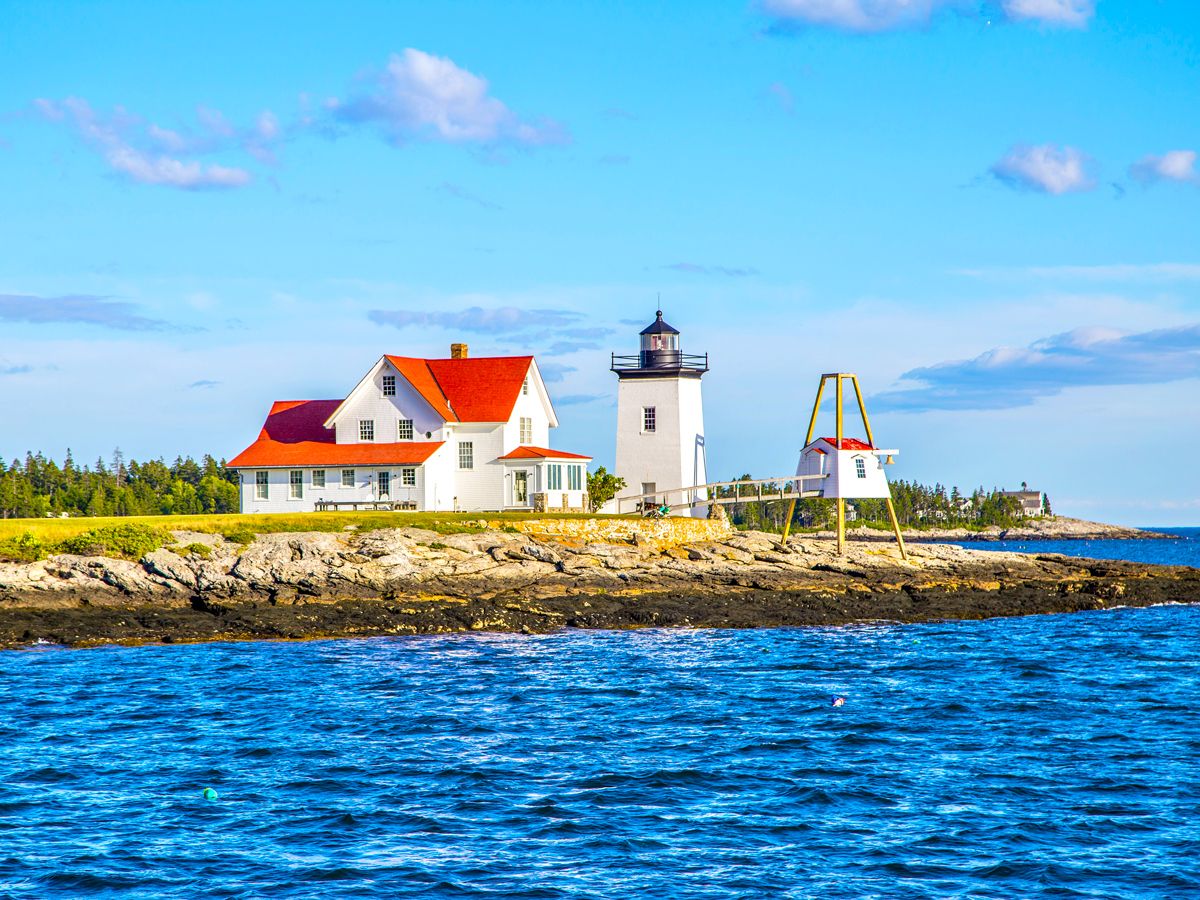
Maine is often overlooked in favor of its busier New England neighbors. That’s despite having a mostly untouched tidal coastline that stretches for more than 3,400 miles — longer than even California’s. It’s dotted with rustic rocky beaches, more than 60 lighthouses, and an abundance of seafood shacks (a lobster roll is a must).
The state’s crown jewel, Acadia National Park, welcomes upwards of 4 million visitors each year, but inland Maine offers plenty of quiet, forested areas as well. Storybook towns such as Bar Harbor and Camden feature lively dining and shopping areas with plenty of sailboats on the water for that distinct New England charm.
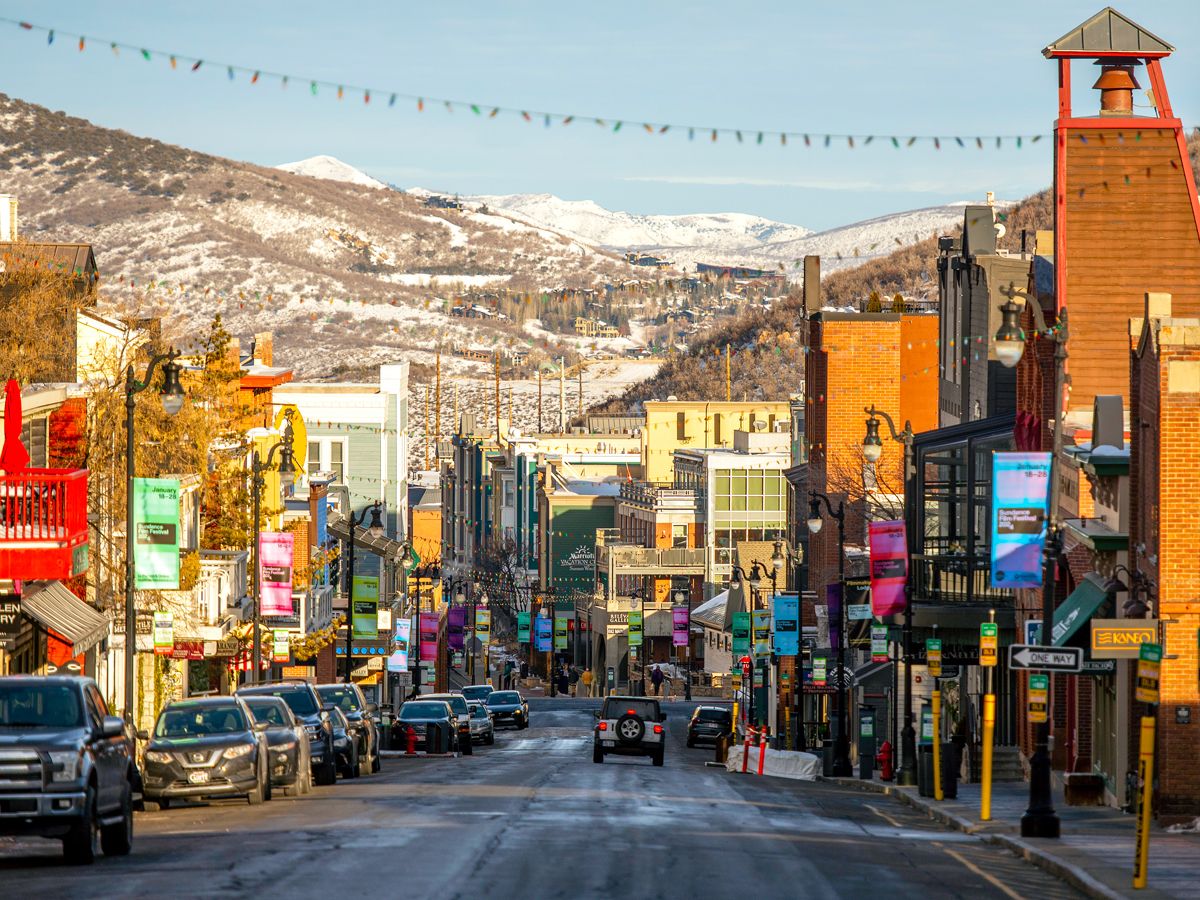
Home to five national parks — known as the “Mighty Five” — Utah is a dream for outdoor adventurers. But it still ranks among the least-visited states, possibly because its awe-inspiring landscapes tend to be far from major urban centers. For those who do make the trek, Utah’s parks, including Zion and Arches, feature breathtaking sights of red rock canyons, sandstone arches, and wide-open desert vistas. In winter, world-class ski resorts like Park City and Snowbird draw snow enthusiasts to the stunning Wasatch mountain range.
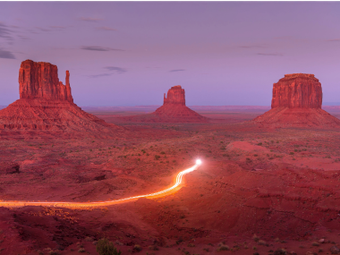
Utah also boasts a deep Indigenous history, which you’ll discover at the cliff dwellings once inhabited by the Ancestral Puebloans, now part of the Trail of the Ancients Scenic Byway. Utah’s natural wonders are just as captivating beyond the national parks, from the vast, otherworldly view of the Bonneville Salt Flats to the towering red rock buttes of Monument Valley — an iconic landscape in Western film. Plus, outside of its national parks, much of Utah remains uncrowded and quiet, making it a haven for those looking for a trip of space and solitude.
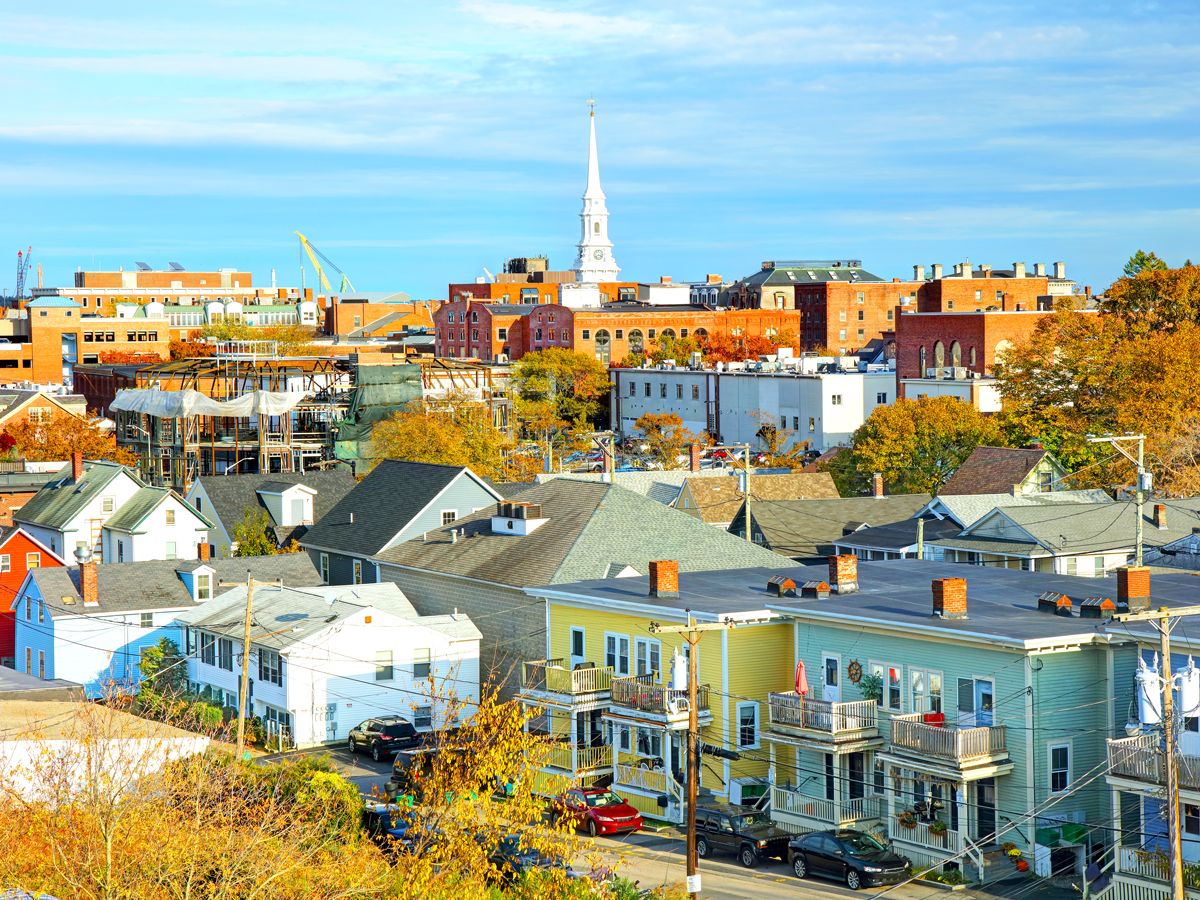
New Hampshire has a small footprint and an understated tourism scene. In fall, scenic foliage drives along the Kancamagus Highway are popular attractions, and in winter, ski areas like Loon Mountain and Bretton Woods attract devoted regional crowds. The Granite State also shines in the summer: New Hampshire’s coastline is short (just 18 miles) but scenic, featuring popular Hampton Beach and trendy Portsmouth.
With just 9,349 square miles of land, New Hampshire is the fifth-smallest state in the country, and much of it is forest or mountains. But visitors will perhaps find the winding backroads, family-friendly inns and resorts, and vast stretches of unspoiled nature a welcome change of pace.
With long stretches between towns and a lack of major cities — Billings, the state’s largest, has just 120,000 residents — Montana keeps crowds at bay. Glacier National Park is the state’s star attraction; its crystal-clear alpine lakes, snow-capped peaks, and dark, stargazing skies draw millions of nature lovers each summer.
Beyond the parks, visitors can explore Big Sky Resort’s ski slopes, paddle the Missouri River, or simply take in the wide-open views that give the fourth-largest U.S. state its “Big Sky Country” nickname.
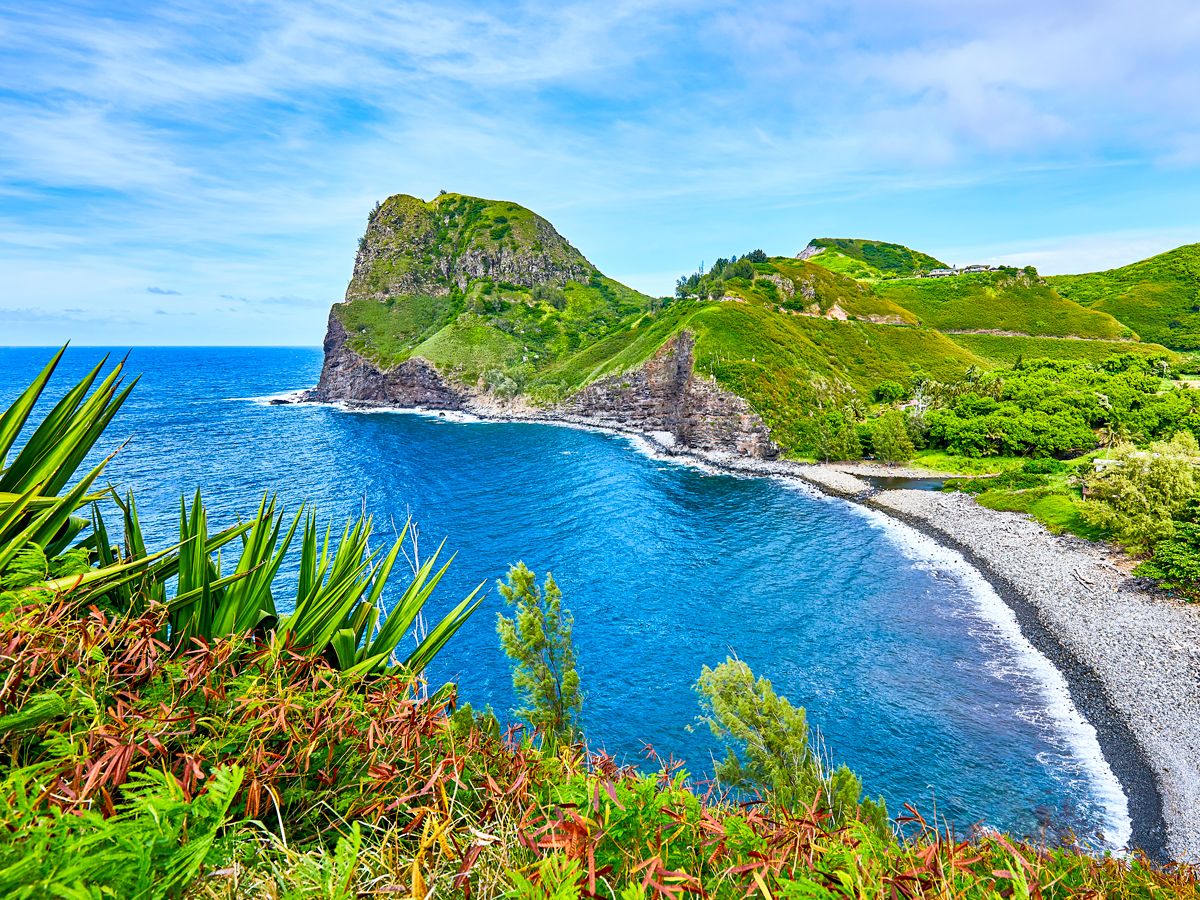
It may seem surprising that Hawaii ranks among the least-visited states. After all, its lush rainforests, volcanic landscapes, tropical beaches, and relaxed pace of life make it a bucket-list destination for many. But in 2023, tourism dipped following the devastating wildfires that struck Maui, including the historic town of Lahaina, and overall visitation to the state hasn’t recovered to pre-pandemic levels.
Still, nearly 10 million people made the journey in 2023 — most to Oahu, home to major attractions like Waikiki’s second-to-none surf, the Pearl Harbor National Memorial, and the state capital of Honolulu, rich with shopping, dining, and local cultural experiences. Traveling to Hawaii isn’t cheap or simple, but for those who go, the Aloha State has plenty to offer.
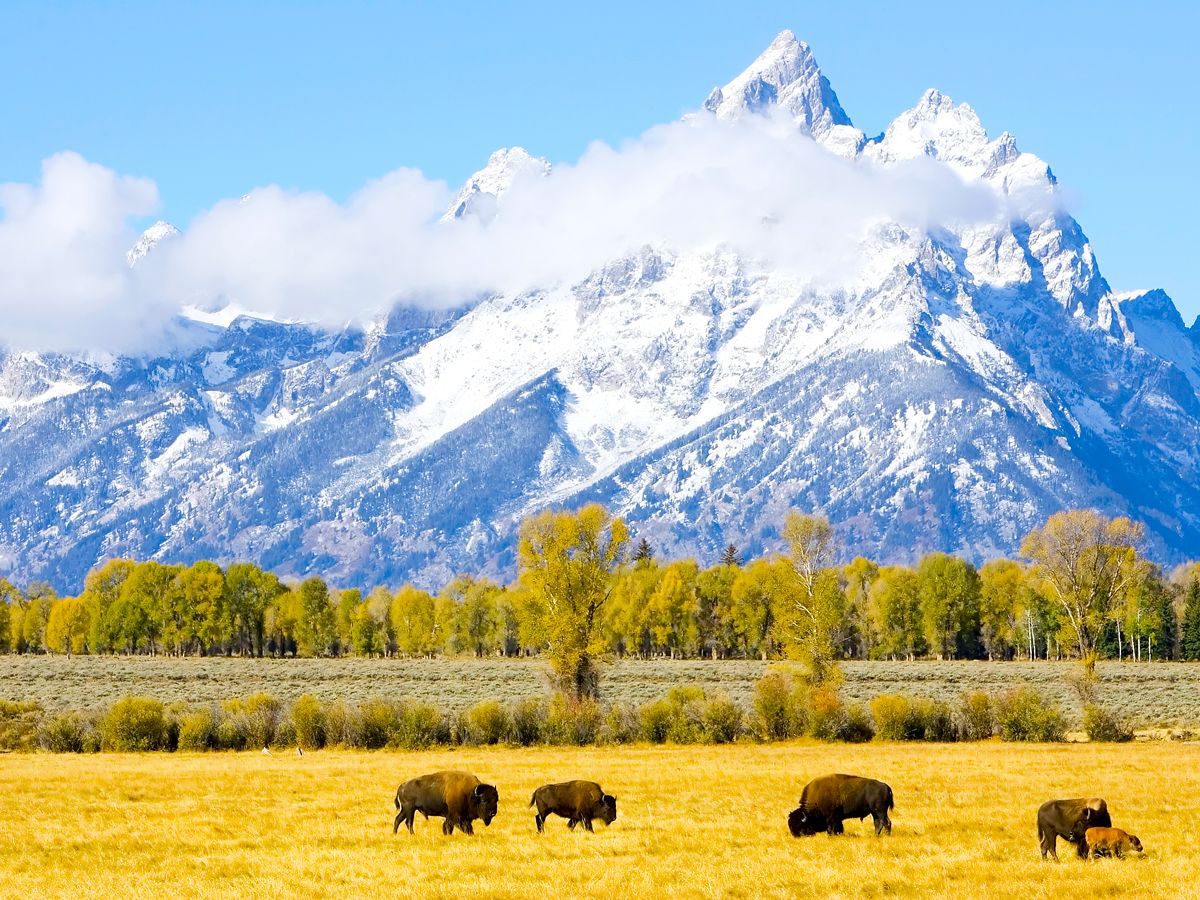
The biggest draws for visitors to America’s least-populated state of Wyoming are a pair of iconic national parks. Yellowstone, the world’s first national park, remains a major draw thanks largely to its Old Faithful geyser and Grand Prismatic Spring. So does Grand Teton National Park, with dramatic backdrops ideal for hiking, climbing, and, of course, snagging the perfect photo op.
The town of Jackson serves as the state’s main tourist hub, with luxury lodges, art galleries, world-class ski slopes, and the unspoiled backcountry of the Tetons. Much of the rest of Wyoming, however, is wide-open country, dotted with frontier towns framed by endless serene sky and relatively few visitors.
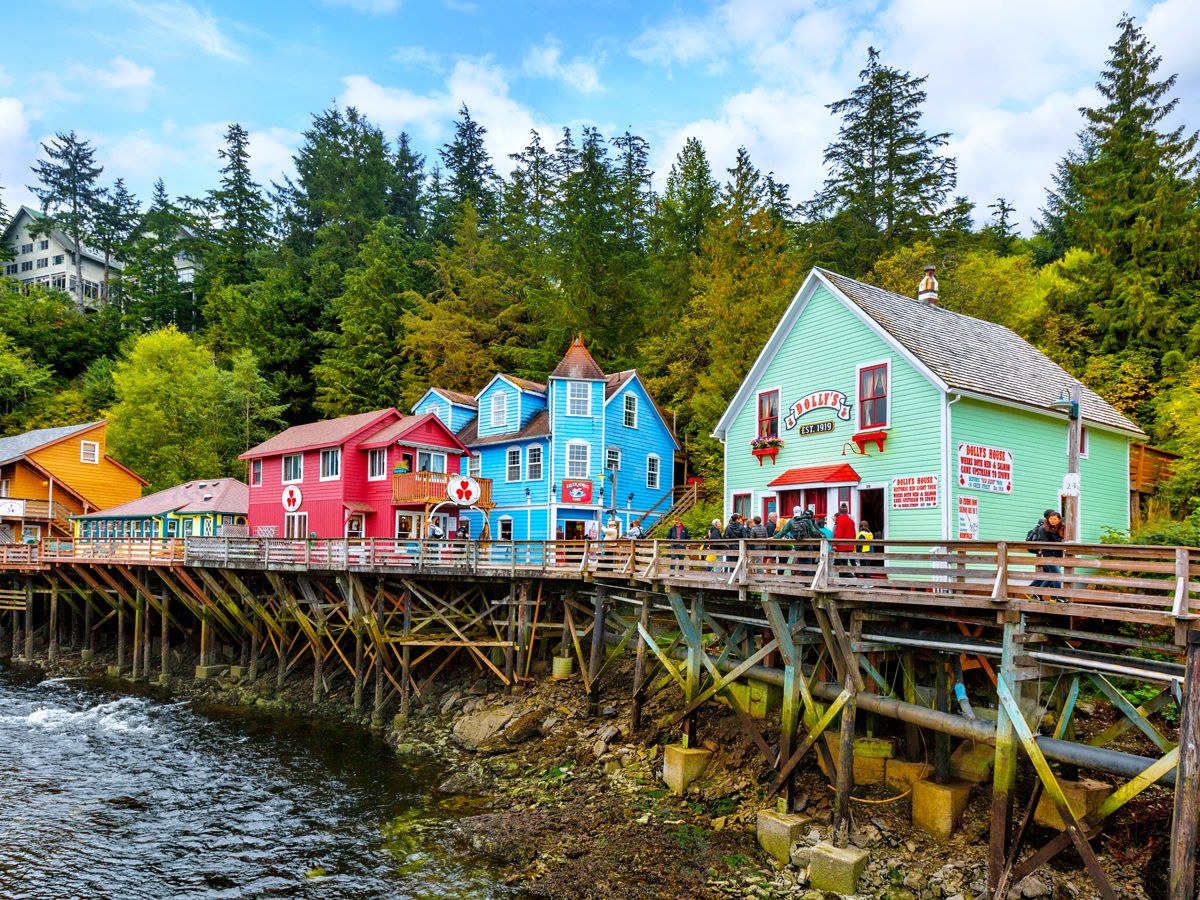
Alaska is America’s least-visited state, but that’s mostly a matter of geography. Its distance from the contiguous U.S. and limited infrastructure outside of major hubs such as Anchorage and Fairbanks keep visitor numbers low. However, tourism does play a major role in the state’s economy — many visitors arrive by cruise ship, especially to southeastern ports like Juneau and Ketchikan. The population can more than triple in Ketchikan during the busy season, when visitors take in the shops and restaurants of Creek Street, a well-known historic boardwalk that sits on stilts over the water.
Visiting Alaska wouldn’t be complete without taking part in some epic wilderness adventures, from hiking Denali to spotting grizzly bears and bald eagles, and kayaking through glacier-studded fjords. These promise to be once-in-a-lifetime moments you won’t soon forget — and ones that relatively few tourists get to experience.
About the data: This ranking is based on the most recently available 2023 or 2024 visitation numbers, as published by official tourism boards and government offices.
4 Things That Will Help Get You Through TSA Faster
By
Bennett Kleinman
Read time: 5 minutes
July 18, 2025
Updated: November 1, 2025
4 Things That Will Help Get You Through TSA Faster
Tips •July 18, 2025•Updated: November 1, 2025
By Bennett Kleinman
Author
Bennett Kleinman
Bennett is a New York City-based staff writer for Daily Passport. He previously contributed to television programs such as the Late Show With David Letterman, as well as digital publications like the Onion. Bennett has traveled to 48 U.S. states and all 30 Major League Baseball stadiums.
A 2024 study found that many U.S. airports have TSA wait times of 30 minutes or more during peak travel periods, with Newark Liberty International having the longest average peak wait time at around 60 minutes. With waits like these, being prepared with TSA-compliant luggage and accessories is more important than ever. We’ve rounded up some of the best gear and services to streamline your experience, ensuring your journey through TSA is smooth sailing.
One of the most effective ways to fast-track your journey through security is to enroll in a Trusted Traveler Program. TSA PreCheck offers expedited screening in dedicated security lines and eliminates the need to remove items such as belts, laptops, liquids, and other personal belongings.
According to the TSA, 99% of PreCheck passengers wait 10 minutes or less at security checkpoints at U.S. airports. As of mid-2025, a five-year TSA PreCheck membership costs $76.25, with discounted renewal rates available. Frequent international flyers may also benefit from Global Entry, which includes a TSA PreCheck membership plus expedited U.S. customs processing. A five-year membership bundle costs $120.
Another option is CLEAR Plus, which uses biometric identification (eyes and fingerprints) to let you bypass the traditional ID check line. This service costs $209 annually. While it doesn’t include TSA PreCheck, that program can be bundled with CLEAR at a discounted rate. It’s also worth mentioning that all three of these services — TSA PreCheck, Global Entry, and CLEAR — can often be discounted through airline status or premium credit cards, so be sure to check with your provider to see if you’re missing out on these extras.
One of the most significant slowdowns at security? Liquids. TSA’s strict 3-1-1 rule requires that liquids in carry-on bags be 3.4 ounces or less and stored in a single, 1-quart clear bag per traveler. Investing in a quality quart-size toiletry bag makes it easy to remove your items for screening.
If you don’t already own travel-size versions of your essentials, consider refillable bottles, such as this 18-pack silicone travel set, all of which fit neatly into a quart-size bag. Magnetic travel capsules, such as the Cadence leakproof containers, are another option. These TSA-compliant capsules are available in customizable sets that are prelabeled for skin care, body care, or hair care. Their matching clear bag, called the Parcel, keeps everything organized and visible.
Another way to stay organized is by using packing cubes, which allow you to fit more items into your carry-on while keeping them easily accessible during security checks. Compression cubes feature a double zipper that expels excess air without the need for a vacuum. For electronics, TSA-friendly backpacks like the ScanSmart Backpacks by Swiss Gear offer lay-flat compartments that allow laptops to remain inside the bag during screening.
To reduce your time spent waiting in the TSA line even further, consider minimizing the liquids you pack altogether. This also helps mitigate pesky leaks, which can slow you down at any point during your journey.
Many everyday items now come in solid or wipe form. Try Pedialyte electrolyte powder (suitable for kids and adults) instead of liquid bottles, Purell hand-sanitizing wipes instead of gel, and Tide stain remover wipes for spills. Most toiletries also come in solid forms, such as shampoo and conditioner bars (like those from Kitsch), powdered mouthwash packets (MySmile), and sunscreen sticks (Blue Lizard), all of which are TSA-approved.
Since the TSA starting requiring travelers to remove their shoes in 2006, footwear was one thing that could definitely down at security, especially if you had to untie and retie laces. But we’ve got big news on that front: As of July 2025, the TSA no longer requires you to remove your shoes for standard security screening.
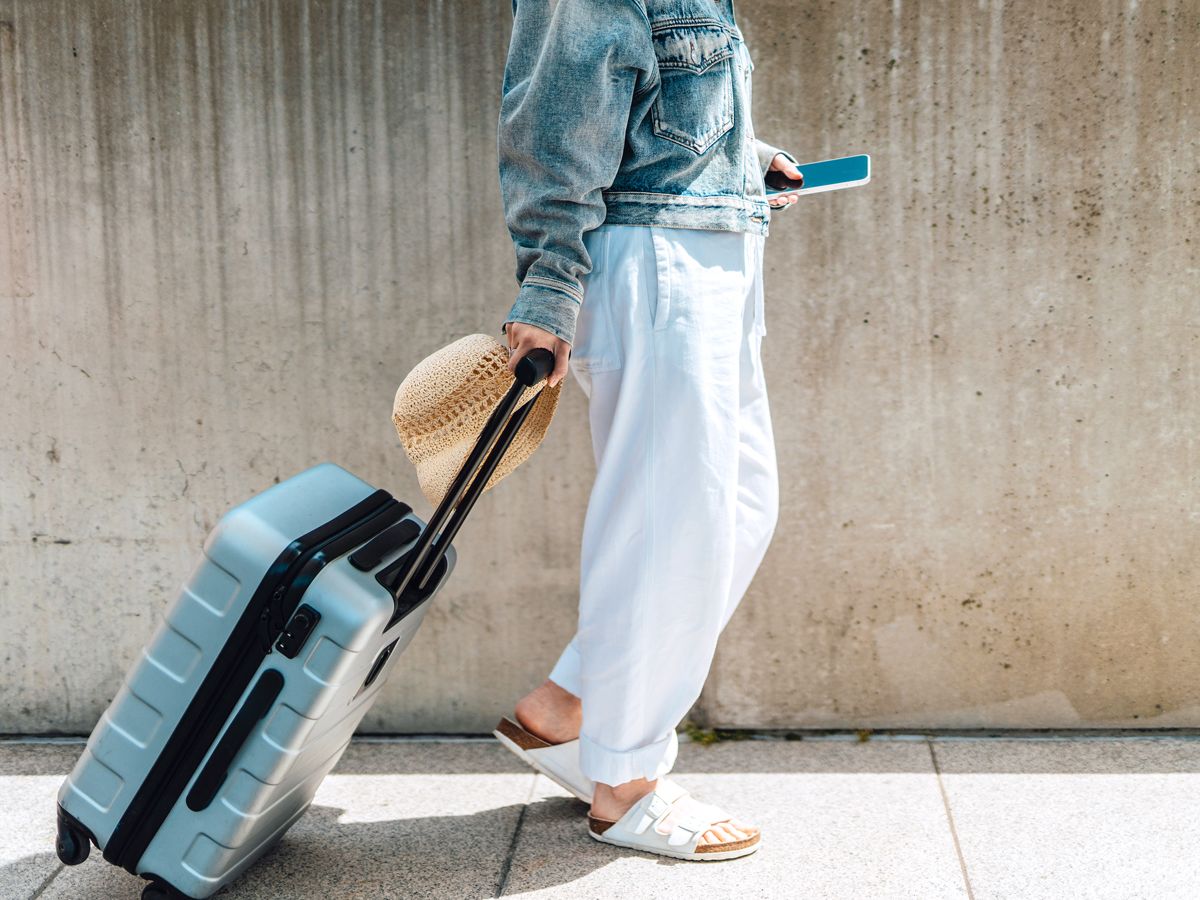
That said, travelers may still be asked to remove their shoes for additional screening if they trigger any alarms or sensors. And if you’re traveling internationally, removing shoes at the security checkpoint is still required in many countries. In that case, it’s advisable to wear a pair of slip-on shoes, which are ideal for hassle-free removal and can also be a more comfortable choice for long travel days.
According to podiatrists Dr. Ebonie Vincent and Dr. Brad Schaeffer from the TLC show My Feet Are Killing Me, the key is choosing shoes with a stable heel and a rear pull tab for ease and support. Look for footwear made of sturdy yet flexible materials — such as rubber, foam, mesh, and nylon — and avoid stiff textiles like leather and canvas, as these can cause blisters after a long day of walking. “Materials that have a certain amount of give can be beneficial with slip-on shoes as they will allow the ease of use the slip-on shoes can offer,” Dr. Vincent explained to ABC News.
Some of our favorite athletic slip-ons include the Skechers Go Walk 7, available in both men’s and women’s styles. This model features elastic bungee laces that offer the appearance and support of lace-up shoes with the convenience of a slip-on design. Another great option is Dr. Scholl’s Time Off travel sneaker, which is also available in a slip-on version and a variety of colors.
For a more polished look, consider knit loafers or ballet flats, such as these square-toe loafers from Frank Mully, or Mary Jane-style shoes, like this pair from Arromic, which feature Velcro straps for quick removal at security. With the right gear in your bag and shoes on your feet, you’ll breeze through TSA and be on to your next destination in a jiffy.
Advertisement
More from our network
Daily Passport is part of Inbox Studio, an email-first media company. *Indicates a third-party property.
Flight Attendant-Approved Hacks for Sleeping Well in Any Hotel Room
By
Rachel Gresh
Read time: 4 minutes
July 15, 2025
Updated: July 15, 2025
Flight Attendant-Approved Hacks for Sleeping Well in Any Hotel Room
Tips •July 15, 2025•Updated: July 15, 2025
By Rachel Gresh
Author
Rachel Gresh
Rachel is a Washington, D.C.–based travel and lifestyle writer with roots in the Great Lakes region. When she’s not writing for publications such as The Discoverer and Interesting Facts, you’ll find her wandering through museums or exploring destinations off the beaten path.
If anyone knows how to get quality sleep in a hotel room, it’s a flight attendant. After all, some flight attendants stay in hotels up to 200 nights each year, so they know a thing or two about turning any hotel room into a home away from home. From dreamy pillowcases and luxurious eye masks to pest deterrents and aromatherapy sprays, here are a few flight-attendant approved products and tips to guarantee a peaceful slumber on your next getaway.
Ask any flight attendant, and there’s a good chance they will have go-to sleep aids that help them rest after a long day in the air. Vera, a Boston-based flight attendant, suggested on TikTok that travelers create their own sleep kits in a compact toiletry bag. She explained, “You’re in an unfamiliar environment. You never know how bright it’s going to be in the room, how loud the hallways are going to be. So I have a kit that helps with all of that.”
Vera’s must-haves include a contoured eye mask that blocks out excess light without putting pressure on the eyes and a set of high-quality earplugs designed for sleeping. (The Loop Quiet 2 comes with four different tip sizes for a comfortable, custom fit.)
Another item in Vera’s sleep kit is lavender oil, which she says is now part of her daily wind-down routine. If you’ve never tried aromatherapy to help you fall asleep, consider the Pillow Mist by Baloo, which was ranked the Best Sleep Spray of 2024 by the Sleep Foundation. It combines calming scents of lavender and bergamot and comes in a 3.4-ounce TSA-compliant bottle.
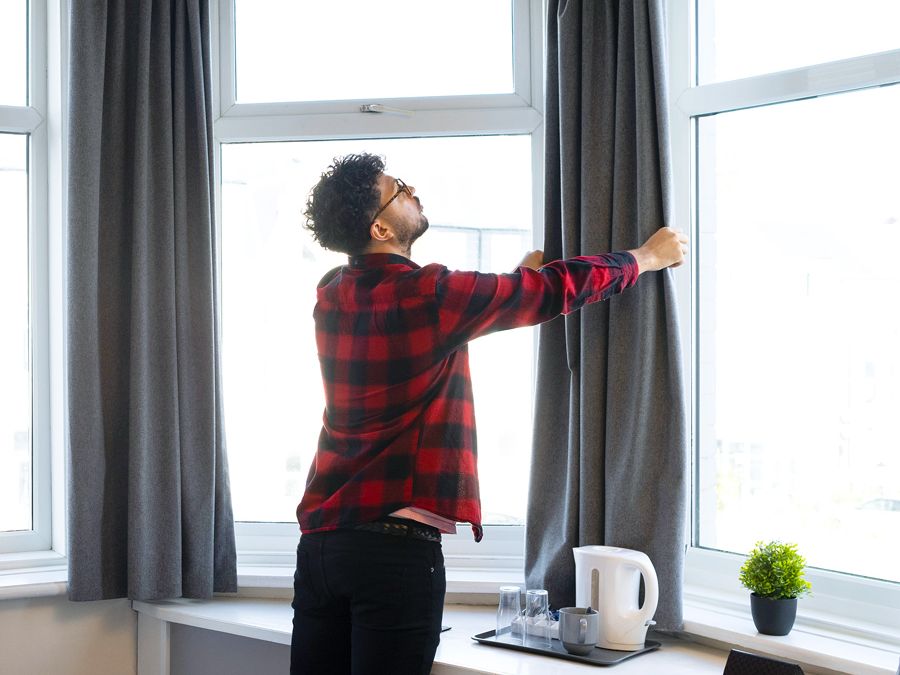
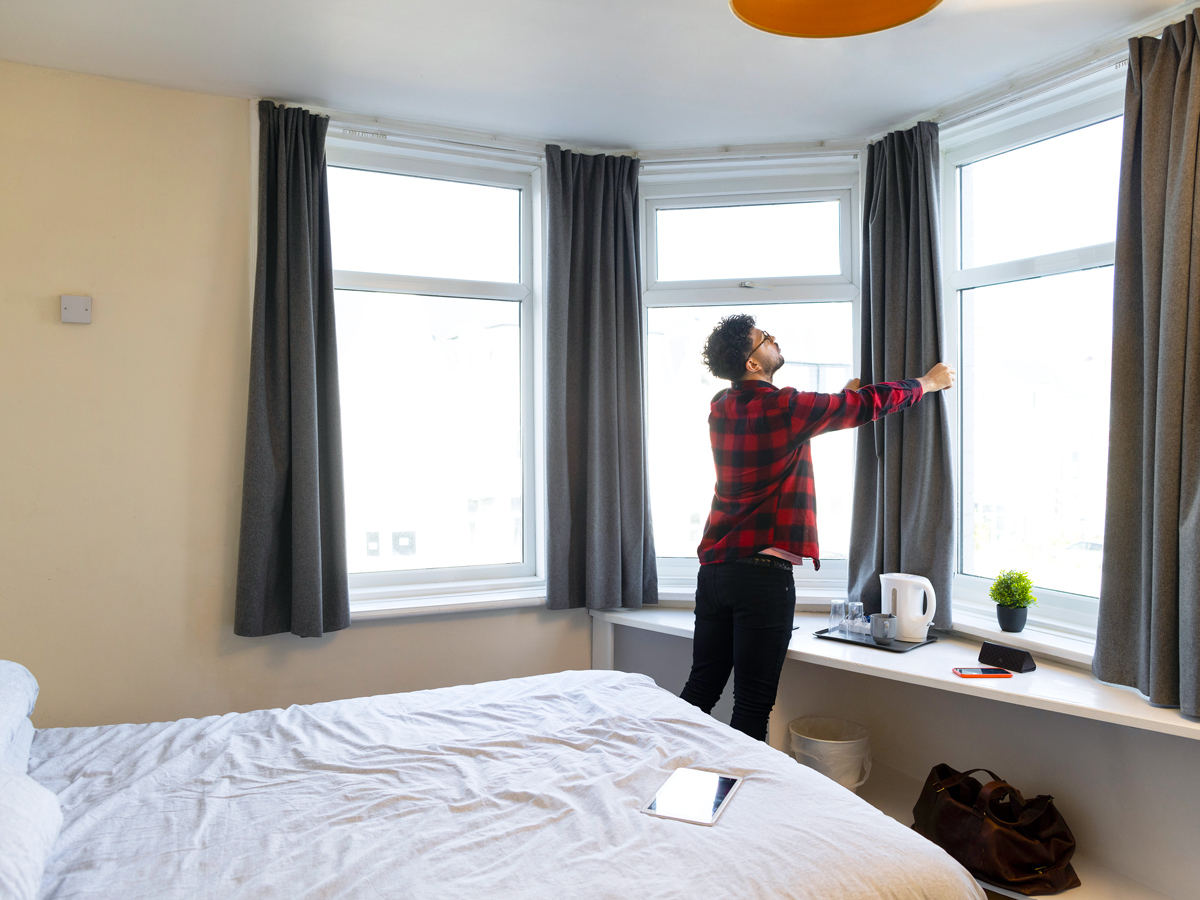
Picture this: You arrive at your hotel well after sunset and get into bed, only to be abruptly woken up at sunrise by light streaming through the curtains that you thought were drawn closed. Fortunately, flight attendants have a hack for this: a humble clip.
TikTok user Sisterhood Women Travel shared this bit of advice from a clever flight attendant: Clip the curtains closed to avoid being woken up earlier than you want. No clips? Look in the hotel closet for a hanger with clamps, which will work in a pinch. Frequent travelers might also consider investing in their own set of lightweight plastic clips, which can not only block out light, but also be used to organize electronic cables, seal bags, or hang wet clothes in the bathroom.
Tinsley, a flight attendant who shares her travel tips and tricks on TikTok, says that she always packs at least one pillowcase from home. Not only can sleeping on your own pillowcase from home be more comfortable, but it can also save you from coming into contact with bacteria and unwanted allergens that may be lurking in dirty sheets.
According to allergist Dr. Tania Elliott, sleeping on a hotel pillowcase is one thing she would never do because of the commercial-grade detergents used by hotels. While they may remove dirt and bacteria, these detergents can cause irritation, which may disrupt your sleep.
From late-night arrivals to weddings and events, you never know what might wake you up when staying in a hotel. Another recommendation from flight attendant Tinsley is to bring a portable sound machine. She uses the compact Hushh portable white noise machine from Yogasleep, which features three different white noise sounds and measures 3.5 inches in diameter.
If you prefer more sound options, the Dreamegg White Noise Machine is slightly larger, measuring 4 inches in diameter and weighing half a pound, but it features 21 different noise options, along with a timer and volume adjustment.
Before settling in to catch some z’s, many flight attendants have one more critical check: the bedding. Your first approach is to always examine the bed and upholstered furniture for unwanted roommates, namely bed bugs, mites, lice, and other pests. But you may also consider bringing your own repellent: After a run-in with hotel bed bugs 15 years ago, flight attendant Chelle now always sprays the hotel room bed with repellent.
“I spend about 180 days a year in hotel rooms,” Chelle explained on TikTok. “It’s the first thing I do when I get to my hotel room.” There are many pest spray options on the market: Chomp! is a naturally formulated peppermint-scented spray that targets bed bugs and dust mites. For a scent-free option, Hygea Natural also targets bed bugs, dust mites, lice, and allergens; both sprays are TSA-approved.
How Much Do Airlines Really Spend on In-Flight Meals?
By
Bennett Kleinman
Read time: 4 minutes
July 15, 2025
Updated: July 17, 2025
How Much Do Airlines Really Spend on In-Flight Meals?
Tips •July 15, 2025•Updated: July 17, 2025
By Bennett Kleinman
Author
Bennett Kleinman
Bennett is a New York City-based staff writer for Daily Passport. He previously contributed to television programs such as the Late Show With David Letterman, as well as digital publications like the Onion. Bennett has traveled to 48 U.S. states and all 30 Major League Baseball stadiums.
Airplane food has a reputation for leaving something to be desired. While certain airlines go above and beyond for first- and business-class passengers, there’s a good chance that the average economy passenger may feel underwhelmed by the food they’re served. But the truth is that airplane food is a multibillion-dollar industry, which begs the question: Just how much do airlines spend on in-flight meals? Though some details are shrouded in secrecy, here’s what we’ve uncovered about the true cost of airplane food.
The Average Cost of In-Flight Meals
Credit: Caia Image/ Collection Mix: Subjects via Getty Images
In 2015, Condé Nast Traveleranalyzed data provided by the 10 largest domestic airlines to the U.S. Department of Transportation and found that those airlines spent an average of $3.61 per meal per passenger. This marked a steep decline from the late 1990s, when the cost was closer to $4.79 per meal.
According to the magazine’s analysis, spending on in-flight catering reached a nadir back in 2007, when airlines were spending just $3.30 for the average in-flight dish. Much of that has to do with service cutbacks: Following the 9/11 terrorist attacks and the financial effects on the industry, airlines started to eliminate free in-flight meals — Continental Airlines (which later merged with United) was the last U.S. airline to provide complimentary meals in economy class on U.S. domestic flights.
The DOT data from 2015 also showed that American Airlines spent the most of the 10 major airlines, with an average cost of $6.43 per meal, closely followed by United at $6.08 and Delta at $5.36. At the other end of the spectrum, JetBlue spent $1.39 per meal, while budget airline Spirit shelled out just 26 cents per passenger. (At the time, both airlines offered snacks, not full meals, but JetBlue has since introduced a business-class product called Mint, which comes with hot meals.)
Of course, those numbers were published a decade ago, and prices for everything have shot up in that time. That said, up-to-date data can be difficult to come by. A 2019 article in The Points Guy travel blog cited industry sources who stated that U.S. airlines pay as little as $4 for the average economy meal, between $25 and $30 for business class meals, and upwards of $100 for a multicourse, first-class dining experience.
Meanwhile, a 2024 article for the travel blog Simple Flying showed a slight increase over those numbers, claiming economy-class meals cost between $5 and $15 per passenger, while business class runs between $30 and $50. First class may cost upwards of $100 per meal, though certain special offerings prepared by globally renowned chefs may run the airline as much as $300 per meal.
With billions of dollars being spent annually on airline food, it’s natural to wonder where all that money is going. There are several companies that specialize in airline catering, such as Gate Gourmet or LSG Sky Chefs. Since our taste buds are dulled at higher altitudes, airline food needs to be prepared differently, often with more spices. These catering companies have the training, knowledge, and resources to try to make sure the food tastes halfway decent in the air.
Some airlines have also partnered with famous chefs and major restaurants as part of a larger effort to attract customers. For instance, Delta Airlines and Shake Shack now provide the chain’s signature hamburgers to Delta’s first-class passengers in select markets. And in 2025, Seattle-based Alaska Airlines is rolling out an exclusive collaboration with West Coast chefs such as James Beard Award winner Brady Ishiwata Williams. While there are no publicly known details as to what these collaborations cost the airline, the potential increase may be worth it to attract new passengers.
Which Airlines Have the Most Expensive In-Flight Food?
These days, U.S. airlines offer complimentary meals only on longer international flights, but they offer food for sale on shorter domestic flights. However, prices vary across airlines.
A 2023 analysis conducted by Finance Buzz determined that JetBlue tops the list of the 10 biggest U.S. airlines, charging $13 for an average entree. Delta was next up at $12 per entree, followed by Alaska at $10.50 and United at $9. Some airlines — such as Alaska, American, Delta, JetBlue, Southwest, and United — offer free packaged snacks and soft drinks, while budget carriers such as Allegiant, Frontier, and Spirit charge for just about everything aboard — even bottled water.
When it comes to alcohol, passengers pay an average cost of $10.61 per boozy beverage on Spirit, which is the highest of any of the 10 airlines that were analyzed. United, American, and JetBlue all charged an average price of $9, while Southwest charged the least for alcoholic beverages in 2023 — an average of $6.67 per drink.
Featured image credit: lechatnoir/ E+ via Getty Images
Advertisement
More from our network
Daily Passport is part of Inbox Studio, an email-first media company. *Indicates a third-party property.
Daily Passport writers have been seen in publications such as National Geographic, Food & Wine, CBC, Condé Nast Traveler, and Business Insider. They're passionate about uncovering unique destinations and sharing expert tips with curious travelers.
From coast to coast, waterfront towns and cities in the U.S. have perfected the boardwalk concept — elevating it from a simple wooden walkway to a neon-lit vacation in and of itself, fitted with arcade games and fresh-pulled taffy, live music, and thrilling rides along one flank and spectacular beach views on the other. Here are seven famous boardwalks and piers in the U.S. to visit this summer.
Atlantic City Boardwalk – Atlantic City, New Jersey
Credit: SeanPavonePhoto/ iStock Editorial via Getty Images Plus
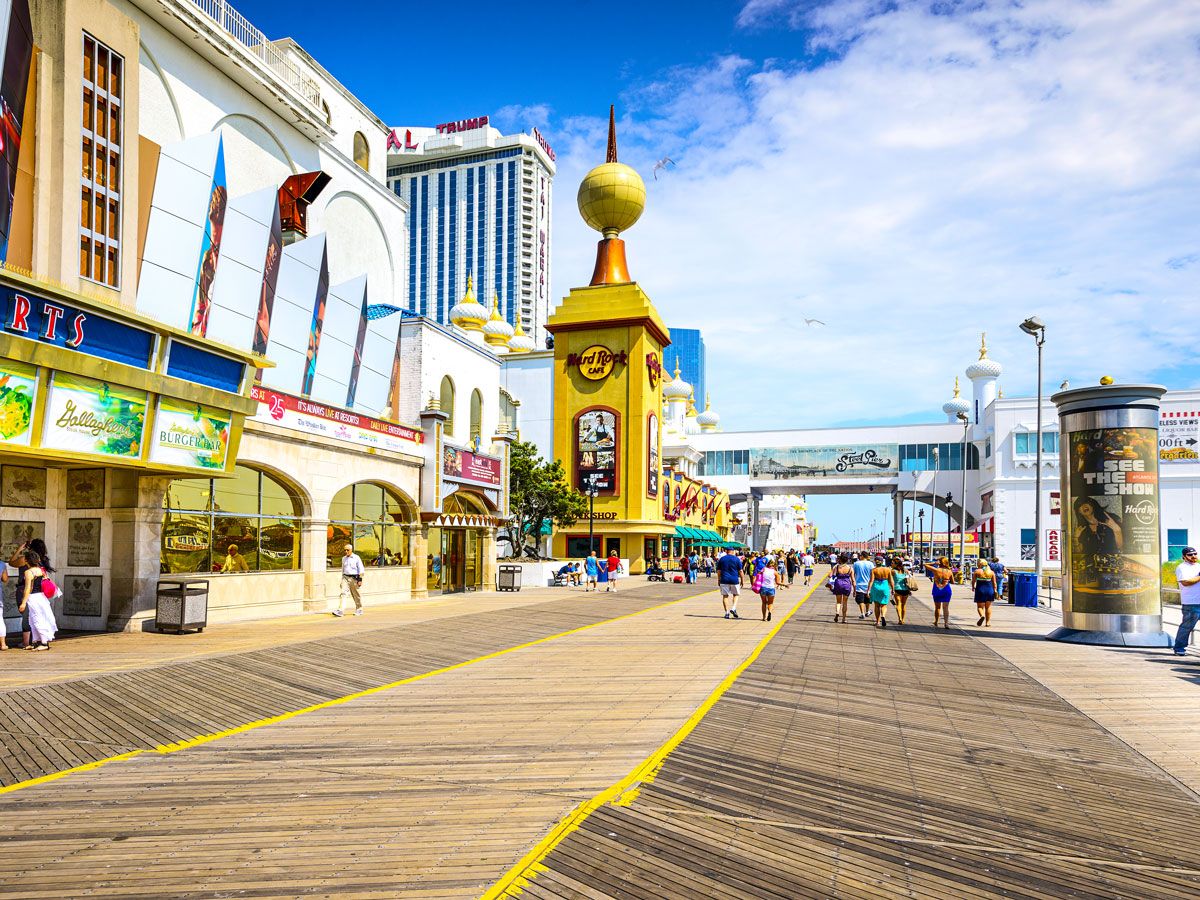
The concept of erecting an oceanfront wooden pathway as a tourist attraction began when 19th-century developers decided to promote Atlantic City as a resort destination. Even if they didn’t want to get sand in their shoes, visitors to the Jersey Shore could stroll the length of the beach, admiring the view and breathing in the fresh salt air. And thus, history was made on June 26, 1870, when the first boardwalk in the U.S. opened in Atlantic City, New Jersey.
The original boardwalk was disassembled during the winter months, before it was replaced with the permanent structure seen today. The boardwalk helped to establish the Jersey Shore as a must-visit East Coast getaway, giving vacationers a whole new seaside world of shops, hotels, casinos, and restaurants to enjoy. Spanning more than 5 miles today, the Atlantic City boardwalk remains the longest boardwalk in the world.
Coney Island Beach & Boardwalk – Brooklyn, New York
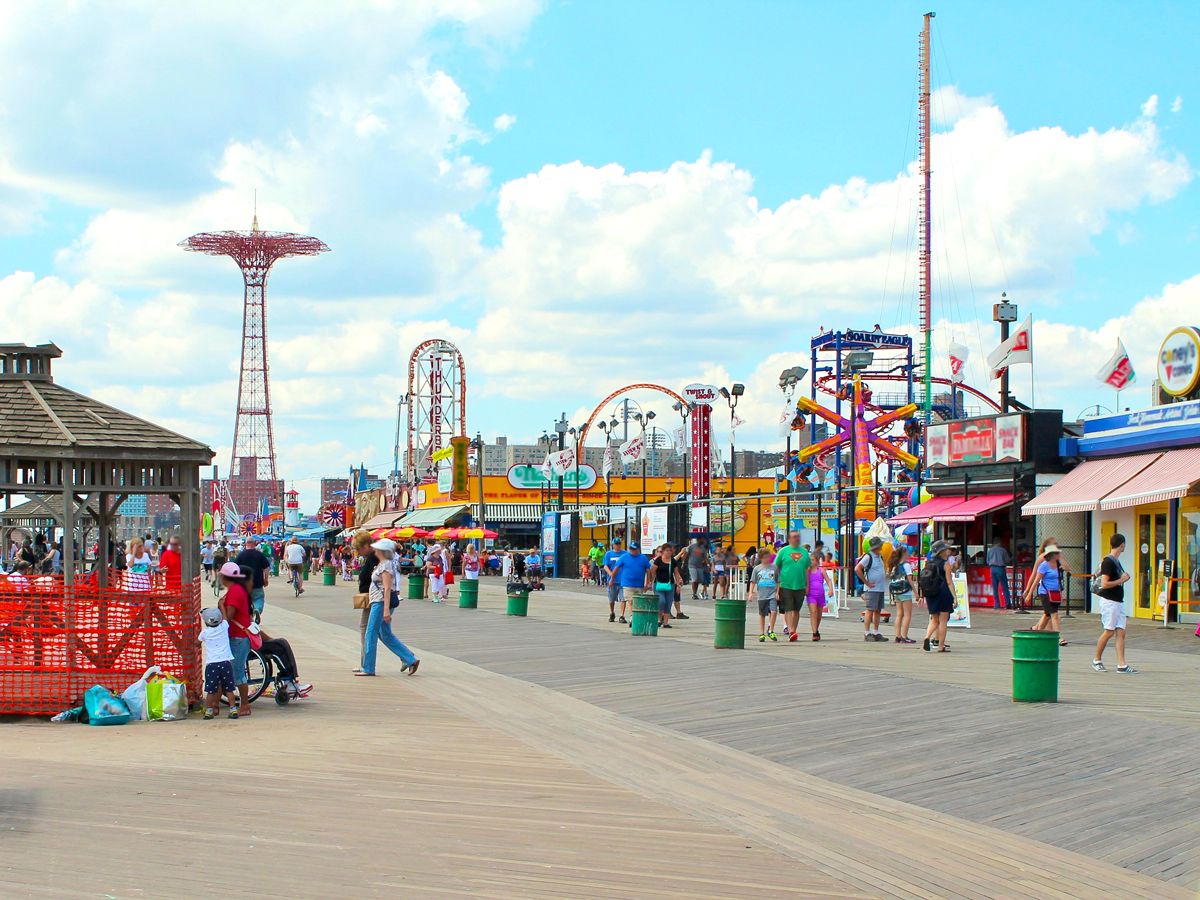
Coney Island in Brooklyn is the site of a boardwalk that feels uniquely New York: noisy, thrilling, and kitschy; simultaneously sophisticated and rough; and filled with unbeatable people watching. Though the boardwalk’s heyday was in the first half of the 20th century, Coney Island is still a popular destination in summer months, when its amusement parks and sandy beaches lure city dwellers by the thousands.
Landmarks such as Nathan’s Famous (site of the annual hot-dog eating contest), the Wonder Wheel, and the Cyclone wooden roller coaster anchor the boardwalk, while salsa dancers, strolling retirees, canoodling teenagers, and sunbathing beachgoers share its wide stretches. And beyond the sand beach and riprap jetties, the blue waters of the Atlantic beckon.
Santa Cruz Beach Boardwalk – Santa Cruz, California
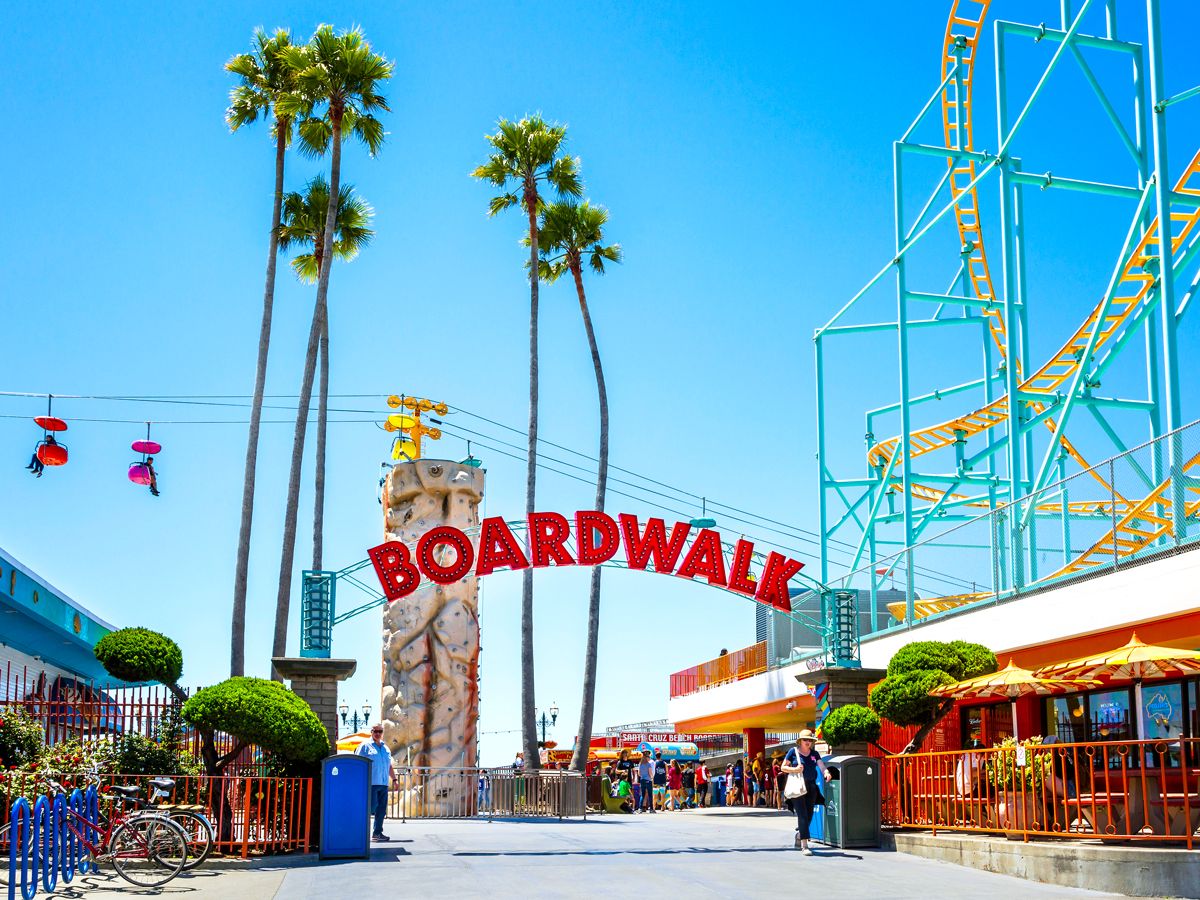
The Santa Cruz Beach Boardwalk began as a saltwater pool inside a bathhouse. At the time, saltwater bathing was thought to bring good health, and some practitioners were interested in the benefits of seawater (without the sand, ocean currents, or harsh sunlight). Soon, other businesses sprang up around the bathhouse — souvenir shops, photo studios, arcade games, a bandstand, and even a casino — and by the time the boardwalk was officially established in 1907, these eclipsed the bathhouse altogether.
Though it has weathered as many ups and downs over the years as its famous Giant Dipper roller coaster, the historic boardwalk has undeniable appeal, resplendent in neon and California sunlight and cooled by a bracing Pacific breeze. Don’t miss the deep-fried artichoke hearts (grown locally and fried on-site) or a ride on the candy-colored Sky Glider cars that cruise over the boardwalk on cables.
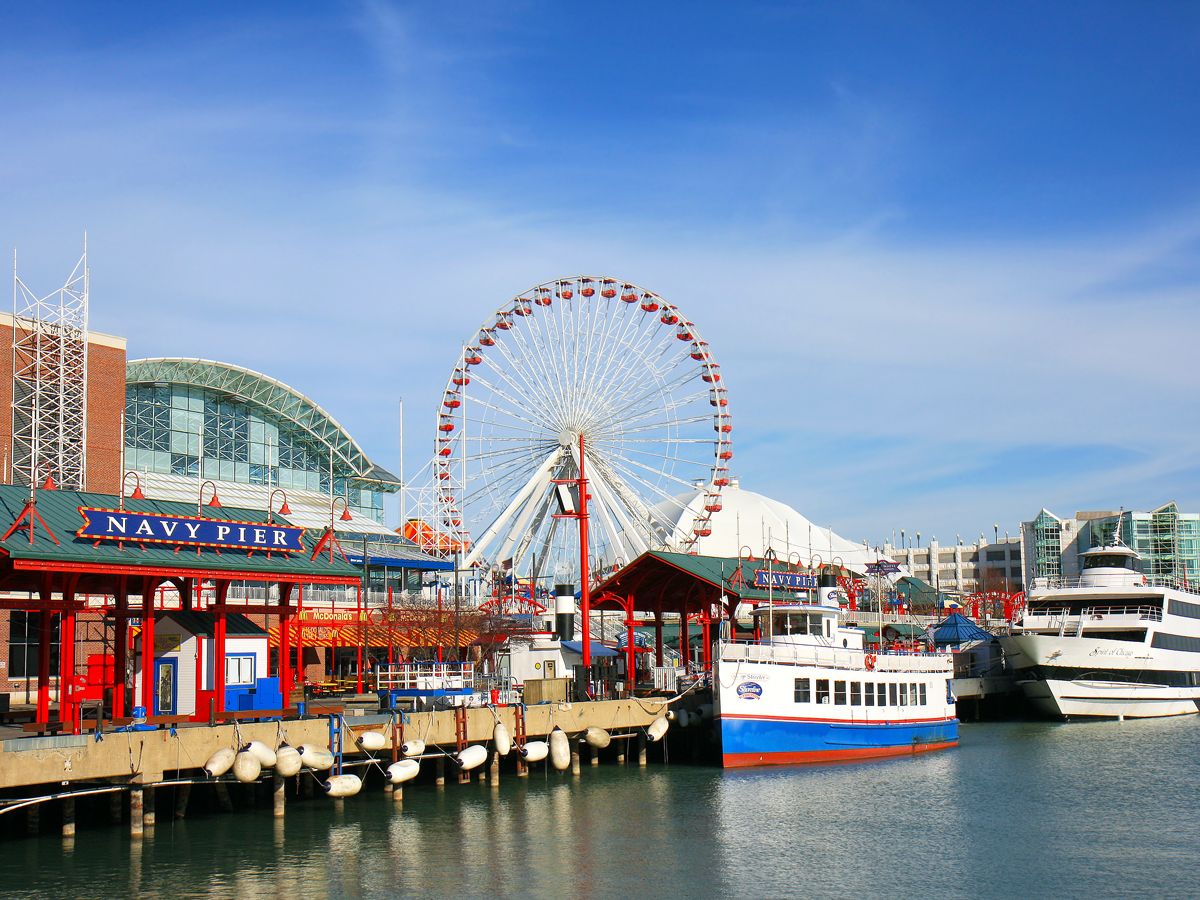
Sometimes boardwalks run parallel to the water, and sometimes, as in the case of Chicago’s Navy Pier, they jut out into the water atop docks or piers. Originally, the buildings on Navy Pier were erected on an existing shipping pier to house soldiers and sailors and military operations during World War I, a use that continued through the end of World War II.
The pier’s position, at the mouth of the Chicago River near the city’s downtown area and the museums along the lakefront, made it attractive to developers. In 1995, they transformed the 50-acre site into the amusement and entertainment hub that it is today. Navy Pier’s distinctive profile — with an enormous 196-foot Ferris wheel, the merrily lit and tilting mushroom top of a swing chair ride, and the pointed and striped canopy of a carousel — lends an air of playfulness to the city’s imposing skyline.
Myrtle Beach Boardwalk – Myrtle Beach, South Carolina
Credit: Mak Studio/ iStock Editorial via Getty Images Plus
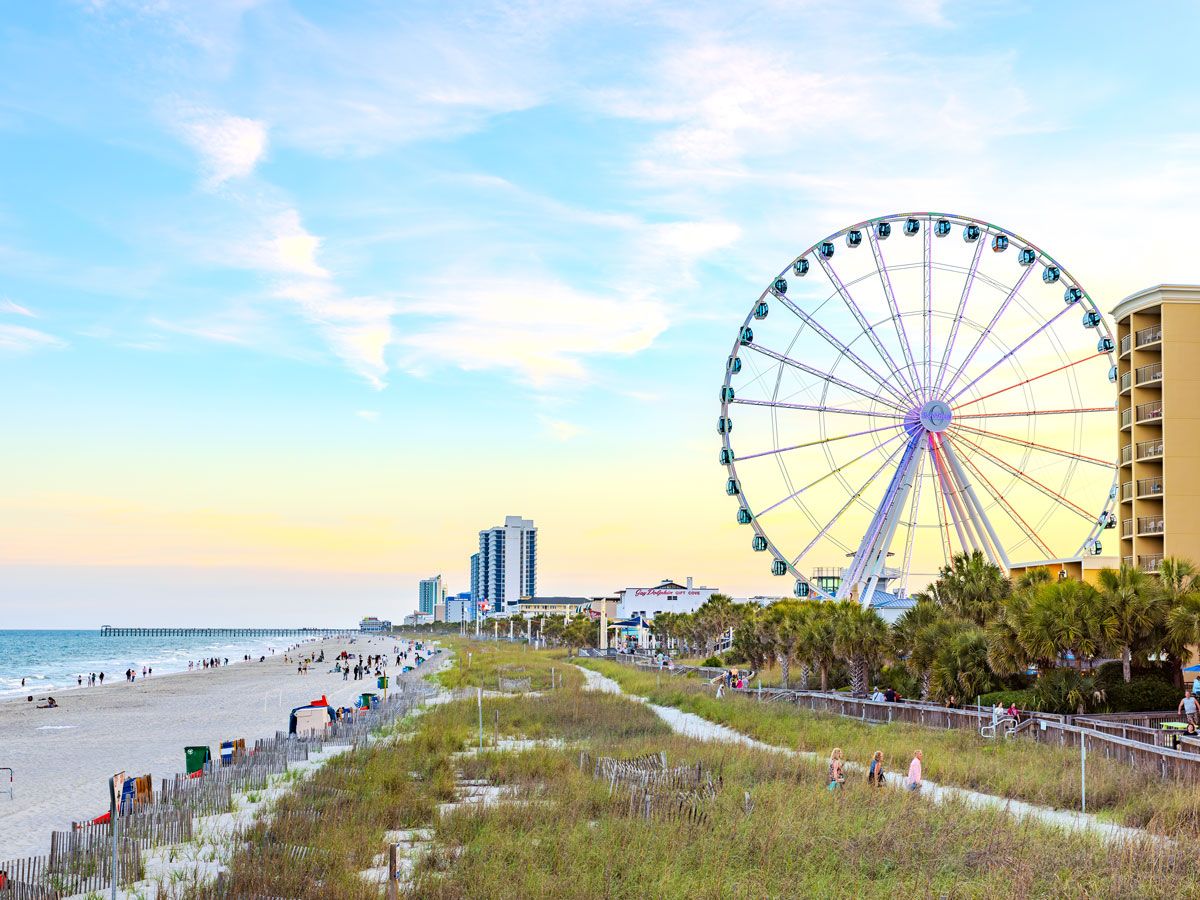
The 60-mile stretch of Atlantic Coast in South Carolina known as the Grand Strand contains several of the state’s most famous beach destinations. That includes Myrtle Beach — which attracts more than 10 million visitors every year to its 1.2-mile beachfront boardwalk, lined with seafood restaurants, amusement parks, golf courses, and other family-friendly attractions.
Replacing a former wooden boardwalk built in the 1930s, which was later destroyed by a hurricane, the current Myrtle Beach Boardwalk opened in 2010 at a cost of over $6 million. Visitors can hop aboard the SkyWheel in Myrtle Beach — one of the country’s tallest Ferris wheels — to take in panoramic views of the Grand Strand. Nearby, other popular beaches along the Grand Strand include Surfside Beach, Murrell’s Inlet, and Garden City Beach.
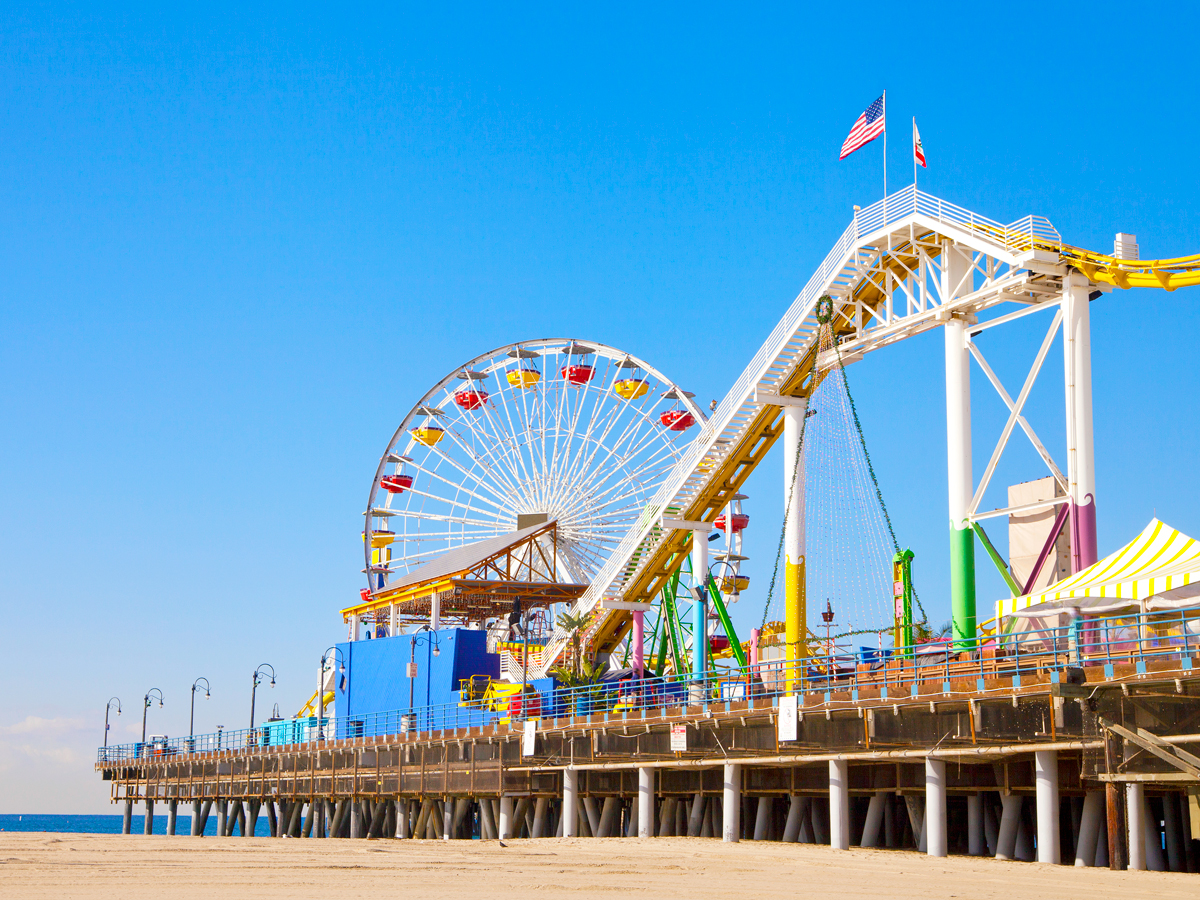
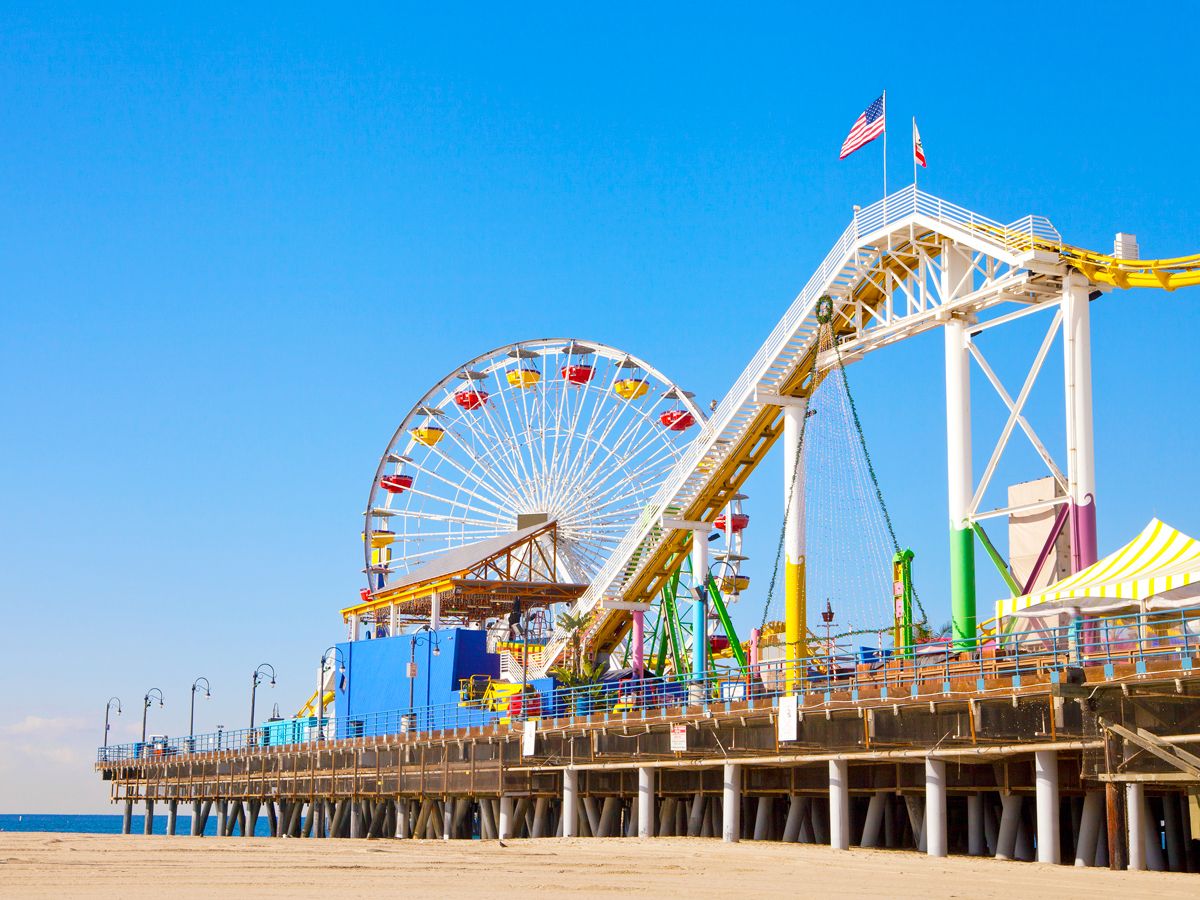
The Atlantic City and Coney Island boardwalks may be more historic, but it’s hard to imagine a more classic American boardwalk than the Santa Monica Pier west of Los Angeles. The pier is topped with a tangle of primary-color rides and attractions, as haphazardly arranged as a child’s tinkertoy construction. After a day in the SoCal sun, the whole joyous affair is lit in the evening by a winning combination of neon lights and the Pacific sunset.
The western terminus of the famous Route 66, the pier has been a favorite Hollywood location since Charlie Chaplin first used it in 1914. In the modern era, it has hosted the cinematic likes of the Muppets, Forrest Gump, Iron Man, and Sharknado. You’ll find a Ferris wheel, dozens of carnival rides and games, T-shirt shops, a historic carousel with hand-carved wooden horses, and even an ocean education center and aquarium called Heal the Bay.
Ocean Front Walk at Venice Beach – Venice Beach, California
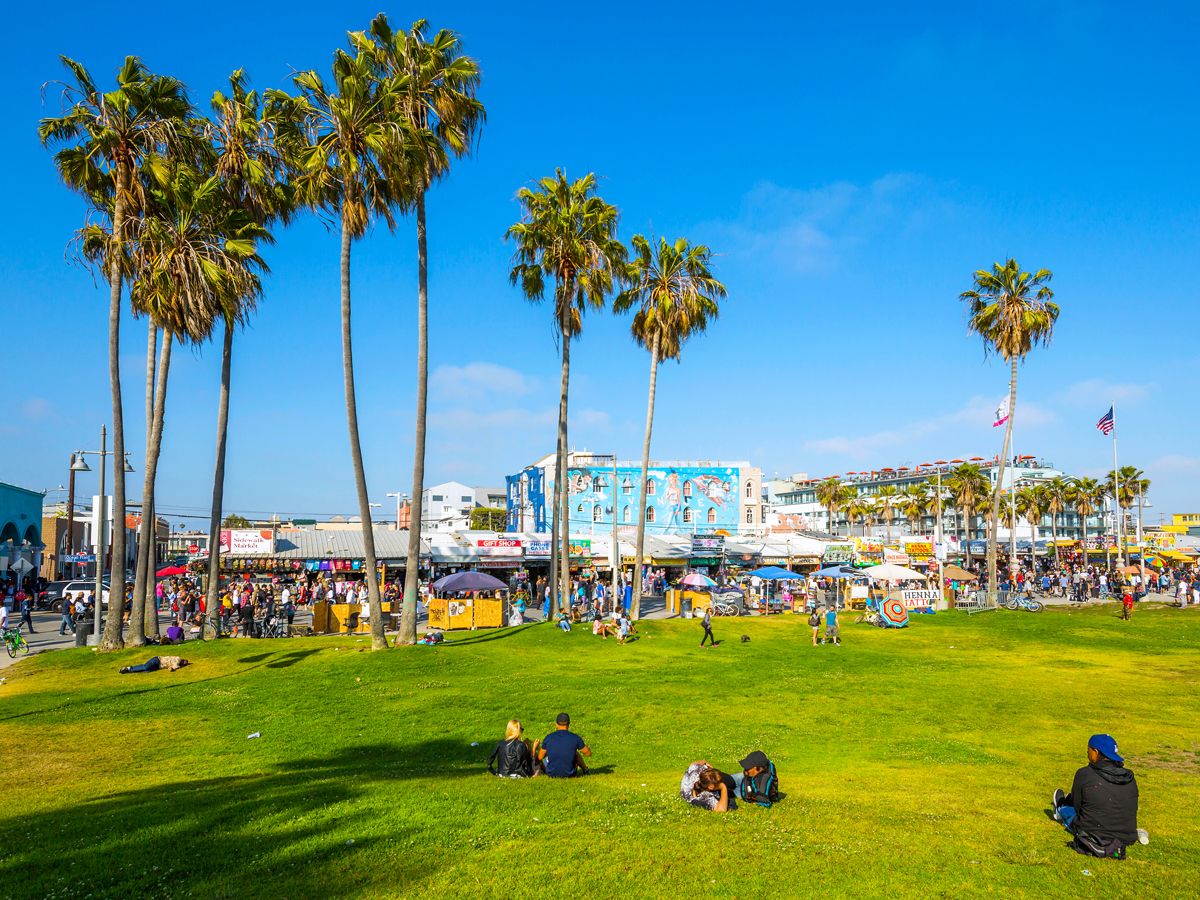
A mere 2 miles south of the Santa Monica Pier, the Ocean Front Walk at Venice Beach offers many of the same familiar elements as other boardwalks, with an added flavor all its own. First, the boardwalk is not elevated — it’s just a wide paved walkway so you can easily step off into the sand or grass along the way to watch volleyball, witness stunts at the skatepark, or observe the many bodybuilders under the shade of towering palms. (The area is nicknamed Muscle Beach for a reason — it’s where a young Arnold Schwarzenegger was a regular.)
But perhaps the biggest reason to visit is the one-of-a-kind culture of the boardwalk. It offers a delightful mix of quirky street entertainers, attention-seeking philosopher-poets, and tanned surfers who look like they’ve just arrived from central casting. This is the wild-eyed, hippie, health-nut version of Californian culture come to life — and it’s not to be missed.
Architecture •July 14, 2025•Updated: July 15, 2025
By Fiona Mokry
Author
Fiona Mokry
Fiona has spent her career exploring the world and working in the travel industry, turning her lifelong passion into a profession. From planning custom trips to sharing stories as a travel writer for publications such as The Discoverer, she’s all about helping others experience the world in a deeper, more meaningful way.
Wood may appear to be a modest and simple building material, but in the right hands, it can be transformed into something truly remarkable. From Japan’s futuristic Grand Ring to historic churches in Russia built without a single nail, these five wooden landmarks are the work of some of the world’s most skilled and creative architects.
Completed in early 2025, the Grand Ring is recognized by Guinness World Records as the largest wooden architectural structure in the world. It was built for Expo 2025 Osaka, the latest iteration of the World Expo — an international event held every five years that promotes and celebrates the exchange of technology information between nations. Standing 65 feet tall with a 1.2-mile circumference, the ring reflects the 2025 event’s theme, “Unity in Diversity.”
Built entirely from wood using nuki, a traditional Japanese carpentry technique that joins timber without nails or screws, the Grand Ring also features a Skywalk, offering sweeping views of the expo grounds and the city of Osaka. Completed in just 14 months in advance of the event, which runs from April to October 2025, the structure was designed to be temporary, though organizers are now considering reuse proposals from private businesses and public organizations to make it a permanent fixture.
Kizhi Pogost (also known as the Kizhi enclosure) is a pair of 18th-century churches and a clock tower that are built entirely of wood, including their iconic onion-shaped Russian Orthodox domes. The architectural ensemble is located on Kizhi Island, part of Lake Onega’s Kizhi Archipelago in northwest Russia.
According to legend, the 121-foot-tall Church of the Transfiguration and 99-foot-tall Church of the Intercession were constructed using only an axe. The architect, Master Nestor, used an ancient carpentry method called interlocking corner joinery, which connects timber through precisely hand-carved, fitted joints — no nails or metal required. Even the ashen shingles on the onion bulbs were fixed in place using wooden pegs. Named a UNESCO World Heritage Site in 1990, Kizhi Pogost “has no parallel in either Russian or global wooden architecture,” according to UNESCO.
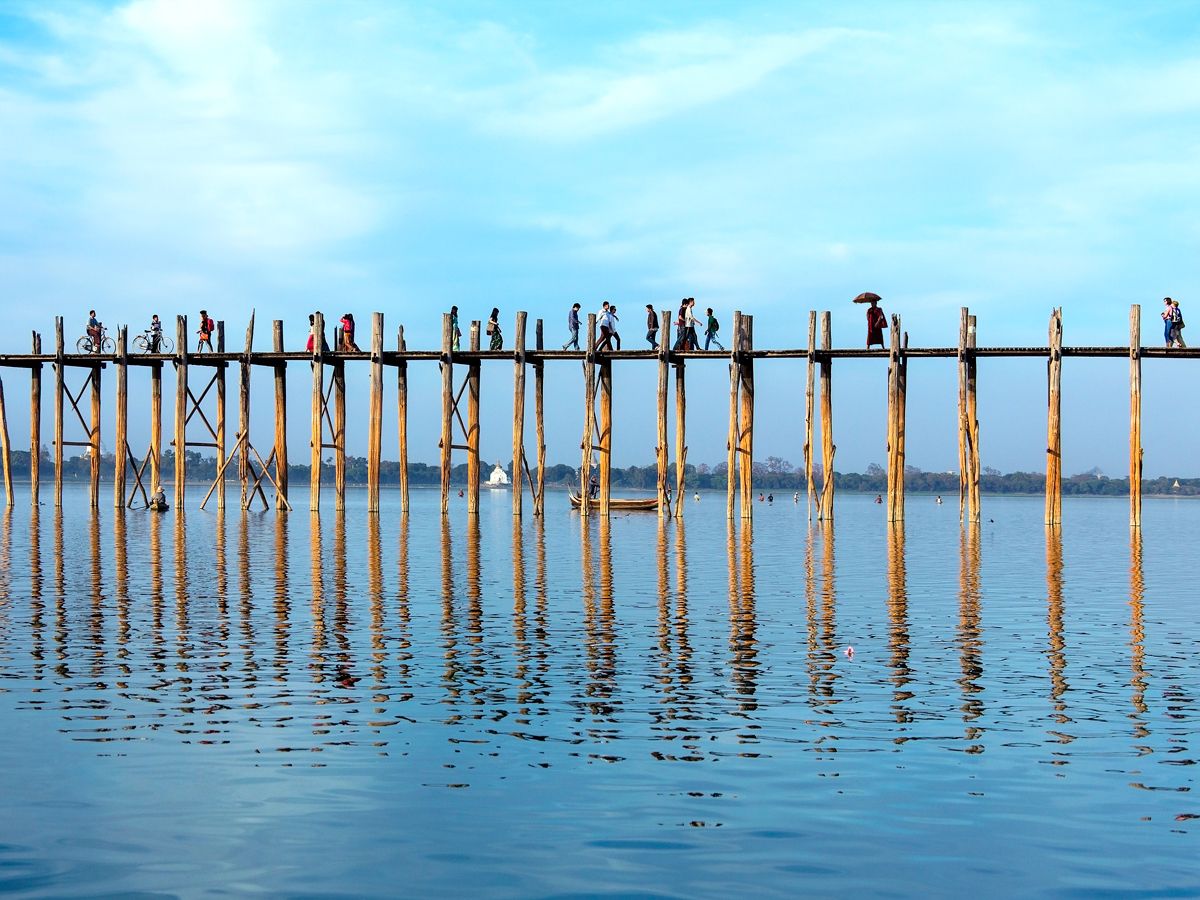
Measuring 0.75 miles long, U Bein Bridge is the longest teak bridge in the world. Built between 1849 and 1851, it spans the tranquil Taungthaman Lake near Amarapura, just outside Myanmar’s former royal capital of Mandalay. The wood used for the bridge’s construction was salvaged from a former palace in Innwa that was destroyed by earthquakes a decade earlier. While more than 1,000 original wooden pillars support the bridge, some have been reinforced with concrete to preserve the structural integrity of the bridge, which is still in use today.
One of the world’s largest freestanding wooden structures, the Metropol Parasol — also known as Las Setas de Sevilla or “The Mushrooms of Seville” for its distinctive shape — was built in 2011. Its designer was German architect Jürgen Mayer, who won a competition to rebuild the Plaza de la Encarnación, one of Seville’s most notable squares.
Constructed primarily from polyurethane-coated wood and reinforced with steel and concrete, the massive structure is held together by over 16 million screws and nuts. Today, it serves as a multifunctional hub with shaded walkways, a traditional market, restaurants, a museum, event spaces, and a rooftop terrace offering panoramic views of Seville’s old town.
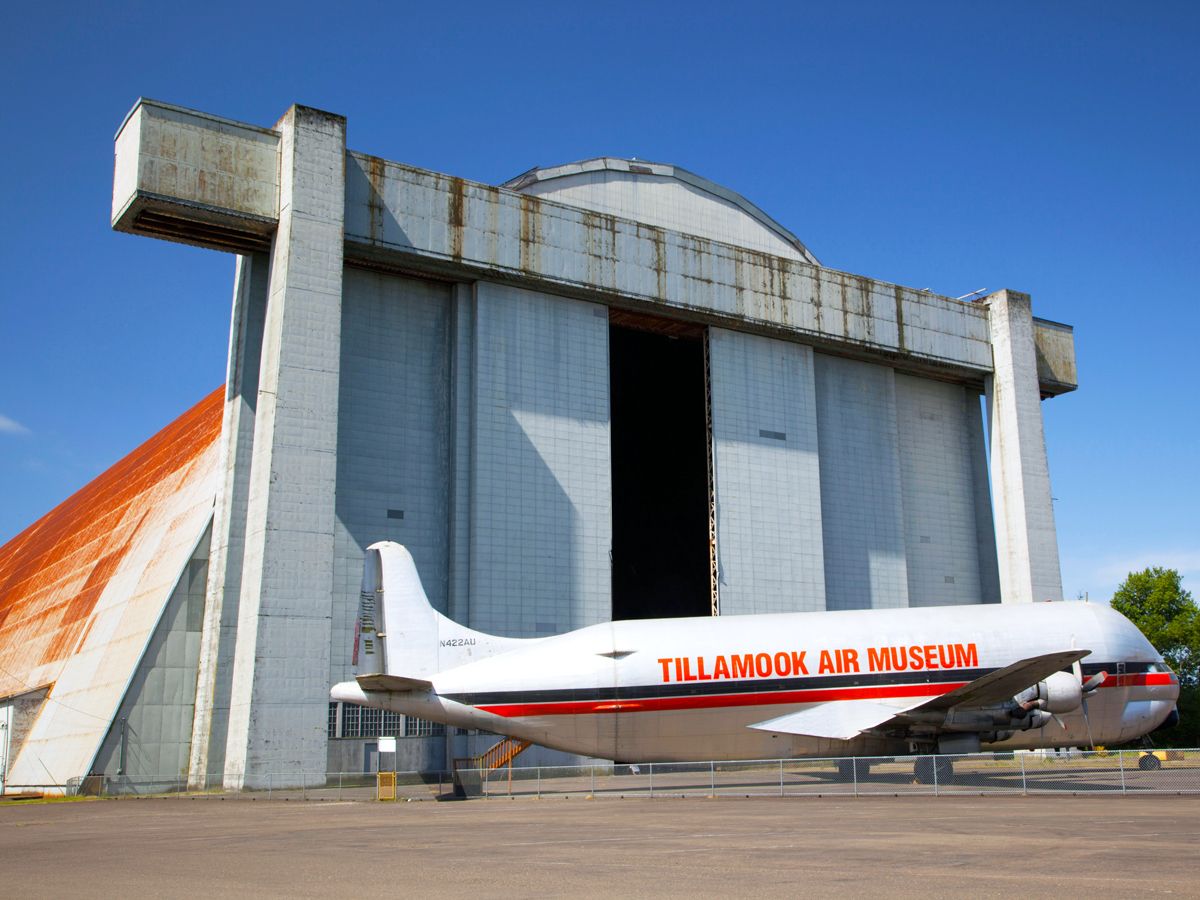
The Tillamook Air Museum is housed within a former blimp hangar in a U.S. Naval Air Station along the central Oregon coast. It is the world’s largest clear span wooden structure, meaning it does not have any internal support columns or beams. The hangar — built in 1943 by the U.S. Navy — measures 1,072 feet long, 192 feet tall, and 296 feet wide, and it covers approximately 7 acres of land. It is one of the world’s last remaining wooden World War II-era blimp hangars. Inside, the Tillamook Air Museum features wartime and aviation artifacts, vintage aircraft models, and interactive exhibits detailing the history of the Naval Air Station during World War II.
Advertisement
More from our network
Daily Passport is part of Inbox Studio, an email-first media company. *Indicates a third-party property.
6 Tips for Navigating an Airport With Mobility Challenges
By
Rachel Gresh
Read time: 5 minutes
July 14, 2025
Updated: July 14, 2025
6 Tips for Navigating an Airport With Mobility Challenges
Tips •July 14, 2025•Updated: July 14, 2025
By Rachel Gresh
Author
Rachel Gresh
Rachel is a Washington, D.C.–based travel and lifestyle writer with roots in the Great Lakes region. When she’s not writing for publications such as The Discoverer and Interesting Facts, you’ll find her wandering through museums or exploring destinations off the beaten path.
Navigating an airport can be challenging for anyone, but for those with a mobility disability, it often requires additional planning and support. Fortunately, there are many ways to make air travel smoother if you or someone you’re traveling with uses a wheelchair or requires other special assistance. This guide offers practical tips to ensure a more accessible and comfortable airport experience from check-in to arrival.
The Air Carrier Access Act protects passengers with disabilities by prohibiting airlines from discriminating against them. These regulations apply to all flights operated by U.S. airlines, as well as flights to or from the U.S. operated by foreign airlines. The ACAA requires airlines to assist passengers with disabilities whenever necessary, including providing a wheelchair or guided assistance during boarding, deplaning, and connections.
Under the ACAA, airplane seating accommodations must also meet the needs of individuals with disabilities; these needs can be specified during the booking process. Additionally, airline employees must assist in the transportation of assistive devices (such as walkers), including checking them at the gate and stowing them during flight. These regulations ensure that flying is safe and comfortable for all airline passengers.
Airline employees will gladly assist you with your mobility needs, but you’ll need to notify the airline before you fly. You should be able to make requests during the booking process, where a special checkbox labeled “Add Special Assistance” typically appears. You’ll then be prompted with more specific questions so that the airline can tailor its services to fit your needs. This can include wheelchair use or escort service from check-in, through TSA, and to your airplane seat. If your special request does not appear on your emailed itinerary confirmation, reach out to the airline to confirm.
However, one aspect of accessibility that airlines do not control is airport parking. So, try to reserve accessible parking in advance if you need to leave a car at the airport. The airport’s website should provide ample information on parking options, including airport maps that clearly label parking garages, elevators, and ramps. With your parking spot secured, you’ll arrive at the airport with peace of mind.
The general rule of thumb at U.S. airports is to arrive two hours before your scheduled domestic flight and three hours before departure for an international flight. But those who require assistance might want to arrive at least an hour before those guidelines, just in case.
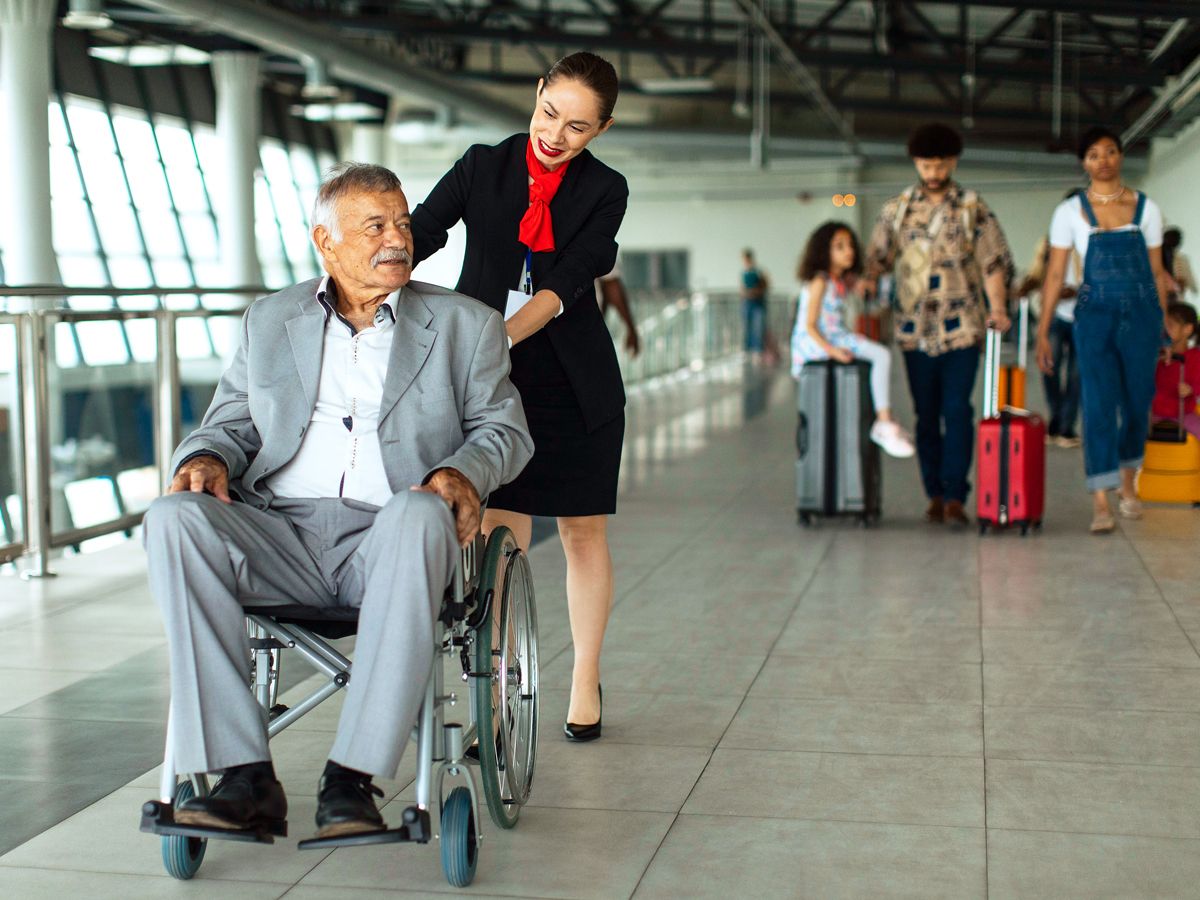
This is because there might be a wait for a certain type of assistance, especially if you requested a wheelchair or cart service. If you’ve reserved a wheelchair or cart service in advance, your reservation information should indicate where to go to obtain access. This could be the check-in desk or another designated assistance point; when in doubt, look for an airline employee to direct you to the correct location.
Navigating security checkpoints can be challenging for any traveler. Fortunately, special guidelines have been established to ensure a smooth process for travelers with mobility issues to pass through TSA quickly and efficiently. Effective communication with TSA officers is key to success: You can verbally notify an officer of your medical condition, or you can quietly hand them medical documentation or the TSA notification card, which you can download and print at home ahead of time.
If you are unable to walk or stand independently for screening, you may request to use a chair or to remain seated in your wheelchair or scooter. Wheelchairs and scooters are also screened during this process, and any removable parts will undergo X-ray screening. Other mobility devices, such as canes, crutches, and walkers, are also permitted through the TSA checkpoint. Items that fit through the X-ray device must be screened in this manner, so let an agent know if you need assistance at any point during this process.
For additional questions or concerns regarding security procedures for travelers with medical conditions, contact TSA Cares. Through this program, travelers can request a dedicated TSA Cares assistant to accompany them through a security checkpoint, ensuring a seamless experience.
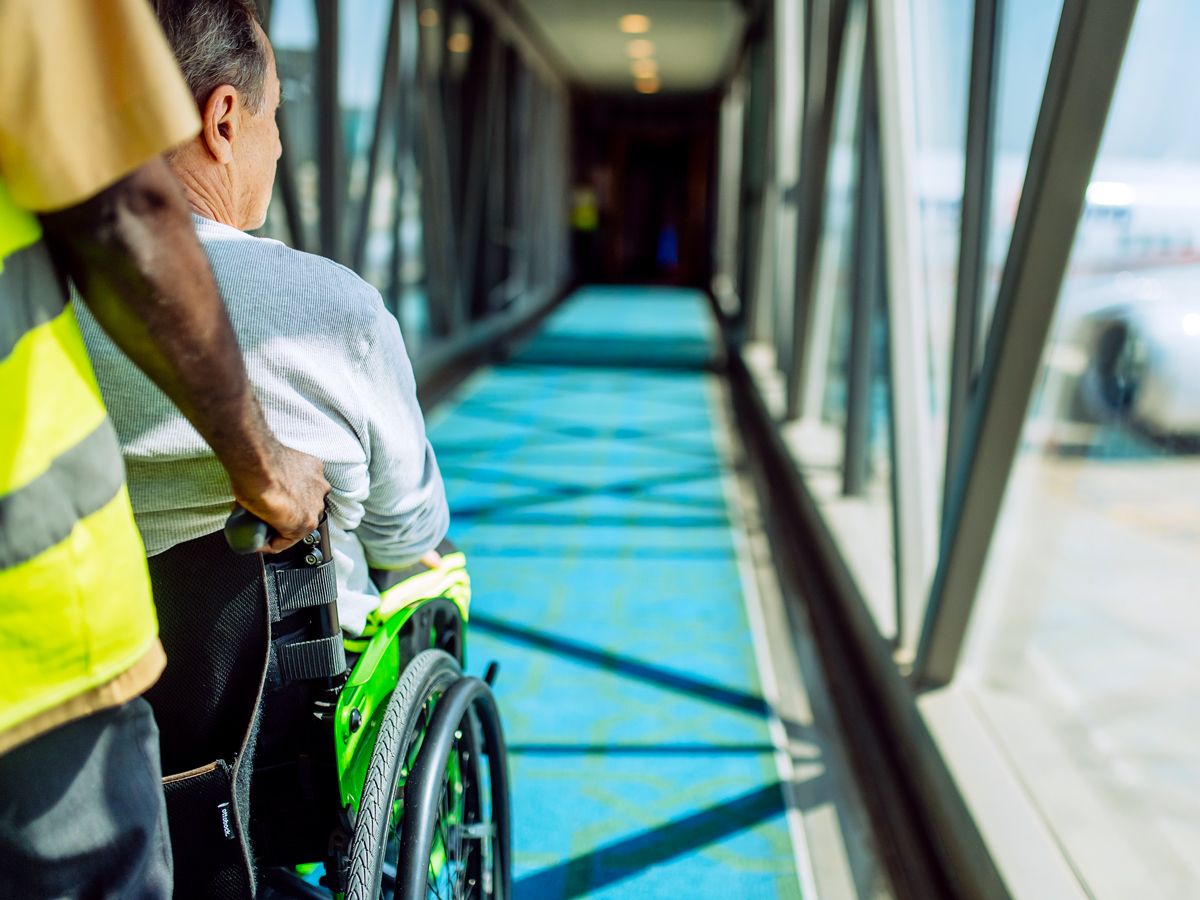
When you reach your gate, check in with the gate agent to discuss any mobility needs. This includes checking larger mobility devices, including walkers and collapsible wheelchairs, at the gate. If you need assistance getting through the jet bridge and onto the plane from the gate, let the gate agent know, and an employee can assist you with a wheelchair onto the plane.
Those needing a wheelchair or other assistance should consider early boarding. According to the Department of Transportation, “If you self-identify as a passenger with a disability who needs additional time or assistance to board the airplane, the airline must allow you to board the airplane before other passengers.” As the boarding time approaches, a gate agent will announce that preboarding is taking place, allowing passengers who require extra time and assistance to board first.
If you’ve requested special assistance or an escort during your booking process, you should receive that assistance during your layover. If you need mobility assistance during a layover but aren’t traveling with a wheelchair or scooter, you may be able to request a courtesy cart to help you to your next gate.
Some U.S. airports, especially large hubs with many gates, operate these carts free of charge, but airports are not required by law to do so, so they may not be readily available everywhere. These golf cart-style vehicles can sometimes be reserved through your airline during online booking or by calling the special assistance phone number.
However, at other airports, carts pick up passengers on a schedule, with no reservations needed. At Minneapolis-St. Paul International Airport, for example, electric carts pick up passengers every 10 to 15 minutes from designated cart stops along every gate in most terminals. Visit your airport’s website before your trip to determine what type of cart services are offered.
Upon arrival, remember that disembarking from the plane may take longer if you’ve requested special assistance. Typically, the airline will allow all other passengers to deplane first before assisting passengers with disabilities or those who use a wheelchair. The airline agent will also accompany you to baggage claim, if necessary, and stay with you until you leave the terminal and are en route to your destination.
Advertisement
More from our network
Daily Passport is part of Inbox Studio, an email-first media company. *Indicates a third-party property.
Daily Passport writers have been seen in publications such as National Geographic, Food & Wine, CBC, Condé Nast Traveler, and Business Insider. They're passionate about uncovering unique destinations and sharing expert tips with curious travelers.
In a world where overtourism is a growing issue, it’s refreshing to find destinations that are making strides when it comes to sustainable travel. By capping visitor numbers or charging a tourist fee, these places aim to preserve their natural environments, cultural heritage, and local communities. From the spiritual temples of Bhutan to the breathtaking wilderness of Antarctica, here are five incredible destinations that limit tourism to protect what makes them so special in the first place.
In 2004, the Royal Government of Bhutan implemented a Sustainability Development Fee (SDF) as part of a broader commitment to high-value, low-volume tourism. The fee is currently capped at $100 USD per adult per night and $50 per night for children ages 6 to 12 (until 2027). This is a 50% discount from its peak price, which reached $200 per night for adults in 2022. Though the fee has been criticized for its cost and for limiting Bhutan’s tourism industry, it is still in place.
While Bhutan doesn’t impose a strict cap on visitor numbers, it limits tourism through the enforcement of the SDF, making it one of the world’s most expensive countries to visit. In 2024, Bhutan welcomed just over 145,000 tourists. Compared to its neighbors India (19 million visitors) and China (32 million), this land of enchanting Buddhist monasteries and high Himalayan landscapes remains far off the beaten tourist track — and that’s by design.
Glacier National Park – Montana
Credit: Jeffrey Ross/ iStock via Getty Images Plus
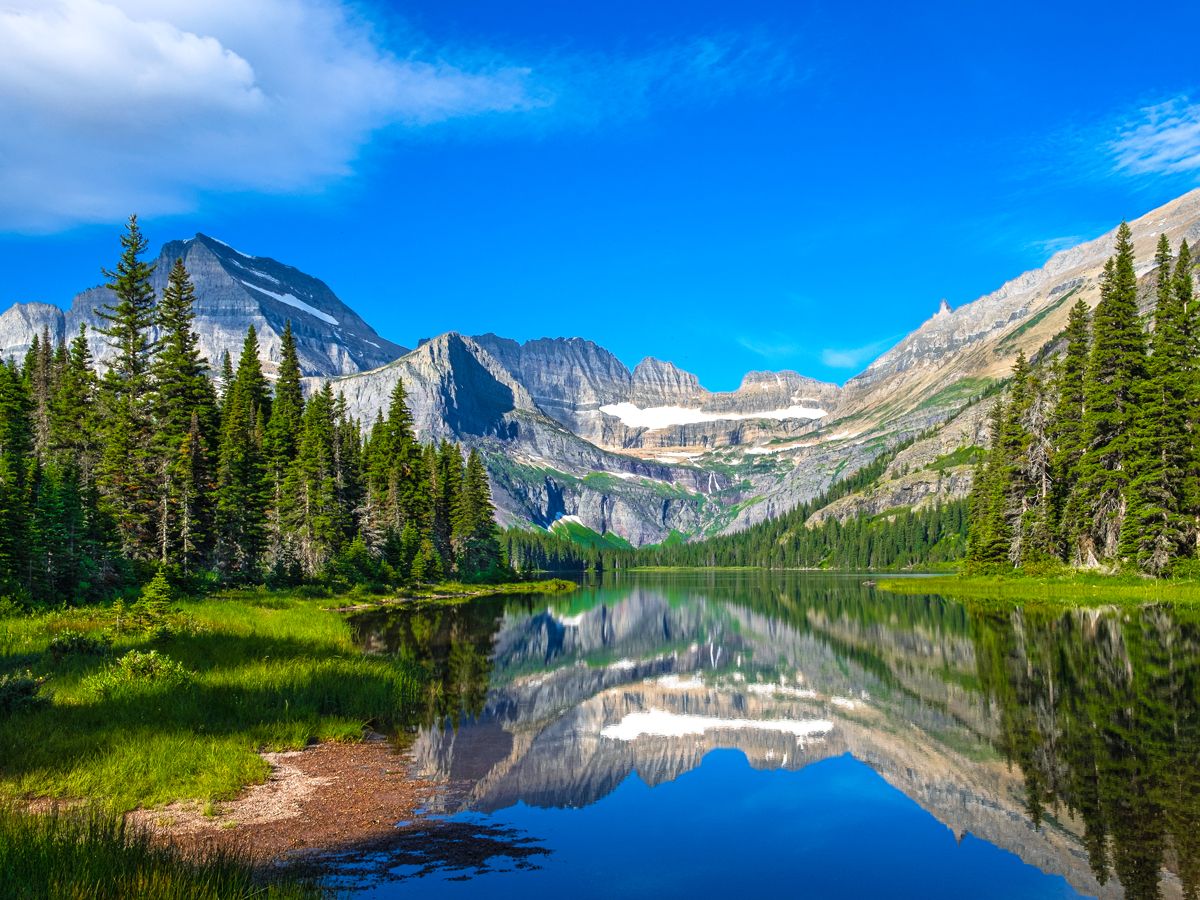
Bordering Canada in the northwest corner of Montana, Glacier National Park is known for its stunning valleys, dramatic landscapes, and roughly two dozen named glaciers. That number is reduced from the nearly 80 that existed around 1850, so preservation is a top priority here — and visitor numbers are carefully managed, especially during peak season.
One of the park’s highlights, Going-to-the-Sun Road, is a 50-mile scenic drive offering stunning views of mountains, valleys, and glaciers. To prevent overcrowding, timed vehicle reservations are required from June 13 to September 28, between 7 a.m. and 3 p.m. on the west side of the road and in the North Fork area, a remote corner of the park without cell service that is a favorite for bird-watching, hiking, and camping.
A limited number of reservations for Going-to-the-Sun Road open up 120 days in advance, with additional passes released the day before. As one of the 10 most-visited national parks in the U.S., Glacier National Park has gone to great lengths to protect its wild, rugged beauty for generations to come.
Credit: Mint Images/ Mint Images RF via Getty Images
Thanks to the Antarctic Treaty System and International Association of Antarctic Tour Operators (IAATO), Antarctica’s untouched wilderness and unique wildlife are carefully protected. While there’s no cap on total visitors, strict rules limit how many people can go ashore at once — no more than 100 at a time — and control the number and size of visiting ships. Vessels with over 500 passengers aren’t allowed to land at all, while smaller ships must coordinate landings to avoid overlapping with other groups of tourists.
Choosing a ship with fewer than 120 passengers gives you more shore time, though landings are still done in shifts and might include alternative activities, such as zodiac cruises, while another group is ashore. To protect Antarctica’s fragile ecosystem, other site guidelines in place include a ban on smoking, noise restrictions, and careful waste management protocol.
Hiking to the Historic Sanctuary of Machu Picchu is one of the most sought-after experiences on the South American continent. This ancient Inca citadel, perched high in the Andes Mountains, is known for its breathtaking views, intricate stonework, and mysterious history.
Because of its popularity, the site is closely regulated to prevent overcrowding, with daily visitor limits set by the Peruvian government. These limits vary by season — 4,500 visitors per day in the low season (October 16 to May 31) and 5,600 in the high season (June 1 to October 15). When booking, you’ll choose from several routes (including the famous Inca Trail) and specific timed-entry slots. After visiting the summit, each visitor has up to four hours to explore the ancient city before making their descent. These regulations mean meticulous planning is required to ensure you can enjoy your visit to this world-famous UNESCO World Heritage Site.
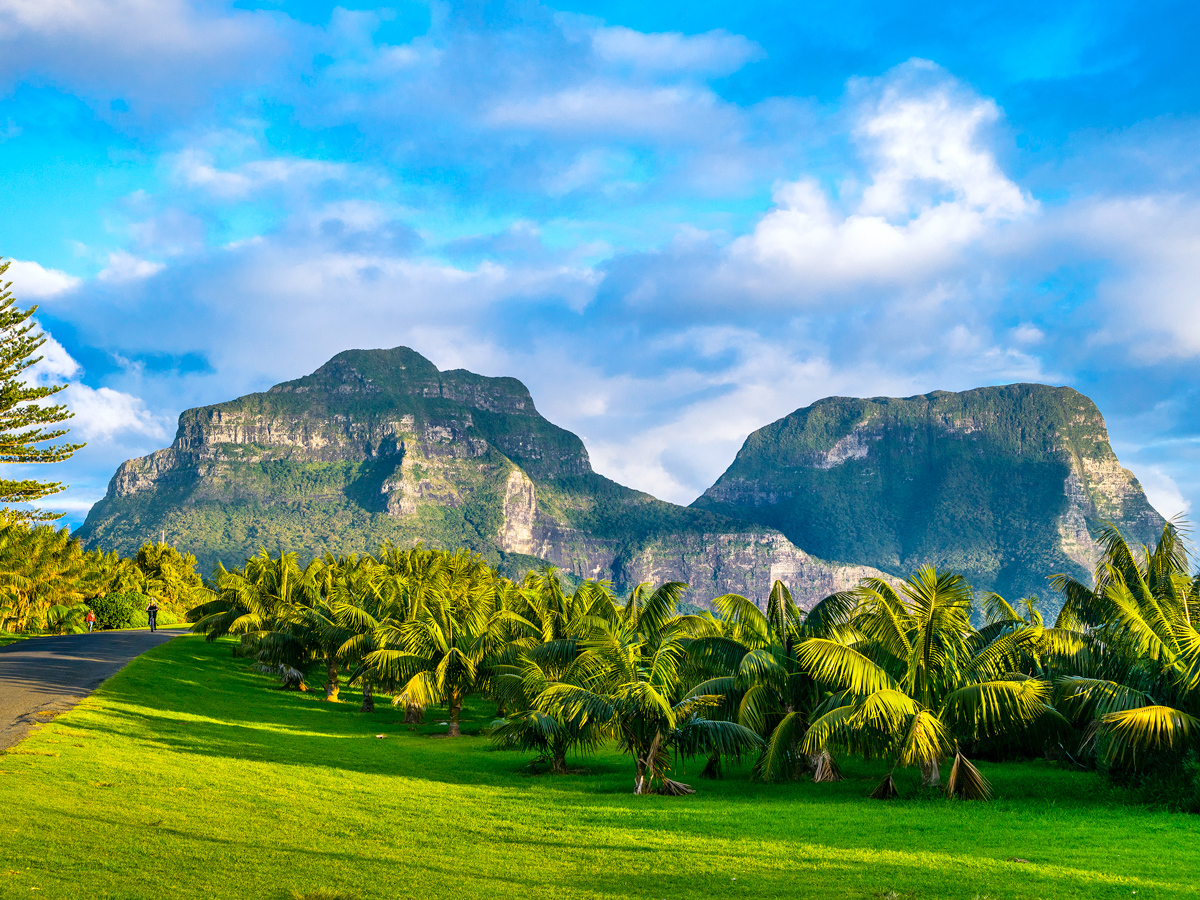
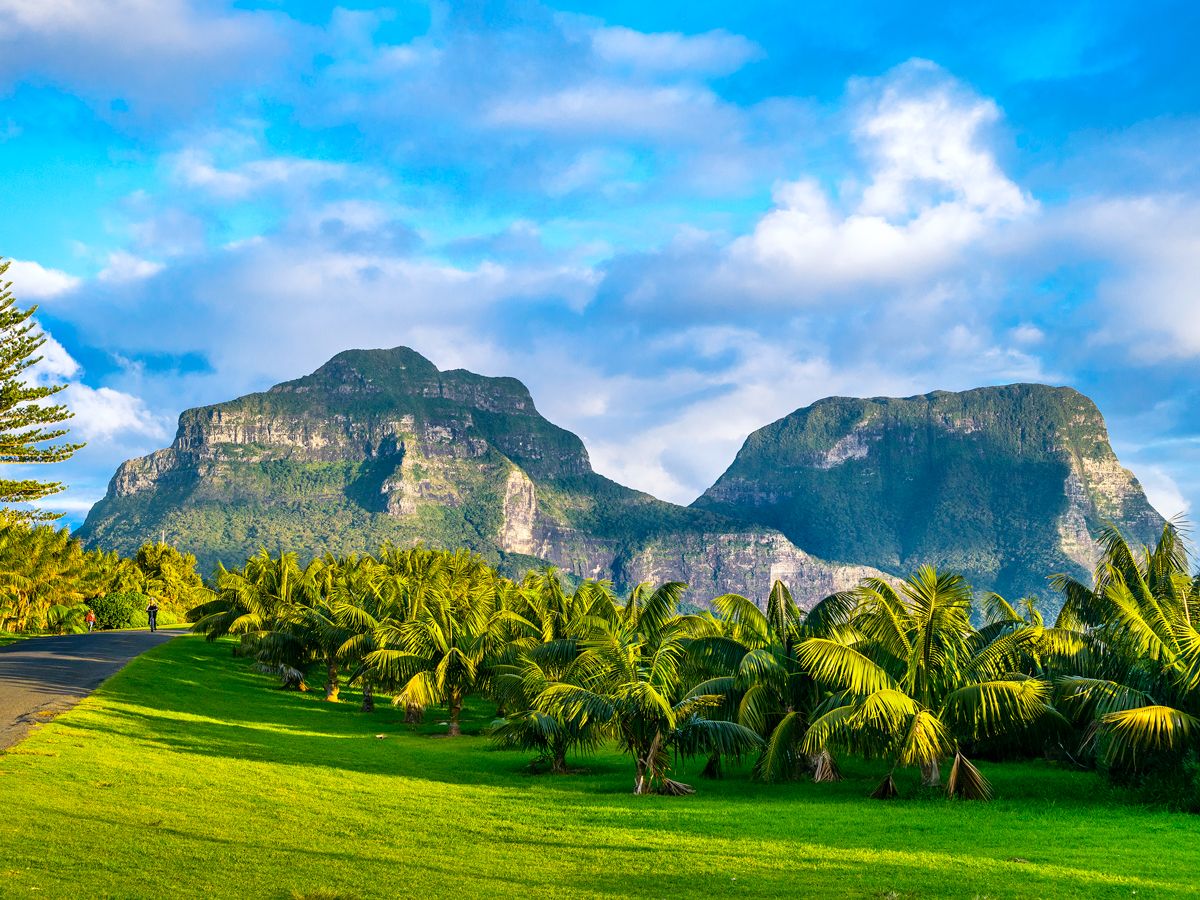
Accessible only by air or private boat, Lord Howe Island is a remote slice of paradise located 435 miles northeast of Sydney in the crystal-clear waters of the South Pacific Ocean. With only 400 visitors allowed at a time and only one daily, two-hour flight from Sydney, Lord Howe Island is a destination that definitely requires some advance planning.
Accommodations, ranging from cozy guesthouses to luxury retreats, are limited, so it’s wise to book your stay and your flight at the same time, so you know you have somewhere to stay on the island. Once you arrive, you’ll find quiet white-sand beaches, pristine coral reefs perfect for diving and snorkeling, lush jungle trails, incredible bird-watching, and curated local tours. For those lucky enough to visit, Lord Howe Island is a hidden gem in New South Wales that’s well worth the effort to reach.