Post Banner Image
Geography

16 Highly Unusual Cities Built in Unlikely Locations

By Daily Passport Team
Read time: 14 minutes
August 10, 2023
Updated: December 22, 2025

16 Highly Unusual Cities Built in Unlikely Locations

By Daily Passport Team
Author
Daily Passport Team
Daily Passport writers have been seen in publications such as National Geographic, Food & Wine, CBC, Condé Nast Traveler, and Business Insider. They're passionate about uncovering unique destinations and sharing expert tips with curious travelers.

The globe is dotted with villages and cities built in unlikely places, but some take their unusual locations and environments to an entirely new level. From underground dwellings to communities tucked into cliffside precipices and even one built on the rim of a volcano, these 16 cities and towns are some of the most uniquely located communities in the world. 

Setenil de las Bodegas, Spain

Homes built under rock in Setenil de las Bodegas, Spain
Photo credit: magic26/ Shutterstock

It’s safe to say that those who reside in this town of about 3,000 people in southern Spain are living under a rock. The stunning buildings of Setenil de las Bodegas are built under and up against huge cliffs of basalt rock. But the town’s unlikely location also serves a practical purpose — the cliffs provide protection from both invaders and the elements. It’s also simpler to build a façade that backs up to climate-controlled rock than it is to build a full house. Because of these factors, historians believe the spot has been settled since prehistoric times and the preexisting nooks and crannies were even used to extend the life of fresh produce. These cliffs still keep residents warm in the winter and shade them from the heat in the summer.

Historically, Sentenil de las Bodegas was a Moorish stronghold, one of the last Muslim territories on the Iberian Peninsula in medieval times. You get a sense of that history as you walk along the town’s oldest thoroughfare — Calle Herreria. Charming stucco and stone buildings line the curving corridor, melding into a sheer, sweeping rock backdrop and ceiling. You will literally see stone rather than sky in some places — how’s that for a surreal atmosphere?

Yanjin, China

City of Yanjin, China, built along river between steep mountains
Photo credit: Mieszko9/ iStock

Considered by many to be the world’s narrowest city, Yanjin hugs the Nanxi River as it runs through the steep mountains of northwest China. When viewed from above — a winding river sandwiched between a slim row of tall, narrow buildings — this city in the Yunnan province doesn’t seem real. The widest sections of the city measure less than 1,000 feet across, and at its narrowest point, Yanjin is less than 100 feet wide. There is one main road on each side, running parallel to the river, and fewer bridges than you might expect. And since many of the buildings in town are located right on the banks of the river, to protect from flooding, the city’s buildings are built atop concrete pillars.

The mountains surrounding the city have kept it isolated and prevented much tourism or development, but despite that more than 450,000 call Yanjin home today. Though it’s difficult to reach, recent viral drone footage has boosted its popularity with tourists, too.

Rocamadour, France

Cliffside village of Rocamadour, France
Photo credit: saranya33/ Shutterstock

Rocamadour, a tiny, medieval village built along and above a gorge on the Alzou River in southwestern France, rises in stages and platforms up the side of a cliff. The lower portion of town is home to its only street, Rue de la Couronnerie. The lane is lively with shops and well-maintained homes built between the 13th and 17th centuries. From there, a monumental staircase of 233 steps rises to a group of churches and shrines officially recognized as a UNESCO World Heritage Site and offering some of the best views in the town.

Once nearly deserted after the French Revolution, Rocamadour buzzes with tourists and those making the religious pilgrimage up the stairs to St. Amadour, the town’s namesake church. Legend has it the saint witnessed the deaths of St. Peter and St. Paul in Rome before settling in the tiny French village to live out his life in solitude. The famous Black Madonna — the iconic, holy statue — also resides in the spectacular, cliff-sheltered Notre-Dame Chapel.

Ronda, Spain

Medieval walls of Ronda, Spain
Photo credit: PhotoFires/ Shutterstock

Ronda, an Andalusian city in southern Spain with 35,000 residents, is the home of modern bullfighting. It was here, in the 18th century, that bullfighters got off their horses and began facing their bull opponents on foot for the first time. But, more than bullfighting, Ronda is famous for El Tajo Gorge — a dramatic, 328-foot-tall crevasse that divides the town in half. To get around the gorge, the town features a series of picturesque bridges and walkways.

From the oldest part of town, a scenic path leads visitors to the very bottom of El Tajo and the beautiful Puente Nuevo (New Bridge), which dates back to 1793. The surrounding landscape is rugged, which meant constructing the span was dangerous — a feat evident from the balconies jutting out from the sides of the gorge. Two smaller bridges also cross the gorge: the Puente Viejo (Old Bridge) completed in 1616 and the Puente Romano, a span dating to the Moorish period.

Ganvie, Benin

Homes built above the water in Ganvie, Benin
Photo credit: Dave Primov/ Shutterstock

Ganvie, located in the Republic of Benin on the Gulf of Guinea in West Africa, has been called the “Venice of Africa.” And for good reason: The city’s structures stand on stilts above water and its 30,000 residents navigate around town in canoes. But instead of canals, Ganvie has the lagoons of Lake Nokoue — a large body of water north of Benin’s largest city, Cotonou.

Interestingly, the city originated as a safe space for the Tofinu tribe back in the 17th century. The group was fleeing another tribe, the Fon, whose religious beliefs prevented fighting on the lake, which they considered sacred. Today, the city is officially recognized as a UNESCO World Heritage Site and is dotted with bamboo huts and pens built from reeds where residents raise fish. The city’s one patch of dry land features a school and a soccer field; another is being built as a city cemetery.

Coober Pedy, Australia

Homes built into sandstone rock in Coober Pedy, Australia
Photo credit: fritz16/ Shutterstock

It’s hot in Coober Pedy — very hot. Located in the Australian Outback, this town’s temperatures typically soar into triple digits. There are few trees, and very little grass. The landscape is otherworldly and almost bleak — dusty, with crags of reddish-brown sandstone. The views are a bit apocalyptic and, perhaps, a bit familiar — Coober Pedy was the backdrop of the 1985 dystopian action film Mad Max Beyond Thunderdome starring Tina Turner and Mel Gibson.

You might wonder how anyone could live in such a desolate town with an extreme climate. Well, it’s because this small village — home to only 3,500 residents — happens to be the “Opal Capital of the World.” About 70% of the world’s opals come from Coober Pedy. And the folks who hunt for the precious stones have adapted: they live underground. It’s cooler down there, and all those miners were digging holes anyway. About half of the town’s residents live in underground dugouts where temperatures stay closer to 75 degrees Fahrenheit. In addition to residences, the town is also home to underground museums, churches, shops, and even hotels.

Monemvasia, Greece

View of Monemvasia, Greece, between steep cliffs with ocean and sunset in background
Photo credit: Georgios Tsichlis/ Shutterstock

Tiny Monemvasia is a mostly-seasonal settlement concealed behind a huge rock face in the region of Laconia in Greece. To get to this enchanting village, you must travel to the town of Gefyra, park your car (since there’s no driving in Monemvasia — only narrow, cobblestone walking paths), and cross a small footbridge. This rocky outcropping was once attached to the mainland but an ancient earthquake made it an island.

Nearly every building in this enchanting walled village is made of stone and stucco painted in earth tones with red-tiled roofs. These structures date from the Byzantine, Venetian, or Ottoman eras. Most of these beautiful buildings are vacation homes, guesthouses, and cafés — and few people live here year-round. At the end of the main drag, a path leads outside the fortress walls to a lighthouse with incredible views of the Myrtoan Sea. In town, you can visit one of two historic churches; the Church of Elkomenos Christos dates back to the sixth or seventh centuries. Its simple yet elegant façade belies the ornate and massive icon of the Crucifixion within. After that, be sure to sample the region’s renowned wines and olive oils.

Bonifacio, Corsica

Sea cliffs of Bonifacio, Corsica
Photo credit: PyrosXav/ Shutterstock

Located on the southern coast of Corsica, the town of Bonifacio is perched along 230-foot-tall limestone cliffs overlooking the Mediterranean Sea. The village’s precarious location and stunning views have earned the medieval town and its fortifications a few nicknames — “Mediterranean’s Sentinel” and “Citadel of Cliffs” among them. The spot is a tourist’s dream — boasting perfect weather year-round and featuring charming, red-roofed buildings and cobblestone lanes and a sparkling shoreline with turquoise waters. Even at the height of summer, you won’t find the village crowded, and there’s plenty of history on every street corner. As Corsica’s oldest settlement, Bonifacio is home to numerous monasteries, museums, and churches offering tours.

Corsica, a French island, is separated from the Italian island of Sardinia by the Strait of Bonifacio — named for the idyllic town. Interestingly, the two islands were once converged but volcanic activity caused the land to rift. Over centuries, the water flowing through the strait has carved into the cliffsides, putting the town on the lip of a dramatic precipice. The unforgettable view of this magical spot from the sea creates an illusion of a gleaming city suspended over the churning sea below.

Civita di Bagnoregio, Italy

Narrow cobblestone streets and archways in village of Civita di Bagnoregio, Italy
Photo credit: canadastock/ Shutterstock

Perched on a fragile and erosion-prone cliff is Civita di Bagnoregio — the first Etruscan settlement founded over 2,500 years ago. Today, this hamlet located in the Tiber River Valley in central Italy is home to only about 12 people (and 20 or so cats). This tiny village welcomes tourists to experience a walled, medieval town dangling from a slim volcanic plateau. The nearest neighboring municipality, a town called Bagnoregio, is a canyon away. To get from Bagnoregio to Civita di Bagnoregio, visitors must cross a steep pedestrian bridge cantilevered 1,200 feet above the gorge that winds up the village’s stone walls.

The population of this historic village dwindled for a number of reasons, but mostly because of the town’s remote location, which is two hours north of Rome in the badlands of sand and sedimentary tufa rock. Many residents moved over to the larger town of Bagnoregio over the centuries — especially after an 18th-century earthquake created the canyon dividing the two settlements. The bridge between the two towns was destroyed in World War II, and it wasn’t rebuilt until the 1960s — a situation that left the few remaining residents living in extreme poverty. Tourism (and a small fee to cross that epic bridge) has started to bring life back to the tiny town — there are now a few bed and breakfasts, restaurants, and souvenir shops lining the fairytale-like stone alleys and stairwells.
Matmata, Tunisia

Courtyard of semi-underground dwelling in Matmata, Tunisia
Photo credit: Valery Bareta/ Shutterstock

The small Berber village of Matmata, located in southern Tunisia, features a series of semi-underground dwellings. These homes are configured around deep, circular pits in the native sandstone — a rock that tends to be soft enough to carve into even with hand tools. From there, additional caves, or “rooms,” are created around the central courtyard pit. The purpose of this construction is to protect residents from the extreme desert heat. In the 1970s, more traditional, above-ground construction hit the area, but many locals still preferred their subterranean dwellings hidden among the area’s olive and palm trees.

It’s unclear when nomadic tribes first settled in the area. The town was virtually unknown until a flood in the 1960s brought the settlement and its underground homes to the attention of the Tunisian government. That said, these homes and the arid, craggy landscape typical in the Djebel Dahar mountains of southern Tunisia might seem familiar. They were featured prominently in Star Wars; an inn called the Hotel Sidi Driss was used as the otherworldly backdrop of Luke Skywalker’s family home.

Monsanto, Portugal

Stone homes in Monsanto, Portugal
Photo credit: gumbao/ Shutterstock

Monsanto was dubbed the “most Portuguese town in Portugal” back in 1938. But that might be a bit of a misnomer — few towns in Portugal, or anywhere, are so defined by their unusual landscape. Centrally located in the countryside, Monsanto is perched at the crest of a 400-foot-tall hill famous for its massive granite boulders and outcroppings. The rocks are so prevalent that the village is built right into them — homes and buildings use the massive stone slabs as walls and even roofs. Some homes are carved right into the boulders; keep your eyes peeled for huge granite mounds featuring windows and front doors.

The town’s unique construction has a storybook effect, with the village featuring moss-covered stone, red-tiled roofs, and narrow, cobblestone lanes curving up the remains of a castle. Dating back to medieval times, the castle and the village below have sweeping views in all directions. That visibility made Monsanto and the Templar Castle a strategic defensive stronghold throughout prehistoric times — famously withstanding the Napoleonic invasion. Today, the village has been designated a living museum by the Portuguese government, which means this spot looks a lot like it has for centuries and will remain that way.

Jezzine, Lebanon

Jezzine, Lebanon, seen from above
Photo credit: M7kk/ Shutterstock

About 25 miles south of Beirut, among pine forests and vineyards, is the resort town of Jezzine. Dangling from a rocky promontory and overlooking a lush valley, the town hugs a 240-foot-tall waterfall — one of the highest in the country. Those eponymous falls — the reason Jezzine is nicknamed the “City of Falls” — are especially dramatic in winter and spring. You can experience the sweeping views from a lookout point or one of the cafés at the top. Or, you can hike along the falls — taking in the region’s idyllic, high-altitude landscape and exploring the cliff’s caves. One cave, the Fakhreddine Grotto, is especially significant — serving as a refuge and hiding spot from the 17th-century Ottoman Empire through World War II.

Jezzine is rich with history — there are monasteries and churches, Phoenician and Roman ruins, an antique wine press, and the huge Bkassine pine forest — home to historic bridges and mills. In town, visitors can sample the region’s well-known wines and shop for traditional mosaic and stone daggers featuring intricate inlay patterns at the many shops made of stucco with red-tiled roofs.

Fira, Greece

Steps leading past whitewashed homes overlooking the sea in Fira, Greece
Photo credit: Havoc/ Shutterstock

Fira, the capital of the Greek island of Santorini, is home to around 15,000 residents, but the island hosts over 2 million tourists each year. That’s no surprise; this gorgeous spot boasts some of the most famous and stunning sunsets in the world. And the town isn’t too shabby, either. Clinging to sheer cliffs, the town features whitewashed stucco walls, charming archways, beautiful tiles, azure blue roofs, and a warren of cobbled streets that open up to lush gardens and sweeping ocean views.

But Fira’s Old-World charm and glorious turquoise waters aren’t just beautiful, they’re incredibly unique. The town — actually, the whole island — is a caldera. And it’s the only inhabited one in the world. A caldera is a cauldron-like depression or sinkhole that is formed after a volcano erupts and collapses. The island’s bay, famously half-moon shaped in the center of the caldera, was created during a massive eruption in the Minoan era. This means Santorini and the picturesque town of Fira are located on the brim of a volcano!

Huacachina, Peru

Overview of Huacachina, Peru, surrounded by sand dunes
Photo credit: tr3gin/ Shutterstock

Peru might be well-known for its majestic Andes mountains, but along the coast lies a strip of desert with sweeping, white sand dunes that could double for the Sahara. One of the most interesting ways to check out this region, which is among the driest on Earth, is a trip to Huacachina. Located a few hours south of Lima, and close to the city of Ica, this tiny town encircles a spring-fed lagoon that fosters a lush oasis dotted with palms and rich tropical foliage. The waters of the lagoon are believed to have therapeutic properties, which made this village a popular destination for Peruvian elites in the 1940s. Today, Huacachina is a popular vacation destination, offering adventure sports, lively parties, and winery tours. It’s easy to be enchanted by the Spanish colonial architecture, the main drag’s mermaid statue, and the dramatic way the town is illuminated at night.

Less than 100 people call Huacachina home, and most work in tourism at inns, hostels, and restaurants. Taking a paddleboat across the lagoon is a popular pastime, along with desert hikes, sandboarding, and dune buggy rides. Those who don’t work in tourism still work in sand — exporting it is the region’s other main industry.

Constantine, Algeria

Bridges and canals of Constantine, Algeria
Photo credit: Abdenour A/ Shutterstock

The city of Constantine, named in honor of Emperor Constantine the Great, is famous for its eight picturesque bridges (and its “City of Bridges” moniker). Why so many bridges? The city is split by the Rhommel Gorge — over a mile in length with an average depth of 400 feet. The bridges connect the crags and cliffs the city is built on — adding architectural wonder to this rugged mountain landscape. Gantaret El Hibal Bridge (also known as the Sidi M’Cid Bridge) is the city’s most famous bridge. Completed in 1912, it was the highest bridge in the world until 1929.

Constantine dates back to 600 BCE, when under the Berbers, it was called Citra. The city was also a Roman stronghold, and still offers visitors the chance to experience ancient Roman ruins both within city limits and two hours away at Djemila, an official UNESCO World Heritage Site. In addition, Constantine is also home to Ottoman palaces, ornate French colonial hotels, a huge mosque, and a series of epic monuments to marvel at.

Castelluccio, Italy

Bikers on flower-field meadow in Castelluccio, Italy
Photo credit: Fabio Lamanna/ Shutterstock

At roughly 4,700 feet above sea level, the Italian village of Castelluccio is one of the highest-elevation towns in the Apennines Mountains. Getting to town is quite the journey — the hairpin turns along the narrow road to town, running through Monti Sibillini National Park, aren’t for the faint of heart. But visitors are rewarded with breathtaking panoramic views of the Umbrian countryside — especially in the spring and summer when the region’s meadows and lentil fields erupt with colorful poppy, daisy, orchid, and cornflower blossoms.

The village is precariously located in front of the park’s highest peak, Monte Vettore. It dates to the 13th century, but the area has been settled since the ancient Roman era — thanks to its incredible views and fertile lands. Today, visitors flock to Castelluccio for skiing, horseback riding, hiking, hang-gliding, and paragliding, but the town is home to few permanent residents. Only about a hundred people actually live in Castelluccio since a series of earthquakes struck the area in 2016.

Post Banner Image
Architecture

6 Beautiful Metro Stations Around the World

By Bennett Kleinman
Read time: 5 minutes
August 10, 2023
Updated: August 10, 2023

6 Beautiful Metro Stations Around the World

By Bennett Kleinman
Author
Bennett Kleinman
Bennett is a New York City-based staff writer for Daily Passport. He previously contributed to television programs such as the Late Show With David Letterman, as well as digital publications like the Onion. Bennett has traveled to 48 U.S. states and all 30 Major League Baseball stadiums.

While the majority of metro stations serve a practical purpose as commuter hubs, some train terminals take their design to new artistic heights. Highlighted by unusual architecture, stunning mosaics, and even a few ancient relics, these metro stops have been transformed into vibrant art installations, adding an unexpected twist of culture to an otherwise mundane commute. Just be careful not to miss your train while basking in the architectural and artistic wonder of these six strikingly beautiful subway stations around the world.

T-Centralen Station – Stockholm, Sweden

Blue-painted interior of T-Centralen Station in Stockholm, Sweden
Photo credit: imageBROKER.com GmbH & Co. KG/ Alamy Stock Photo

Nicknamed the “world’s longest art gallery,” the Stockholm Metro is famous for its picturesque subway stations, many of which incorporate the exposed underground rock into fantastic art displays. Since the 1950s, more than 150 artists have worked on transforming every station in the network. A highlight is Solna Centrum, which features a ceiling that’s painted a bright red color and adorned with tiny houses and trees. Then there’s Thorildsplan T-Bana, known for its bright mosaics designed to reflect classic eight-bit video game scenes. 

T-Centralen station, which opened in 1957, was the first station in the city to feature vibrant artwork. T-Centralen serves the city’s blue line — an appropriate fact given that it’s decorated with a striking combination of white and blue paint. Artist Per-Olof Ultvedt covered the station in murals which prominently feature leaves on the vine crawling up the walls. Located at the top of the escalator are a series of blue silhouettes painted onto the rock that depict the individuals who built the station.

Alisher Navoiy Station – Tashkent, Uzbekistan

Commuters inside the Alisher Navoiy Station in Tashkent, Uzbekistan
Photo credit: Thiago Trevisan/  Alamy Stock Photo

Serving Uzbekistan’s capital city of Tashkent, Alisher Navoiy Station was named after the great 15th-century Uzbek poet who laid the groundwork for the development of the modern Uzbek language. Much like the poetry of Alisher Navoiy, this station is renowned for its beauty, highlighted by its marble columns that line the main platform and extend upwards. The main platform’s roof is even grander, with floral-decorated domes that are reminiscent of Silk Road-era mosque designs that were built long before the railway existed. 

The station’s halls are lined with a series of turquoise ceramic murals that depict scenes from Navoiy’s poetry collections, including images of mythical figures, ancient scholars, and legendary musicians. Alisher Navoiy Station first opened in 1984, though it took until 1997 for work to be completed.

Formosa Boulevard Station – Kaohsiung, Taiwan

Colorful Dome of Light above the Formosa Boulevard Station in Kaohsiung, Taiwan
Photo credit: mauritius images GmbH/ Alamy Stock Photo

A miraculous Dome of Light looms above Formosa Boulevard’s transit station, which serves the Taiwanese city of Kaohsiung. The station opened in 2008 after four years of painstaking development and design by artist Narcissus Quagliata. The artist used 4,500 glass panels to cover an area of 7,100 square feet — impressively, 1,152 of those panels are hand-painted.

The Dome of Light — one of the world’s largest works of glass art —  showcases four elements of human life: water, earth, light, and fire. It can be viewed for free by commuters and art lovers alike. A point of pride for Kaohsiung, the station’s opening catalyzed a city-wide cleanup effort that helped revitalize and rehabilitate the community.
Syntagma Metro Station – Athens, Greece

Archaeological display at Syntagma Metro Station in Athens, Greece
Photo credit: Rawf8/ Alamy Stock Photo

While perhaps lacking the same visual wow factor as other metro stops on this list, the Syntagma metro station in Athens is unique for its archeological value. The station is home to a free museum containing ancient Greek relics that date as far back as the fourth century BCE. 

Among the many highlights is a column that once stood within an ancient Greek temple and was later repurposed as a gameboard after the temple’s destruction. Other notable pieces include terracotta vessels from the third century BCE and perfume vessels from the second century BCE. It’s not just ancient works: Modern Greek art is found around every corner, including a clock sculpture from acclaimed Greek sculptor Thodoros Papadimitriou. Syntagma is among the city’s busiest metro stations, which has been the case since it first opened in 2000 as part of a revitalization effort in anticipation of the 2004 Athens Olympic Games.

Station Arts et Métiers – Paris, France

Interior of Station Arts et Métiers in Paris, France
Photo credit: Richard Croft/ Alamy Stock Photo

Prior to 1994, the Paris metro station Arts et Métiers wasn’t much to write home about. But that year, the station underwent a massive renovation that transformed it into a scenic steampunk paradise. Under the watchful eye of Belgian comic artist François Schuite, the station was outfitted with copper paneling throughout. The platform was also lined with portholes that commuters can look through, each of which contains fantastical scenes straight out of a Jules Verne novel — from flying airships to steampunk style compasses.

Gazing up at the ceiling, it’s hard not to be left in awe by the cogs and wheels hanging downward that make it seem like you’re in a working steampunk submarine. This scene can be found on platform number 11 at the Arts et Métiers station.

Toledo Metro Station – Naples, Italy

Escalators and blue-painted interior of Toledo Metro Station in Naples, Italy
Photo credit: Sergey Yatunin/ Alamy Stock Photo

The redesigned Toledo metro station in Naples resulted from the citywide Stazioni dell’Arte project, in which contemporary Italian artists transformed several transit stations. Toledo’s station was freshly adorned with work from artists William Kentridge and Robert Wilson, who worked alongside architect Oscar Tusquets Blanca to redesign the space. 

At the top of the station are black walls that reflect the asphalt of modern civilization. The further you sink into the station, those colors transform to ochre and yellow, reflecting the natural beauty of the region’s sun-soaked terrain. At the station’s lowest level, two LED light boxes create a wavelike effect as the colors transform to blue and green, reflecting the sea. The station’s centerpiece is a striking art installation called Crater de Luz (cone of light). Looming above the escalators, this bright, funnel-shaped mosaic structure draws light into the station, and is enhanced by an accompanying LED installation titled Relative Light from Robert Wilson.

Post Banner Image
Outdoors

The Best Spots for Stargazing in the U.S.

By Fiona Mokry
Read time: 4 minutes
August 3, 2023
Updated: August 3, 2023

The Best Spots for Stargazing in the U.S.

By Fiona Mokry
Author
Fiona Mokry
Fiona has spent her career exploring the world and working in the travel industry, turning her lifelong passion into a profession. From planning custom trips to sharing stories as a travel writer for publications such as The Discoverer, she’s all about helping others experience the world in a deeper, more meaningful way.
America’s big cities tend to draw the attention of travelers, but often overlooked are the many dark and isolated corners of the country that provide ideal conditions for one of nature’s most pleasurable pursuits: stargazing. In particular, many national parks — famous for their breathtaking landscapes and incredible wildlife — lay claim as the darkest places in the country, making them the ideal environment for stargazing. Looking to feel humbled by the vast size and beauty of the universe? Here are six great stargazing spots to visit in the U.S..
Big Bend National Park – Texas

Overlook of Big Bend National Park in Texas
Photo credit: Zack Frank/ Shutterstock

Big Bend National Park — covering over 800,000 acres in West Texas — has the lowest level of light pollution of any national park in the lower 48 states. The park forms part of the 9-million-acre Greater Big Bend International Dark Sky Reserve — the largest such protected area for stargazing in the world. Contributing to the optimal stargazing in this wild and isolated corner of the country is the lack of human population, ruling out the chance of seeing a glowing light from a house or nearby town. With just a pair of binoculars (or even the naked eye), visitors can spot meteor showers, constellations, and much of the Milky Way Galaxy. October to April is the park’s dry season and the most popular time to visit the park. 

Canyonlands National Park – Utah

Person standing on ledge overlooking Canyonlands National Park in Utah
Photo credit: canadastock/ Shutterstock

Canyonlands National Park is another certified International Dark Sky Park, which means it has “an exceptional quality of starry nights and a nocturnal environment that is specifically protected for its scientific, natural, educational, cultural heritage, and/or public enjoyment,” according to the organization that set out “to preserve and protect the nighttime environment and our heritage of dark skies.” Located in southeastern Utah, Canyonlands is famous for its dramatic rock formations. It also joins the ranks with Big Bend National Park with one of the darkest skies in the contiguous U.S. — on the darkest, clearest nights, roughly 15,000 stars can be seen from the park (compared to 500 by the average city-dweller). On a moonless night, binoculars can even be enough to see the rings of Saturn.

Death Valley National Park – California

Landscape of Death Valley National Park
Photo credit: David Rajter/ Shutterstock

Spanning 3.4 million acres, Death Valley National Park is the largest national park in the lower 48. With all that wide open and undeveloped land (which means no light pollution in sight), the area is prime for stargazing. Skies above the park are so dark that Death Valley was designated a “Gold Tier” Dark Sky Park, the organization’s highest rating in darkness, allowing stargazers to see astronomical objects that can be seen from few other locations on the planet. Death Valley’s arid desert climate also leads to a high number of clear nights with a pleasantly cool temperature. There are many places throughout the park that are dark enough to sit back and enjoy the show, but Mesquite Flat Sand Dune, Harmony Borax Works, Badwater Basin, and Ubehebe Crater are a few of the more popular spots. 

Hawaiʻi Volcanoes National Park – Hawaii 

Arch over Pacific Ocean in Hawai'i Volcanoes National Park
Photo credit: Milan van Weelden/ Shutterstock

Hawaiʻi Volcanoes National Park is home to two of the world’s most active volcanoes, Kilauea and Mauna Loa. This UNESCO World Heritage Site and International Biosphere Reserve protects one of the world’s most unique geological landscapes, which also happens to be spectacularly free of light pollution. The park is open 24 hours a day, seven days a week, and there are plenty of places to post up in the park to gaze up at the sky — the Kulanaokuaiki Campground and Kipukapuaulu parking area offer spectacular viewing platforms on clear nights.

Denali National Park – Alaska

Image of Denali in Alaska's Denali National Park
Photo credit: Bryan Neuswanger/ Shutterstock

In Alaska, fall, winter, and early spring experience long hours of darkness. Coupled with the fact that the surrounding area has very little light pollution, it’s the perfect recipe for incredible stargazing. Indeed, it doesn’t take much effort to see the stars in Denali — one of the most common and accessible routes is along the first 15 miles of Denali Park Road. You can drive your own car and choose where you want to pull over to gaze up at the sky. Riley Creek Campground is open year-round and is also a great place to spend the night enjoying the stunning night skies of Alaska. Lucky visitors to the park will also sometimes catch a glimpse of the northern lights.

Sedona – Arizona

Red rock formations of Sedona, Arizona
Photo credit: S Cosens/ Shutterstock

The best part about visiting this charming northern Arizona town — about halfway between Phoenix and the Grand Canyon —  is that you don’t have to completely abandon civilization and electricity to get a good look at starry night skies. In 2014, Sedona was designated an International Dark Sky Community, thanks to a city ordinance that helped reduce light pollution. Dozens of trails crisscross the iconic red rock landscape surrounding Seoda, creating a truly magical environment for stargazing. Once you’ve had your fill of twinkly stars, discover Sedona’s stunning natural parks, spiritual wellness scene, and vibrant culture. 

Post Banner Image
Outdoors

Fascinating Facts About the Galápagos Islands

By Jersey Griggs
Read time: 5 minutes
August 3, 2023
Updated: August 3, 2023

Fascinating Facts About the Galápagos Islands

By Jersey Griggs
Author
Jersey Griggs
Jersey is a travel and lifestyle writer whose work has appeared in publications such as Condé Nast Traveler, Business Insider, and Bust. When she’s not exploring her adopted home state of Maine, she’s likely planning her next big trip.

Straddling the equator 500 miles west of Ecuador in the Pacific Ocean, the Galápagos Islands are, quite simply, unlike anywhere else on Earth. Home to over two dozen endemic species of land and marine life, the isolated volcanic archipelago provides some of the best wildlife viewing in the world — just ask Charles Darwin. Learn more about the islands’ wildlife, history, and conservation efforts through these nine fascinating facts.

The Galápagos Inspired the Theory of Evolution

Waves crashing off the coast of the Galápagos Islands
Photo credit: Danita Delimont/ Shutterstock

When famed naturalist Charles Darwin visited the Galápagos Islands in 1835 to observe the local flora and fauna, he soon became fascinated by the physical variations of the archipelago’s endemic island species, particularly finches. Through his observations, Darwin hypothesized that species change over time in order to adapt to their environment, which led to the theory of evolution by natural selection. To honor his special relationship with the Galápagos, a statue of the famous naturalist has been erected on the island of San Cristóbal.

The Archipelago Is Named After a Giant Tortoise

Giant tortoise in the Galápagos Islands
Photo credit: FOTOGRIN/ Shutterstock

The archipelago was fittingly named for its most iconic resident — the giant tortoise. The word galápago is derived from an old Castillian word that translates to “riding saddle,” a reference to the saddle-like shell of a tortoise. Although these turtles can live up to 100 years of age, they are still endangered due to being over hunted by sailors in the 18th century, which led to the extinction of various species. 

The Charles Darwin Research Station on Santa Cruz Island is an ideal spot to learn more about efforts to conserve these fascinating creatures and to witness them in their natural habitat.

A National Park Covers 97% of the Islands

Overview of the landscape of the Galápagos Islands
Photo credit: npavlov/ Shutterstock

To conserve this unique region of the world, a whopping 97% of the Galápagos Islands’ land mass is dedicated to Galápagos National Park. Established in 1959 and encompassing 3,040 miles, the park aims to protect the 56 species (27 of which are endemic) that call the archipelago home. The unique species aren’t just limited to land animals — the waters surrounding the islands are a UNESCO Biosphere Reserve, home to 500 species of fish and almost 800 species of mollusks.

The Number of Islands Fluctuates

Mountainous landscape of the Galápagos Islands
Photo credit: Greens and Blues/ Shutterstock

As of 2023, the Galápagos Islands are officially home to 108 islets and rocks, plus 19 large islands — four of which are inhabited. However, since the Galápagos are considered one of the most volcanically active places in the world, these numbers are subject to change. With 21 active volcanoes and 50 eruptions in the last 200 years, the number of islands is constantly fluctuating, with different formations emerging or disappearing due to heightened volcanic activity.
The World’s Smallest Penguins Live Here 

Galápagos penguin standing on rock overlooking the sea
Photo credit: Guadalupe Polito/ Shutterstock

The only species of penguins found in the Northern Hemisphere, Galápagos penguins are native to the islands for which they are named. They are also the smallest penguins on the planet, which makes them agile and avid hunters beneath the water. 

With a current population of 2,000, these birds make their homes in caves and coastal crevices and are known to mate for life. They most often reside on Isabela and Fernandina Islands but can often be spotted swimming around Pinnacle Rock on Bartolome.

Three Species of Boobies Inhabit the Islands

Pair of blue-footed boobies standing on rocks
Photo credit: Kevin Oke Photo/ Shutterstock

Named by Spanish sailors who believed these birds to be clumsy “bobos,” boobies are alsoendemic to the Galápagos Islands. There are three different species — identified by their colorful markings — which inhabit the various islands. The smallest of the three are the red-footed boobies, known to be agile fliers, while blue-footed boobies are larger and more adept at diving underwater. The Nazca booby is recognized for its black-and-white plumage but does not share the brightly colored feet of the rest of the booby population.

It’s the Only Place on Earth Where Marine Iguanas Exist

Marine iguanas on sandy beach in the Galápagos
Photo credit: Discover Marco/ Shutterstock

Native to the Galápagos, marine iguanas are the only lizards in the world that can swim. Unlike other land-bound reptiles, these sea-faring iguanas are able to relocate between islands, swimming distances as far as 40 miles. Referred to by Charles Darwin as the “imps of darkness,” marine iguanas dive under the water to forage for algae on the ocean floor, while employing their claws to cling onto rocks. 

The Islands Have an Unofficial Post Office

Striking red flora on the Galápagos Islands
Photo credit: sunsinger/ Shutterstock

Post Office Bay on Floreana Island earned its name from homesick 18th-century whalers who devised a unique system to send letters home. They use a floating barrel as a makeshift post office, allowing whalers departing the region to sift through the messages and hand-carry mail back home for delivery — no postage stamp required. The system continues to be in operation today, with visitors simultaneously dropping off or picking up letters for delivery to a final destination.

The Galápagos Contain the Largest Shark Biomass on the Planet

Small outcrops of the Galápagos Islands
Photo credit: Maurizio De Mattei/ Shutterstock

As a designated marine sanctuary, the Galápagos Islands is home to a rich and diverse array of marine wildlife, including 30 species of sharks. In fact, these waters contain the largest shark biomass on the planet, measuring 12.4 tons per hectare. The region is most famous for whale sharks, scalloped hammerhead sharks, Galápagos sharks, and whitetip reef sharks — and snorkel and shark diving tours are available for adventurous visitors.

Post Banner Image
Outdoors

20 Places on Earth That Shouldn’t Exist (But Do)

By Daily Passport Team
Read time: 11 minutes
August 3, 2023
Updated: April 1, 2026

20 Places on Earth That Shouldn’t Exist (But Do)

By Daily Passport Team
Author
Daily Passport Team
Daily Passport writers have been seen in publications such as National Geographic, Food & Wine, CBC, Condé Nast Traveler, and Business Insider. They're passionate about uncovering unique destinations and sharing expert tips with curious travelers.

From bubblegum pink lakes to rainbow-hued hot springs and glowing neon blue bays, there are many places on Earth that look like they might belong on another planet. While the photos below might look more like a CGI movie backdrop or surreal works of art, the places depicted in these breathtaking images are actual places you can visit. Don’t believe us? Take a look for yourself at these 20 photos of places on Earth that don’t look real. 

Lake Hillier – Australia

Pink waters of Australia's Lake Hillier
Photo credit: Vera Larina/ Shutterstock

You might do a double take when you first see this lake, which looks more like a puddle of bubblegum ice cream than an actual body of water. The stunningly pink Lake Hillier sits on Middle Island, part of a nationally protected reserve on an archipelago off the coast of Western Australia. Its color is likely a result of micro-algaes, such as Dunaliella salina, that thrive in the lake’s salty water. These microorganisms produce beta-carotene, a pigment found in carrots, which is believed to be the cause of the lake’s unforgettably pink hue.

Grand Prismatic Spring – Wyoming

Rainbow-colored waters of Grand Prismatic Spring in Yellowstone National Park
Photo credit: Iv-olga/ Shutterstock

The Grand Prismatic Spring adds a splash of tie-dye color to the beauty of Yellowstone National Park. It’s the third-largest spring in the world and also the most photographed thermal sight in Yellowstone.

The varying bands of color around the spring result from the presence of thermophilic, or heat-loving, bacteria. Hot water moves from the center of the Earth’s crust to the surface of the spring. It cools at the edges of the spring, and the bacteria there create the rainbow of colors that draws thousands of visitors each year.

Fjaðrárgljúfur – Iceland

River running through dramatic, green Fjaðrárgljúfur canyon in Iceland
Photo credit: Daniel Turbasa/ Shutterstock

We’ll forgive you if you can’t pronounce this canyon’s name, because the view alone will probably leave you speechless. Fjaðrárgljúfur formed about 9,000 years ago and remained a hidden gem until Justin Bieber filmed a music video there in 2015, bringing this magnificent spot to the world’s attention.

After being flooded with an influx of visitors in the following years, the Environmental Agency of Iceland temporarily closed the canyon in 2019. The country is now focused on reducing the effects of climate change and building the necessary infrastructure to support year-round visitors. Once it’s open to the public again, you can marvel at the 300-foot-high canyon walls that wind like a serpentine through the southern part of the island.

Socotra – Yemen

Image of a dragon's blood tree on Socotra island in Yemen
Photo credit: javarman/ Shutterstock

This isolated, four-island archipelago in the Indian Ocean is home to a variety of plants and animals you won’t find anywhere else on Earth, which is how it earned its place on the UNESCO World Heritage list. Approximately 37% of Socotra’s plants (including the superbly named dragon’s blood tree, pictured here), 90% of its reptiles, and a whopping 95% of its land snails are endemic to the archipelago.

Despite its remote location, Socotra is home to about 50,000 human residents, too. Many of them fish, dive for pearls, and raise crops and animals. The island’s famous exports include frankincense, fish, and ghee.

Salar de Uyuni – Bolivia

Reflective white surface of Salar de Uyuni in Bolivia
Photo credit: blubery/ Shutterstock

Stretching more than 4,000 square miles across the Andes of Southwestern Bolivia, the Uyuni Salt Flat contains an estimated 10 billion tons of salt. Within the layers of salt lies 70% of the world’s lithium reserves, making this area particularly important for the manufacturing industry, as lithium is used to make batteries for laptops, cellphones, and electric cars.

For travelers, however, the area’s appeal lies in the unique hexagonal formations on the surface, as well as the mirroring effect that’s created when a thin layer of water covers the salt flat on a sunny day. Though local legends have different takes on how the area came to be, scientists tell us that the salt flat formed over 40,000 years ago, when an evaporated lake left behind a thick crust of salt.
Fly Geyser – Nevada

Image of Fly Geyser in Nevada
Photo credit: Lukas Bischoff Photograph/ Shutterstock

The Fly Geyser consists of three strange misshapen mounds of Earth rising from the northern Nevada desert. But these mounds are actually the result of human actions, rather than nature.

The first geyser formed here in 1916 when residents in the area dug a well, only to discover that, at 200 degrees Fahrenheit, the water was too warm to be useful. About five decades later, a geothermal power company drilled a test well on the site. Because the well had been improperly sealed, hot water spewed forth. Over time, mineral deposits formed and eventually grew into the multicolored green and red cones we see today.

Notably, the insides of the cones contain quartz, which typically doesn’t start forming inside geysers until at least 10,000 years have passed, making these geysers even more unusual than they appear.

Naica Mine – Mexico

Crystals inside Mexico's Naica Mine
Photo credit: Paul Hakimata/ Alamy Stock Photo

In Mexico, the Cave of the Crystals within Naica Mine looks like a supersized salt shaker you can climb right into. This cave is home to the largest crystals in the world, which were remarkably discovered only 20 years ago.

The conditions inside the cave are ideal for growing crystals since the air is acidic, humidity is high, and no natural light enters. As a result, the crystals inside the cave have reached lengths of up to 36 feet. The largest crystal is believed to have been growing for approximately 500 years. Unsurprisingly, the ideal conditions for growing crystals aren’t so ideal for humans, so you can’t enter the cave without wearing a special suit.

Richat Structure – Mauritania

Aerial view of Richat Structure, Mauritania
Photo credit: GLF Media/ Shutterstock

Unlike other sites on this list, this structure doesn’t offer much to see at ground level. In fact, you may even have trouble finding it, despite its 28-mile diameter. From space, however, this formation looks like a giant bullseye or a landing site for flying saucers, which has earned it the “Eye of the Sahara” nickname. Its unique appearance has long captured the imagination of astronauts, but alas, the geological feature does have origins here on Earth.

The Richat Structure consists of what geologists call a domed anticline that has been eroded by the elements over 100 million years, revealing layers of older igneous and sedimentary rocks surrounded by newly formed rocks.

Tunnel of Love – Ukraine

Verdant Tunnel of Love over abandoned rail tracks in Ukraine
Photo credit: Zoonar GmbH/ Alamy Stock Photo

An industrial train track wouldn’t normally make a list of incredible places to visit, but the Tunnel of Love is a notable exception. Just outside of Klevan, Ukraine, this two-mile tunnel is formed from trees growing over the tracks, their branches and leaves creating a brilliant green canopy overhead.

The tunnel dates back to the Cold War, when trees were planted around the tracks to hide the transporting of war materials to and from a nearby military base. Since then, the Tunnel of Love has undergone quite the rebranding. Today, it’s believed that couples who make sincere wishes during their visit will see their hopes and dreams come true.

Mosquito Bay – Puerto Rico

Bioluminescence of Puerto Rico's Mosquito Bay in the distance
Photo credit: Wirestock, Inc./ Alamy Stock Photo

Mosquito Bay is the world’s brightest bioluminescent bay, located off the island of Vieques. The bay gets its dazzling neon blue color from microscopic organisms in the water that capture light energy from the sun and glow when agitated or touched.

Though these microorganisms live in the ocean, you can only find them in a few rare spots on Earth, which makes Mosquito Bay even more special. Their large concentration produces a visible glow-in-the-dark effect in the bay’s waters. For a truly otherworldly experience, visit during a new moon, when the dark night sky will further illuminate their glow.

Zhangye National Geopark – China

Rainbow-colored mountains of Zhangye National Geopark in China
Photo credit: THONGCHAI.S/ Shutterstock

Also known as the Rainbow Mountains, these colorful peaks offer one of the most surreal sights in the world. Known as a Danxia landform, meaning “red cloud,” the site covers approximately 19 square miles in China’s Gansu province and has become a popular UNESCO World Heritage Site.

The colorful stripes are reflective of how the mountains formed. The land was once flat, containing layers of different minerals. When the tectonic plates collided millions of years ago, the land was pushed up and the various layers were revealed — creating an array of colors that attract visitors from all over the world.

Mendenhall Ice Caves – Alaska

People exploring Mendenhall Ice Caves in Alaska
Photo credit: Zhukova Valentyna/ Shutterstock

For those willing to brave bone-chilling temperatures, the tunnels of blue ice formations in the Mendenhall Ice Caves are a worthy payoff. Located about 12 miles outside of Juneau, Alaska, the Mendenhall Glacier stretches another 12 miles into the Mendenhall Valley, and its partially hollow interior allows for easy exploration.

Unfortunately, climate change has had a negative impact on the glacier, causing it to recede nearly two miles over the last 60 years. If the ice melts and the caves continue to shift, they may eventually become inaccessible to humans. But for now, the stunning blue hues of the ice caves leave an indelible mark on anyone who makes the trek inside.

Tulip Fields – The Netherlands

Fields of tulips and windmills in the Netherlands
Photo credit: Olena Znak/ Shutterstock

With rows of blooms in vibrant colors, the seasonal tulip fields in the Netherlands look like a postcard come to life. Here, the flowering season begins in March, with crocuses and tulips in full bloom from mid-April through the first week of May. Though there are a number of fields across the country, the largest and most famous are at Keukenhof.

Every autumn, more than seven million bulbs are planted, turning the area into an enormous patchwork quilt of kaleidoscopic colors. Keukenhof is located just 25 miles southwest of Amsterdam — which makes it a convenient destination for your springtime travels.

Antelope Canyon – Arizona

View of wavy canyon walls of Antelope Canyon in Arizona
Photo credit: V_E/ Shutterstock

The smooth red sandstone slopes of the canyon consist of multihued striations, artfully sculpted by wind and water over 190 million years. Located in Arizona on Navajo land, this famous slot canyon is divided into Upper Antelope Canyon and Lower Antelope Canyon, both of which can be accessed only by guided tours.

The upper canyon is particularly popular with tourists. There, visitors can see shifts of cascading sunlight grazing the 120-foot rock walls, creating incredible photo ops that make it one of the most photographed places in the Southwest. The hike through the lower canyon is more physically demanding but offers equally memorable scenery.

Dead Vlei – Namibia

Barren landscape surrounded by sand dunes in Dead Vlei in Namibia
Photo credit: Fotografie-Kuhlmann/ Shutterstock

Located on the western edge of Namibia, the landscape at Dead Vlei looks like a surrealist painting, with its starkly contrasting red-orange sand dunes set behind apocalyptic trees and the dried white clay pan of the desert floor..

The trees began to grow when the area was flooded by a nearby river. In later centuries, however, newly formed sand dunes cut off the water supply. Though the trees here are around 900 years old, they haven’t yet decomposed due to the extreme dryness of the climate — leaving them intact in all their bleak, barren beauty.

Stone Forest – China

Person observing karst landforms in China's Stone Forest
Photo credit: JekLi/ Shutterstock

While touring China, you won’t want to miss Shilin, also known as the Stone Forest. Its towering karst landforms have earned it a place on the UNESCO World Heritage list. The landscape began forming 270 million years ago and today covers approximately 150 square miles in the Yunnan Province. In addition to the labyrinth of limestone towers and ridges, the Stone Forest is home to caves, lakes, waterfalls, and even an underground river.

Hitachi Seaside Park – Japan

Sea of blue flowers in Hitachi Seaside Park, Japan
Photo credit: jiratto/ Shutterstock

The beautiful trails of Japan’s Hitachi Seaside Park wind through flower beds lined with millions of daffodils, tulips, roses, red Kochia, and baby-blue Nemophila that seem to stretch as far as the eye can see. Flowers bloom in every season, making it a popular year-round attraction which you can explore on foot or bike.

There’s also an amusement park on site, complete with a Ferris wheel and roller coaster, so you can enjoy a little adrenaline rush after admiring the flowers.

Bergpark Wilhelmshöhe – Germany

Bridge over waterfall and verdant landscape in Germany's Bergpark Wilhelmshöhe
Photo credit: Masoodaslami.de/ Shutterstock

Combining ornate Baroque architecture with waterfalls and overgrown gardens, Bergpark Wilhelmshöhe evokes thoughts of a fairytale castle. Europe’s largest hillside park offers a mix of unexpected sights, from a Chinese pagoda to a towering statue of Zeus.

The park is located in the city of Kassel in central Germany. Its construction began in 1696; over the following centuries, various features such as gardens and fountain displays were added to the park.

The Gates of Hell – Turkmenistan

Image of burning gas crater in Turkmenistan nicknamed "the Gates of Hell"
Photo credit: Matyas Rehak/ Shutterstock

The Darvaza gas crater has been burning in a Turkmenistan desert for about five decades, earning it the nickname of “The Gates of Hell” or “The Door to Hell.” Approximately 226 feet in diameter and 98 feet deep, the pit is located in a natural gas field. This gives it all the fuel it needs to light up the desert like the world’s biggest campfire.

According to most accounts, the crater was first discovered in 1971, when geologists thought they had found an oilfield. Instead they were drilling on top of a large pocket of natural gas, which collapsed under the weight of their equipment. Since the high quantity of methane in natural gas can make it hard to breathe, the scientists set the pit on fire in order to protect the area’s wildlife. They hoped to burn off the gas in a few short weeks, but their plan failed. Since it’s difficult to tell exactly how much gas there’s left to burn, the Gates of Hell could stay open for a while.

Carlsbad Caverns – New Mexico

Interior of Carlsbad Caverns in New Mexico
Photo credit: Doug Meek/ Shutterstock

The stalactites and stalagmites, underground pools, and rippled limestone walls give the 100 caves that make up the Carlsbad Caverns an otherworldly appearance.

One of the oldest cave systems in the world, estimated to have formed 3.9 million years ago, the caverns are also biologically diverse ecosystems with bat colonies and other habitats. Each of the various chambers — such as the Temple of the Sun, the Big Room, and the Hall of the Giants — has unique geological features that were formed over centuries.

Post Banner Image
History

Where Do U.S. Presidents Like To Vacation?

By Daily Passport Team
Read time: 7 minutes
August 3, 2023
Updated: June 26, 2025

Where Do U.S. Presidents Like To Vacation?

By Daily Passport Team
Author
Daily Passport Team
Daily Passport writers have been seen in publications such as National Geographic, Food & Wine, CBC, Condé Nast Traveler, and Business Insider. They're passionate about uncovering unique destinations and sharing expert tips with curious travelers.

As anyone who’s watched The West Wing can tell you, there’s a lot on your plate when you’re the U.S. President. And yes, even Commanders-in-Chief need a little R&R sometimes. But where do you choose as a vacation spot when you hold the highest office in the land? From a seaside resort on the Jersey shore to a ski resort in Colorado, here are 10 destinations that bear the presidential seal of approval.

Hotel Colorado – Glenwood Springs, Colorado

Hotel Colorado surrounded by mountains in Glenwood Springs, Colorado
Photo credit: Danita Delimont/ Alamy Stock Photo

Long before President Ford hit the slopes in Vail, another American president made Colorado a preferred vacation destination. Outdoorsman Theodore “Teddy” Roosevelt visited Colorado seven times during his 1901-1908 tenure as the nation’s 26th president. His longest stay was at the Hotel Colorado in Glenwood Springs, where the rough-and-tumble Republican brought friends and associates on a six-week trip to hunt bears.

The Medici-inspired hotel was the “Grand Dame of the Rockies,” hosting royalty and celebrities who came for the crisp mountain air and the healing waters of the town’s hot springs. Following extended visits by Roosevelt and his successor, President William Howard Taft, the hotel earned the nickname “Little White House of the West.”

Camp David – Frederick County, Maryland

Fence post on grassy hill at Camp David
Photo credit: Edwin Remsberg/ Alamy Stock Photo

About 60 miles northwest of Washington, D.C., is the official “country home” of the sitting U.S. President. Camp David was initially dubbed “Shangri-La” by its first resident, President Franklin D. Roosevelt, who modeled the main house after his vacation home in Warm Springs, Georgia. The famously plain-spoken President Dwight D. Eisenhower found the name “a little too fancy,” and renamed the 200-acre property in Maryland’s Catoctin Mountain Park in honor of his grandson, David.

The grounds include 11 residence cabins as well as a swimming pool, bowling alley, skeet shooting range, and helipad. Numerous foreign leaders have been entertained at Camp David, including the Soviet Union’s Premier Nikita Khrushchev during the height of the Cold War.

State Game Lodge – Custer, South Dakota

Exterior of State Game Lodge in Custer, South Dakota
Photo credit: RaksyBH/ Alamy Stock Photo

In 1927, the West was expanding and vacationers were hitting the road in newfangled automobiles when Calvin Coolidge, America’s 30th President, decided to see the booming region and escape the muggy summer weather of D.C. Initially planning on a three-week stay in the Black Hills of South Dakota, the President and his family liked the State Game Lodge in the small town of Custer so much that they extended their visit for three months — a huge boon for the state’s fledgling tourism attractions.

In addition to fishing and horseback riding, Coolidge officially dedicated the inaugural work on the nearby carving of Mount Rushmore, and declared that he would not seek another term in 1928. He wasn’t the only American President to succumb to the area’s charms; President Dwight D. Eisenhower also stayed at the lodge for three days in 1953. Want to see the area’s majesty for yourself? Book a room or specialty cabin at the lodge and don’t skip the popular Buffalo Safari Jeep Tour.

Congress Hall – Cape May, New Jersey

Bright yellow facade of Congress Hall in Cape May, New Jersey
Photo credit: mauritius images GmbH/ Alamy Stock Photo

Built in 1816 in the heart of Victorian Cape May, Congress Hall claims to be “America’s First Seaside Resort” and has been a favorite vacation spot for U.S. Presidents throughout many administrations. President Benjamin Harrison made the hotel his official “Summer White House,” and Presidents Franklin Pierce, James Buchanan, and Ulysses S. Grant vacationed here, conducting business in the classic estate and smoking cigars on the Grand Lawn. Located right across the street from the Atlantic Ocean, Congress Hall is less than 200 miles from the nation’s capital and routinely earns a spot on various “best hotels” lists on the Eastern Seaboard.

Lincoln’s Cottage – Washington, D.C.

Image of Lincoln's Cottage in Washington, D.C.
Photo credit: Dennis K. Johnson/ Alamy Stock Photo 

Much closer to the office (just three miles from the White House) is President Abraham Lincoln’s summer retreat — a 34-room, Gothic Revival-style “cottage” that was originally a home for elderly and wounded soldiers. The President commuted by horseback to the White House (surviving a sniper’s assassination attempt) but also worked on legislation at the hilltop home, including the Emancipation Proclamation. Today, President Lincoln’s Cottage is a historic site and museum dedicated to Honest Abe’s life and legacy, with galleries and extensive exhibits that focus on decision-making, dialogue, and social justice.

Martha’s Vineyard – Massachusetts

Boats docked in harbor on Martha's Vineyard, Massachusetts
Photo credit: Clarence Holmes Photography/ Alamy Stock Photo

This charming (and expensive) island just south of Cape Cod is used to hosting U.S. Presidents: President Ulysses S. Grant arrived in the summer of 1874, enjoying fireworks and fishing, and the parade of POTUSes hasn’t stopped since. President Bill Clinton and President Barack Obama have both vacationed frequently in private houses — playing golf, browsing bookstores, and making ice cream runs just like other island regulars. And the private Kennedy family compound in Hyannis Port is only an hour (by ferry) away.

Little White House – Key West, Florida

Image of the Little White House in Key West, Florida
Photo credit: Dennis MacDonald/ Alamy Stock Photo

A naval officer residence at the end of the Overseas Highway was a welcome escape for President Harry S. Truman, who spent no less than 175 days during 11 working vacations at his “Little White House” in Key West’s Old Town. The structure built in 1890 saw many critical developments during Truman’s presidency, including the development of the Marshall Plan to rebuild post-WWII Europe and deliberations over the fate of Palestine.

Subsequent Presidents including Eisenhower, Kennedy, and Clinton also visited the home. Turned over to the State of Florida in 1987, the Little White House is now a state historic site and museum. If you take the guided tour, you’ll see Truman’s famous desk sign proclaiming, “The Buck Stops Here.”

Rapidan Camp – Madison County, Virginia

Snowy Rapidan Camp in Madison County, Virginia
Photo credit: Nature and Science/ Alamy Stock Photo

In 1929, President Herbert Hoover and his wife Lou Henry bought and designed this rustic retreat in what is now part of Shenandoah National Park in Virginia. Where two springs join to form the Rapidan River, engineers struggled to create 13 separate structures connected by a series of bridges and paths. The First Couple entertained a host of celebrities in the log cabins, including Charles Lindbergh, Will Rogers, and Thomas Edison in addition to Cabinet members and family and foreign dignitaries such as British Prime Minister Ramsay MacDonald.

Although the Hoovers donated the property hoping it would be used by future heads of state, the remote location and rustic accommodations were not appealing to President Franklin D. Roosevelt. All but three of the original structures were demolished by the National Park Service in 1959.

Western White House – Vail, Colorado

Steps leading to "Western White House" in Vail, Colorado
Photo credit: Dennis Frates/ Alamy Stock Photo

Both President Gerald Ford and his wife Betty were avid skiers, so they bought a condo in the developing resort village of Vail in 1970, long before Congressman Ford was chosen to be the vice president (who would later take office when President Richard Nixon resigned). As commander-in-chief, Ford often returned to Vail, bringing along a group of Secret Service agents who could keep up with him on the slopes.

After leaving the White House, the Fords retired to a luxurious home in the nearby enclave of Beaver Creek. Today, the couple is memorialized in Vail with the Gerald R. Ford Amphitheater and the Betty Ford Alpine Garden, the highest botanical garden in the United States.

Bedford Springs Resort – Bedford Springs, Pennsylvania

Fountain and gardens in front of Bedford Springs Resort
Photo credit: H. Mark Weidman Photography/ Alamy Stock Photo

Mineral-rich hot springs in the Allegheny Mountains have lured a succession of commanders-in-chief to Pennsylvania’s exclusive Bedford Springs Resort. In 1821, President James Buchanan made his first visit, and would return for 40 summers. The resort served as the 15th President’s “Summer White House” during his term in the 1800s, and Buchanan received the first transatlantic cable in the hotel’s lobby in 1858.

Other U.S. Presidents who have made themselves at home at the luxurious hotel (which had one of the nation’s first indoor swimming pools as well as one of the earliest golf courses) include former Presidents Andrew Jackson, John Tyler, James K. Polk, Zachary Taylor, James Garfield, and William H. Taft.

Post Banner Image
Architecture

These Are 10 of the World’s Weirdest Statues

By Daily Passport Team
Read time: 8 minutes
August 2, 2023
Updated: January 16, 2025

These Are 10 of the World’s Weirdest Statues

By Daily Passport Team
Author
Daily Passport Team
Daily Passport writers have been seen in publications such as National Geographic, Food & Wine, CBC, Condé Nast Traveler, and Business Insider. They're passionate about uncovering unique destinations and sharing expert tips with curious travelers.

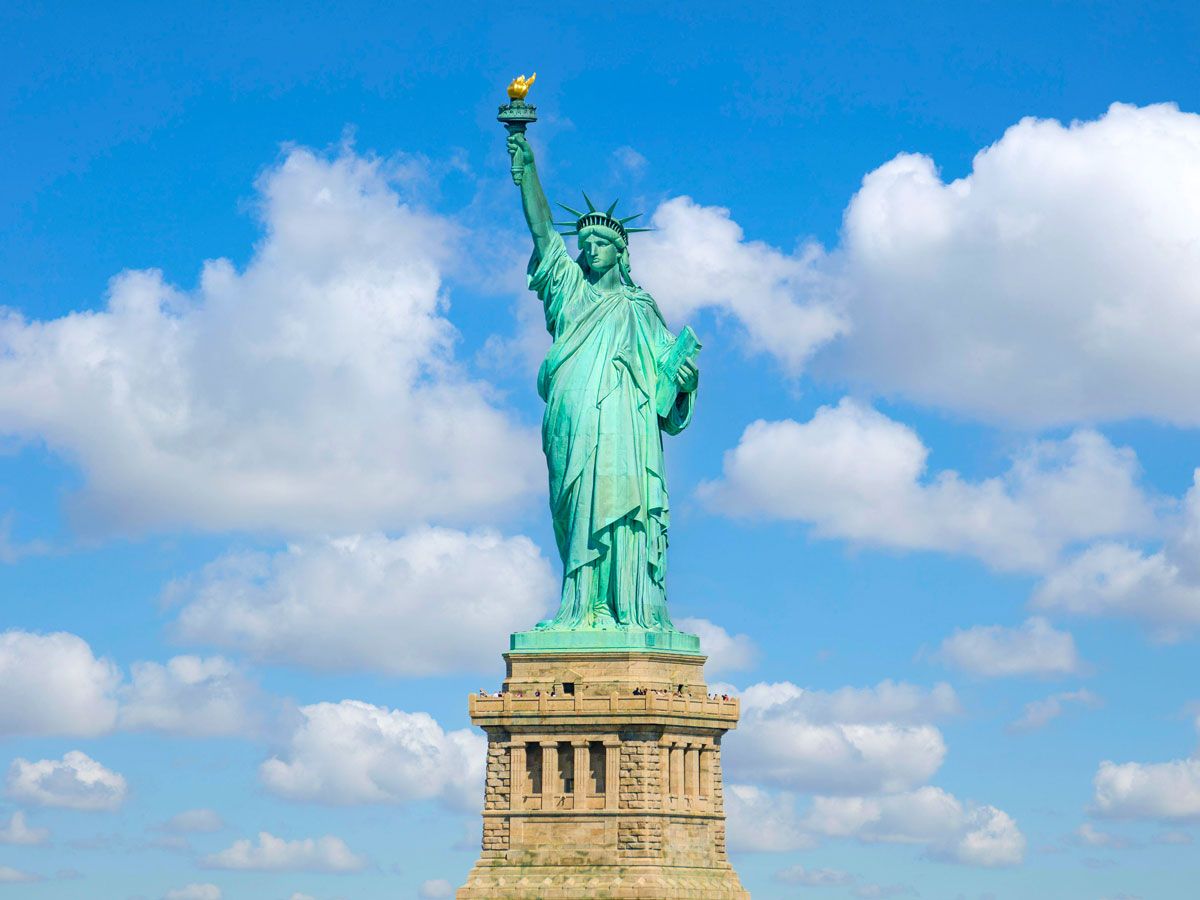
Iconic statues — from Christ the Redeemer in Rio de Janeiro to China’s Spring Temple Buddha and New York City’s Statue of Liberty — are famous for their elegant, artfully sculpted designs. But some statues buck that trend. Think: metal chickens, lumpy rockets, or a teetering stack of sailing ships. Discover 10 of the world’s weirdest statues, monuments, and fountains you never knew existed.

Hand of the Desert – Atacama Desert, Chile

Image of Hand of the Desert statue in the Atacama Desert of Chile
Photo credit: Kseniya Ragozina  Alamy Stock Photo

In 1992, out in Chile’s vast and desolate Atacama Desert, Santiago sculptor Mario Irarrázabal installed a striking sculpture of a left hand rising from the sand. The massive, 36-foot-tall sculpture, constructed of iron and cement, reminds some viewers of the Percy Bysshe Shelley poem “Ozymandias,” which tells the tale of a fallen monumental statue of an arrogant king lying in pieces in a desert.

The statue, commissioned by the nearby mining town of Antofagasta, has a mate — thousands of miles away in the Uruguayan coastal resort town of Punta del Este, a giant right hand by the sculptor rises from the beach, a “Monument to the Drowned.”

Man Hanging Out – Prague, Czechia

"Man Hanging Out" statue dangling over streets of Prague, Czechia
Photo credit: Manfred Gottschalk/ Alamy Stock Photo/

Frequently the motivation for concerned calls to the Prague police, this dangling sculpture of Sigmund Freud can be easily mistaken for a person in danger. And maybe that initial startle that viewers feel is the point of the sculpture by David Černý, a popular Prague visual and performance artist. Critics have said that the work was created to question the outsized role of intellectualism in the 20th century and to possibly portray Freud’s fear of his own death.

The sculpture depicts Freud, who was born in the Czech Republic, hanging onto a pole by one hand, above the cobbled streets of the city’s Old Town. When it was installed in 1996, “Man Hanging Out” proved so popular that the artist was invited to display the work at museums and art fairs around the world. Now it has returned to Prague and has a permanent midair home.

Floralis Generica – Buenos Aires, Argentina

Person walking by flower-shaped "Floralis Generica" statue in Buenos Aires, Argentina
Photo credit: Frank Nowikowski/ Alamy Stock Photo

In a reflecting pool in United Nations Park in Buenos Aires’s Recoleta neighborhood, a 75-foot-tall mechanical flower made of stainless steel and aluminum opens and closes with the sun. The immense sculpture, which has a diameter of 131 feet when opened, was a gift of famed Argentinian architect Eduardo Catalano in 2002, designed by him to honor his beloved hometown.

Every morning at 8 a.m., photocells on the sculpture react to the sunlight and set off a hydraulic system that slowly opens six enormous shiny petals. The petals reflect and refract the city skyline, the sky, and the pool in which it stands, making it a popular addition to the city’s numerous public artworks. At sunset, the petals close back up, but the interior glows with colored light through the night. In its relatively short lifespan, “Floralis Generica” has become one of the most iconic symbols of Buenos Aires.

Peter the Great Statue – Moscow, Russia

"Peter the Great" statue on the banks of the Moskva River in Moscow, Russia
Photo credit: Yadid Levy/ Alamy Stock Photo

This massive statue of Peter the Great standing on the deck of a ship, which itself rests on top of a column made of several ships, was originally modeled as a memorial to honor the 500th anniversary of the first voyage of Christopher Columbus. Allegedly, the artist Zurab Tsereteli could not find a taker for a Columbus statue, so he substituted Peter the Great for the Spanish explorer and got his patron, the then-mayor of Moscow, to commission the work for a spot on the banks of the Moskva River.

Moscow’s citizens are noisy in their disapproval, which is multifaceted. First, the ungainly sculpture, which tops off at a whopping 322 feet tall (the Statue of Liberty is 305 feet with its base), blocks the view of a beautiful and historic section of the Moscow skyline. Second, Peter the Great is not considered a favorite among Muscovites: The “great” emperor disliked the city so much he moved the capital to St. Petersburg. After the mayor left office, Moscow quickly offered the statue to St. Petersburg, which politely declined the offer.

Carhenge – Alliance, Nebraska

Image of Carhenge statue in Nebraska
Photo credit: Bryan Mullennix World View/ Alamy Stock Photo

When Nebraska-born geologist Jim Reinders noticed that the proportions of the car models of the 1950s and 1960s were roughly on the same scale as the stones that make up England’s Stonehenge, he began to stockpile vintage cars with an artistic purpose. In 1987, Reinders erected a replica of Stonehenge, constructed from 38 cars, some upended with others balanced atop, like the dolmens of the original prehistoric site, and arranged them in an incomplete circle with the same 96-foot diameter. The vehicles were painted a flat grey to resemble stones (and to stop rust), but there’s no denying that the raw materials used in the sculpture were originally cars.

During the 2017 solar eclipse, the totality of the eclipse passed over Alliance, Nebraska, and Reinders’s installation. A group of over 4,000 observers, including the state governor, assembled at Carhenge to watch.

Einstein Fountain – Ulm, Germany

Close-up image of the Einstein Fountain in Ulm, Germany
Photo credit: ightspruch/ Alamy Stock Photo

Imagine Albert Einstein’s wild-haired head cast in bronze and tucked into the sideways shell of a snail, which itself forms the top of a rocket, from whose bottom shoots out a fountain of water. Get the idea? We’ll admit, we don’t quite either. The city of Ulm, Germany, where Einstein was born in 1879 and lived for one year, erected this fountain in 1984 to honor the physicist. This chaotic creation, conceived by Jürgen Goertz, combines the man-made technology of the rocket and the perfect natural engineering of the snail shell, with the head of a genius, to somehow represent or honor his work.

Other easier-to-understand monuments to the charismatic physicist include a statue outside of the National Academy of Science in Washington D.C., a cast bronze bust at Princeton University in New Jersey, where he taught, and a lifesize bronze statue in the Griffith Observatory in Los Angeles.

Mr. Eggee, the Chicken – Chicken, Alaska

Metal chicken statue in Chicken, Alaska
Photo credit: James Talalay/ Alamy Stock Photo

Just as you can see the namesake animals of Buffalo, New York, and Elk, Michigan, all over town on business signs and sports jerseys, a town named Chicken would surely inspire some chicken-flavored memorabilia. The tiny gold-mining town of Chicken, Alaska, near the border of Canada’s Yukon Territory, does, in fact, sport a few chicken depictions.

The most prominent, “Mr. Eggee,” was made to celebrate the annual Chickenstock music festival in 2011. Designed and constructed by a high school welding teacher (and music fan) with his shop class, the 12-foot-tall metal chicken has a basic skeletal frame adorned with metal feathers cut out of old school lockers. Transported 600 miles from the school in coastal Homer to Chicken, the sculpture now stands on the hill above the Chicken Gold Camp, an RV park.

La Fourchette – Vevey, Switzerland

Giant fork statue of "La Fourchette" poking out of Lake Geneva in Vevey, Switzerland
Photo credit: imageBROKER.com GmbH & Co. KG/ Alamy Stock Photo

A 26-foot-tall stainless steel fork sculpture was stuck, tines down, in Lake Geneva in 1995 to commemorate the tenth anniversary of Alimentarium, a food-themed museum in Vevey, Switzerland. After a year, when the anniversary had passed, the immense fork — the work of Swiss artists Jean-Pierre Zaugg and Georges Favre — was plucked out of the lake. It was moved to mark the grounds of a Swiss factory that manufactures cutlery.

But during its tenure in the picturesque lake, the fork became a favorite landmark for the people of Vevey, and they wanted it back. Finally, the fork fans won. In 2007 it was brought back to become a permanent installation in the water off Vevey. Its mate, a giant spoon, is mounted on the side of the museum, not far from another notable statue, this one depicting former Vevey resident Charlie Chaplin.

La Tête Carrée Library – Nice, France

Image of La Tête Carrée (The Square Head) library in Nice, France
Photo credit: Rostislav Glinsky/ Alamy Stock Photo

French sculptor Sacha Sosno (born Alexandre Joseph Sosnowsky) liked to mask or create voids in recognizable representations — a rectangular hole in the middle of a realistically sculpted torso, for instance, or the head, hoofs and tail of a galloping horse, its body replaced by a monolithic bronze block. Sosno called this the art of obliteration, believing that by withholding part of an image meant that the viewer would be forced to use their imagination to complete the work.

One image that Sosno returned to time and again was a human bust with the upper part of the head replaced by a block. In 2002, an 85-foot-tall architectural version of this image, La Tête Carrée (the Square Head), was constructed in the artist’s home city of Nice, France, to house seven floors of offices of the Louis Nucéra municipal library. The interior of the library offices are visible at night through perforations in the exterior sheath of aluminum on the building-sculpture.

Christ of the Abyss – San Fruttuoso, Italy

Underwater statue of "Christ of the Abyss" off the Italian Riviera
Photo credit: Realy Easy Star/Adriano Penco/ Alamy Stock Photo

Christ of the Abyss was erected in 1954 in the waters off San Fruttuoso, Italy, on the Italian Riviera. The statue sits on the floor of the bay at a depth of almost 60 feet, near the site where an Italian diver died. Every year, on the last Sunday of July, a torch-lit mass is celebrated on the beach nearby to honor those who’ve died at sea. After the mass, divers secure floral crowns at the base of the underwater statue.

When one of the statue’s hands was knocked off by a boat anchor, the bronze statue was hauled to dry ground for repairs and restoration in 2003. The 8.5-foot-tall statue was recast several times, and replicas can be visited at underwater sculpture parks in the Florida Keys and off the coast of Grenada. A dry-land version is kept near the dive site at the church at the San Fruttuoso Abbey.

Post Banner Image
History

7 Fascinating Places for History Buffs to Visit in the Southern U.S.

By K.C. Dermody
Read time: 6 minutes
August 2, 2023
Updated: August 3, 2023

7 Fascinating Places for History Buffs to Visit in the Southern U.S.

By K.C. Dermody

The Southern U.S. has a unique and unmistakable identity, with distinctive customs, musical styles, and varied cuisine. That’s also true of the region’s rich and interesting history, marked by early European colonial settlements, the Civil War, and the institution of slavery. The region’s intriguing and often complicated past can be explored in many ways, but these seven historical monuments are some of the best you’ll find in the South.

Castillo de San Marcos National Monument – St. Augustine, Florida

Visitors exploring Castillo de San Marcos National Monument
Photo credit: Jeffrey Isaac Greenberg 2+/ Alamy Stock Photo

Castillo de San Marcos was built by the Spanish between 1672 and 1695 to protect St. Augustine, the oldest permanent European settlement in the U.S. As the oldest masonry fort in the continental U.S., it also played a key role in the Civil and Spanish-American Wars and was used as a military prison. Made from coquina shells quarried nearby, some of its ocean-facing walls are 19 feet thick, which helped to protect the fort against cannon firing. In 1924, the site was declared a national monument.

Today, visitors can climb the 50 steps to the fort’s upper level for a magnificent view of historic St. Augustine and Matanzas Bay, as well as get a look inside the Bell Tower and Sentry Box. From the lower level barracks, visitors can see the prison, sleeping quarters, storage rooms, and chapel. Historic weapon demonstrations given by volunteers and staff dressed as British and Spanish soldiers take place several times a day on the top deck of the fort.

The Alamo – San Antonio, Texas

Image of the Alamo in San Antonio, Texas
Photo credit: Steven Frame/ Alamy Stock Photo

One of the first Spanish missions built in Texas in 1716, the Alamo attracts more than 2.5 million visitors each year. It was originally constructed as a learning center to re-educate Native Americans after their conversion to Catholicism, but it’s best known for the 1836 Battle of the Alamo — where Mexican forces surrendered to the Texan Army during the Texas Revolution. Some of the most famous figures to defend the Alamo included Davy Crockett, James Bowie, and William B. Travis, who were joined by around 200 others. 

While many of the Alamo’s original buildings are no longer standing, the Long Barrack has managed to survive as the oldest structure on the site, dating back to its origins as the Mission San Antonio de Valero. Today, it houses a museum that details the history of Texas with a variety of interesting artifacts. The central element of the complex is the mission church, with its instantly recognizable colonial façade. One of the most photographed monuments in Texas, the two-story building is where most members of the Texan garrison withdrew during the infamous battle, and where they made their final heroic last stand. 

Fort Sumter National Monument – Charleston, South Carolina

Visitors exploring Fort Sumter National Monument in Charleston, South Carolina
Photo credit: Enrico Della Pietra/ Alamy Stock Photo

Part of Fort Sumter and Fort Moultrie National Historical Park, Fort Sumter was built in 1812 on an artificial island in the middle of Charleston Harbor to protect the city from invaders. The sea fort is best known as the site of the first shots of the Civil War. On April 12, 1861, Confederate forces first fired upon Federal troops, and less than 34 hours later, the Union forces surrendered. 

Visitors to the fort today arrive via ferry, departing from the Fort Sumter Visitor Center at Liberty Square on Gadsden’s Wharf in downtown Charleston. The park rangers offer 10-minute programs detailing the fort’s role in American history. Those who arrive on the first ferry can assist them in raising the U.S. flag over the fort and those on the last ferry leaving can help lower the flag and fold the colors.

Vicksburg National Military Park – Vicksburg, Mississippi

Steps leading to domed building in Vicksburg National Military Park
Photo credit: Zachary Frank/ Alamy Stock Photo

Vicksburg National Military Park commemorates the Battle of Vicksburg and the soldiers who gave their lives during this pivotal event of the Civil War. Following a 47-day siege, General John C. Pemberton surrendered the city on July 4, 1863, giving the Union control of the Mississippi River. It was a critical supply line and part of the Union’s successful plan to cut off all trade to the Confederacy.

Today, the national military park includes the Vicksburg National Cemetery, where 18,000 soldiers are buried (two-thirds of which have never been identified), along with more than 1,300 historical markers and monuments. An outdoor display includes a cannon and fortification exhibit, while the visitor center plays a short film on the park’s history.

Oak Alley Plantation – Vacherie, Louisiana

Canopy of oak trees leading to Oak Alley Plantation
Photo credit: Sean Pavone/ Alamy Stock Photo

Located outside of New Orleans, Oak Alley Plantation is named for its quarter-mile-long entrance that features a magnificent canopy of 28 centuries-old oak trees, each named after the plantation’s various owners. Many come just to capture a photo of the picturesque alley, but there’s also a restored historic plantation home, the quarters used for the plantation’s enslaved peoples, a sugar mill, barns, and 1,200 acres of farmland to explore. 

Visitors can experience the National Historic Landmark via a tour, led by guides in period dress. The Greek Revival mansion was built in 1837 in a perfect square with a colonnade of 28 Doric columns on all four sides, corresponding to the alley’s 28 trees. The tours detail the tragic stories of the many men and women who were forced into slavery on the plantation.

Old Fort Jackson – Savannah, Georgia

Image of Old Fort Jackson in Savannah, Georgia
Photo credit: JCPhoto/ Alamy Stock Photo

Savannah is one of the most picturesque and historic cities in the South. That is particularly evident in the city’s Old Fort Jackson, a National Historic Landmark and the oldest surviving brick fortification in Georgia. Set along the Savannah River, the fort was built in 1808 and helped protect the city during the War of 1812. It was also used as a Confederate headquarters during the Civil War for local defense. 

Visitors can witness cannon firings twice daily (at 10 a.m. and 2 p.m.) in the spring and summer months. Two powder magazines and most of the casemates are open to the public, containing displays of tools and weapons used at the fort, along with artifacts from the CSS Georgia, a Confederate ship that now lies at the river bottom just a few hundred feet away. Tours with guides dressed in traditional period garb revealing the stories of soldiers who fought at this historic site. 

Wright Brothers National Memorial – Kill Devil Hills, North Carolina

Tall white statue dedicated to the Wright Brothers at Wright Brothers national Memorial in North Carolina
Photo credit: Ian Dagnall/ Alamy Stock Photo

In the early 1900s, these sand dunes along the Atlantic — in what is now the town of Kill Devil Hills — attracted the attention of Orville and Wilbur Wright. With some of the dunes reaching over 100 feet in height and the winds typically remaining steady, it was an ideal spot for the famous brothers to experiment with their gliders. After flying the gliders, the pair built the Wright Flyer, a powered plane, and on December 17, 1903, Orville created aviation history with its first flight. In 1932, the Wright Brothers National Memorial was officially dedicated, drawing a thousand spectators, including Orville and Wilbur themselves. 

In addition to the granite monument, today’s visitors can also see a sculpture that was dedicated in 2003. Made of bronze and steel, it reenacts the historic first flight, with Orville piloting as Wilbur runs alongside while the witnesses who assisted are cheering them on.

Post Banner Image
Outdoors

The 10 Most-Visited U.S. National Parks

By Bradley O'Neill
Read time: 6 minutes
August 2, 2023
Updated: October 7, 2024

The 10 Most-Visited U.S. National Parks

By Bradley O'Neill

National parks provide a gateway to some of the most unique, serene, and awe-inspiring landscapes across the United States. Beloved for their recreational opportunities that range from camping to climbing and scenic road trips, national parks offer an educational glimpse into millions of years of natural and human history. In 2022, the National Park Service reported a staggering 312 million recreational visits. Find out which parks made it into the list of top 10 most visited U.S. national parks. 

10. Glacier National Park – Montana (2.908 Million Visitors) 

River meandering through mountainous landscape of Glacier National Park
Photo credit: Checubus/ Shutterstock

Some call it the “Crown of the Continent,” while others say that it’s the “Backbone of the World.” Whichever nickname you prefer, Glacier National Park is a breathtaking wilderness of rugged peaks, ancient forests, and some 700 lakes (131 of which are named). Boasting 700 miles of trails, including the iconic Grinnell Glacier Trail and Highline Trail, this Montana gem is a paradise for outdoor pursuits. Those who prefer more relaxed adventures can take in all the majestic scenery via the Going-to-the-Sun Road. Don’t miss the summertime Native America Speaks program, which features talks from members of Blackfeet Nation and Confederated Salish and Kootenai Tribes. 

9. Cuyahoga Valley National Park – Ohio (2.913 Million Visitors)

Image of waterfall in Cuyahoga Valley National Park
Photo credit: Kenneth Keifer/ Shutterstock

Perched between Cleveland and Akron, Cuyahoga Valley National Park boasts a fascinating blend of natural wonders and cultural heritage within its 33,000 acres of undulating hills and dense forests. More than 125 miles of hiking trails wind alongside the Cuyahoga River and lead to picturesque waterfalls and rock formations that date back millennia. Visitors can hop aboard the Cuyahoga Valley Scenic Railroad, a two-hour vintage railcar journey amid stunning countryside and past urban landscapes. Winter sports enthusiasts can also carve up powder pistes at the Boston Mills/Brandywine ski area. 

8. Joshua Tree National Park – California (3.06 Million Visitors)

Joshua tree and desert landscape with rock formations in Joshua Tree National Park
Photo credit: AndrePagaPhoto/ Shutterstock

Southern California’s Joshua Tree National Park is a place where curious flora and fauna (including the park’s namesake spiny trees) thrive in an area carved by strong winds and sporadic rainstorms. Famed for its sheer canyons and enormous boulders, the park is a haven for both novice and experienced climbers. Those who would rather keep their feet on the ground can explore dozens of desert trails, or lie down and enjoy stargazing in one of the country’s darkest regions. Overnight campers can pick from nine campgrounds in addition to wild backcountry spots. Early March to early May is a great time to visit, when species such as brittlebush and desert dandelion contribute to a mesmerizing wildflower bloom

7. Yellowstone National Park – Idaho, Montana, and Wyoming (3.29 Million Visitors)

Herd of bison next to river and thermal springs in Yellowstone National Park
Photo credit: YegoroV/ Shutterstock

Considering it was established as the world’s first national park in 1872, it’s probably unsurprising that Yellowstone National Park remains among the most visited parks in the U.S. today. In fact, few sights within the National Park System are as emblematic as Yellowstone’s Old Faithful geyser and Grand Prismatic Spring. When you aren’t marveling at the bubbling hot springs, Yellowstone offers diverse landscapes that range from verdant forest to winding rivers and mountains. The park provides a natural habitat for bison, coyotes, grizzly bears, and wolves, in addition to 150 nesting birds. If hiking off the beaten track is on the agenda, don’t miss the Lone Star Geyser Trail or North Rim Trail. The latter travels into the heart of Yellowtone’s very own Grand Canyon. 

6. Yosemite National Park – California (3.67 Million Visitors)

Vista of Half Dome granite rock formation in the distance in Yosemite National Park
Photo credit: Stephen Moehle/ Shutterstock

Although Yellowstone was officially the first national park, the lands that make up Yosemite National Park received federal protection eight years earlier, under President Abraham Lincoln in 1864. This incredibly biodiverse area spreads across around 750,000 acres in California’s Sierra Nevada mountains, where snowfall from towering peaks creates magnificent waterfalls that flow down cliffs into rivers and meadows. Scenic overlooks, including Tunnel View and Glacier Point, promise postcard-worthy shots of the park’s star attractions, which include the El Capitan and Half Dome granite rock formations, as well as Yosemite Falls. With such jaw-dropping beauty, the park famously inspired Isaac McClellan, Wallace Bruce, and other revered poets. 

5. Acadia National Park – Maine (3.97 Million Visitors)

Rocky shoreline of Acadia National Park
Photo credit: Eric Urquhart/ Shutterstock

Nestled upon a series of islands along Maine’s Atlantic coastline, Acadia National Park packs a whole lot into its relatively small 47,000 acres. And with 150 miles of trails, 78 miles of motor and carriage roads, and 60 miles of shoreline, there are plenty of ways to discover this New England marvel — established in 1919 as the first national park east of the Mississippi River. Much of the park occupies the eastern half of Mount Desert Island. Among its highlights are birding and stargazing on Cadillac Mountain, as well as summertime swimming at Echo Lake Beach. Obtain a deeper appreciation for the park, its people, and its wildlife by visiting Hulls Cove Visitor Center and Sieur de Monts Nature Center.

4. Rocky Mountain National Park – Colorado (4.3 Million Visitors)

Small alpine lake in Rocky Mountain National Park
Photo credit: Colin D. Young/ Shutterstock

Home to lush meadows, glacial lakes, and cloud-busting mountains, Rocky Mountain National Park is a region of extremes. This is one of the highest national parks in the country, home to the Continental Divide and some 77 peaks rising above 12,000 feet. It’s not all about the mountains, though — the park’s montane ecosystem features varied wildlife, including bighorn sheep, elk, moose, and 280 bird species. The park also has a vast museum collection that consists of over 33,000 cultural artifacts and 294 works of art. To see everything on one visit is near impossible, but a trip along the 48-mile Trail Ridge Road uncovers many of the park’s highlights and leaves visitors craving more.

3. Zion National Park – Utah (4.69 Million Visitors)

Hiker in tubular cave in Zion National Park
Photo credit: Galyna Andrushko/ Shutterstock

A jaw-dropping expanse of multicolored canyons and vertical red cliffs in southwest Utah, Zion National Park is a dreamland for hikers. And no visit is complete without reaching the Angels Landing overlook. It requires an adventurous 2.2-mile trek via switchbacks to the top, but the views are well-worth the effort. When the sun is blaring down, hikers can cool off in the waist-high waters of the Zion Canyon. Also not to be missed is the park’s collection of ancient Anasazi petroglyphs that adorn a cliff edge above the Santa Clara River. To aid in the park’s preservation, an eco-friendly shuttle service helps to reduce car traffic. 

2. Grand Canyon National Park – Arizona (4.73 Million Visitors)

View of the Grand Canyon and Colorado River in Grand Canyon National Park
Photo credit: sumikophoto/ Shutterstock

The country’s second-most visited park is home to one of the 7 Natural Wonders of the World. Measuring 277 miles long and up to 18 miles wide, the Grand Canyon has been carved progressively over millions of years by the meandering Colorado River. Arguably the world’s most famous canyon, it is located almost entirely within Grand Canyon National Park, which was established in 1919. The park is loosely divided into two sections: the South Rim (open year-round) and North Rim (open in summertime only). You can explore its 1.2 million acres on foot, by bike, or adrenaline-inducing river rafting trips. Popular areas include the South Kaibab Trail, Rim Trail, and Grand Canyon Skywalk. The Tusayan Pueblo Museum features millennia-old artifacts that showcase ancient human traditions. 

1. Great Smoky Mountains National Park – North Carolina and Tennessee (12.94 Million Visitors)

View of Great Smoky Mountains National Park
Photo credit: anthony heflin/ Shutterstock

With more annual recreational visits than Grand Canyon and Zion combined, Great Smoky Mountains National Park is far and away the most-visited park in the National Park System. This 522,419-acre wilderness showcases both centuries of Appalachian culture and natural beauty sculpted over millions of years. It features 850 miles of hiking trails, 70 of which are part of the famed Appalachian Trail. The park is also home to fascinating geological wonders, historic homesteads, free-roaming black bears, and the Cherokees’ sacred mountain, Clingmans Dome. Part of the reason the park is so popular is due to its excellent infrastructure and accessibility from major population centers. In addition to several campgrounds, lodging is available at busy park towns like Bryson City, Cherokee, and Gatlinburg. The park is also free, so visitors can just lace up their walking shoes and stroll right in. 

Post Banner Image
Outdoors

Where to Experience the World’s Most Unusual Weather Phenomena

By Bradley O'Neill
Read time: 5 minutes
August 2, 2023
Updated: February 4, 2026

Where to Experience the World’s Most Unusual Weather Phenomena

By Bradley O'Neill
Author
Bradley O'Neill
Bradley is an English travel writer who’s wandered through 50-plus countries and lived on four continents while chasing waves, the perfect pint, and family adventures. Bradley's work has appeared in publications such as Skyscanner and Matador Network, and he now splits his time between Buenos Aires and Uruguay.

Earth is an ever-changing planet. A major contributor to both seasonal and permanent changes to Earth’s atmosphere is the weather, and its ability to conjure up unexpected conditions and situations piques the interest of scientists and adventurers alike. From impossibly long wave-like clouds chased by glider pilots to magnified shadows seemingly cast in midair, these six places boast some of the most unusual weather phenomena on the planet. 

Lake Maracaibo – Venezuela

Homes built over Lake Maracaibo in Venezuela
Photo credit: sunsinger/ Shutterstock

The old saying goes that “lightning never strikes twice in the same place,” but this Venezuelan lake tends to debunk that theory. Between 140 to 160 nights each year, lighting strikes up to 280 times per hour at the spot where the Catatumbo River empties into Lake Maracaibo. Called the Relámpago del Catatumbo (Catatumbo Lightning), the phenomenon is believed to produce more ozone than anywhere else on the planet. 

Though scientists aren’t exactly sure what causes it, one theory behind the event is that methane gas rises from bogs around the lake and interacts with storm clouds from the Andes mountains. Another suggests it’s caused by a low-lying Caribbean air current. Visible from 250 miles away, the lighting thwarted nighttime raids on the city of Maracaibo by Sir Francis Drake in 1595 and again in 1923 by a Spanish fleet at the end of the Venezuelan War of Independence.

Harz Mountains – Germany

Image of the Brocken Spectre glory in the Harz Mountains of Germany
Photo credit: Vitalii_Mamchuk/ Shutterstock

A glory is an optical phenomenon typically observed at high altitudes, and the Brocken Spectre is a type of glory that creates a huge, magnified shadow of a person surrounded by a rainbow-like halo of light. It happens when sunlight is diffracted and reflected by water drops in clouds or layers of fog. To experience this mystical event on land, you need to be located at a high vantage point, such as a mountaintop, have the sun behind you, and be able to look down into clouds or foggy conditions. 

The Brocken Spectre takes its name from the 3,744-foot-tall Brocken peak, located in the Harz mountain range of northern Germany — one of the best places to see this phenomenon. With the peak shrouded in mist for much of the year, when the spectre appears, it often seems enormous. This is, in fact, an optical illusion most likely caused by the mist obscuring common reference points. Johann Silberschlag, a German Lutheran natural scientist, documented the phenomenon in 1780, and it has folkloric associations with the legend of evil spirits and witches

Litla Dímun – Faroe Islands

Cloud forming over Litla Dímun in the Faroe Islands
Photo credit: Mathias Berlin/ Shutterstock

Uninhabited and covering less than 250 acres, Litla Dímun is the smallest of the 18 principal islands of the Faroe Islands, a Danish archipelago between Iceland and Norway in the North Atlantic. Despite the island’s tiny size and relatively low maximum elevation of 1,358 feet, this verdant landmark possesses the unique ability to influence the surrounding atmosphere. 

On almost any given day, a lenticular cloud — so called for its similarity to a lens — sits atop the islet. From various angles, it can resemble a fluffy blanket, a hat, or even a UFO. These types of clouds continually reform over the same place as a result of new air rising up and over a landmass. Litla Dímun is visible from the village shorelines of Halba and Sandvik, on the island of Suðuroy. In addition to its quirky cloud, the island is home to a colony of sheep famed for producing some of the world’s most prized sheep meat. 

Yoro – Honduras

Image of fields and mountains in Yoro, Honduras
Photo credit: Chary Liz/ Shutterstock

You’ve heard of the expression “raining cats and dogs” to describe heavy rainfall, but it’s unlikely that you’ve ever witnessed something like it in real life. However, there’s a place in northern-central Honduras where residents gather for an annual celebration of fish falling out of the sky. Around the months of May and June, large storm systems sweep through the town of Yoro, and when the rains have passed, the streets become swarmed with hundreds of live, flapping fish. 

Many locals associate the Lluvia de Peces (“Rain of Fish”) with religious folklore. It’s said that, in the mid-1800s, a priest prayed for sustenance for the starving people. His prayers were answered with the miracle of raining fish. Scientific theories imply that the fish come from underground rivers, or are removed from their natural habitats by the power of the storms. 

Apostle Islands National Lakeshore – Wisconsin

Cave formations along Apostle Islands National Lakeshore in Wisconsin
Photo credit: Gottography/ Shutterstock

Apostle Islands National Lakeshore, set around the eastern shoreline of Lake Superior, boasts a dramatic landscape that’s been sculpted over centuries by waves and continual freezing and thawing. One of its biggest lures are the Mainland Ice Caves, a collection of ethereal caves that change from chamber to chamber and from one day to the next. They occur when the lake freezes over and the water that drips from the rocks turns into needle-like icicles. 

Visitors can explore the caves by hiking on the iced-over lake and even crawling inside to peer through glass-like floors. The temporal nature of the caves makes it impossible to predict how long they will stick around for every year — a slight increase in temperature or strong winds is enough to make them disappear overnight.

Gulf of Carpentaria – Australia

Long clouds over the Gulf of Carpentaria in Australia at sunset
Photo credit: Paul Fauntleroy/ Shutterstock

Head Down Under to Australia’s North Queensland region to observe one of the world’s most extraordinary meteorological phenomena: the Morning Glory cloud. During the months of September and October, this rare type of cloud appears like a never-ending tube above the settlement of Burketown. As its name suggests, the cloud is typically visible in the morning, and forms when cool ocean temperatures collide with warm land temperatures. It can measure around 620 miles long, be situated between 0.62 and 1.24 miles above ground, and move at 37 mph. 

Warm updrafts pushing through the clouds generate ideal conditions for glider pilots, who search for the sweet spots before switching off their engines and cruising at one with nature. The clouds have important cultural connections, too, with the Gangalidda peoples believing that it’s the creation of Walalu, the rainbow serpent deity.