7 Stunning Art Deco Landmarks Architecture Buffs Should Visit
By
Jersey Griggs
Read time: 4 minutes
August 11, 2023
Updated: September 19, 2024
7 Stunning Art Deco Landmarks Architecture Buffs Should Visit
Architecture •August 11, 2023•Updated: September 19, 2024
By Jersey Griggs
Author
Jersey Griggs
Jersey is a travel and lifestyle writer whose work has appeared in publications such as Condé Nast Traveler, Business Insider, and Bust. When she’s not exploring her adopted home state of Maine, she’s likely planning her next big trip.
In the post-World War I era, a new architectural design craze swept across America: Art Deco. Celebrated for its geometric shapes, pleasing symmetry, and metallic accents, the design style originally began in France, where it was referred to as “le style moderne.” Despite its costly materials, the Art Deco trend became popular in the U.S., and it accounted for much of the architecture built during the 1920s and into the Great Depression of the 1930s. Many of these buildings remain standing and are open to visitors today — here are seven stunning Art Deco landmarks architecture buffs should visit.
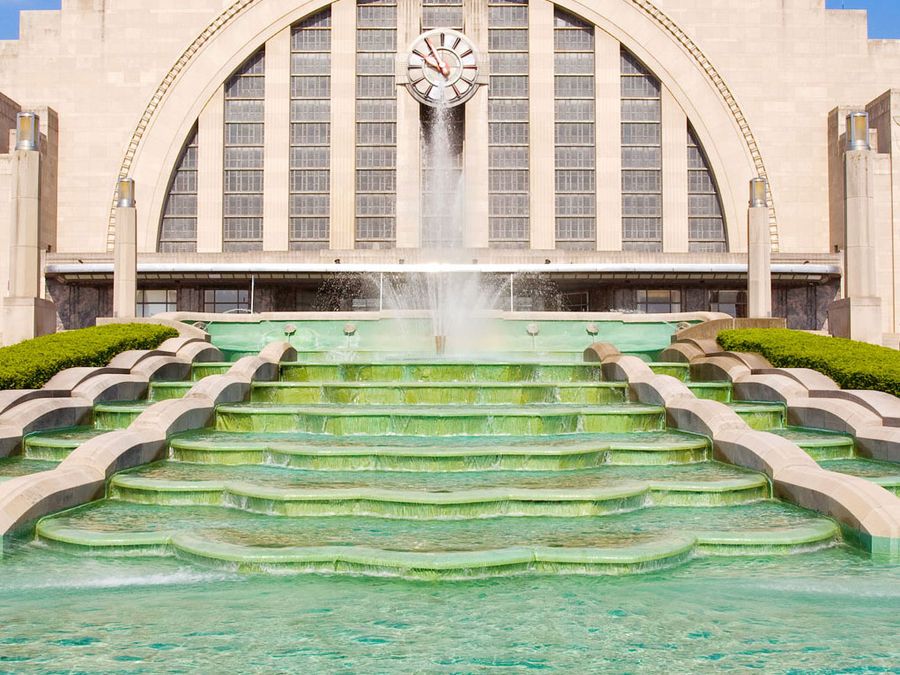
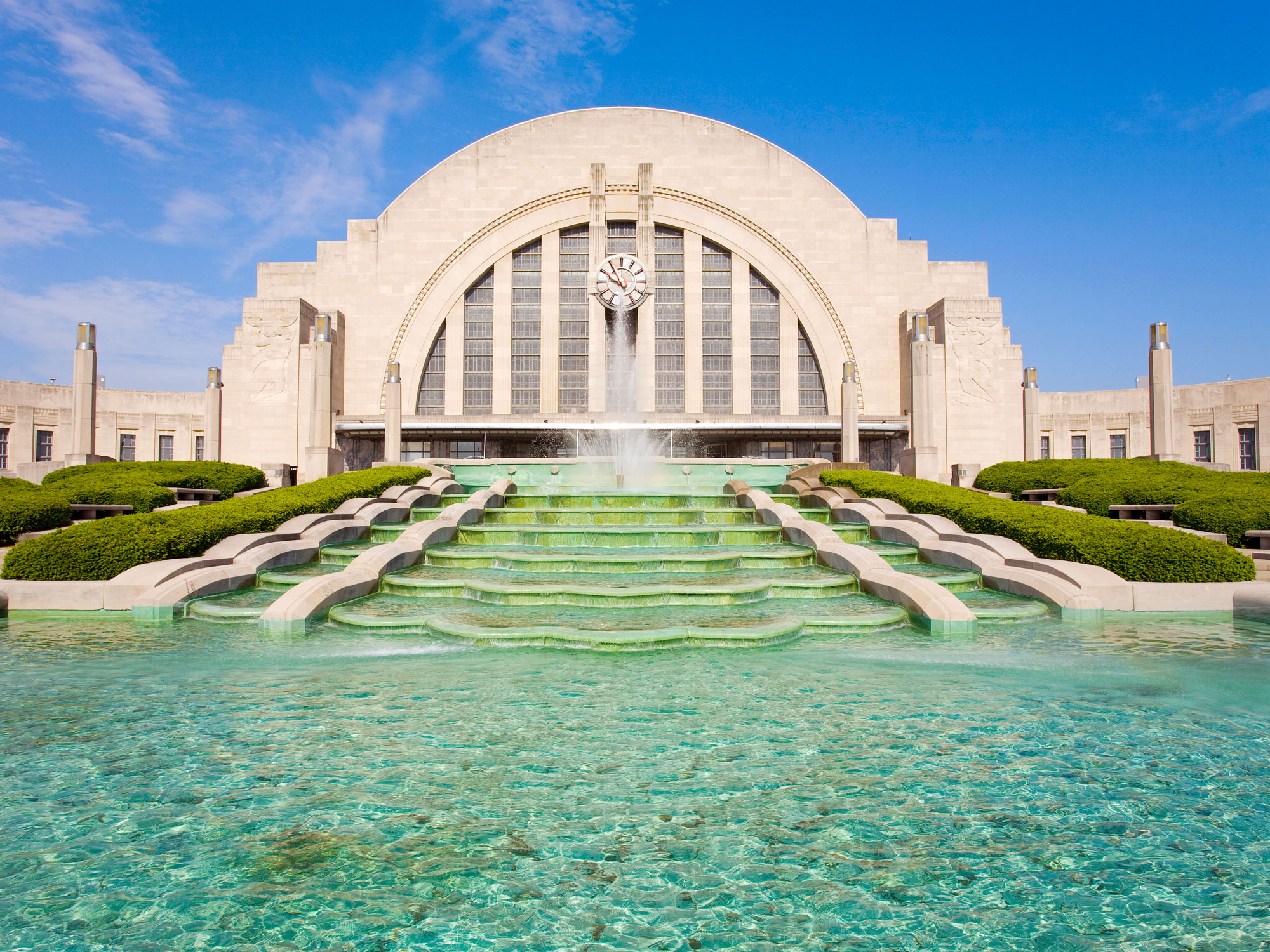
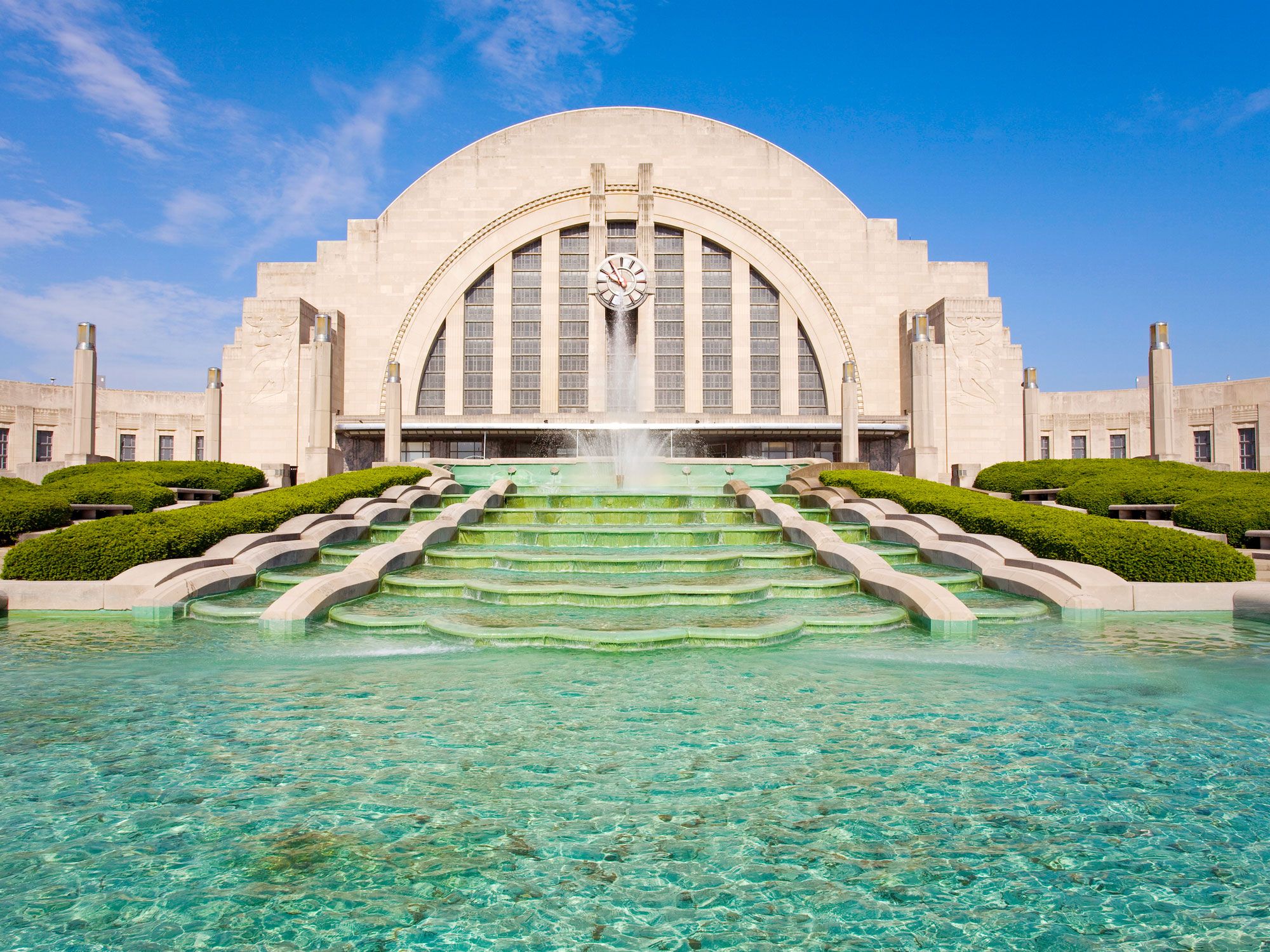
A masterpiece in Art Deco architecture, the Cincinnati Union Terminal was constructed between 1929 and 1933. Now a National Historic Landmark, it is considered to be one of the last great American railway stations to be built. The most famous feature of the terminal is its 10-story, half-domed limestone entrance, which was the largest in the world at the time of opening and remains the second-largest today. Although passenger service ceased in 1974, the railway station was revived in the 1990s as an Amtrak station. It also currently houses the Cincinnati Museum Center, home to a history museum, a children’s museum, and an OMNIMAX theater.
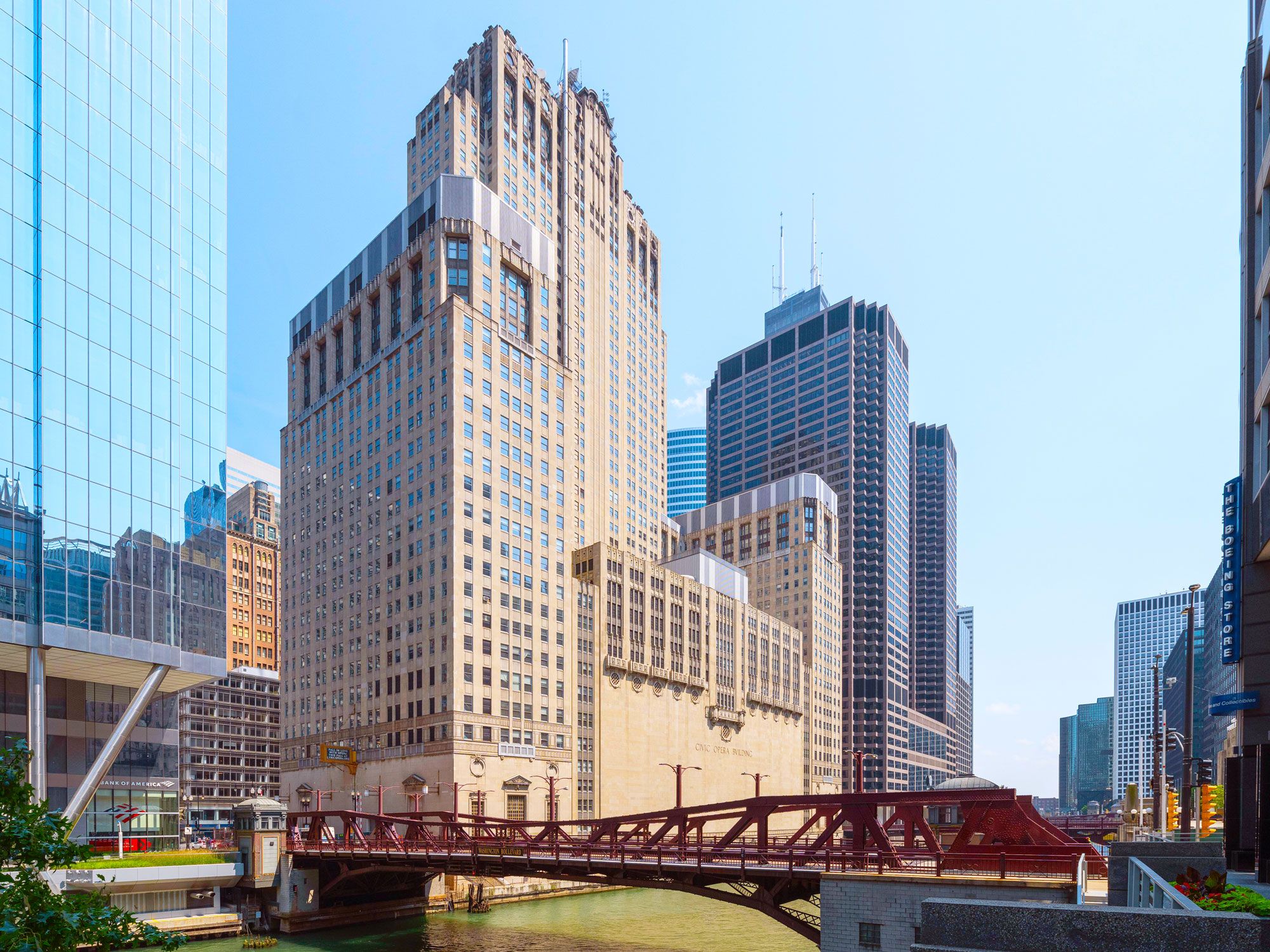
The Civic Opera House in Chicago, Illinois, has remained a shining example of Art Deco architecture since it was built nearly a century ago. Currently housing the Lyric Opera of Chicago, the building opened a mere six days after the 1929 stock market crash and has since been home to various opera companies. The building’s impressive Art Deco facade is constructed of limestone, with two wings flanking a 45-story tower. The interior showcases the geometric shapes and lines associated with classic Art Deco, while also incorporating touches of Art Nouveau in the Comedy-tragedy masks and cornucopias found near the entrances.
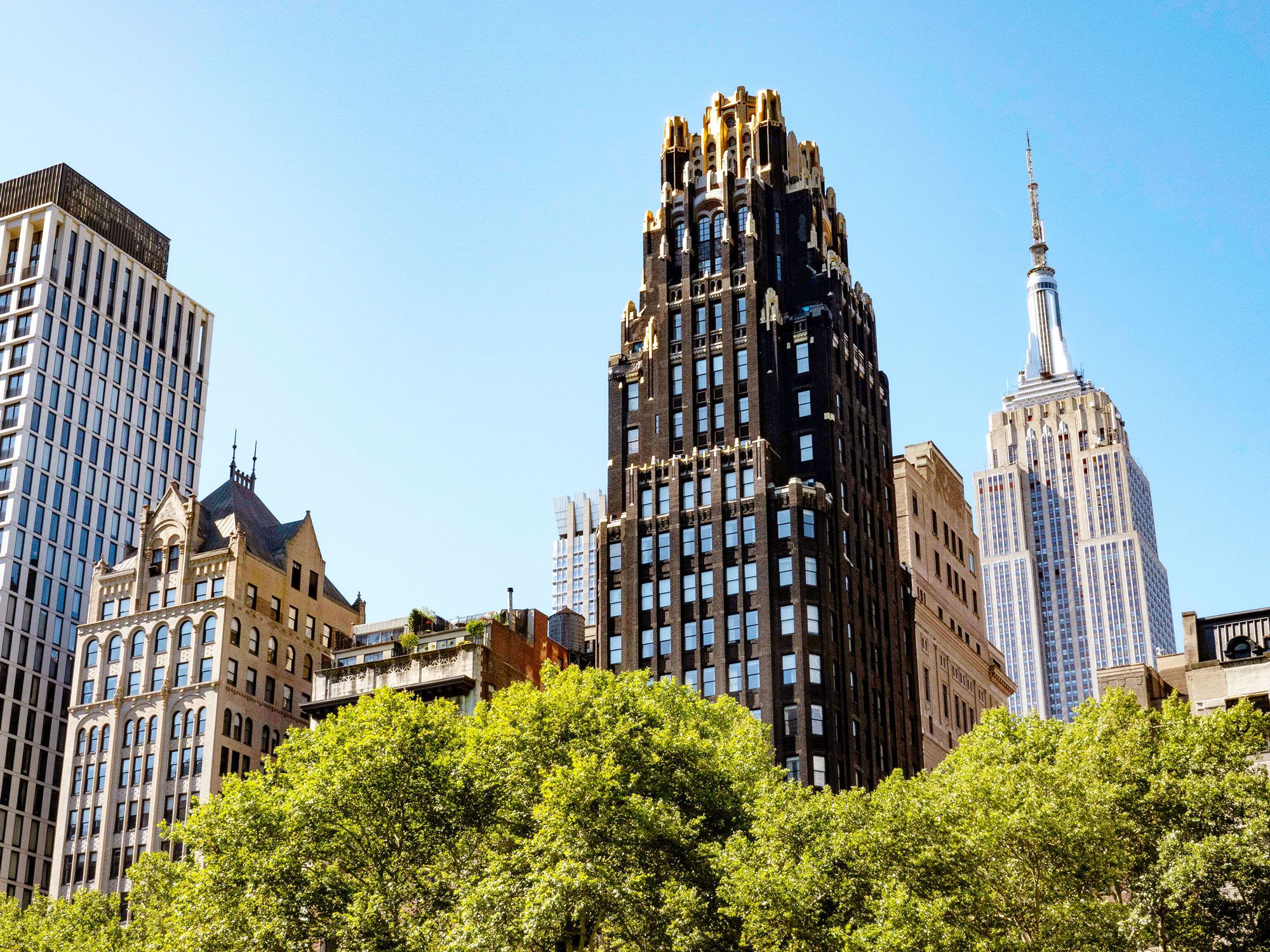
Constructed at the height of the Roaring 20s, the American Radiator Building is another remarkable example of Art Deco architecture. With its black facade, bronze accents, and Gothic pinnacles, the 23-story tower has been a midtown Manhattan landmark since it opened in 1924. The building is not just beloved by pedestrians passing by, but also famous creatives — artist Georgia O’Keefe was once so moved by the dramatic building that she painted a beautiful rendition of the skyscraper in a 1927 piece called Radiator Building at Night. Today, the skyscraper is home to the Bryant Park Hotel.
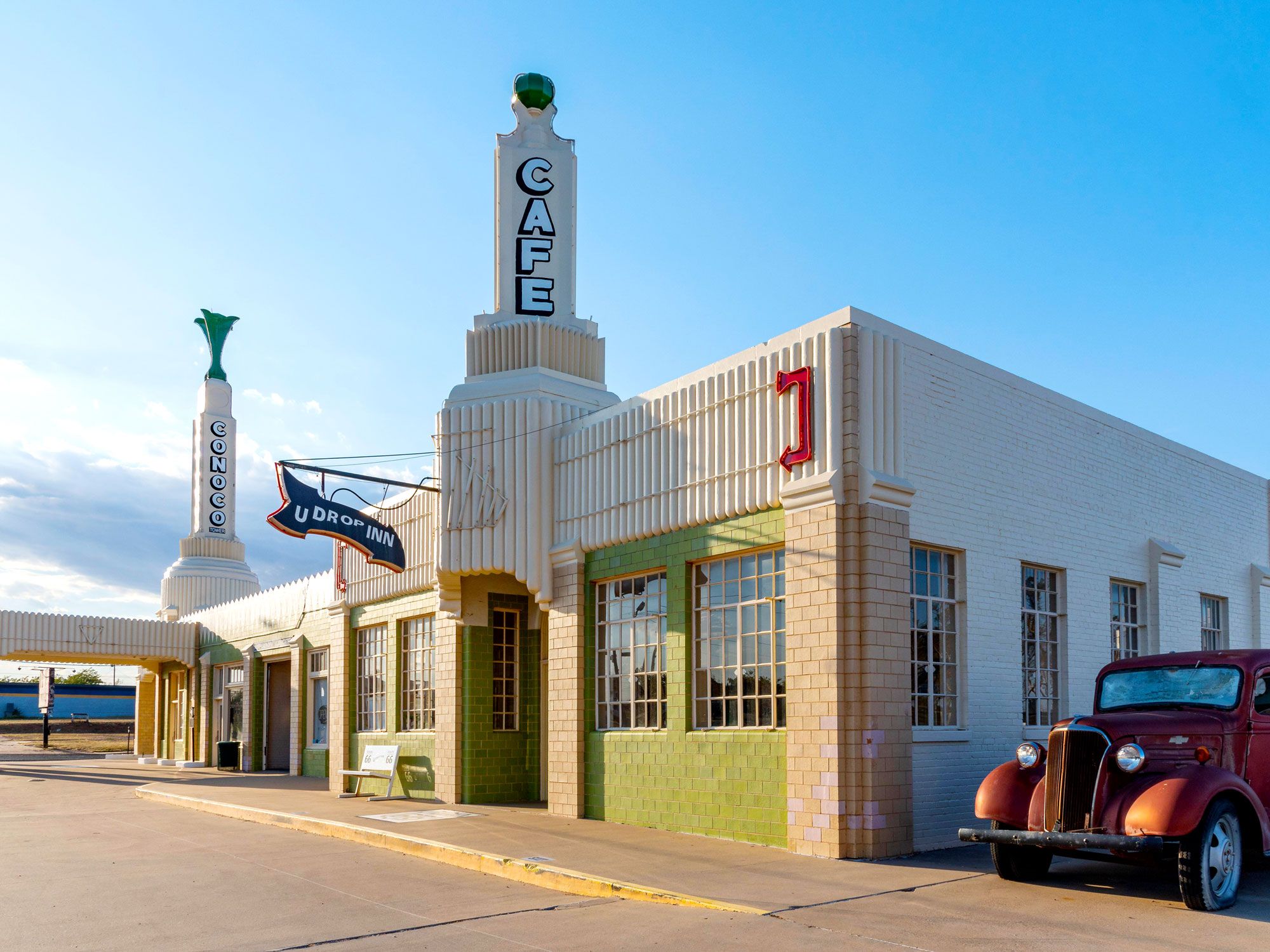
Located on the historic Route 66, a highway built in the 1920s to connect the Midwest and California, the U-Drop Inn and Cafe was once a well-known roadside stop — providing food, gas, and lodging to travelers. It was built in 1936 for $23,000 (equivalent to over $500,000 today), and the structure’s unique design — with its decorative towers, geometric details, and symmetrical facade — was a welcome addition to this small city in northern Texas. The building still stands today, operating as a visitor center, community center, and chamber of commerce office.
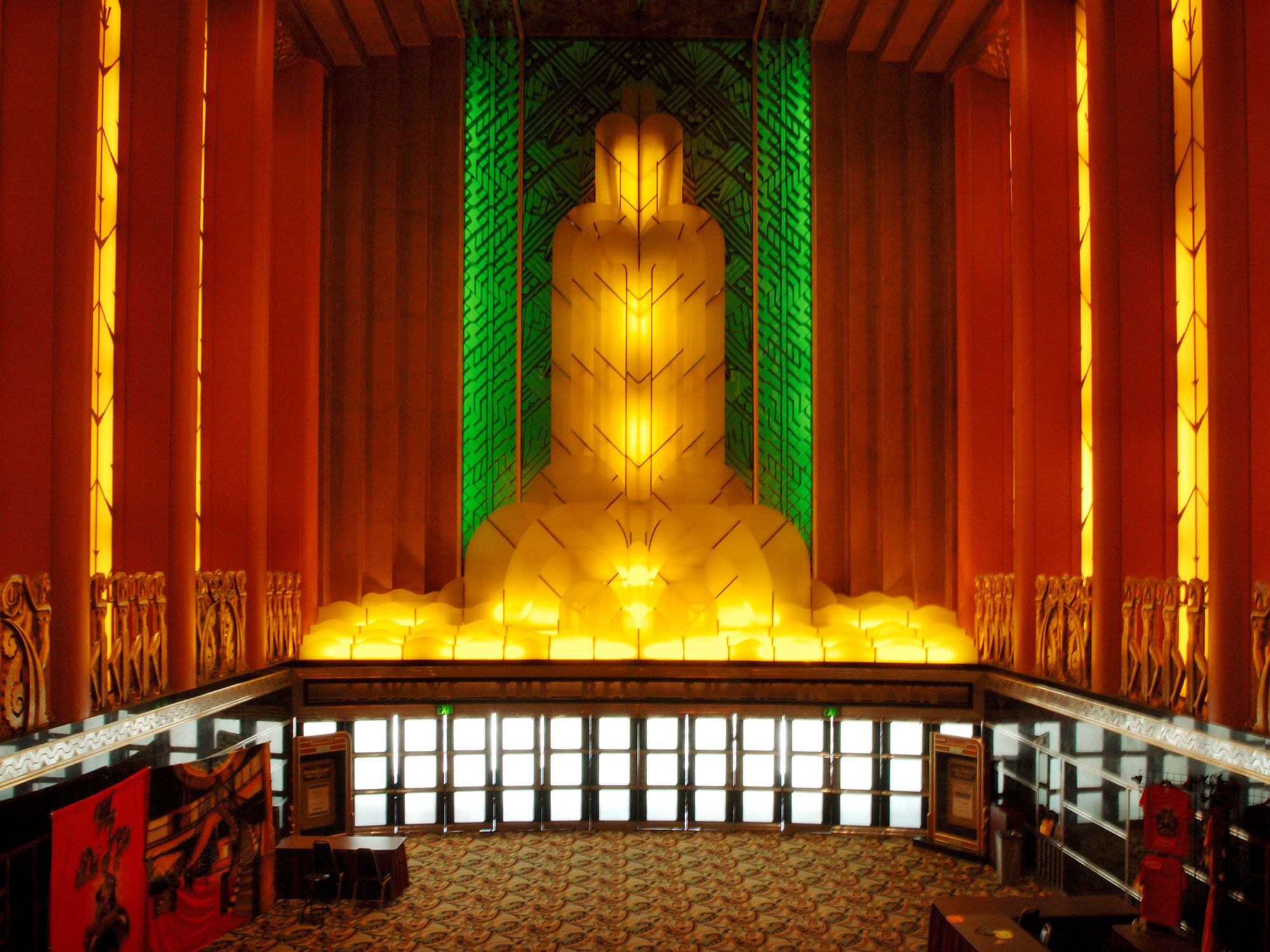
The Paramount Theater opened its doors in 1931 and has since been celebrated as one of the finest examples of Art Deco architecture in the country. Designed by Timothy L. Pflueger, a renowned San Francisco architect, the theater features intricate mosaic patterns, gold accents, and bas-relief sculptures that create a visually stunning interior. The design also includes individual work from various artists, including muralists, sculptors, and painters, a nod to San Francisco’s creative scene. Despite tough years at the onset, the Paramount Theater survived the Great Depression and remains open today, hosting events and speakers year-round.
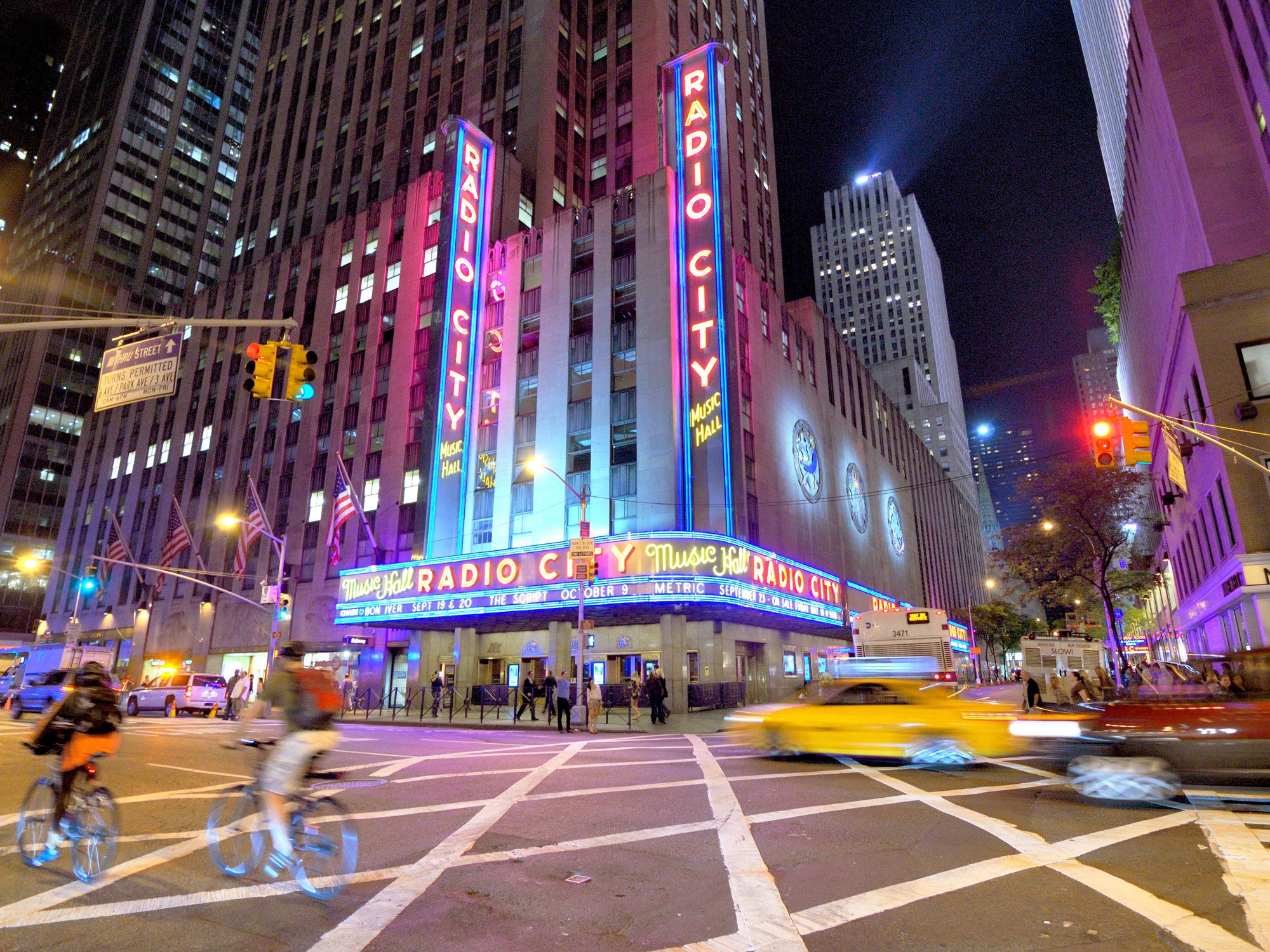
When Radio City Music Hall opened its doors in 1932, it became the largest indoor theater in the world. Nine decades later, the iconic Manhattan music venue still retains its title — and its unmistakable Art Deco style. Despite finishing the building in the early years of the Great Depression, its financier John D. Rockefeller Jr. ensured no corners were cut during the massive build. Radio City is home to the legendary Radio City Rockettes, and its interior features lavish design elements, including a four-story foyer, a 10,000-square-foot stage, and elaborate gold arches. Often touted as the “Showplace of the Nation,” Radio City hosts weekly tours and events.
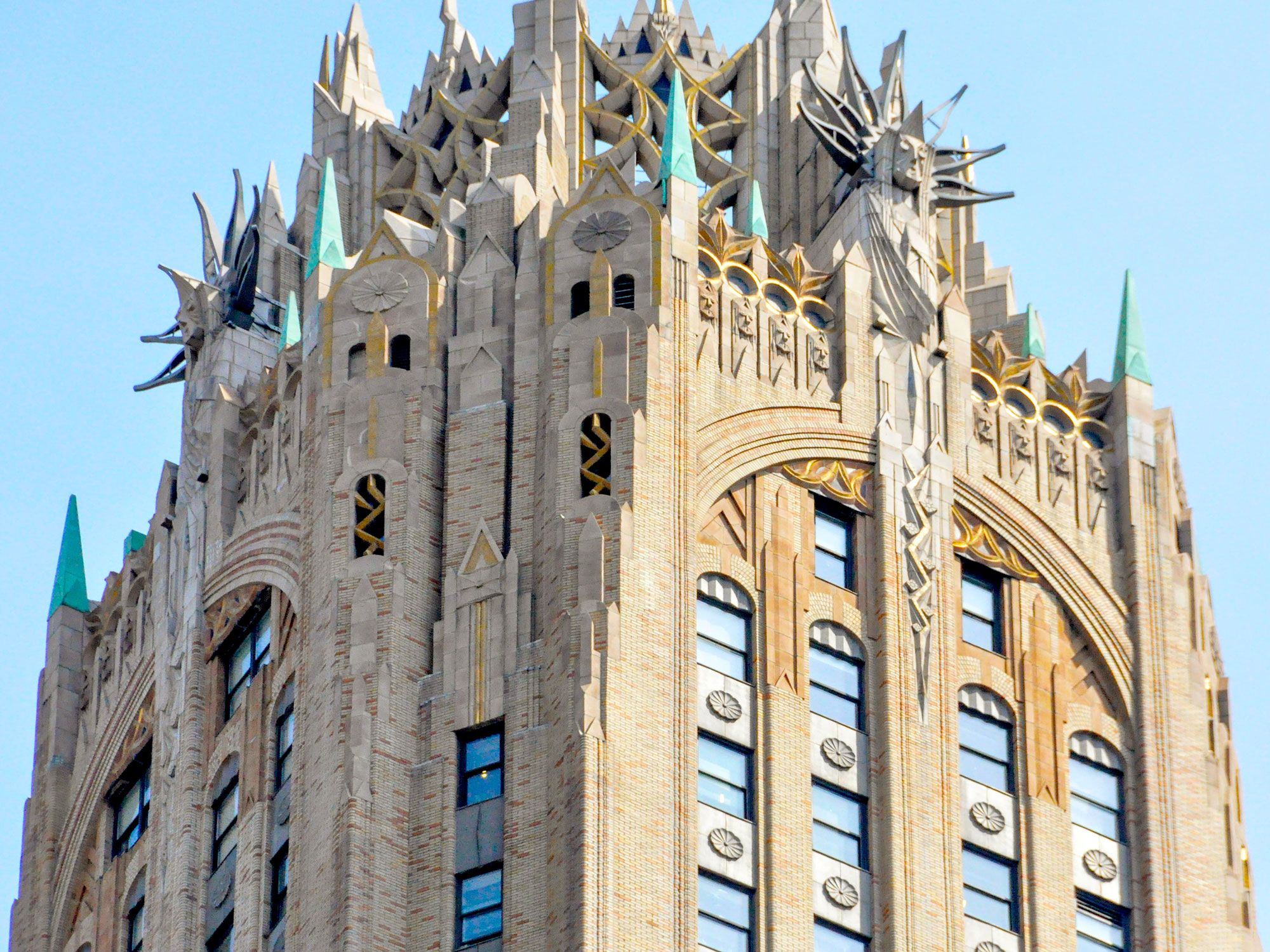
Considered to be one of the most impressive skyscrapers of its era, the General Electric Tower was completed in 1931. Designed by John W. Cross, the Art Deco tower was originally built for the Radio Corporation of America before being handed over to its parent company, General Electric. The towering facade was inspired by its radio roots, with a dramatic lightning bolt design meant to represent wireless communications, while the lobby features Art Deco-inspired patterns and arches. The landmark office building still stands at 570 Lexington Avenue in midtown Manhattan and is open to visitors.
Advertisement
More from our network
Daily Passport is part of Inbox Studio, an email-first media company. *Indicates a third-party property.
Escape the Crowds at These Under-the-Radar Mediterranean Islands
By
Sarah Etinas
Read time: 3 minutes
August 11, 2023
Updated: August 11, 2023
Escape the Crowds at These Under-the-Radar Mediterranean Islands
Geography •August 11, 2023•Updated: August 11, 2023
By Sarah Etinas
You may be familiar with the likes of Ibiza, Santorini, Sicily, and Cyprus, but they are just a handful of the over 150 islands found in the Mediterranean Sea. And while the largest islands such as these have already made names for themselves as tourist hot spots, there are still quite a few unique Mediterranean Islands that have managed to fly under-the-radar, despite their distinctive geographical features and interesting histories. From islands that are home to pink sand beaches to ones with caves frequented by pirates, these are three under-the-radar Mediterranean Islands to know about.
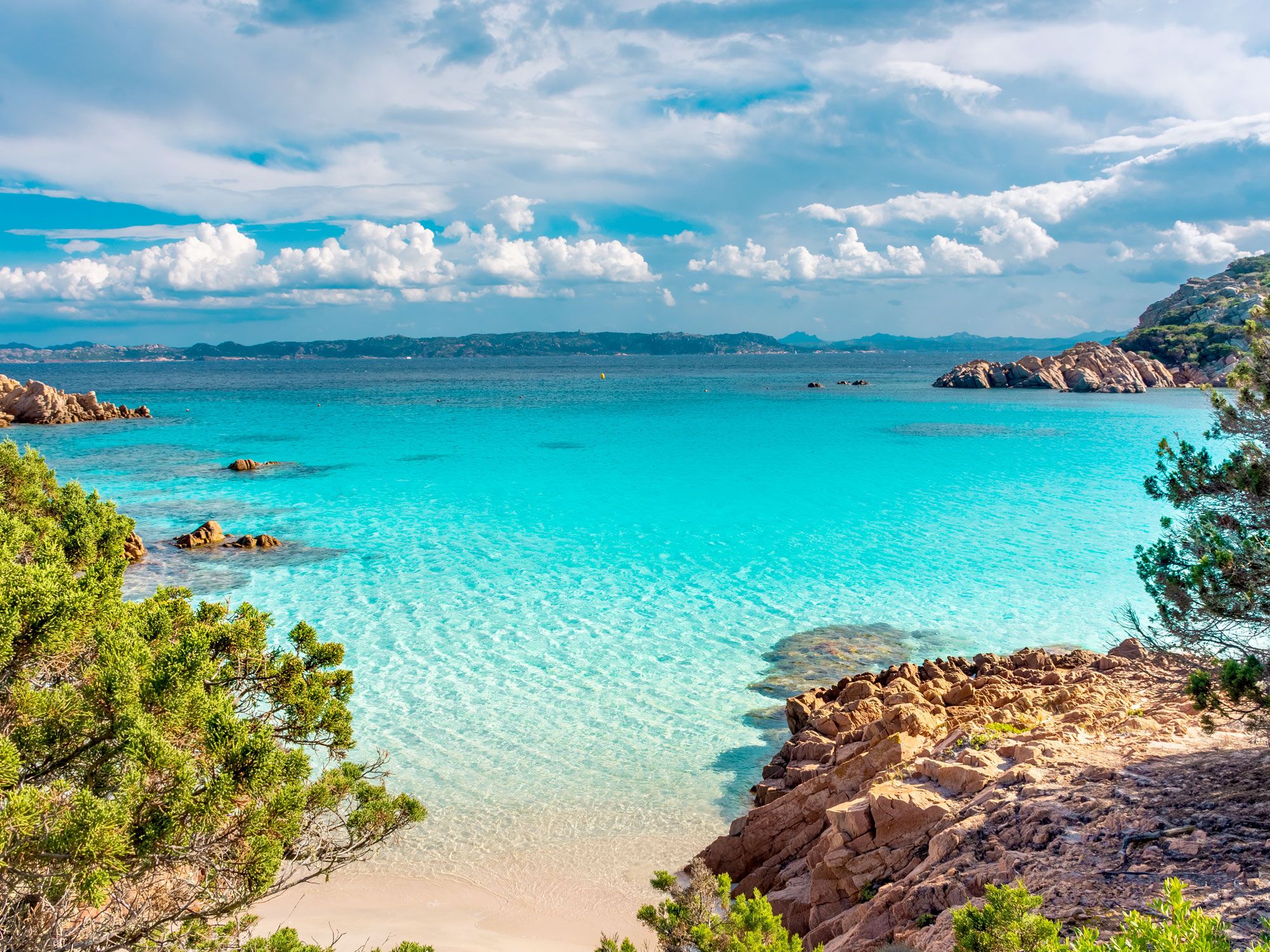
From Spain to Egypt, golden sand beaches line the vast majority of the Mediterranean — but there are a handful of pink sand beaches hidden amongst them. Spiaggia Rosa, which translates to “pink beach” in Italian, gets its stunning pink hue from a microorganism called Miniacina miniacea. These naturally reddish and pinkish foraminifera (or single-celled organisms with shells) are actually common all around in the Mediterranean but particularly in the waters near Budelli.
From the 1970s into the early 1990s, tour boats would take visitors to this uniquely colored beach. Unfortunately, many of these tourists would take some of the pink sand home, and the shoreline quickly became less and less pink. In the 1990s, the government closed off access to Spiaggia Rosa to preserve the pink sand that remained and give nature a chance to create some more. Until 2021, the only person who could access the beach was a man named Mauro Morandi, the island’s unofficial caretaker.
Today, Spiaggia Rosa remains completely untouched, and the only way to see this pink sand beach is by sailing past it. Through these precautionary measures, Spiaggia Rosa will remain pretty-in-pink for years to come.
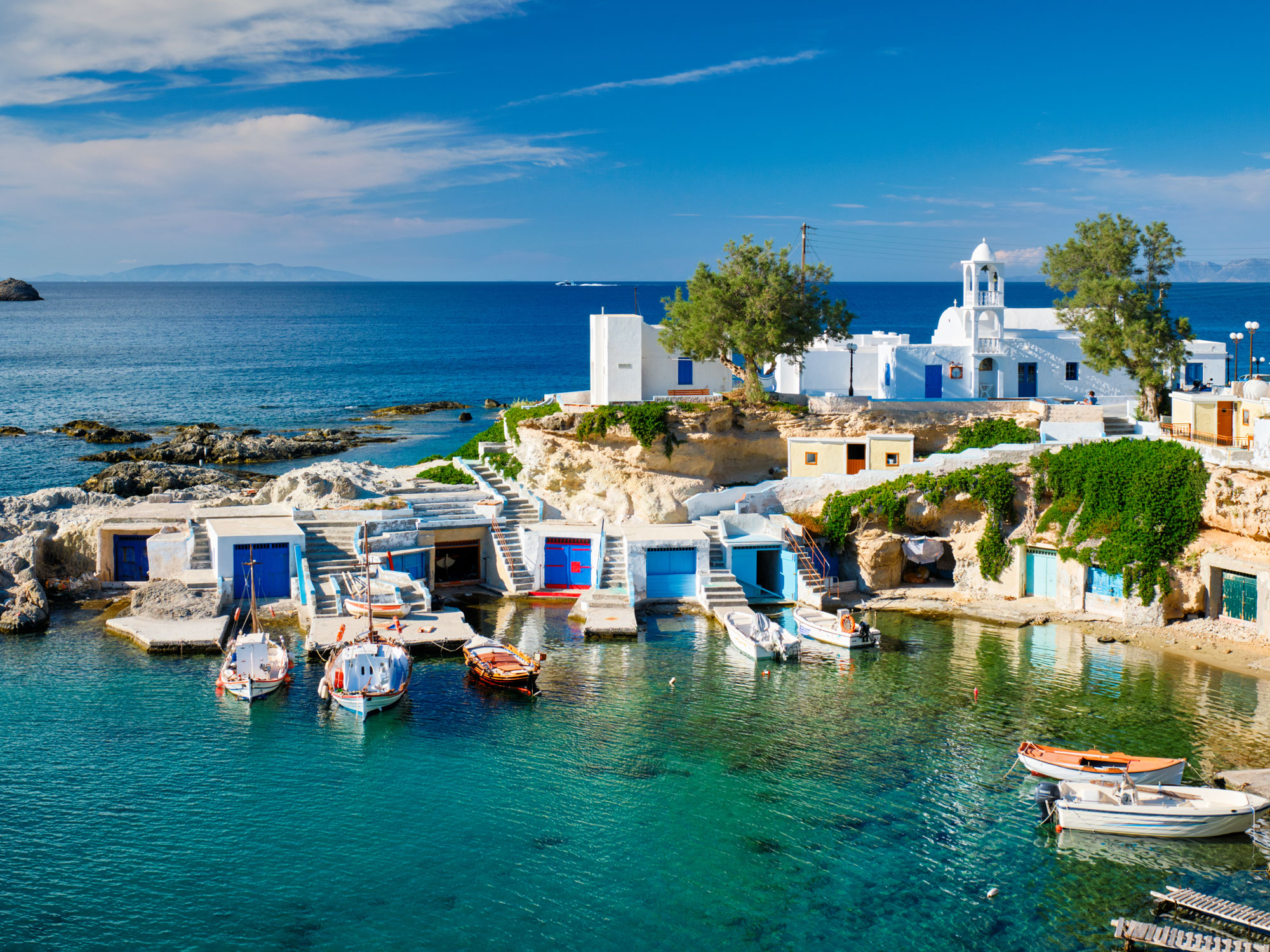
Swashbuckling pirates sailed their way around the Mediterranean for thousands of years, so it should come as no surprise to find out that there were once pirate hotspots all around South Europe and North Africa. And a particularly popular pirate homebase was the island of Milos, Greece.
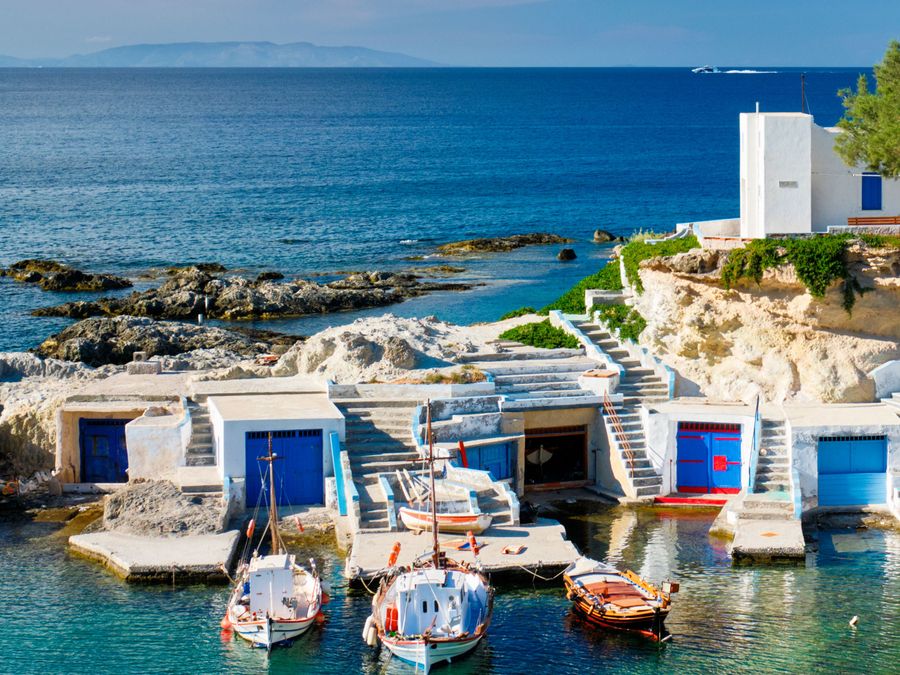
Milos is home to an eye-catching landscape of turquoise waters and waterfront white cliffs filled with caves. These hidden caverns were prime locations for pirates from all around the region — including Venetian, Corsican, Berber, and Saracen pirates — to set up their ambushes against trade vessels from at least the fifth century BCE to around the 15th century.
While there were quite a few cave areas that the pirates used as their homebase, Kleftiko Bay was a favorite, thanks to the ideal cave positions. It was easy enough for pirates to hide away here, often for days on end, until the perfect moment presented itself. Then, they would plunder unsuspecting merchant ships for valuable goods. Fortunately, Milos’ caves are no longer filled with gold-hungry pirates. Thanks to strong government policies, piracy in the Mediterranean officially came to an end in the 19th century, and today the island makes for a scenic (and historic) under-the-radar Mediterranean getaway.
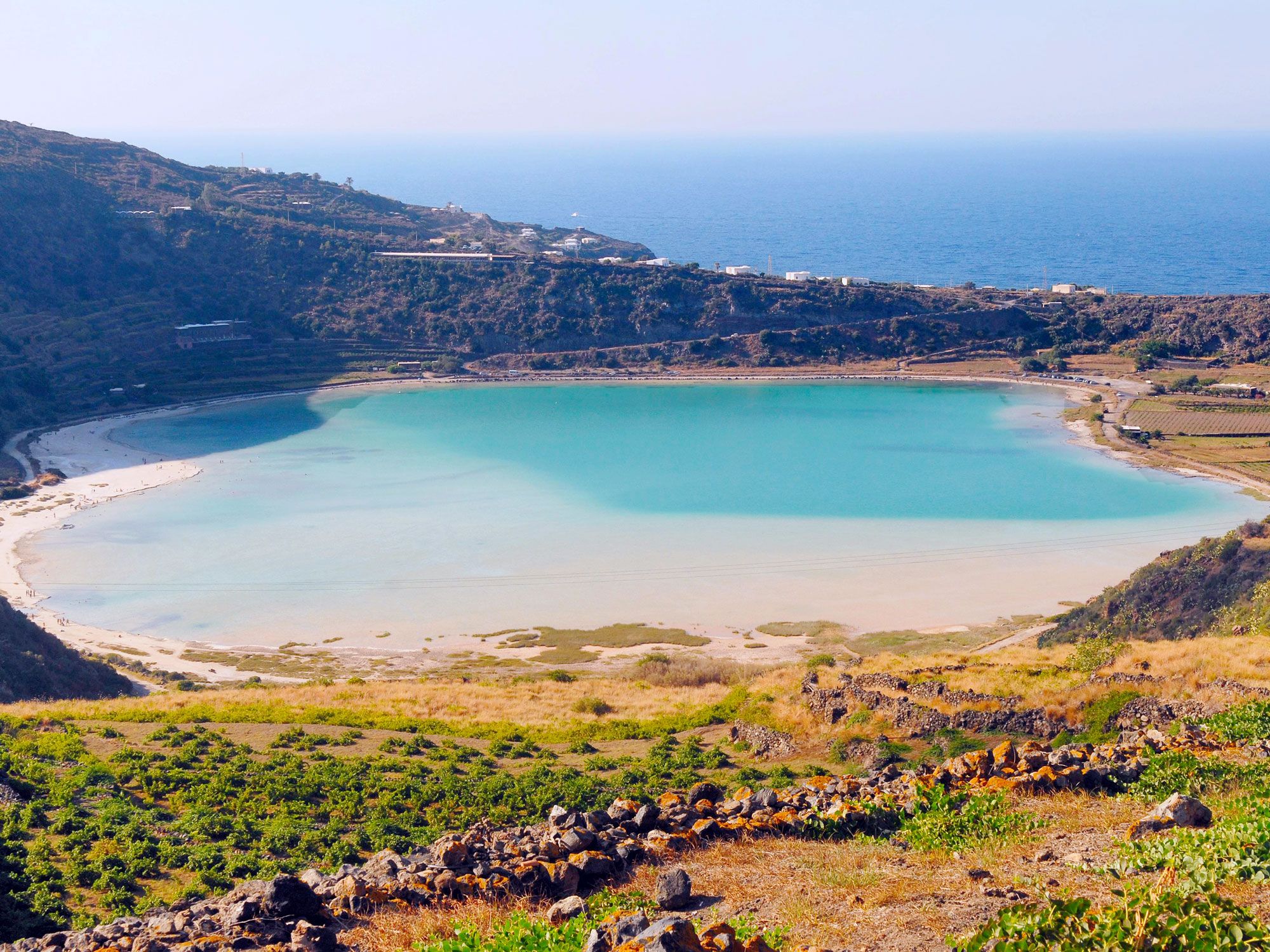
Located in the Strait of Sicily between Italy and Tunisia, the island of Pantelleria, Italy is an architectural gem. Though constructing buildings on a remote island can be challenging, the people of Pantelleria made it work through the one-of-a-kind design of the dammusi.
Dammusiare sturdy, single-story dome homes made of rocks naturally found on Pantelleria. In the earliest buildings from the 10th century, the stones for the Arab-inspired dammusi were shaped and wedged together without using any sort of mortar (since it wasn’t readily available).
Originally, dammusi were built and used by workers who had to move from one part of the island to another, depending on what season it was and which of their crops needed to be tended to. But today, these unique buildings have gotten a status upgrade, as several wealthy vacationers (including Giorgio Armani) have purchased upgraded dammusion Pantelleria as vacation homes.
Advertisement
More from our network
Daily Passport is part of Inbox Studio, an email-first media company. *Indicates a third-party property.
Architecture •August 11, 2023•Updated: May 29, 2024
By Julia Hammond
Author
Julia Hammond
Julia is a U.K.-based travel writer whose work has been featured in The Independent, The Telegraph, The New Zealand Herald, and Culture Trip, among others. She’s an enthusiastic advocate for independent travel and a passionate geographer who has had the privilege of traveling to more than 130 countries in search of a story.
The five-digit ZIP code used in the US was rolled out nationwide in 1963. ZIP — which stands for zone improvement plan — codes enable mail to be sorted and delivered more accurately and efficiently. The U.S. Postal Service typically allocates ZIP codes to cities and communities, according to geography and population. But there are also unique ZIP codes that apply only to a single building, institution, company, or government department. Let’s take a look at five notable U.S. buildings that have been allocated their own ZIP codes.
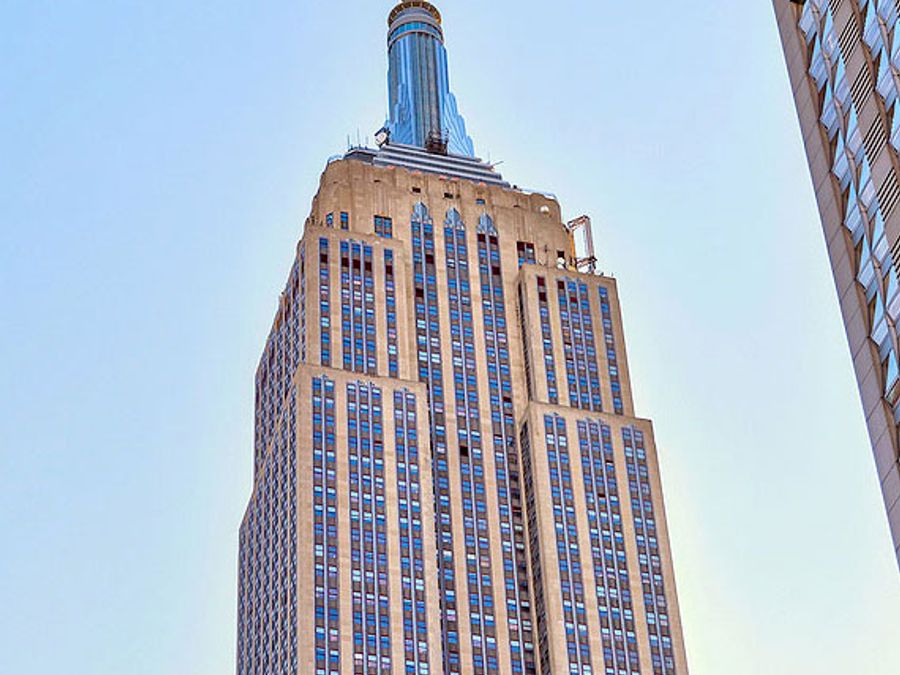
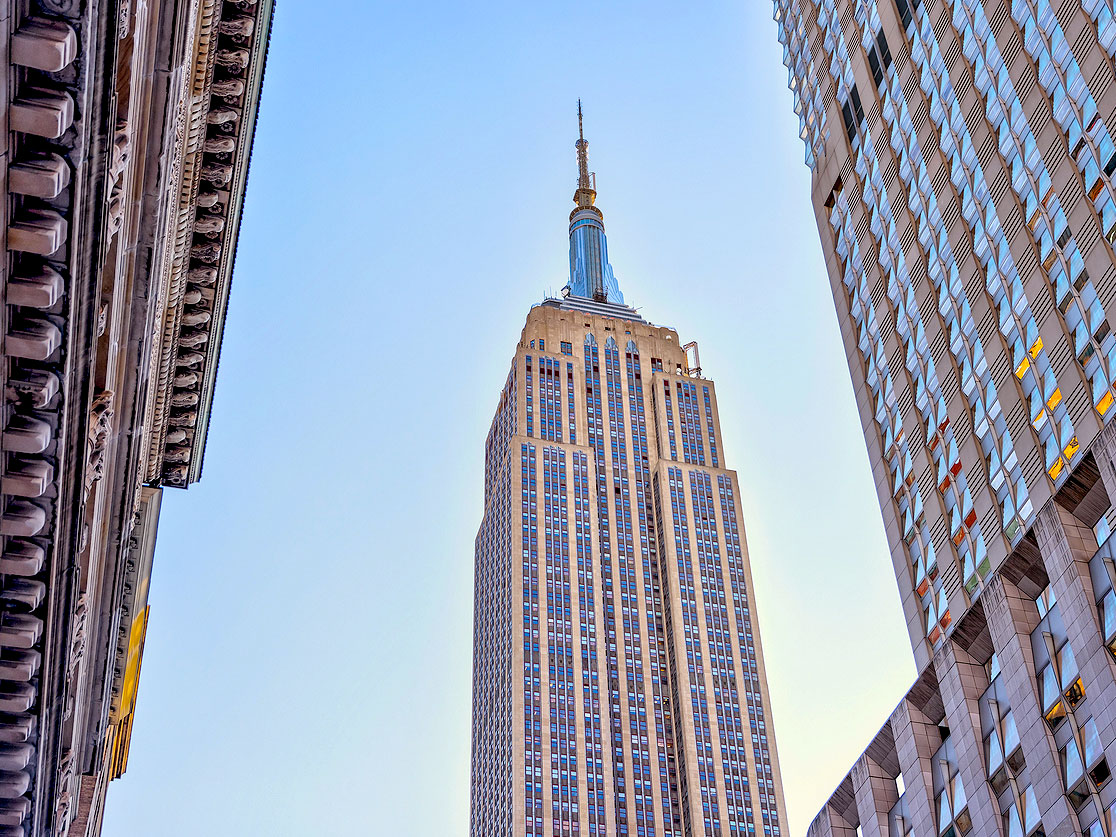
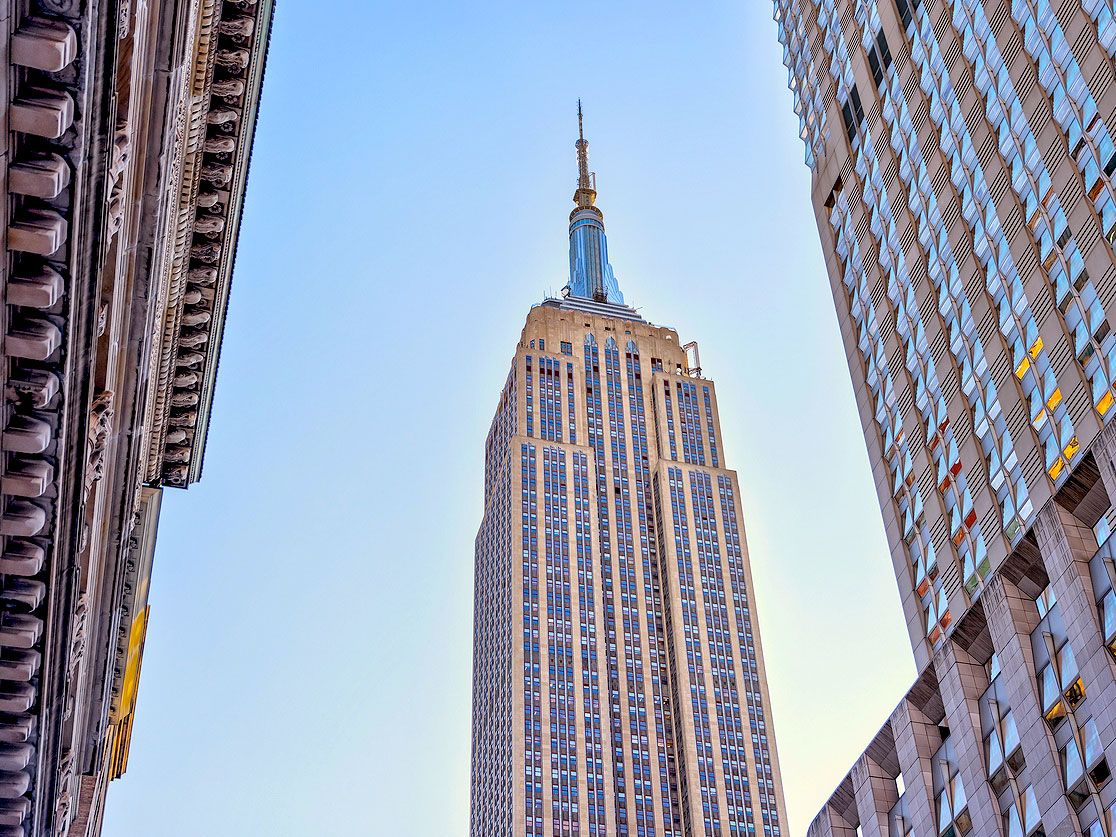
Several skyscrapers in Manhattan’s Midtown or Financial District have been assigned a unique ZIP code because of the high volume of mail they receive, and the Empire State Building is one such example. When the monumental Art Deco skyscraper was finished in 1931, its 102 floors were a groundbreaking achievement, and people flocked to ascend what was then the world’s tallest building.
Today, numerous companies occupy the more than 2.8 million rentable square feet of its commercial floors. They all receive a lot of mail. As a result, the Empire State Building is the only place in New York to have the ZIP code 10118. Over in Chicago, the same is true for Willis (originally Sears) Tower — there, you’d need to use the ZIP code 60606.
President George Washington picked the site for the White House in 1791, and John Adams was the first President to move in before the building was even completed. If you’re looking to send a letter to the current President (though email is preferred), the address is: The White House, 1600 Pennsylvania Avenue, N.W., Washington, D.C. 20500.
Various four-digit suffixes can be added to this primary ZIP code to reach a more specific addressee. You might use 20500-0001 for the President, for instance, or 20500-0002 for the First Lady. Several previously allocated White House ZIP codes are no longer in use. For instance, when former First Lady Hillary Clinton was in office, she could be reached by using the ZIP code 20500-0030. Back then, even Socks the Cat had his own code — fans could have written to the Clinton’s lovable pet at 20500-0010.
In 1889, Thomas Edison based his Edison General Electric Company in Schenectady, New York. When the company merged with the Thomson-Houston Electric Company to form General Electric three years later, the headquarters initially remained Upstate. The company later moved its headquarters to New York City, but the plant — and its iconic monogram logo — have remained Schenectady’s most recognizable landmark.
The plant also has one of the most easily memorized ZIP codes in the country: 12345. Early on, the company was inundated with mail, so the U.S. Postal Service assigned them a different ZIP code than the rest of Schenectady. In 2020, the memorable ZIP code was the subject of a question on Jeopardy, though thecontestant unfortunatelyanswered incorrectly. Coincidentally, many children write the 12345 ZIP code on their letters to Santa Claus, so during the holidays, the company fields a team of volunteers to reply on Santa’s behalf. Templates are used to save time, but each response is personalized.
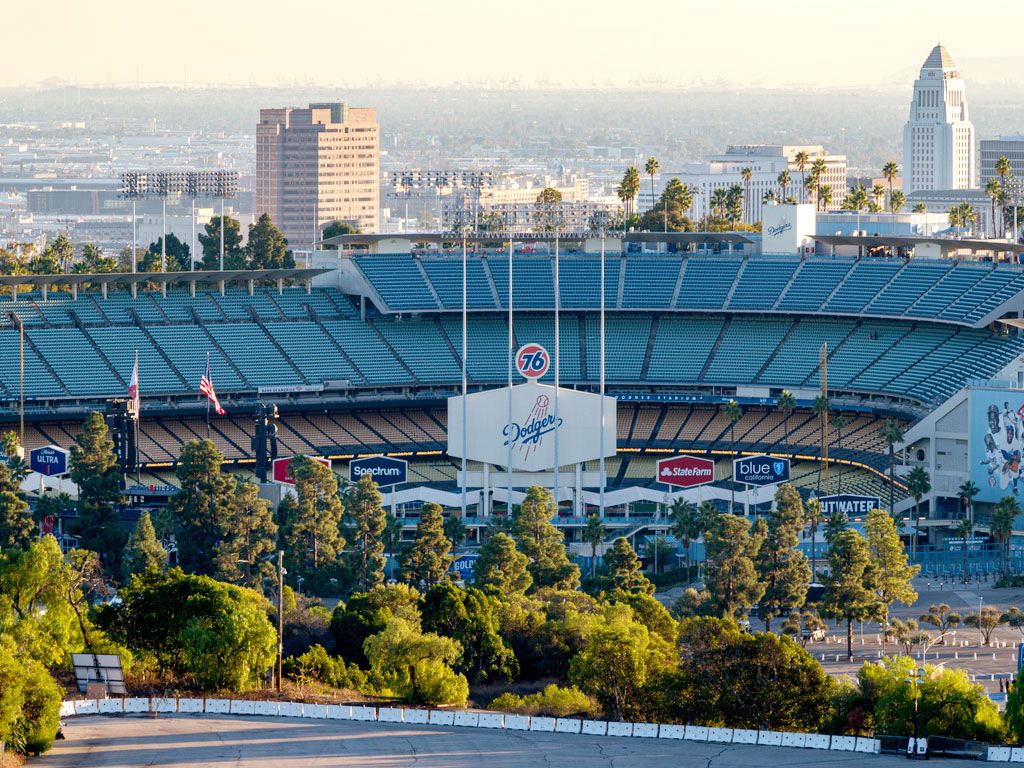
Dodger Stadium in Los Angeles is the nation’s third-oldest Major League Baseball stadium. When it was built between 1959 and 1962, the hills and houses of the surrounding Chavez Ravine neighborhood were flattened to make space. In June 2009, Dodger Stadium became the first sports venue in the U.S. to have its own ZIP code. (Houston Astrodome was allocated a unique ZIP code, 77230, while it housed evacuees from Hurricane Katrina in 2005, but this was only temporary.)
Prior to the change, in October 2008, the L.A. City Council designated the property as Dodgertown. The following year, 90090 replaced the existing ZIP code, 90012, which had been shared with other buildings in the local area. In honor of the occasion, Los Angeles Postmaster Mark Anderson threw the first pitch before the game against the Philadelphia Phillies kicked off.
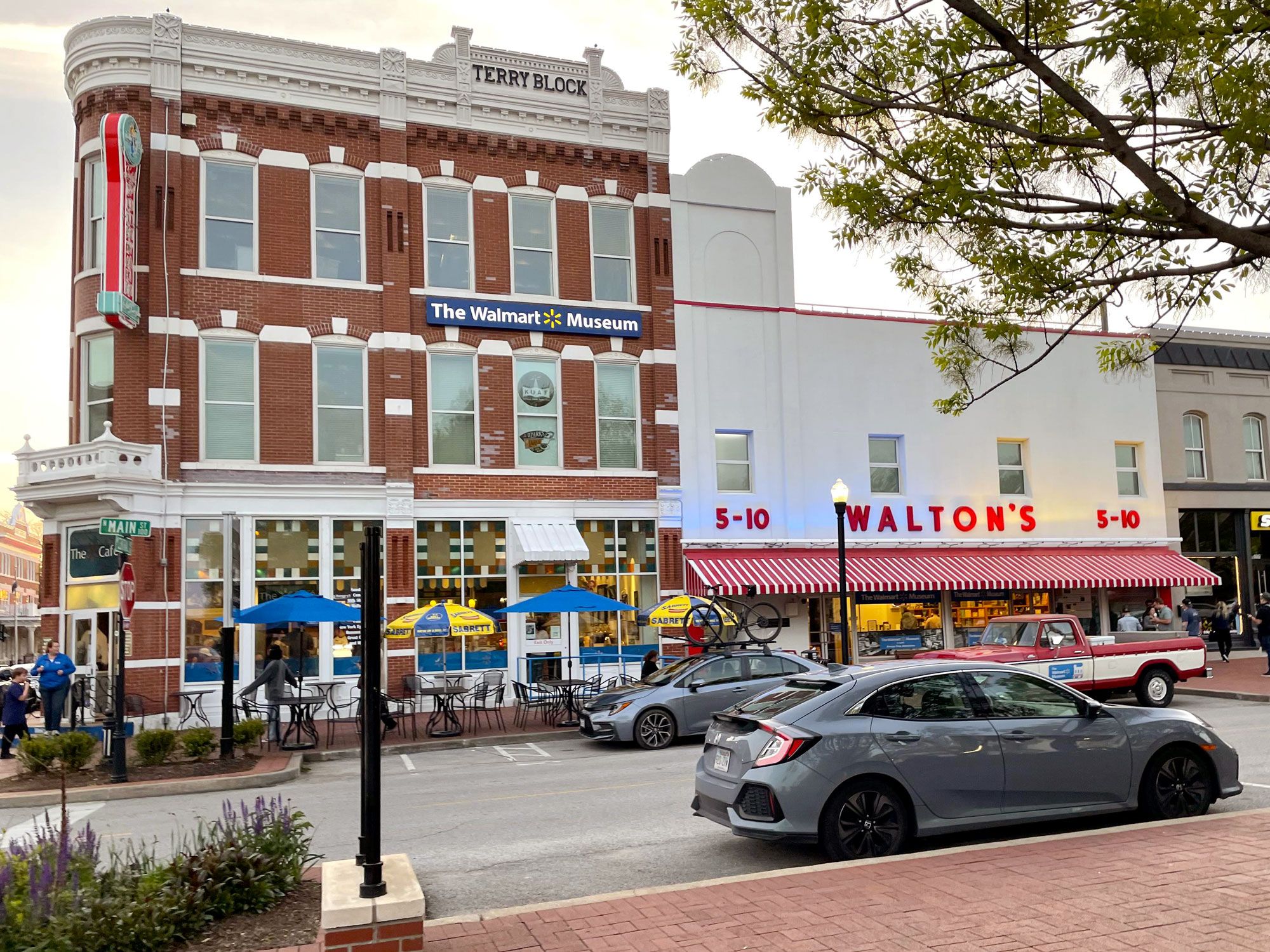
Retail is another industry where you’ll find businesses large enough to require a unique ZIP code. Retail giant Walmart is headquartered in Bentonville, Arkansas, and there’s even a museum dedicated to the company’s history in the city. In 1962, company founder Sam Walton opened his first store in Rogers, a few miles outside Bentonville. The company expanded rapidly; by the end of the decade, it had opened 18 Walmart stores (and a further 17 Ben Franklin stores) under its umbrella.
Today, Walmart is a global company with over 11,000 branches in 28 countries. For an organization of that size, it makes sense that the volume of mail at its headquarters would warrant a unique ZIP code, in this case 72716. The company is in the process of constructing Walmart Home Office, a sprawling new campus covering about 350 acres of land previously used for Walmart offices and warehousing.
Advertisement
More from our network
Daily Passport is part of Inbox Studio, an email-first media company. *Indicates a third-party property.
Discover Why These 6 Fascinating Landmarks Remain Unfinished
By
Daily Passport Team
Read time: 7 minutes
August 10, 2023
Updated: August 11, 2023
Discover Why These 6 Fascinating Landmarks Remain Unfinished
Architecture •August 10, 2023•Updated: August 11, 2023
By Daily Passport Team
Author
Daily Passport Team
Daily Passport writers have been seen in publications such as National Geographic, Food & Wine, CBC, Condé Nast Traveler, and Business Insider. They're passionate about uncovering unique destinations and sharing expert tips with curious travelers.
Some famous landmarks are still evolving. From a memorial slowly emerging from the Black Hills of South Dakota to a cathedral under construction for more than 125 years, unfinished buildings and monuments hold a particular fascination — inviting visitors to envision them as they someday could be. Discover the fascinating reasons these six incredible landmarks around the world remain under construction.
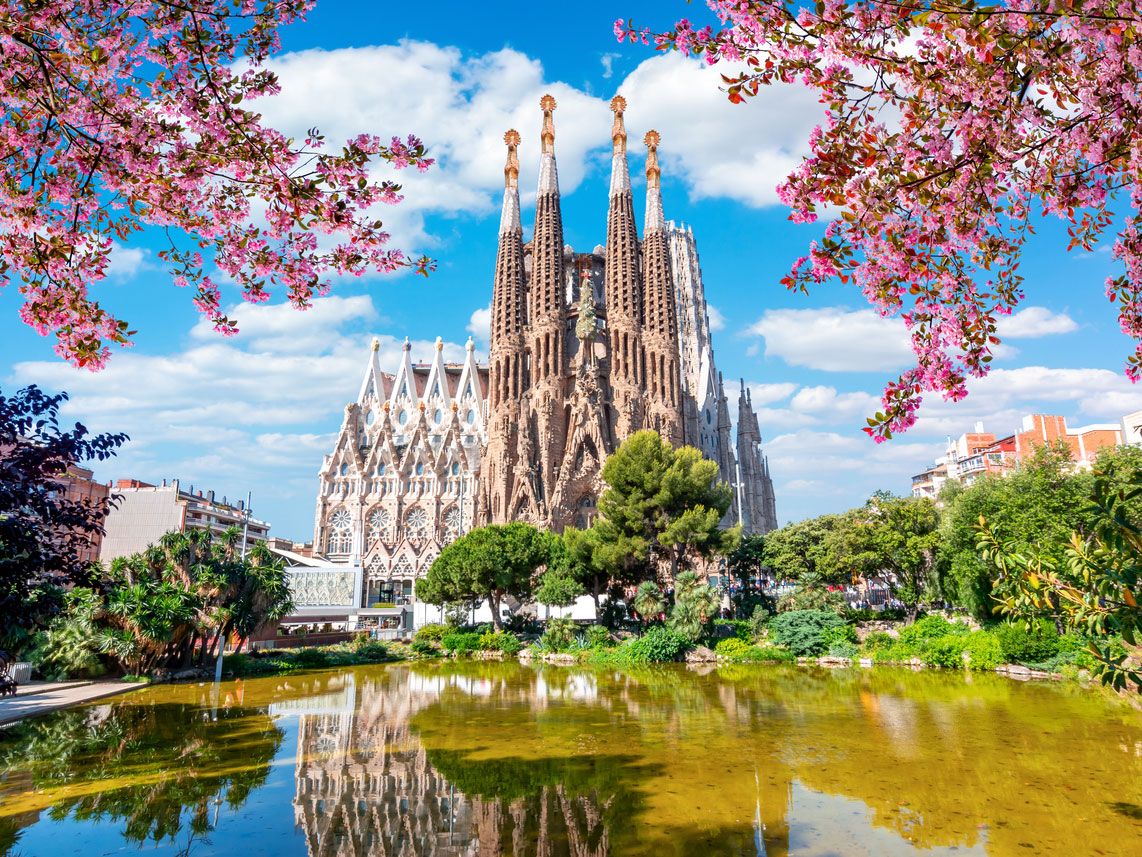
Antoni Gaudí, the visionary architect behind many of Barcelona’s most celebrated buildings, was hired to take over the construction of the city’s Roman Catholic basilica in 1883 when he was only 31 years old. From that time until his sudden death in 1926, Gaudí lovingly labored on the building, his masterwork. The cathedral’s exterior features a magical collection of drip-castle spires; on the inside, intense beams of sunlight filter through stained glass to illuminate a forest of columns.
Gaudí was legendarily whimsical — sometimes changing a design simply because he’d become enamored of a particular stone from a quarry. Gaudí made sketches and plaster models of his vision — some were even large enough to walk through. These had to suffice for the engineers and architects who took over the project when he died with only less than a quarter of the construction completed and no explicit plans. A current architect on the project, Jordi Faulí, told “Time”magazine, “Gaudí left us the path. Sometimes, though, we’ve had to work hard to find it.”
Over 4 million visitors come to La Sagrada Familia each year. The nave was finished and consecrated by the pope in 2010. Hundreds of workers arrive daily to the site to put the finishing touches on the church, which is expected to be completed in 2026 — just in time for the centenary of Gaudí’s death. However, after a century of delays from war, economic hardship, and pushback from the diocese and the local residents, that date may be pushed back yet again.
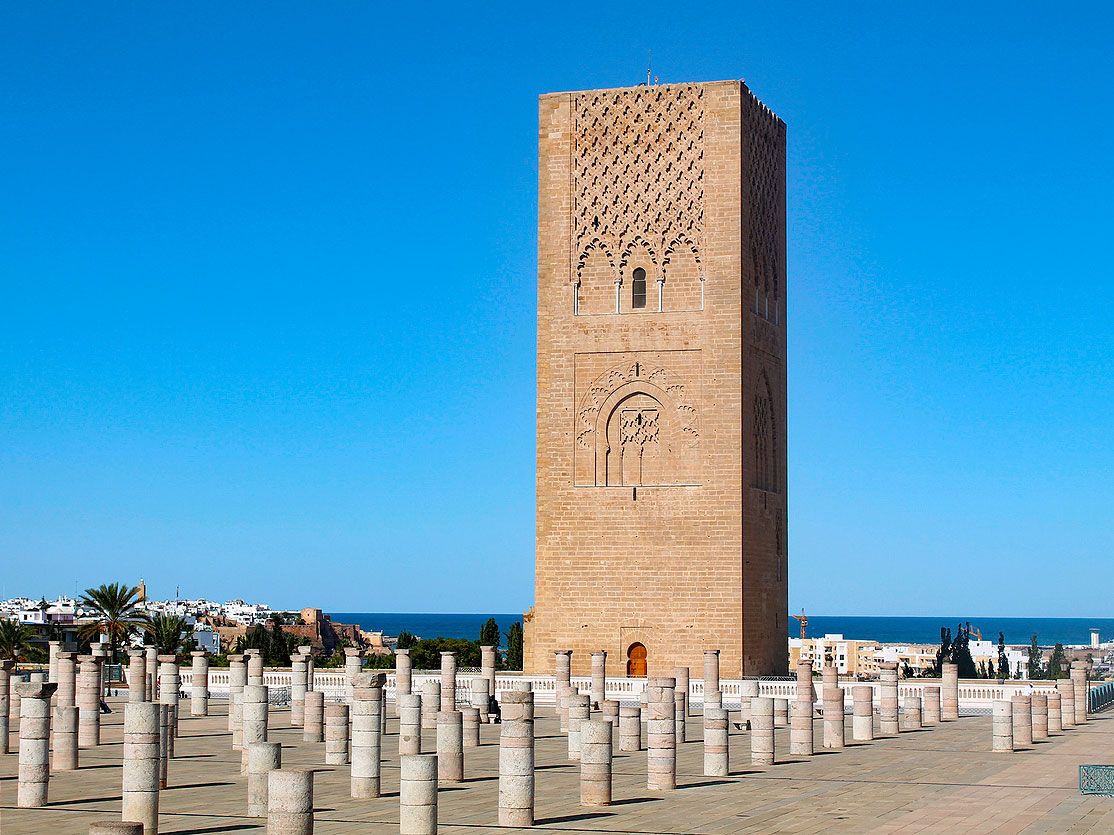
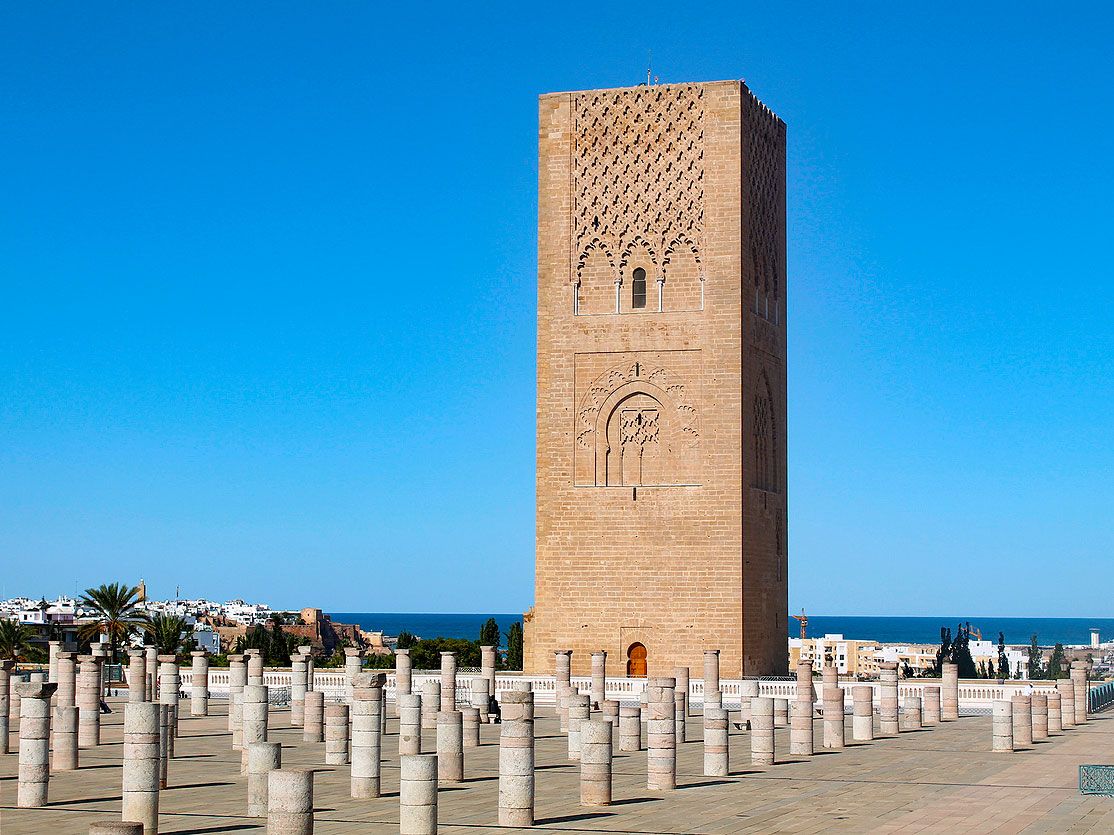
Construction on this magnificent unfinished tower began in 1195 during a period of optimism and expansion of the Islamic world. At the time, Rabat, Morocco, was a small town, but was expected to grow into a cultural and political stronghold due to its location between Marrakech and Cordoba, the capital of western Islam at that time. The tower, at 144 feet (just half of its intended height), was to be the minaret of a grand mosque from which the faithful were called to prayer. Progress on the mosque and minaret ceased when the sultan-architect, Yacoub el-Mansour, died in 1199. Much of the unfinished construction site was destroyed by a massive earthquake in 1755, leaving only the Hassan tower and the vast marble floor and 200 supporting columns that show the massive footprint once planned for the unfinished mosque.
The tower’s design honors the ingenious architects of the period. Instead of stairs, a series of ramps wind to the top of the tower. This allowed animals to haul stones up during construction. The intricate decorative inscriptions and patterns on the exterior mirror other architectural wonders by el-Mansour such as the Giralda, the belltower of the Seville cathedral (which, of course, was converted from a minaret when Christians drove the Muslims from Spain). Together, Rabat and the Hassan Tower are a designated UNESCO World Heritage Site.
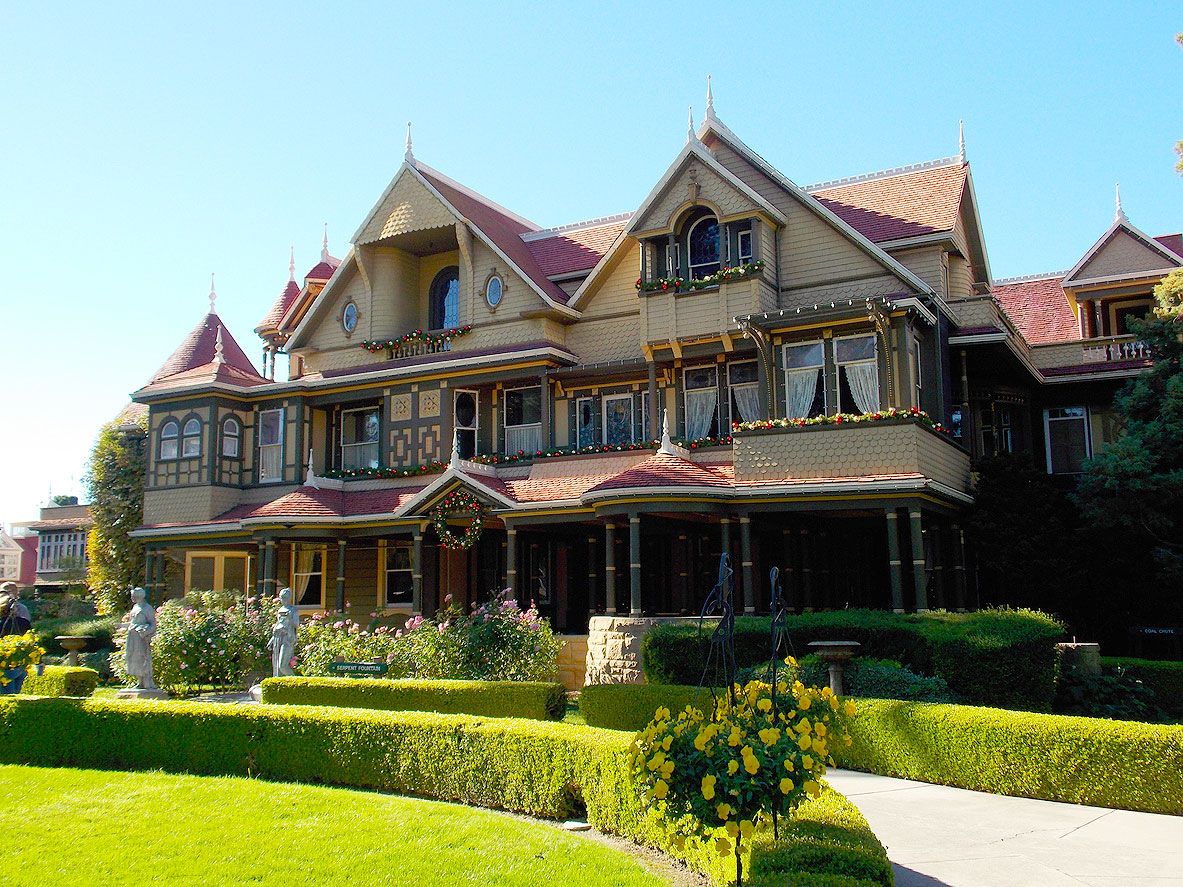
Anyone who has seen a Western film might be familiar with the name Winchester. The Winchester Repeating Arms Company made firearms including a rifle that became known as “the gun that won the West.” When the heir to the sizable Winchester fortune died in 1881, his widow Sarah Winchester used part of her $20 million inheritance to begin renovations on an eight-room house she bought in San Jose, California. The problem was that she never stopped the expansion.
According to some theories, the ghosts of victims who died from Winchester gun violence haunted the house and drove Sarah to continue building new rooms, hoping that they wouldn’t inhabit them. Another theory is that a medium told her that the only way to put off her own death was to continuously add on to the house. Or perhaps she simply was eccentric.
Whatever the reason for the must-build mania, construction on the house continued around the clock from 1884 until Sarah’s death in 1922. The Queen Anne-style Victorian mansion, which is listed on the National Register of Historic Places, has 160 rooms, 2,000 doors, 17 chimneys, and numerous staircases that lead to nowhere.
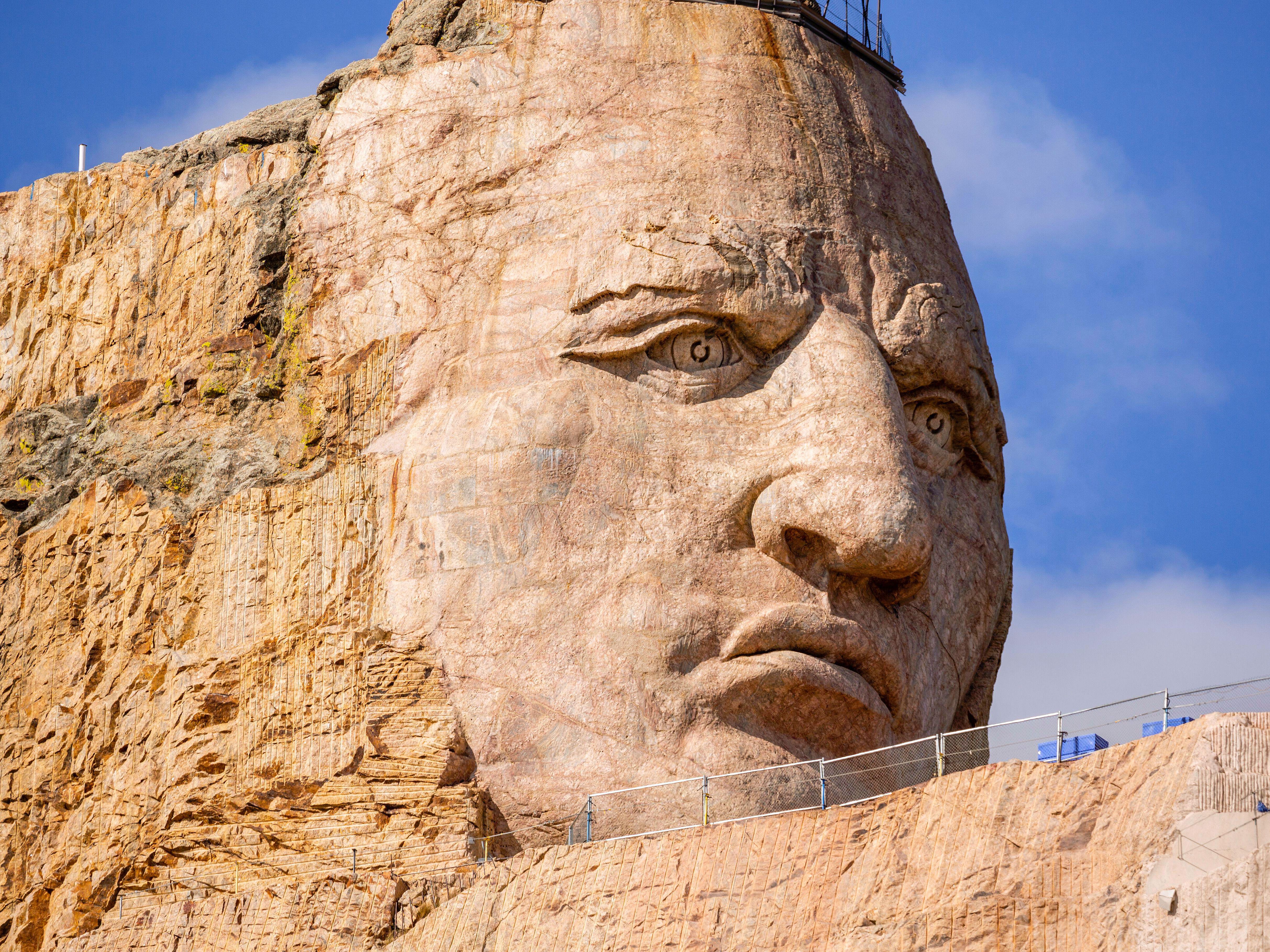
Roughly a million visitors a year make the journey to the unfinished Crazy Horse memorial in the Black Hills of South Dakota. Crazy Horse was the Oglala Lakota chief who successfully fought Custer’s army at the 1876 Battle of Little Big Horn. The majestic profile of Crazy Horse, carved into a rocky mountain face, is the first finished segment of a project intended to produce the largest sculpture in the world.
When completed, the memorial will depict the tribal leader on horseback with his left arm pointing southeast. The planned monument will be so epic in scale that it will be four times the height of the Statue of Liberty and will dwarf the presidents carved into Mount Rushmore — located just 17 miles away. In fact, if those politician heads were stacked one on top the other, they would only reach half the height of Crazy Horse.
Progress on the project, which began in 1948 as a response to Mount Rushmore’s depiction of white leaders in a region that was historically populated by Native Americans, has been slow. The work’s Polish-American sculptor, Korczak Ziolkowski, worked alone on the project for many years, but was eventually joined by volunteers and family and received funding through private donations and admission fees paid by visitors. To maintain control, Ziolkowski refused federal monetary assistance.
Though the monument was initially approved by some Lakota, it has since been met with criticism from the natives about how the money was being spent, why the Ziolkowski family’s involvement often eclipses the memory of Crazy Horse in the press materials published by the memorial foundation, and why the construction project was taking so long. More than 70 years after it began, many are skeptical that the Crazy Horse memorial will ever be completed.
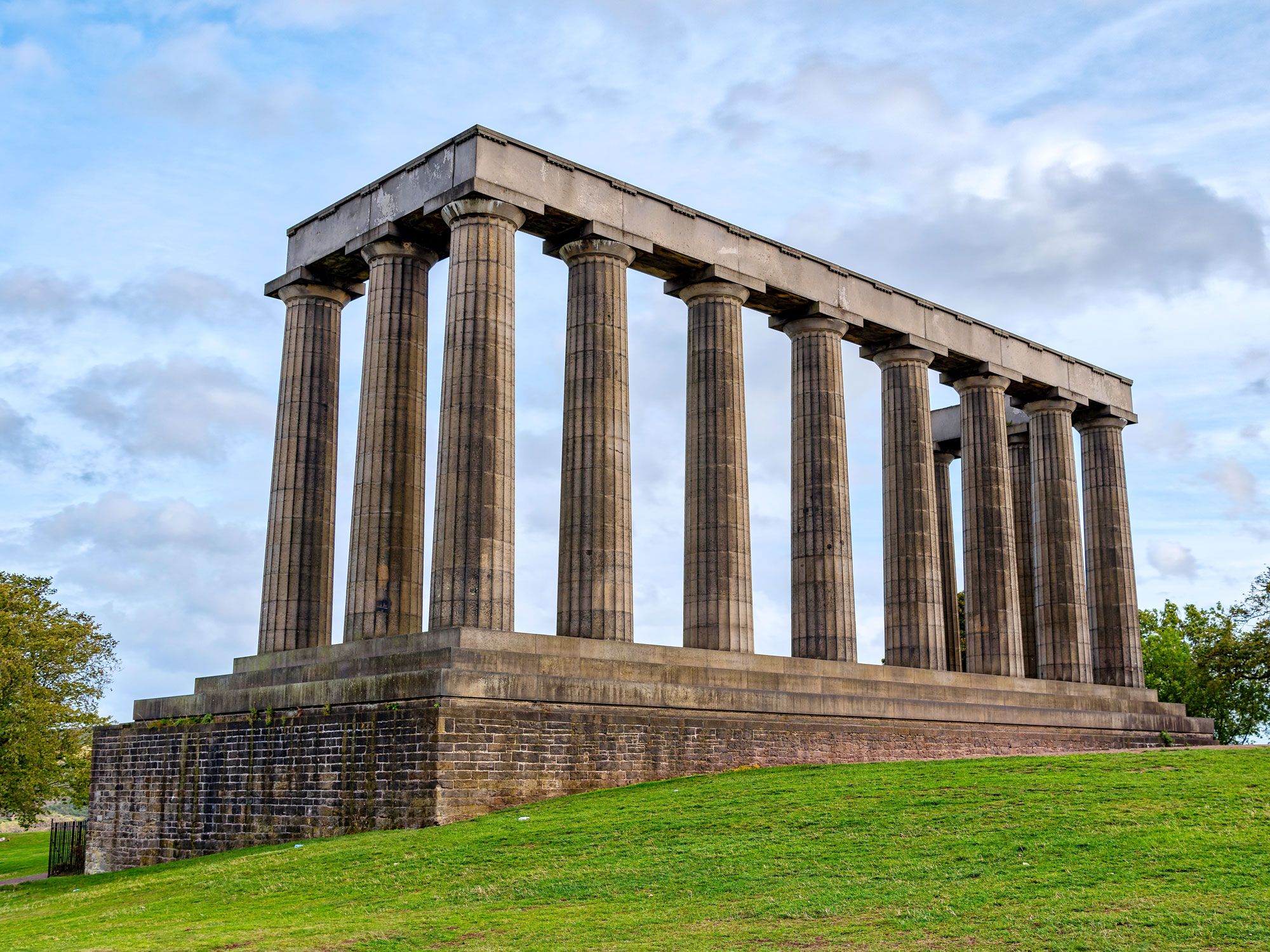
When construction began in 1822 on this monument dedicated to the Scottish soldiers and sailors who died fighting in the Napoleonic Wars, fundraising still wasn’t complete. Confident that the money would come, the foundation stones were laid (the first ceremoniously put in place by King George IV) and the columns began rising atop Carlton Hill in Edinburgh. Then, the money dried up.
The design was intended to exactly replicate that of the Acropolis with the stones quarried in Scotland, but in 1829, construction stopped after only 12 columns had been erected and topped by their lintels. Discussions about how to use the unfinished hilltop memorial have come up in the ensuing years including the possibility of it being used as a site for museums or government buildings. So far, the monument stands incomplete. Although it’s unfinished, the hilltop monument is still a popular site for picnics and Sunday walks.
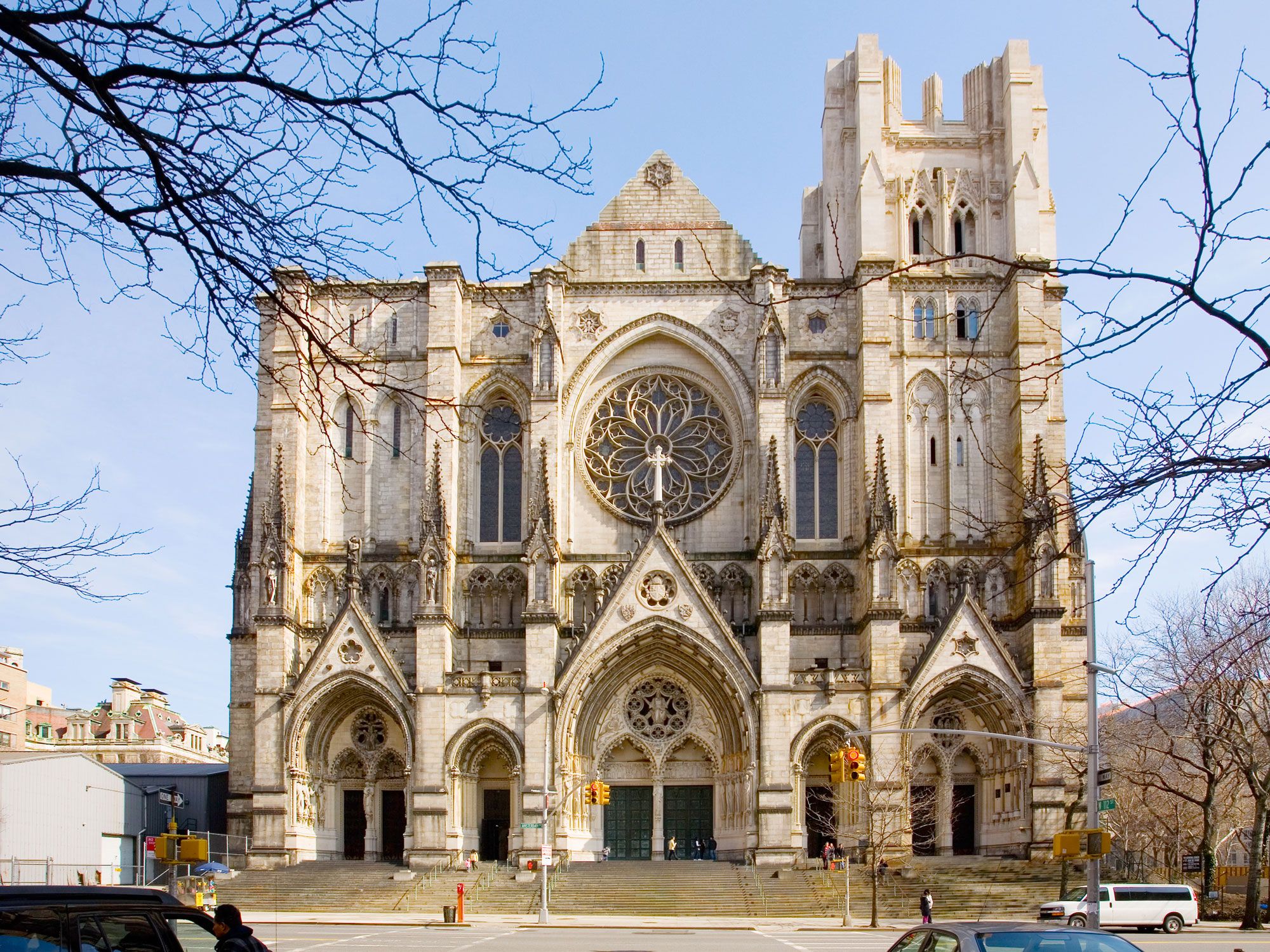
Cathedral of St. John the Divine – New York, New York
St. John the Divine, one of the world’s largest Gothic-style cathedrals, remarkably remains unfinished despite 120 years of construction. The magnificent church is a landmark in the hilly Morningside Heights neighborhood of New York City between Central Park and Columbia University.
Construction on the grand building began in 1892, but even after delays and changes in design and architectural leadership, the first services were held in the unfinished (but habitable) church in 1911. As time went on, the Episcopal church’s leaders decided to prioritize funding for community needs over ongoing construction.
Since 1978, the cathedral has trained young people from the local community as apprentices to the stonecutters who work on the structure. The building, although only two-thirds completed, has been the site of major historic moments such as concerts of new works by Duke Ellington and Leonard Bernstein, highwire walking by Philippe Petit, and numerous anti-war demonstrations.
Advertisement
More from our network
Daily Passport is part of Inbox Studio, an email-first media company. *Indicates a third-party property.
Can You Find Your Way Around These 5 Elaborate Corn Mazes?
By
Daily Passport Team
Read time: 4 minutes
August 10, 2023
Updated: August 10, 2023
Can You Find Your Way Around These 5 Elaborate Corn Mazes?
Outdoors •August 10, 2023•Updated: August 10, 2023
By Daily Passport Team
Author
Daily Passport Team
Daily Passport writers have been seen in publications such as National Geographic, Food & Wine, CBC, Condé Nast Traveler, and Business Insider. They're passionate about uncovering unique destinations and sharing expert tips with curious travelers.
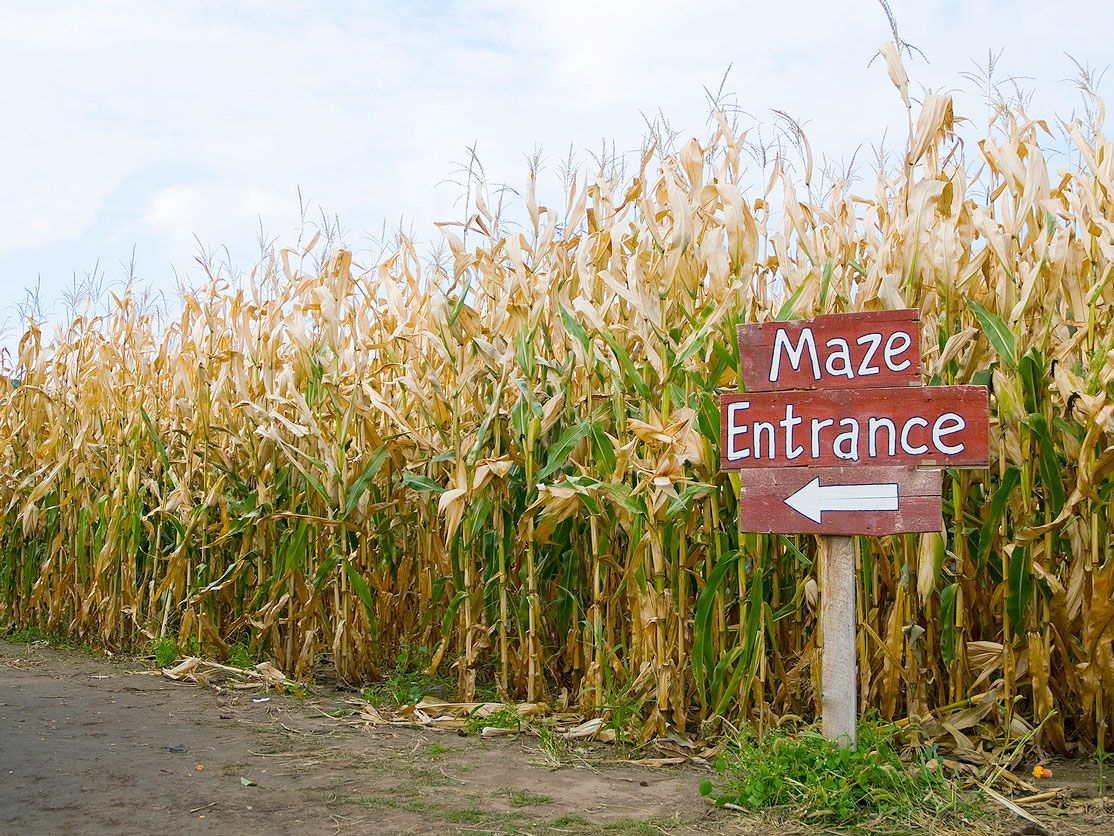
Since the original mazes of ancient Egypt, our fascination with mazes has continued for centuries. In England, hedge mazes began to pop up in many royal gardens in the 1800s, but it wasn’t until 1993 that the trend made its way to the United States. Don Frantz and Adrian Fisher created the country’s first corn maze, called the “Amazing Maize Maze,” in Annville, Pennsylvania. Today, North America claims some of the largest and most intricate corn mazes in the world. Here are five elaborate corn mazes you shouldn’t miss.
Richardson Adventure Farm – Spring Grove, Illinois
The small town of Spring Grove, Illinois, bills itself as the home of “world’s most intricate corn maze.” With four miniature mazes to conquer alone or to tackle as one giant puzzle, the Richardson Corn Maze — a family farm since 1836 — sits on 28 acres of corn fields. The farm includes 10 miles of trails that are sure to lead you astray at least once or twice. The corn fields are planted in May, and the mazes are created after months of collaboration with a full-time team of graphic artists and MazePlay owner Shawn Stolworthy. Maze themes change each year and have incorporated everything from the Beatles to Star Trek.
The largest maze in New England, the Great Vermont Corn Maze spans 24 acres in Danville, Vermont. The site’s Big Maze requires a roughly three-hour commitment to navigate the miles of hilly terrain. (Be sure to wear comfortable walking shoes and bring a water bottle.) An underground tunnel, dinosaurs, numerous bridges with bird’s-eye views, remnants of mazes-past, and new surprises wait within the 10-foot-tall cornfield walls. If you’re not feeling up for the Big Maze, you can still hit all the highlights with a 40-minute, mapped-out stroll through the Scenic Maze.
To call this place a “farm” is a perhaps an understatement. Kraay Family Farm has been operating for 30 years and features over 40 family-friendly attractions. The Kraays decided to open their farm to the public 15 years ago, and have enjoyed watching visitors learn more about farm life ever since. One of the most popular attractions is the 15-acre Lacombe Corn Maze, boasting over three miles of labyrinth pathways.
Challenge yourself by playing Flashlight Maze and try to find your way out with just the light from a torch, glow stick, or even the full moon. Other autumn-themed activities at the farm include mini golf, zip lines, pig races, and a pumpkin cannon that allows shooters to knock pumpkins off the top of a school bus with a kid-friendly cannon.
Cool Patch Pumpkins in Dixon, California, had a humble start. The idea formed after local Matt Cooley and his children found success selling pumpkins on the side of his pumpkin field. Matt and his brother Mark founded Cool Patch Pumpkins soon after in 2001. A few years later, the ambitious brothers set their sights on creating the world’s largest corn maze and achieved this with a 40-acre corn maze in 2007.
The brothers went on to beat their own record in 2014 with a monstrous 63-acre maze. Today, the pumpkin patch and its impressive corn maze are among California’s biggest and best fall attractions. This maze is family-friendly, but no one under 18 is allowed in without adult supervision due to the maze’s size, complexity, and potential to confuse visitors. Amusingly, the Solano County Sheriff’s Office says they receive calls every year from people unable to find their way out.
The two Cornbelly’s locations at Thanksgiving Point and Spanish Forks in Utah offer 55-plus attractions that include four different corn mazes. Cornbelly’s has been crafting mazes since 1996, using just a weed whacker and their imaginations in the early days. Now, over two decades and countless mazes later, computers and high-tech equipment help the staff plan and execute intricate and inventive mazes every year. The main corn maze at Thanksgiving Point sits on eight acres and takes about 30 minutes or more to complete. Maze explorers are also required to answer trivia questions with the help of an “interactive passport” to find their way out.
The smaller, self-guided maze at Spanish Forks is a five-acre maze and takes about 20 minutes to complete. Visitors can also hop aboard the “Grain Train” and take a ride through the network of trails to spot scarecrows and jack-o-lanterns along the way. The spirit of Halloween takes over at night, when Thanksgiving Point and Spanish Forks turn into Insanity Point. Adults and children aged 12 and up can check out the haunted barn, hay maze, and, of course, the haunted corn maze.
Advertisement
More from our network
Daily Passport is part of Inbox Studio, an email-first media company. *Indicates a third-party property.
16 Highly Unusual Cities Built in Unlikely Locations
By
Daily Passport Team
Read time: 14 minutes
August 10, 2023
Updated: December 22, 2025
16 Highly Unusual Cities Built in Unlikely Locations
Geography •August 10, 2023•Updated: December 22, 2025
By Daily Passport Team
Author
Daily Passport Team
Daily Passport writers have been seen in publications such as National Geographic, Food & Wine, CBC, Condé Nast Traveler, and Business Insider. They're passionate about uncovering unique destinations and sharing expert tips with curious travelers.
The globe is dotted with villages and cities built in unlikely places, but some take their unusual locations and environments to an entirely new level. From underground dwellings to communities tucked into cliffside precipices and even one built on the rim of a volcano, these 16 cities and towns are some of the most uniquely located communities in the world.
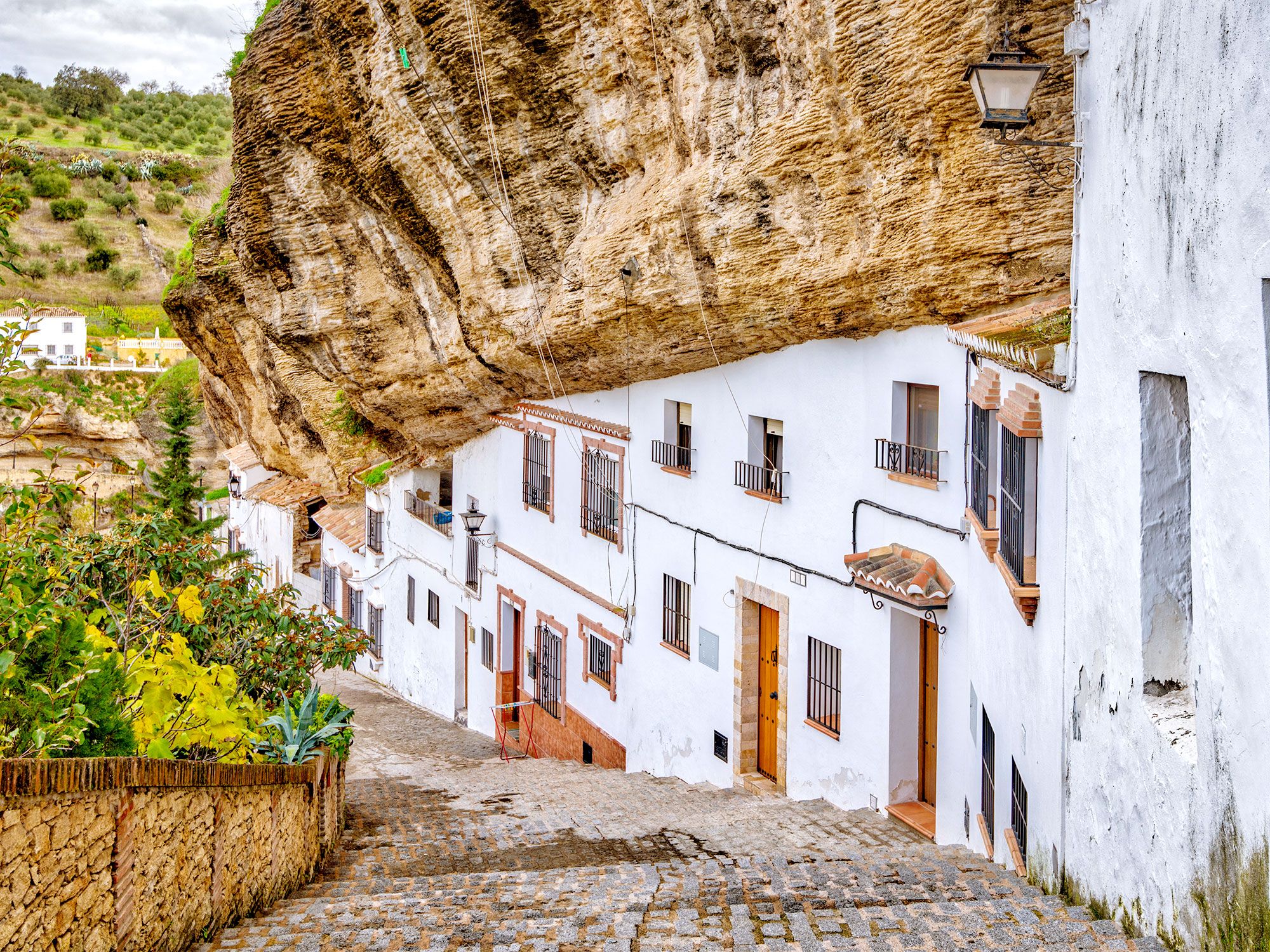
It’s safe to say that those who reside in this town of about 3,000 people in southern Spain are living under a rock. The stunning buildings of Setenil de las Bodegas are built under and up against huge cliffs of basalt rock. But the town’s unlikely location also serves a practical purpose — the cliffs provide protection from both invaders and the elements. It’s also simpler to build a façade that backs up to climate-controlled rock than it is to build a full house. Because of these factors, historians believe the spot has been settled since prehistoric times and the preexisting nooks and crannies were even used to extend the life of fresh produce. These cliffs still keep residents warm in the winter and shade them from the heat in the summer.
Historically, Sentenil de las Bodegas was a Moorish stronghold, one of the last Muslim territories on the Iberian Peninsula in medieval times. You get a sense of that history as you walk along the town’s oldest thoroughfare — Calle Herreria. Charming stucco and stone buildings line the curving corridor, melding into a sheer, sweeping rock backdrop and ceiling. You will literally see stone rather than sky in some places — how’s that for a surreal atmosphere?
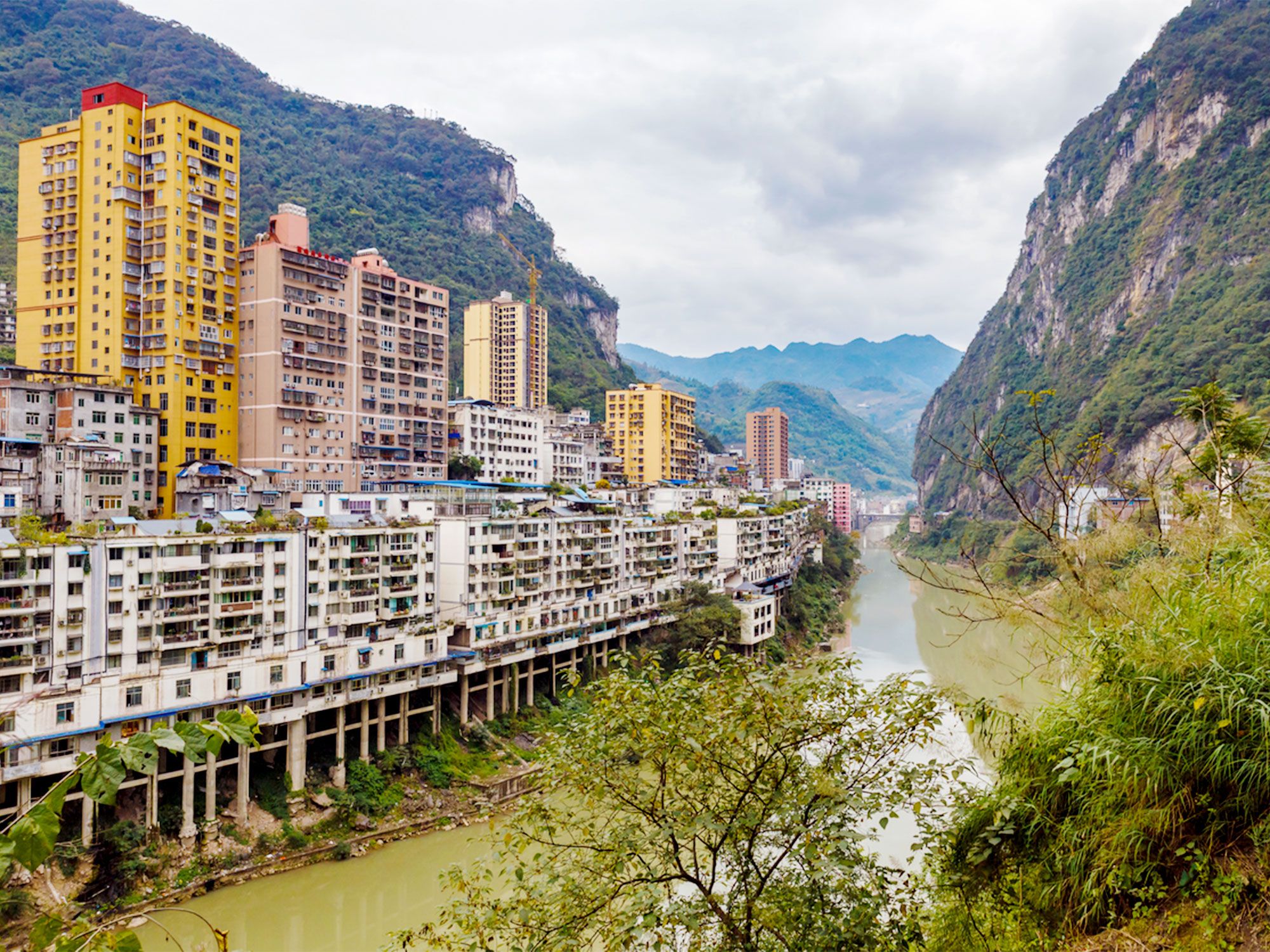
Considered by many to be the world’s narrowest city, Yanjin hugs the Nanxi River as it runs through the steep mountains of northwest China. When viewed from above — a winding river sandwiched between a slim row of tall, narrow buildings — this city in the Yunnan province doesn’t seem real. The widest sections of the city measure less than 1,000 feet across, and at its narrowest point, Yanjin is less than 100 feet wide. There is one main road on each side, running parallel to the river, and fewer bridges than you might expect. And since many of the buildings in town are located right on the banks of the river, to protect from flooding, the city’s buildings are built atop concrete pillars.
The mountains surrounding the city have kept it isolated and prevented much tourism or development, but despite that more than 450,000 call Yanjin home today. Though it’s difficult to reach, recent viral drone footage has boosted its popularity with tourists, too.
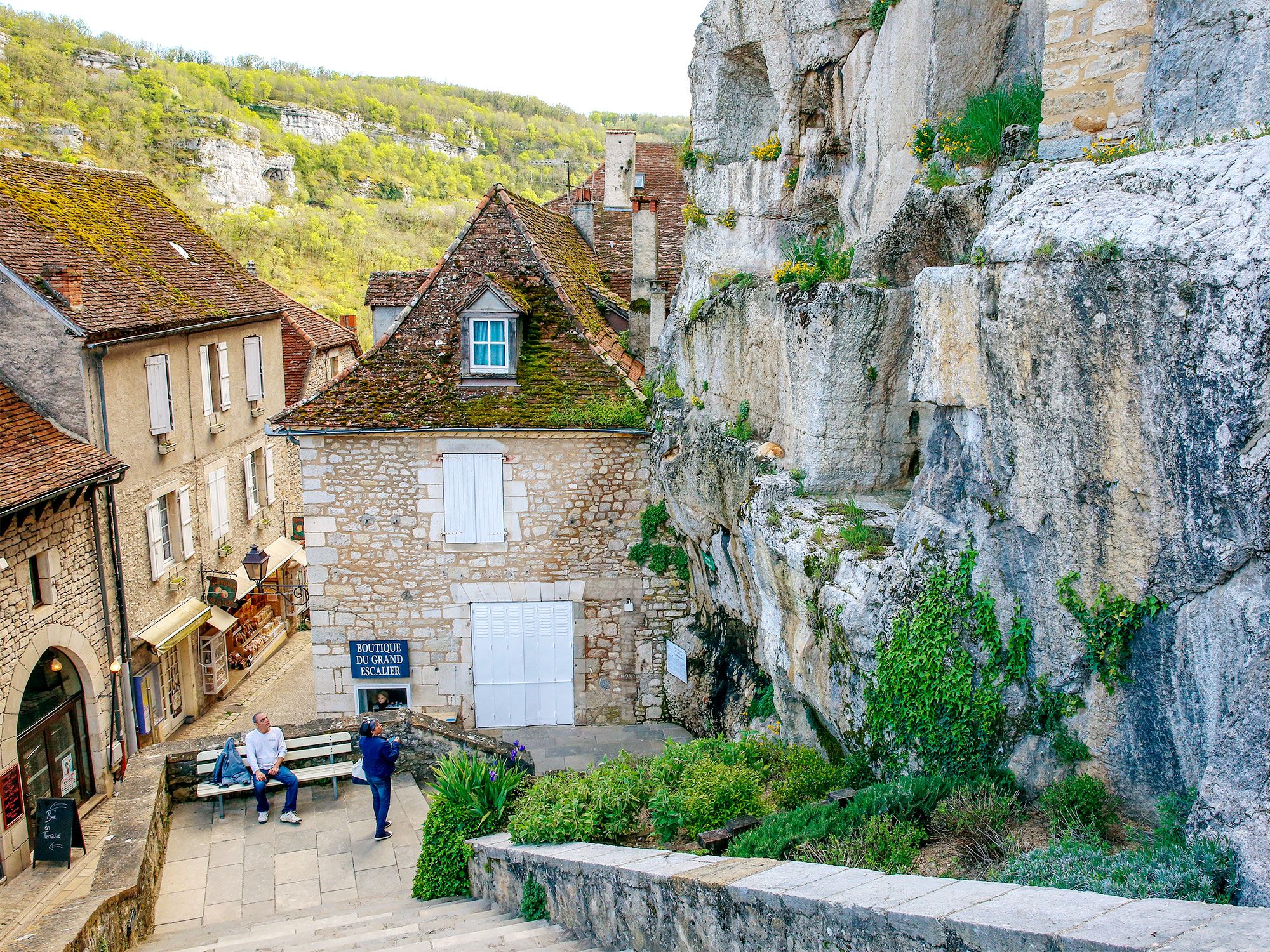
Rocamadour, a tiny, medieval village built along and above a gorge on the Alzou River in southwestern France, rises in stages and platforms up the side of a cliff. The lower portion of town is home to its only street, Rue de la Couronnerie. The lane is lively with shops and well-maintained homes built between the 13th and 17th centuries. From there, a monumental staircase of 233 steps rises to a group of churches and shrines officially recognized as a UNESCO World Heritage Site and offering some of the best views in the town.
Once nearly deserted after the French Revolution, Rocamadour buzzes with tourists and those making the religious pilgrimage up the stairs to St. Amadour, the town’s namesake church. Legend has it the saint witnessed the deaths of St. Peter and St. Paul in Rome before settling in the tiny French village to live out his life in solitude. The famous Black Madonna — the iconic, holy statue — also resides in the spectacular, cliff-sheltered Notre-Dame Chapel.
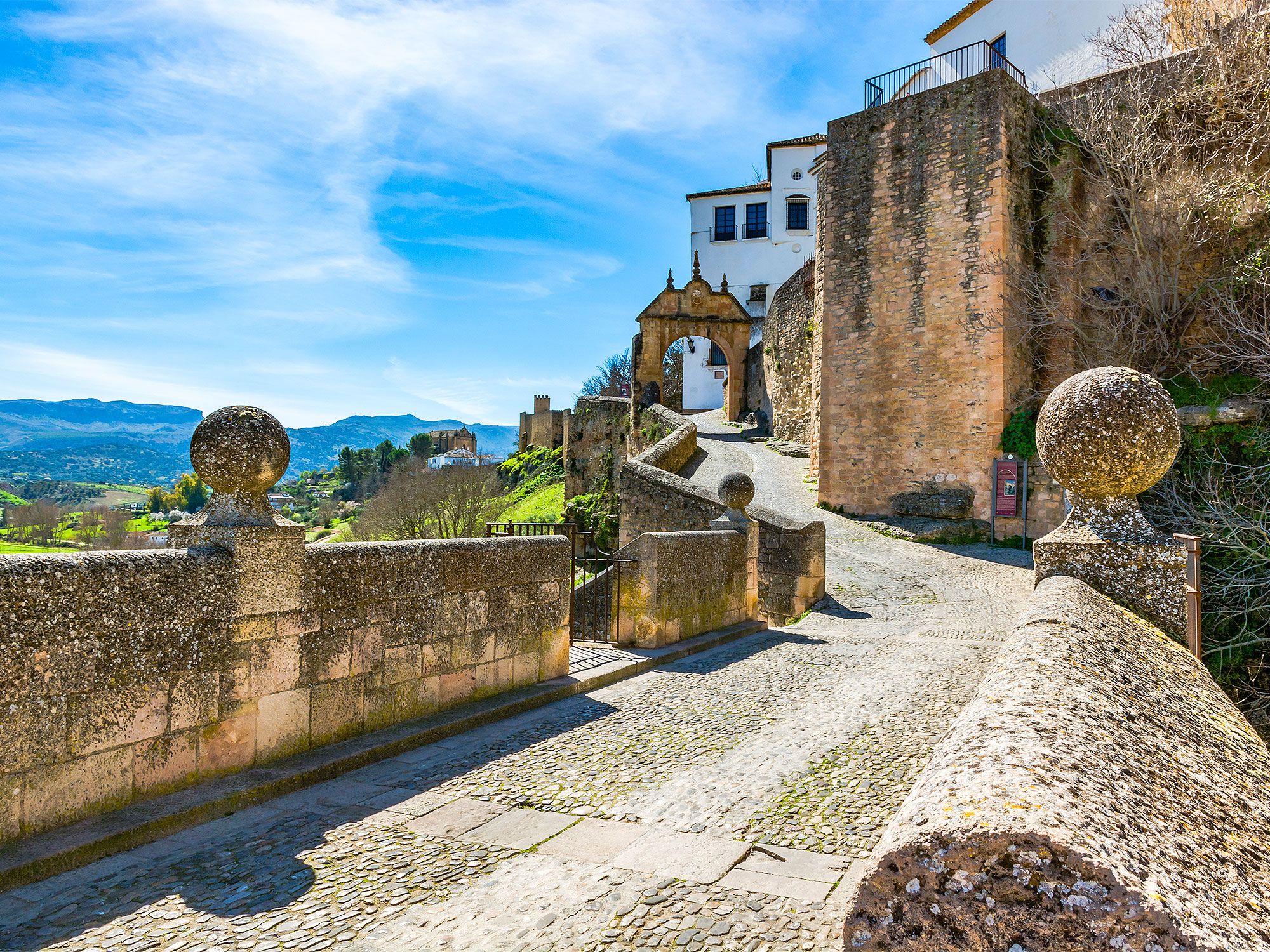
Ronda, an Andalusian city in southern Spain with 35,000 residents, is the home of modern bullfighting. It was here, in the 18th century, that bullfighters got off their horses and began facing their bull opponents on foot for the first time. But, more than bullfighting, Ronda is famous for El Tajo Gorge — a dramatic, 328-foot-tall crevasse that divides the town in half. To get around the gorge, the town features a series of picturesque bridges and walkways.
From the oldest part of town, a scenic path leads visitors to the very bottom of El Tajo and the beautiful Puente Nuevo (New Bridge), which dates back to 1793. The surrounding landscape is rugged, which meant constructing the span was dangerous — a feat evident from the balconies jutting out from the sides of the gorge. Two smaller bridges also cross the gorge: the Puente Viejo (Old Bridge) completed in 1616 and the Puente Romano, a span dating to the Moorish period.
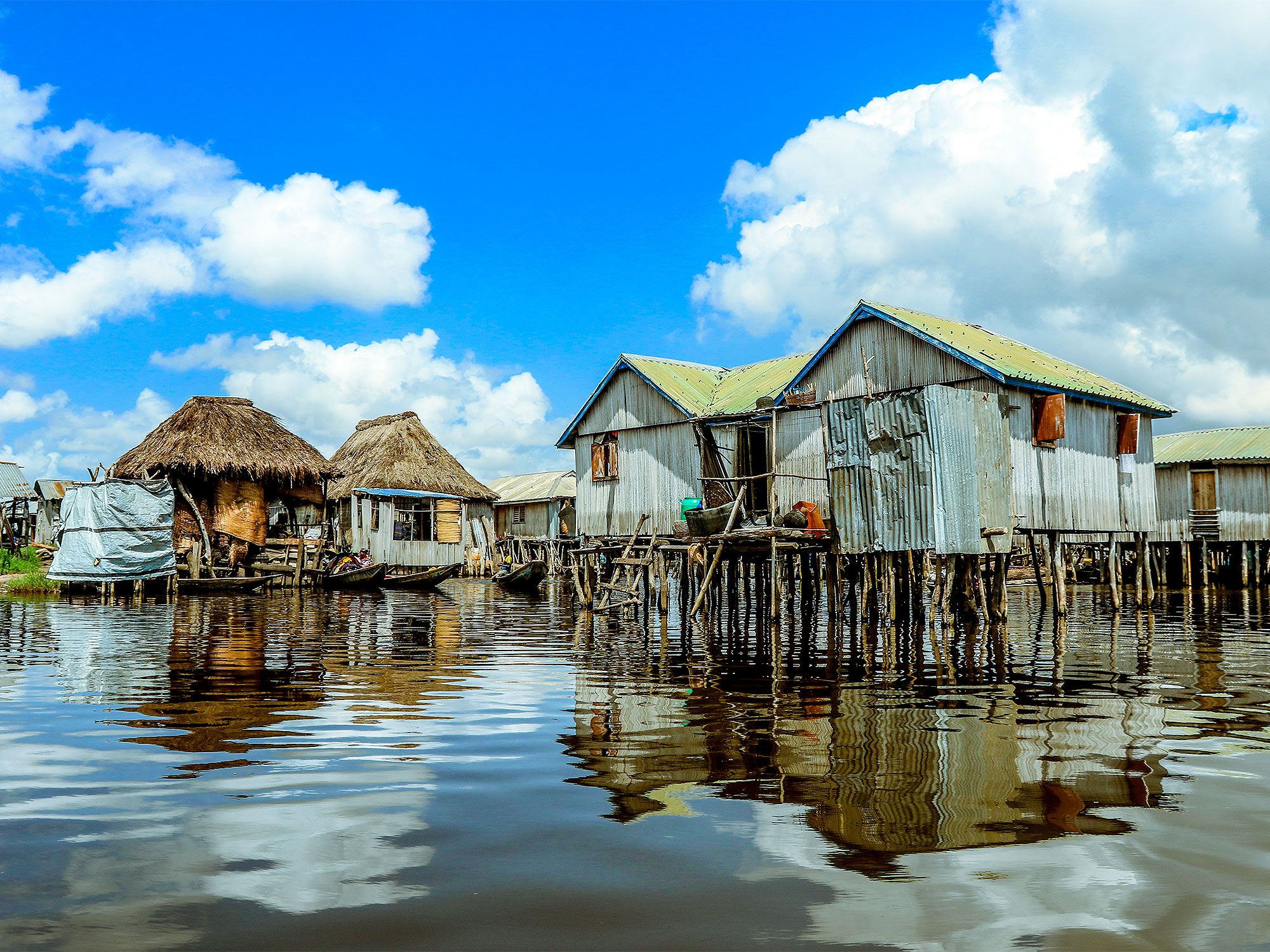
Ganvie, located in the Republic of Benin on the Gulf of Guinea in West Africa, has been called the “Venice of Africa.” And for good reason: The city’s structures stand on stilts above water and its 30,000 residents navigate around town in canoes. But instead of canals, Ganvie has the lagoons of Lake Nokoue — a large body of water north of Benin’s largest city, Cotonou.
Interestingly, the city originated as a safe space for the Tofinu tribe back in the 17th century. The group was fleeing another tribe, the Fon, whose religious beliefs prevented fighting on the lake, which they considered sacred. Today, the city is officially recognized as a UNESCO World Heritage Site and is dotted with bamboo huts and pens built from reeds where residents raise fish. The city’s one patch of dry land features a school and a soccer field; another is being built as a city cemetery.
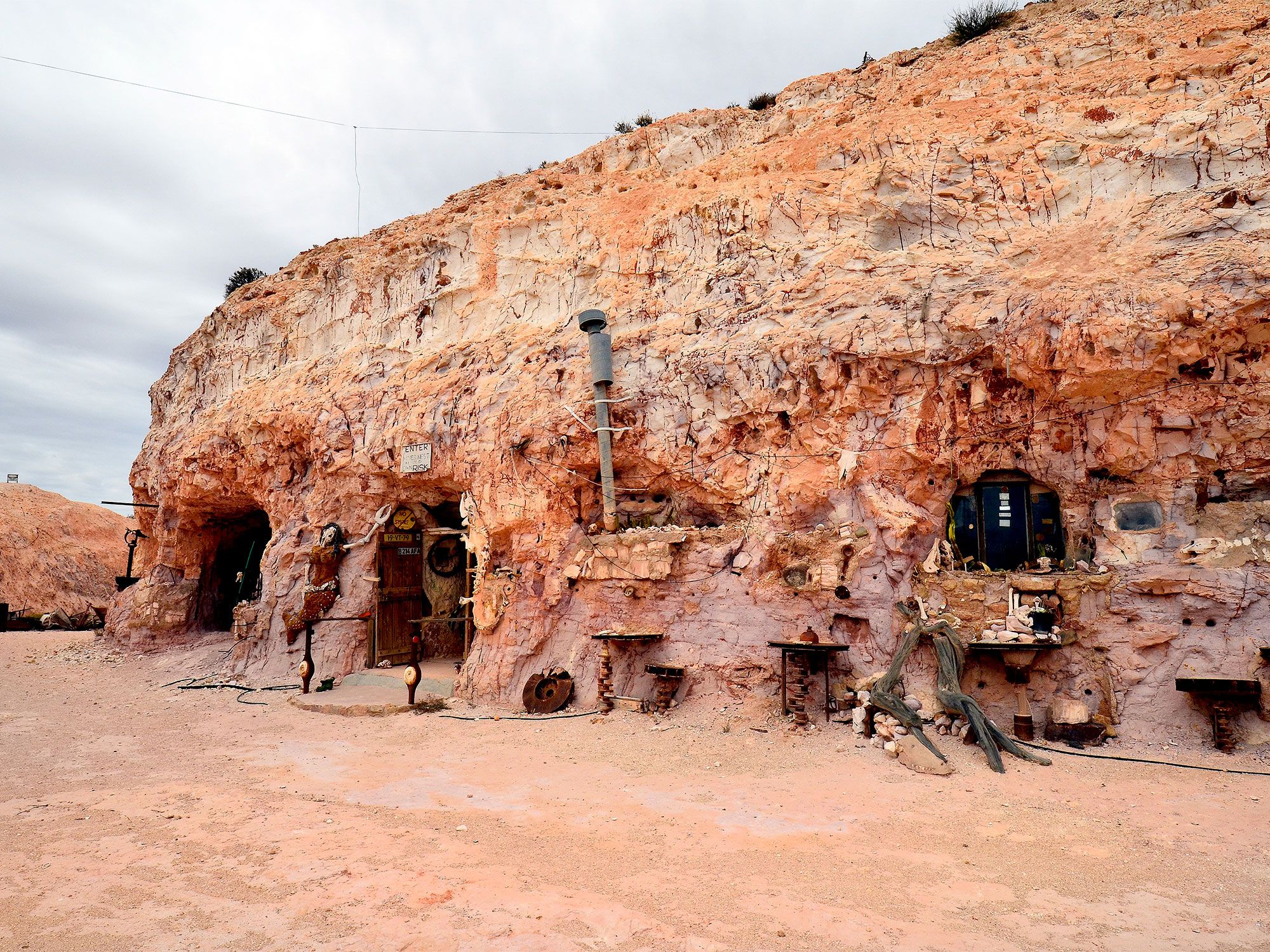
It’s hot in Coober Pedy — very hot. Located in the Australian Outback, this town’s temperatures typically soar into triple digits. There are few trees, and very little grass. The landscape is otherworldly and almost bleak — dusty, with crags of reddish-brown sandstone. The views are a bit apocalyptic and, perhaps, a bit familiar — Coober Pedy was the backdrop of the 1985 dystopian action film Mad Max Beyond Thunderdome starring Tina Turner and Mel Gibson.
You might wonder how anyone could live in such a desolate town with an extreme climate. Well, it’s because this small village — home to only 3,500 residents — happens to be the “Opal Capital of the World.” About 70% of the world’s opals come from Coober Pedy. And the folks who hunt for the precious stones have adapted: they live underground. It’s cooler down there, and all those miners were digging holes anyway. About half of the town’s residents live in underground dugouts where temperatures stay closer to 75 degrees Fahrenheit. In addition to residences, the town is also home to underground museums, churches, shops, and even hotels.
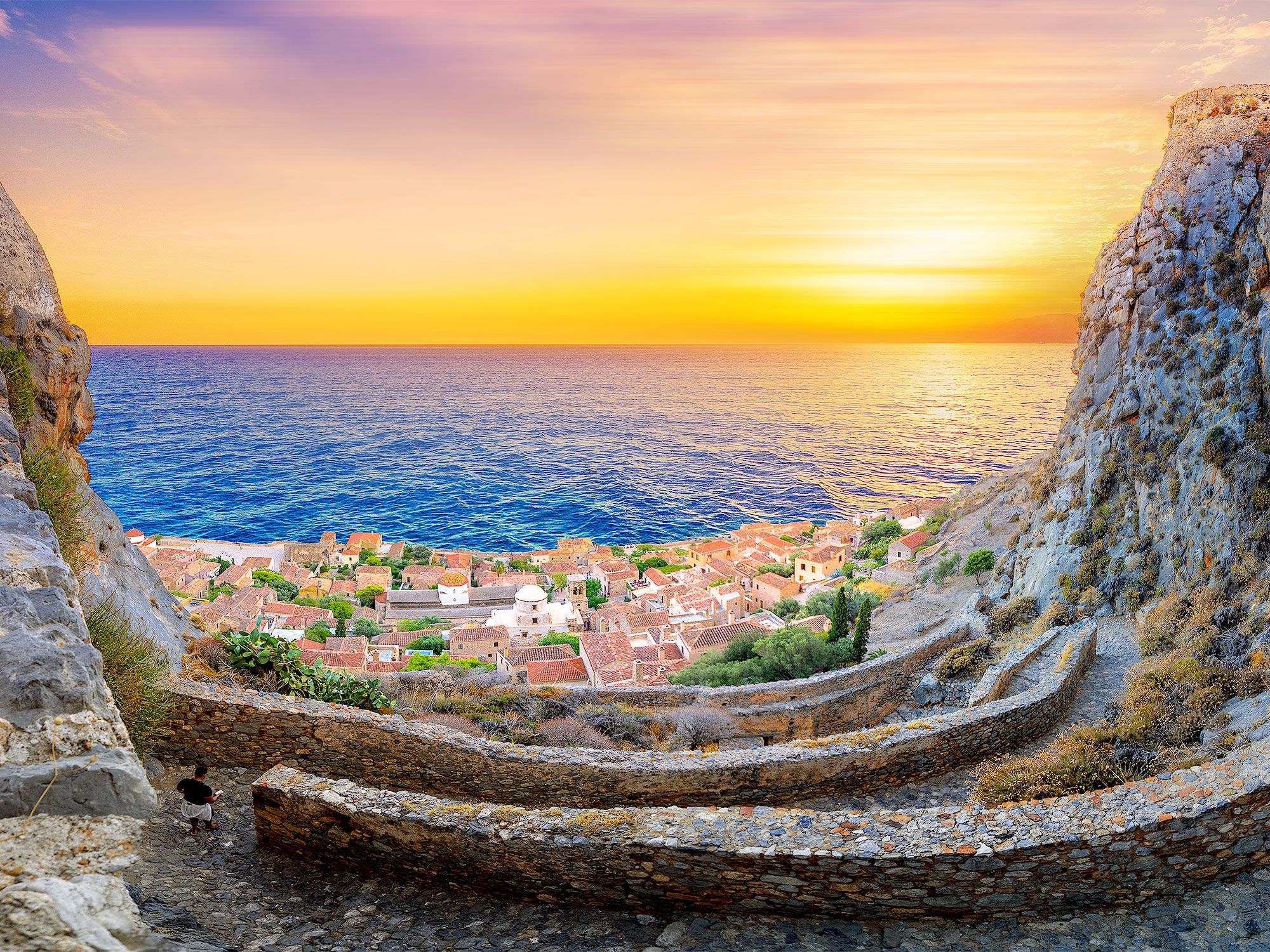
Tiny Monemvasia is a mostly-seasonal settlement concealed behind a huge rock face in the region of Laconia in Greece. To get to this enchanting village, you must travel to the town of Gefyra, park your car (since there’s no driving in Monemvasia — only narrow, cobblestone walking paths), and cross a small footbridge. This rocky outcropping was once attached to the mainland but an ancient earthquake made it an island.
Nearly every building in this enchanting walled village is made of stone and stucco painted in earth tones with red-tiled roofs. These structures date from the Byzantine, Venetian, or Ottoman eras. Most of these beautiful buildings are vacation homes, guesthouses, and cafés — and few people live here year-round. At the end of the main drag, a path leads outside the fortress walls to a lighthouse with incredible views of the Myrtoan Sea. In town, you can visit one of two historic churches; the Church of Elkomenos Christos dates back to the sixth or seventh centuries. Its simple yet elegant façade belies the ornate and massive icon of the Crucifixion within. After that, be sure to sample the region’s renowned wines and olive oils.
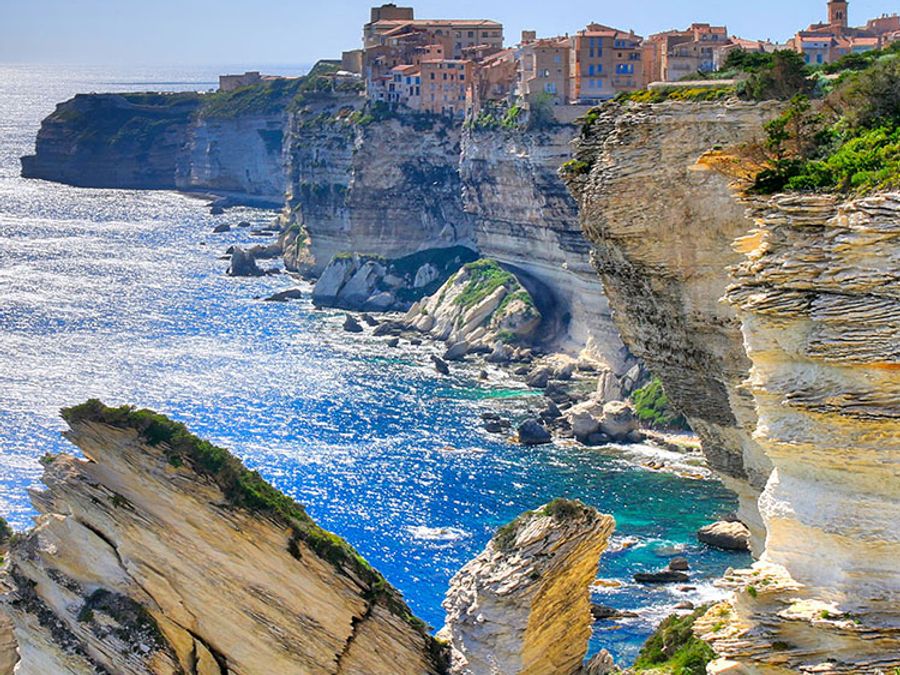
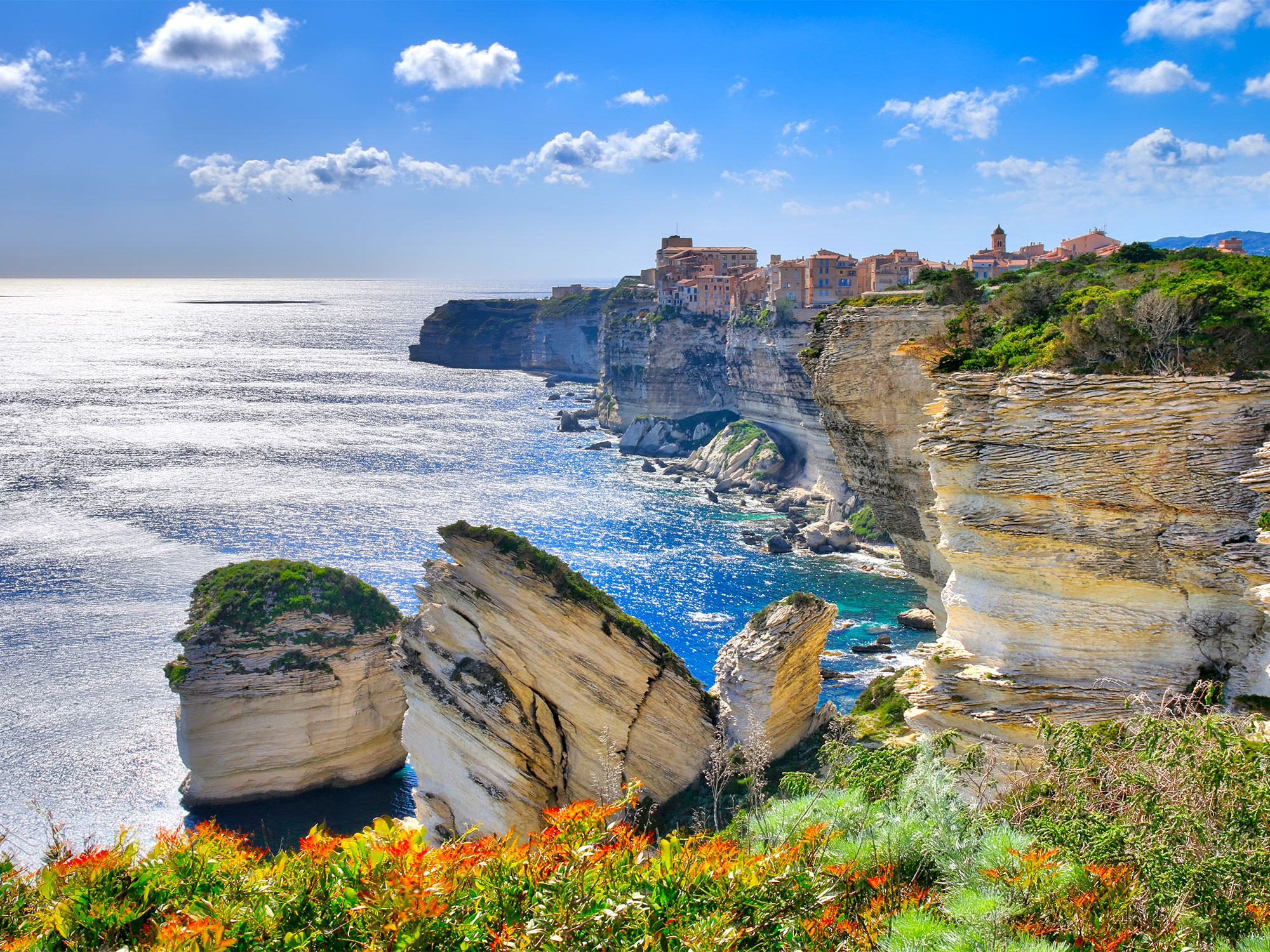
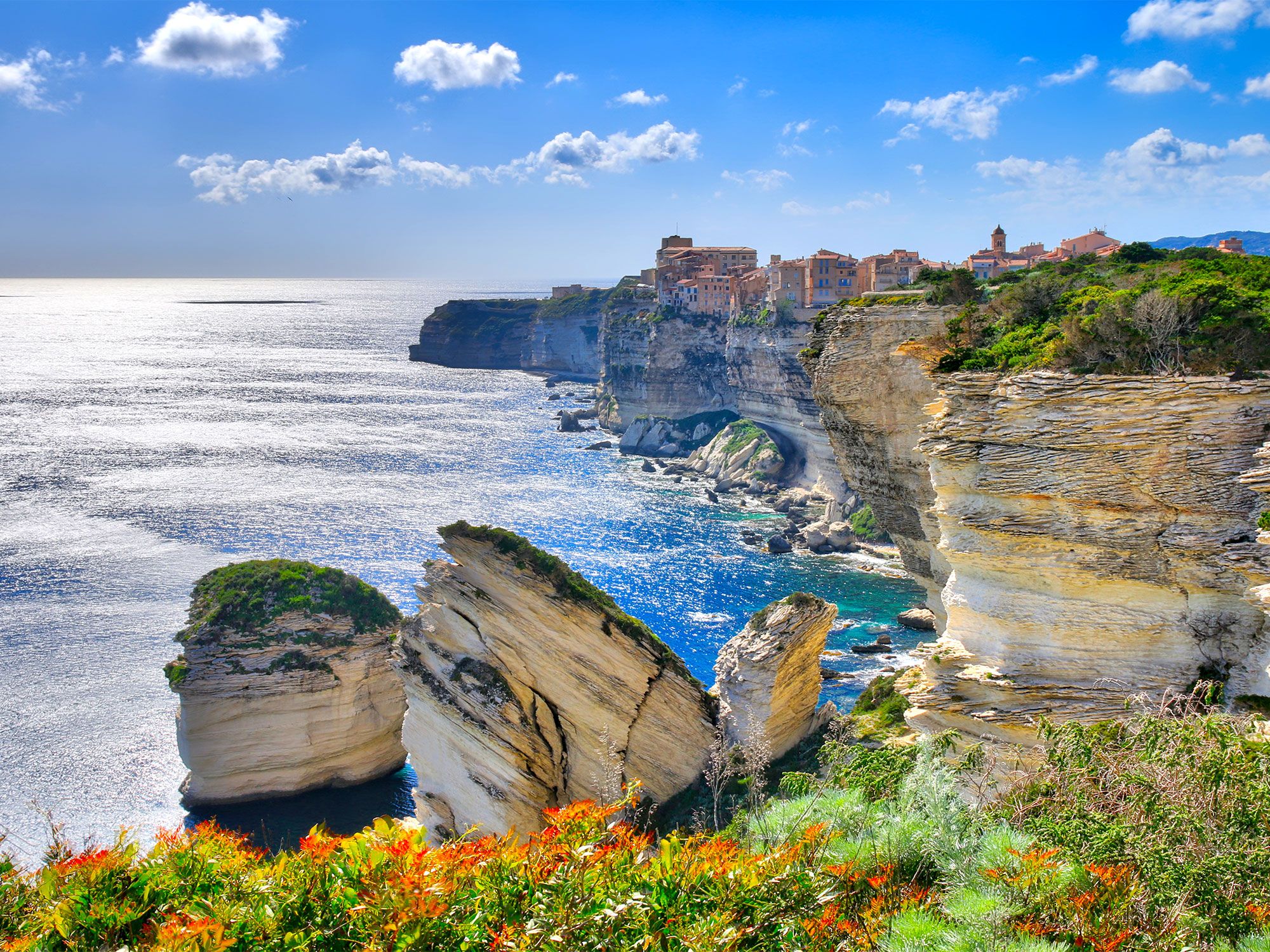
Located on the southern coast of Corsica, the town of Bonifacio is perched along 230-foot-tall limestone cliffs overlooking the Mediterranean Sea. The village’s precarious location and stunning views have earned the medieval town and its fortifications a few nicknames — “Mediterranean’s Sentinel” and “Citadel of Cliffs” among them. The spot is a tourist’s dream — boasting perfect weather year-round and featuring charming, red-roofed buildings and cobblestone lanes and a sparkling shoreline with turquoise waters. Even at the height of summer, you won’t find the village crowded, and there’s plenty of history on every street corner. As Corsica’s oldest settlement, Bonifacio is home to numerous monasteries, museums, and churches offering tours.
Corsica, a French island, is separated from the Italian island of Sardinia by the Strait of Bonifacio — named for the idyllic town. Interestingly, the two islands were once converged but volcanic activity caused the land to rift. Over centuries, the water flowing through the strait has carved into the cliffsides, putting the town on the lip of a dramatic precipice. The unforgettable view of this magical spot from the sea creates an illusion of a gleaming city suspended over the churning sea below.
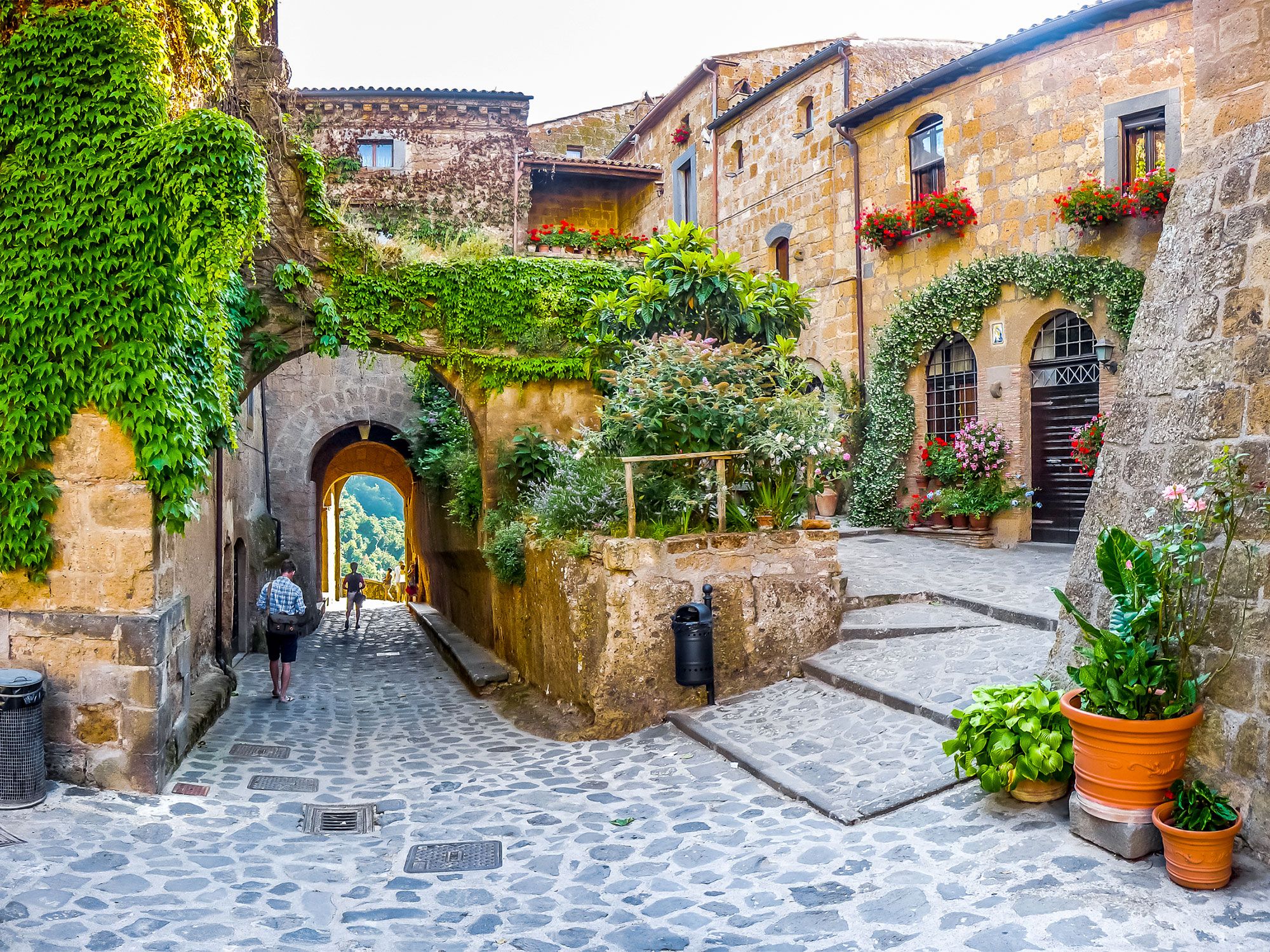
Perched on a fragile and erosion-prone cliff is Civita di Bagnoregio — the first Etruscan settlement founded over 2,500 years ago. Today, this hamlet located in the Tiber River Valley in central Italy is home to only about 12 people (and 20 or so cats). This tiny village welcomes tourists to experience a walled, medieval town dangling from a slim volcanic plateau. The nearest neighboring municipality, a town called Bagnoregio, is a canyon away. To get from Bagnoregio to Civita di Bagnoregio, visitors must cross a steep pedestrian bridge cantilevered 1,200 feet above the gorge that winds up the village’s stone walls.
The population of this historic village dwindled for a number of reasons, but mostly because of the town’s remote location, which is two hours north of Rome in the badlands of sand and sedimentary tufa rock. Many residents moved over to the larger town of Bagnoregio over the centuries — especially after an 18th-century earthquake created the canyon dividing the two settlements. The bridge between the two towns was destroyed in World War II, and it wasn’t rebuilt until the 1960s — a situation that left the few remaining residents living in extreme poverty. Tourism (and a small fee to cross that epic bridge) has started to bring life back to the tiny town — there are now a few bed and breakfasts, restaurants, and souvenir shops lining the fairytale-like stone alleys and stairwells.
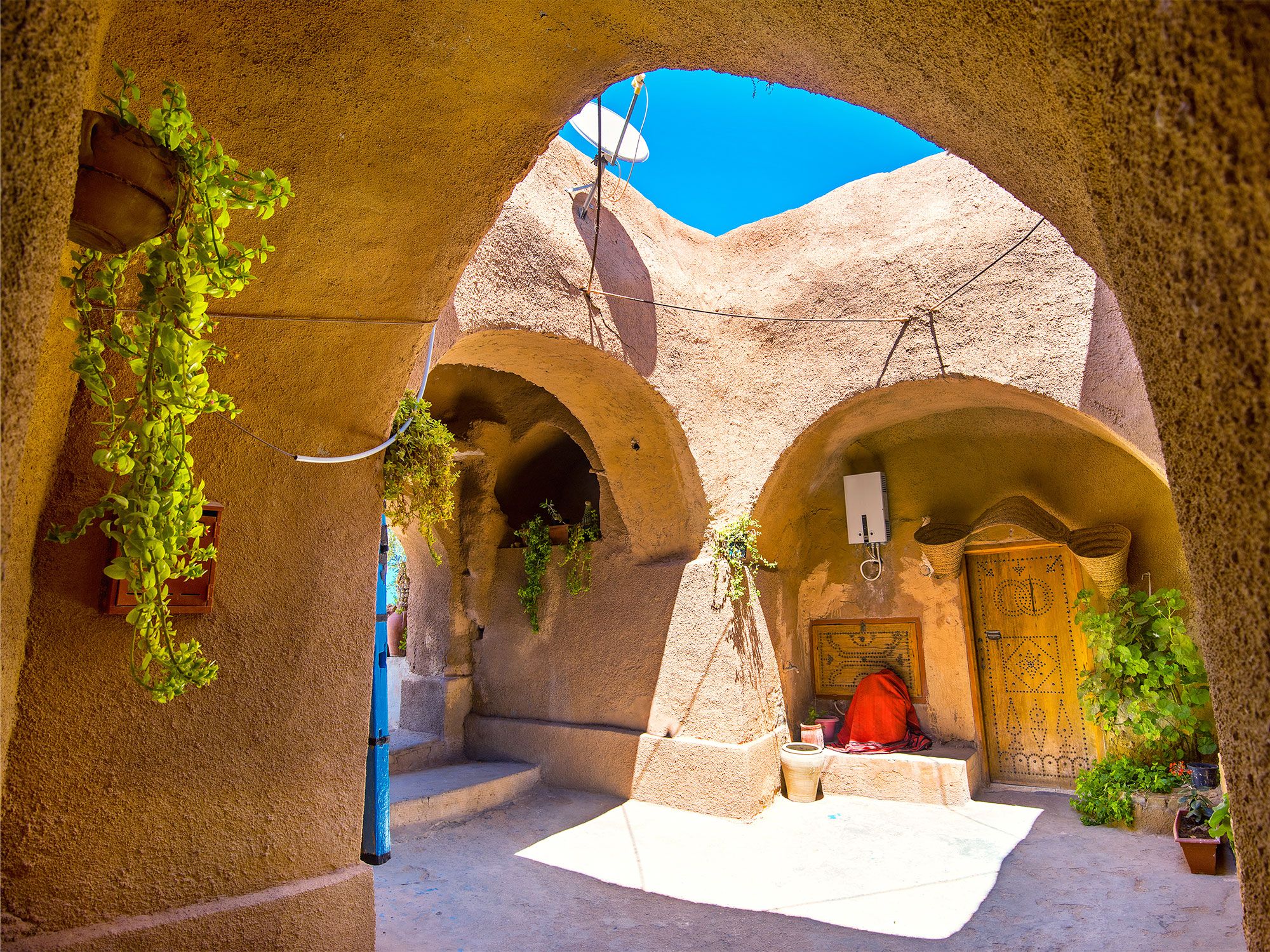
The small Berber village of Matmata, located in southern Tunisia, features a series of semi-underground dwellings. These homes are configured around deep, circular pits in the native sandstone — a rock that tends to be soft enough to carve into even with hand tools. From there, additional caves, or “rooms,” are created around the central courtyard pit. The purpose of this construction is to protect residents from the extreme desert heat. In the 1970s, more traditional, above-ground construction hit the area, but many locals still preferred their subterranean dwellings hidden among the area’s olive and palm trees.
It’s unclear when nomadic tribes first settled in the area. The town was virtually unknown until a flood in the 1960s brought the settlement and its underground homes to the attention of the Tunisian government. That said, these homes and the arid, craggy landscape typical in the Djebel Dahar mountains of southern Tunisia might seem familiar. They were featured prominently in Star Wars; an inn called the Hotel Sidi Driss was used as the otherworldly backdrop of Luke Skywalker’s family home.
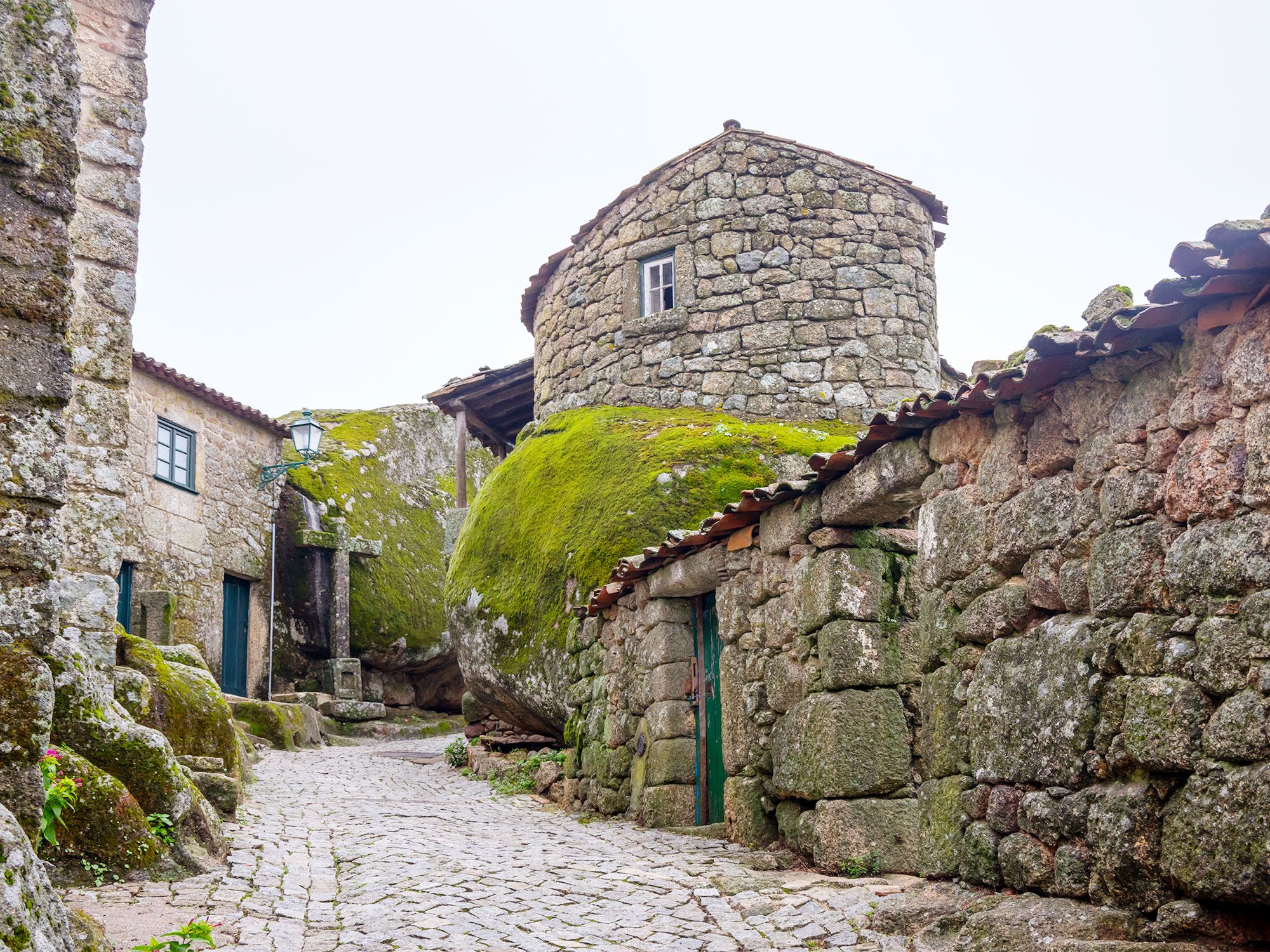
Monsanto was dubbed the “most Portuguese town in Portugal” back in 1938. But that might be a bit of a misnomer — few towns in Portugal, or anywhere, are so defined by their unusual landscape. Centrally located in the countryside, Monsanto is perched at the crest of a 400-foot-tall hill famous for its massive granite boulders and outcroppings. The rocks are so prevalent that the village is built right into them — homes and buildings use the massive stone slabs as walls and even roofs. Some homes are carved right into the boulders; keep your eyes peeled for huge granite mounds featuring windows and front doors.
The town’s unique construction has a storybook effect, with the village featuring moss-covered stone, red-tiled roofs, and narrow, cobblestone lanes curving up the remains of a castle. Dating back to medieval times, the castle and the village below have sweeping views in all directions. That visibility made Monsanto and the Templar Castle a strategic defensive stronghold throughout prehistoric times — famously withstanding the Napoleonic invasion. Today, the village has been designated a living museum by the Portuguese government, which means this spot looks a lot like it has for centuries and will remain that way.
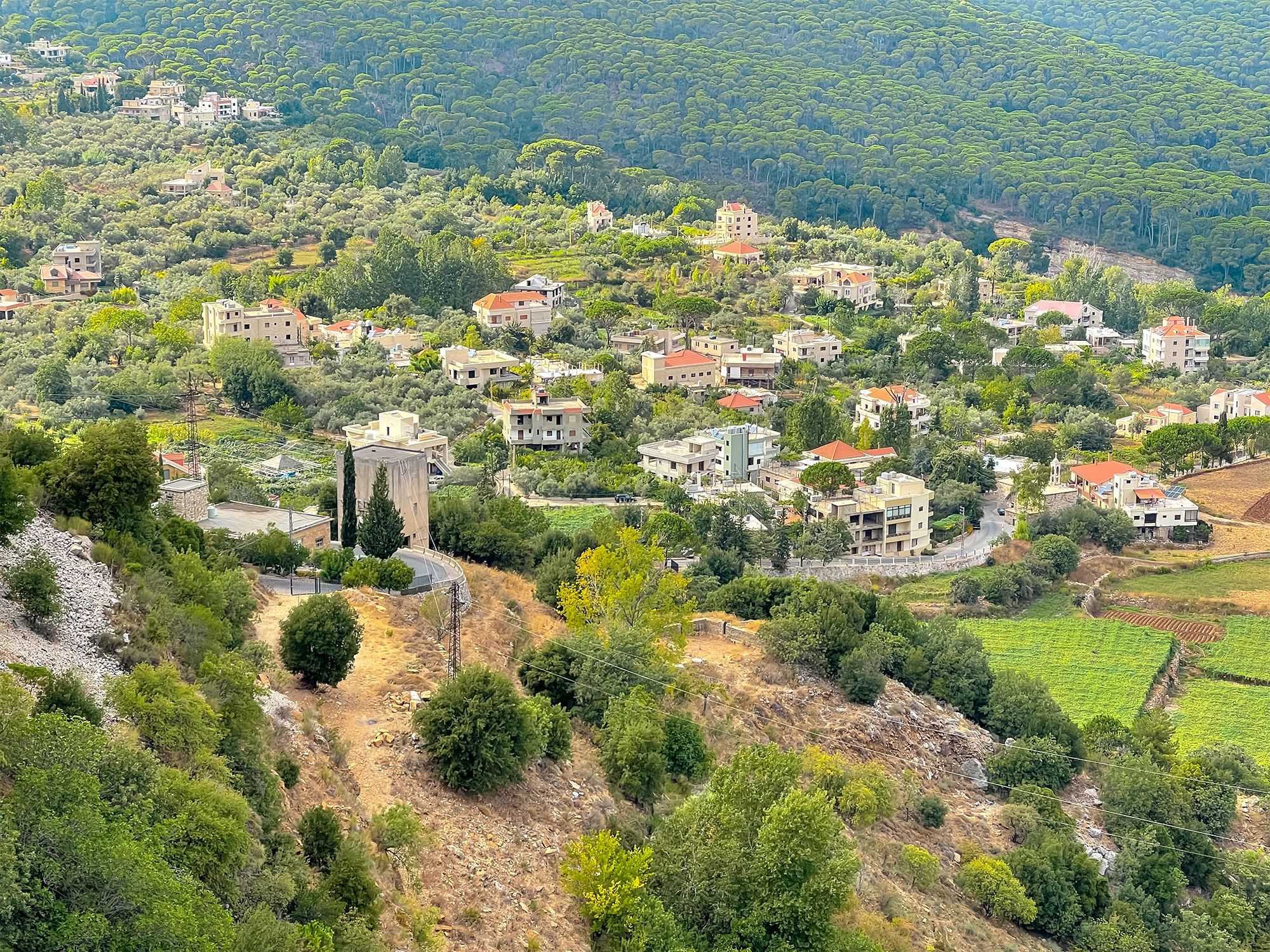
About 25 miles south of Beirut, among pine forests and vineyards, is the resort town of Jezzine. Dangling from a rocky promontory and overlooking a lush valley, the town hugs a 240-foot-tall waterfall — one of the highest in the country. Those eponymous falls — the reason Jezzine is nicknamed the “City of Falls” — are especially dramatic in winter and spring. You can experience the sweeping views from a lookout point or one of the cafés at the top. Or, you can hike along the falls — taking in the region’s idyllic, high-altitude landscape and exploring the cliff’s caves. One cave, the Fakhreddine Grotto, is especially significant — serving as a refuge and hiding spot from the 17th-century Ottoman Empire through World War II.
Jezzine is rich with history — there are monasteries and churches, Phoenician and Roman ruins, an antique wine press, and the huge Bkassine pine forest — home to historic bridges and mills. In town, visitors can sample the region’s well-known wines and shop for traditional mosaic and stone daggers featuring intricate inlay patterns at the many shops made of stucco with red-tiled roofs.
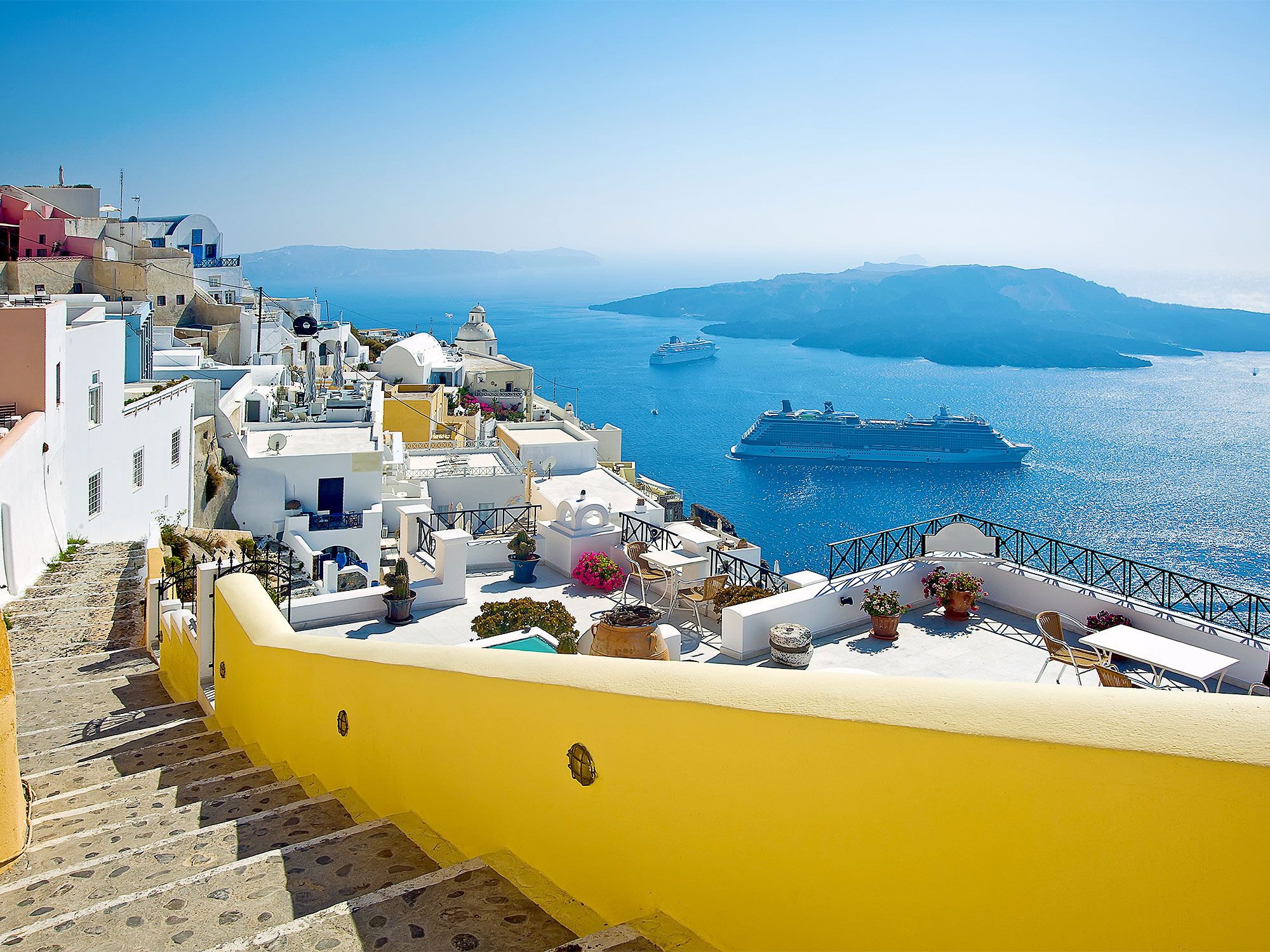
Fira, the capital of the Greek island of Santorini, is home to around 15,000 residents, but the island hosts over 2 million tourists each year. That’s no surprise; this gorgeous spot boasts some of the most famous and stunning sunsets in the world. And the town isn’t too shabby, either. Clinging to sheer cliffs, the town features whitewashed stucco walls, charming archways, beautiful tiles, azure blue roofs, and a warren of cobbled streets that open up to lush gardens and sweeping ocean views.
But Fira’s Old-World charm and glorious turquoise waters aren’t just beautiful, they’re incredibly unique. The town — actually, the whole island — is a caldera. And it’s the only inhabited one in the world. A caldera is a cauldron-like depression or sinkhole that is formed after a volcano erupts and collapses. The island’s bay, famously half-moon shaped in the center of the caldera, was created during a massive eruption in the Minoan era. This means Santorini and the picturesque town of Fira are located on the brim of a volcano!
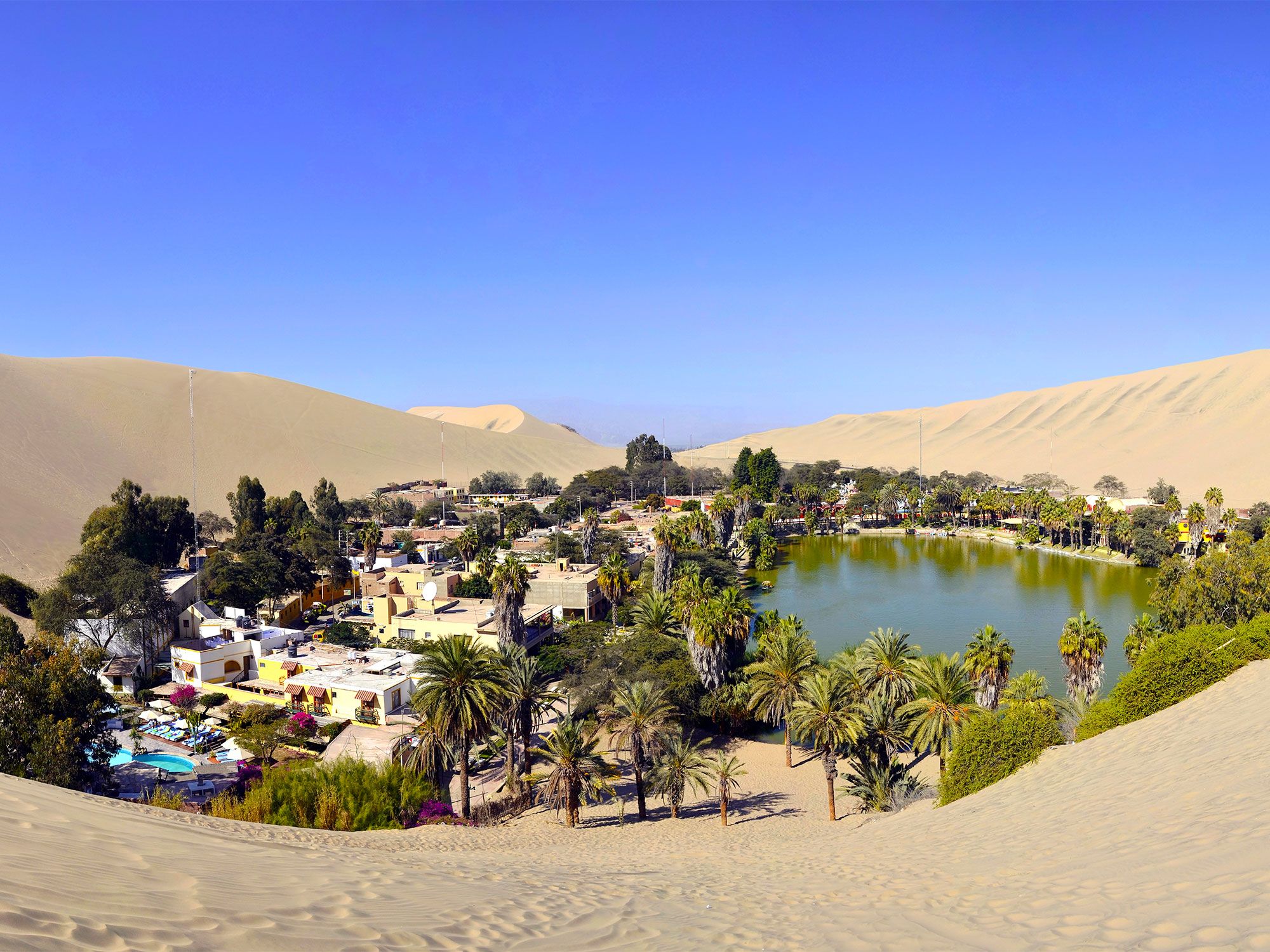
Peru might be well-known for its majestic Andes mountains, but along the coast lies a strip of desert with sweeping, white sand dunes that could double for the Sahara. One of the most interesting ways to check out this region, which is among the driest on Earth, is a trip to Huacachina. Located a few hours south of Lima, and close to the city of Ica, this tiny town encircles a spring-fed lagoon that fosters a lush oasis dotted with palms and rich tropical foliage. The waters of the lagoon are believed to have therapeutic properties, which made this village a popular destination for Peruvian elites in the 1940s. Today, Huacachina is a popular vacation destination, offering adventure sports, lively parties, and winery tours. It’s easy to be enchanted by the Spanish colonial architecture, the main drag’s mermaid statue, and the dramatic way the town is illuminated at night.
Less than 100 people call Huacachina home, and most work in tourism at inns, hostels, and restaurants. Taking a paddleboat across the lagoon is a popular pastime, along with desert hikes, sandboarding, and dune buggy rides. Those who don’t work in tourism still work in sand — exporting it is the region’s other main industry.
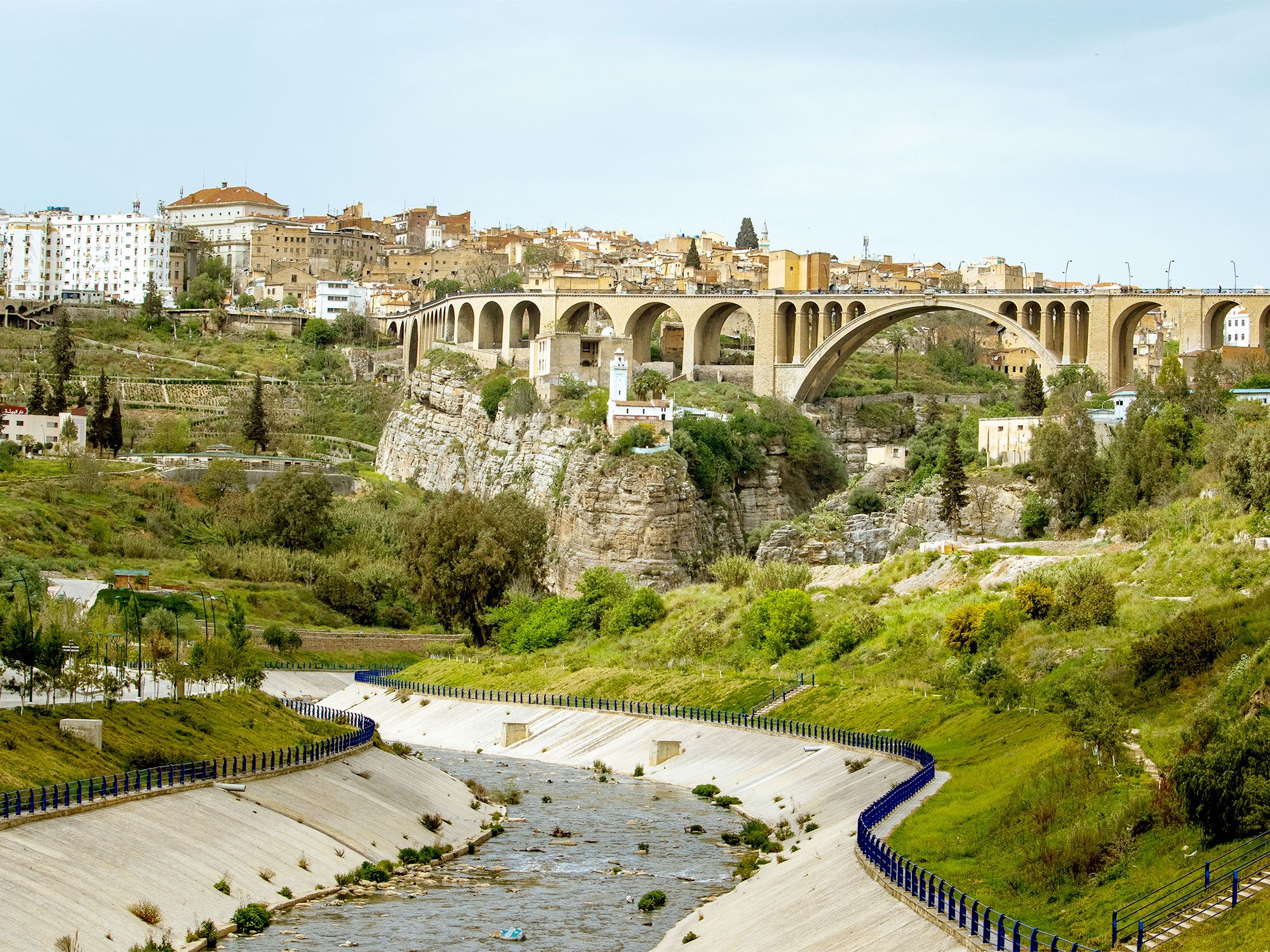
The city of Constantine, named in honor of Emperor Constantine the Great, is famous for its eight picturesque bridges (and its “City of Bridges” moniker). Why so many bridges? The city is split by the Rhommel Gorge — over a mile in length with an average depth of 400 feet. The bridges connect the crags and cliffs the city is built on — adding architectural wonder to this rugged mountain landscape. Gantaret El Hibal Bridge (also known as the Sidi M’Cid Bridge) is the city’s most famous bridge. Completed in 1912, it was the highest bridge in the world until 1929.
Constantine dates back to 600 BCE, when under the Berbers, it was called Citra. The city was also a Roman stronghold, and still offers visitors the chance to experience ancient Roman ruins both within city limits and two hours away at Djemila, an official UNESCO World Heritage Site. In addition, Constantine is also home to Ottoman palaces, ornate French colonial hotels, a huge mosque, and a series of epic monuments to marvel at.
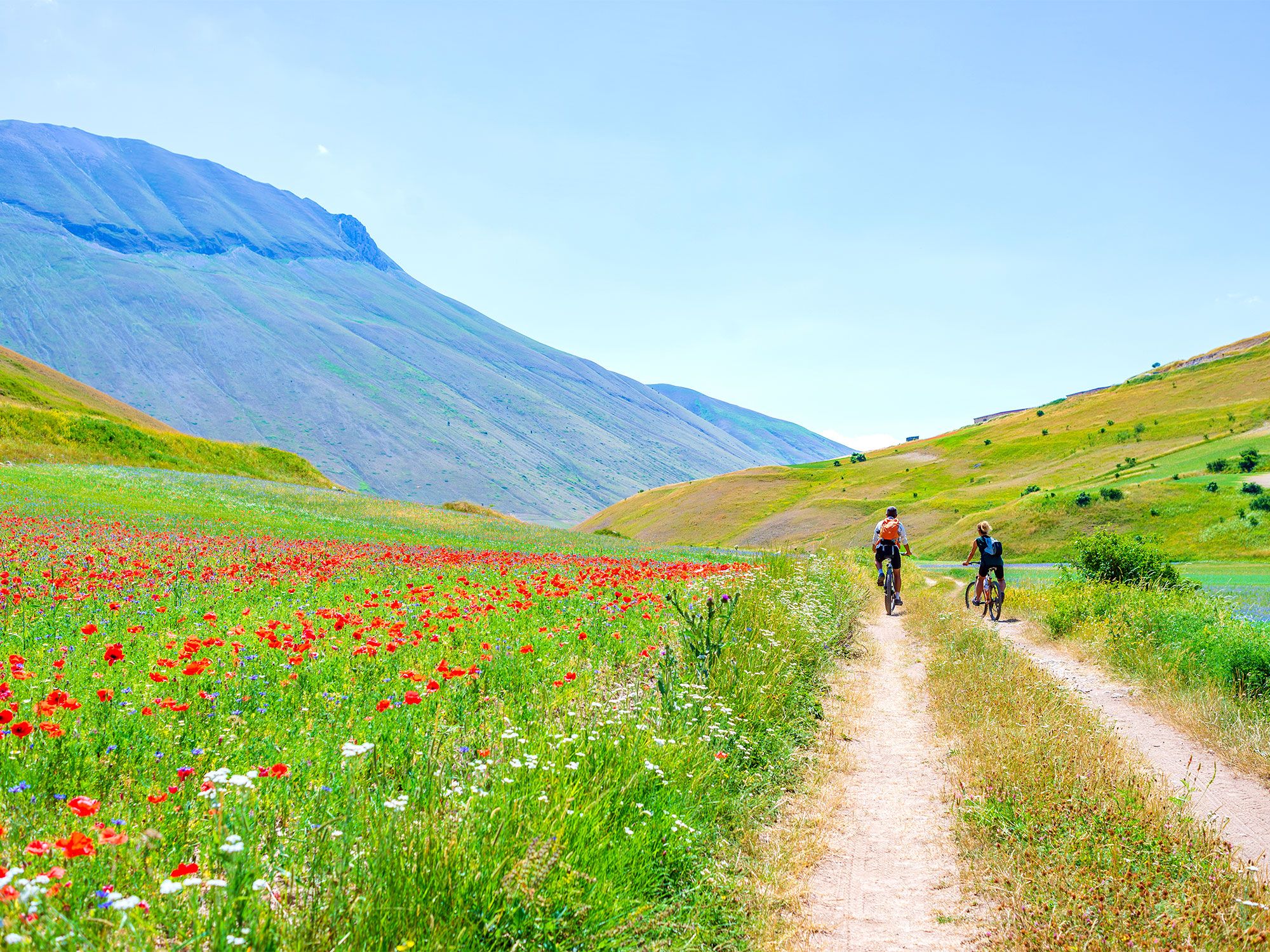
At roughly 4,700 feet above sea level, the Italian village of Castelluccio is one of the highest-elevation towns in the Apennines Mountains. Getting to town is quite the journey — the hairpin turns along the narrow road to town, running through Monti Sibillini National Park, aren’t for the faint of heart. But visitors are rewarded with breathtaking panoramic views of the Umbrian countryside — especially in the spring and summer when the region’s meadows and lentil fields erupt with colorful poppy, daisy, orchid, and cornflower blossoms.
The village is precariously located in front of the park’s highest peak, Monte Vettore. It dates to the 13th century, but the area has been settled since the ancient Roman era — thanks to its incredible views and fertile lands. Today, visitors flock to Castelluccio for skiing, horseback riding, hiking, hang-gliding, and paragliding, but the town is home to few permanent residents. Only about a hundred people actually live in Castelluccio since a series of earthquakes struck the area in 2016.
Advertisement
More from our network
Daily Passport is part of Inbox Studio, an email-first media company. *Indicates a third-party property.
Architecture •August 10, 2023•Updated: August 10, 2023
By Bennett Kleinman
Author
Bennett Kleinman
Bennett is a New York City-based staff writer for Daily Passport. He previously contributed to television programs such as the Late Show With David Letterman, as well as digital publications like the Onion. Bennett has traveled to 48 U.S. states and all 30 Major League Baseball stadiums.
While the majority of metro stations serve a practical purpose as commuter hubs, some train terminals take their design to new artistic heights. Highlighted by unusual architecture, stunning mosaics, and even a few ancient relics, these metro stops have been transformed into vibrant art installations, adding an unexpected twist of culture to an otherwise mundane commute. Just be careful not to miss your train while basking in the architectural and artistic wonder of these six strikingly beautiful subway stations around the world.
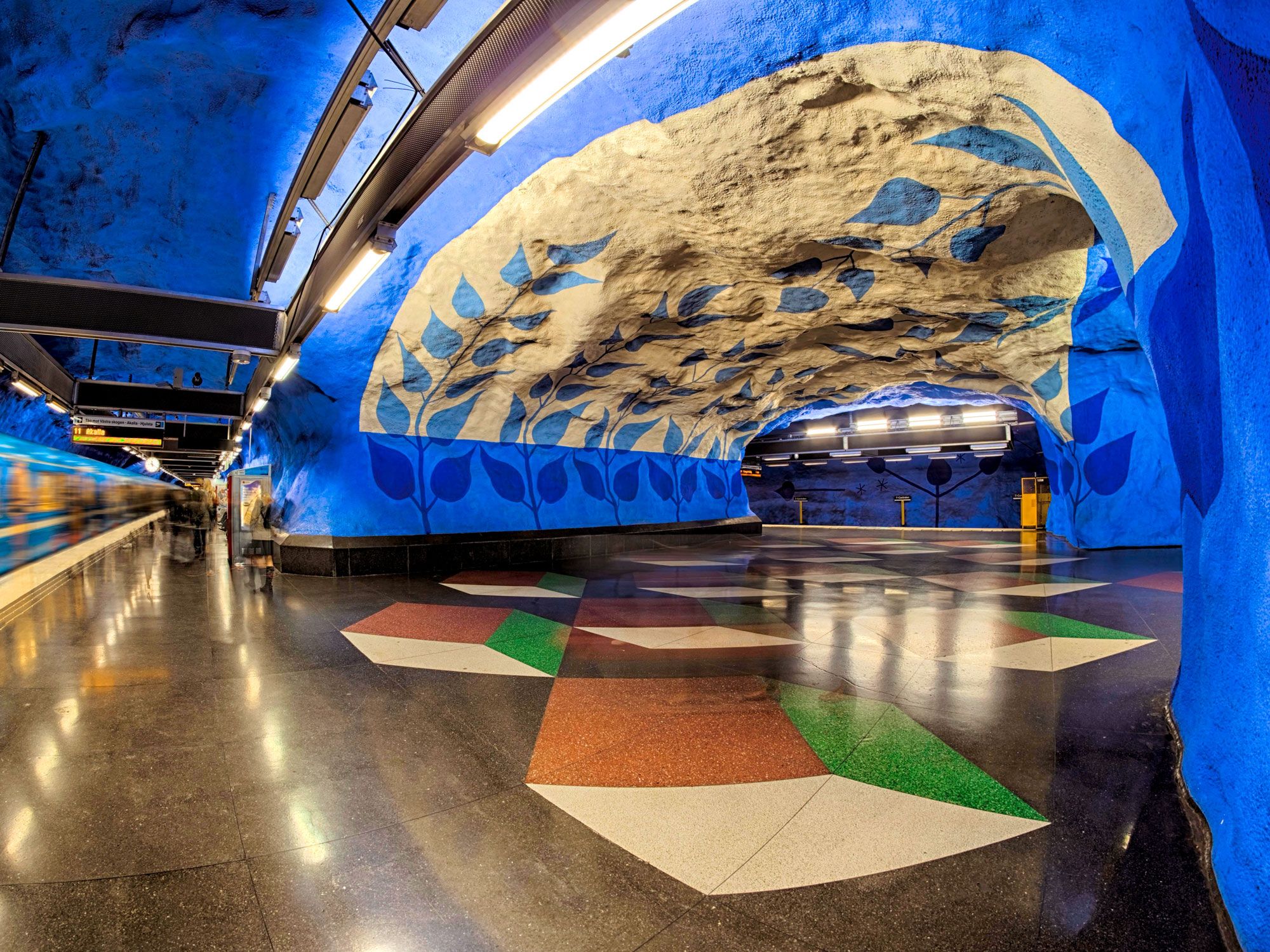
Nicknamed the “world’s longest art gallery,” the Stockholm Metro is famous for its picturesque subway stations, many of which incorporate the exposed underground rock into fantastic art displays. Since the 1950s, more than 150 artists have worked on transforming every station in the network. A highlight is Solna Centrum, which features a ceiling that’s painted a bright red color and adorned with tiny houses and trees. Then there’s Thorildsplan T-Bana, known for its bright mosaics designed to reflect classic eight-bit video game scenes.
T-Centralen station, which opened in 1957, was the first station in the city to feature vibrant artwork. T-Centralen serves the city’s blue line — an appropriate fact given that it’s decorated with a striking combination of white and blue paint. Artist Per-Olof Ultvedt covered the station in murals which prominently feature leaves on the vine crawling up the walls. Located at the top of the escalator are a series of blue silhouettes painted onto the rock that depict the individuals who built the station.
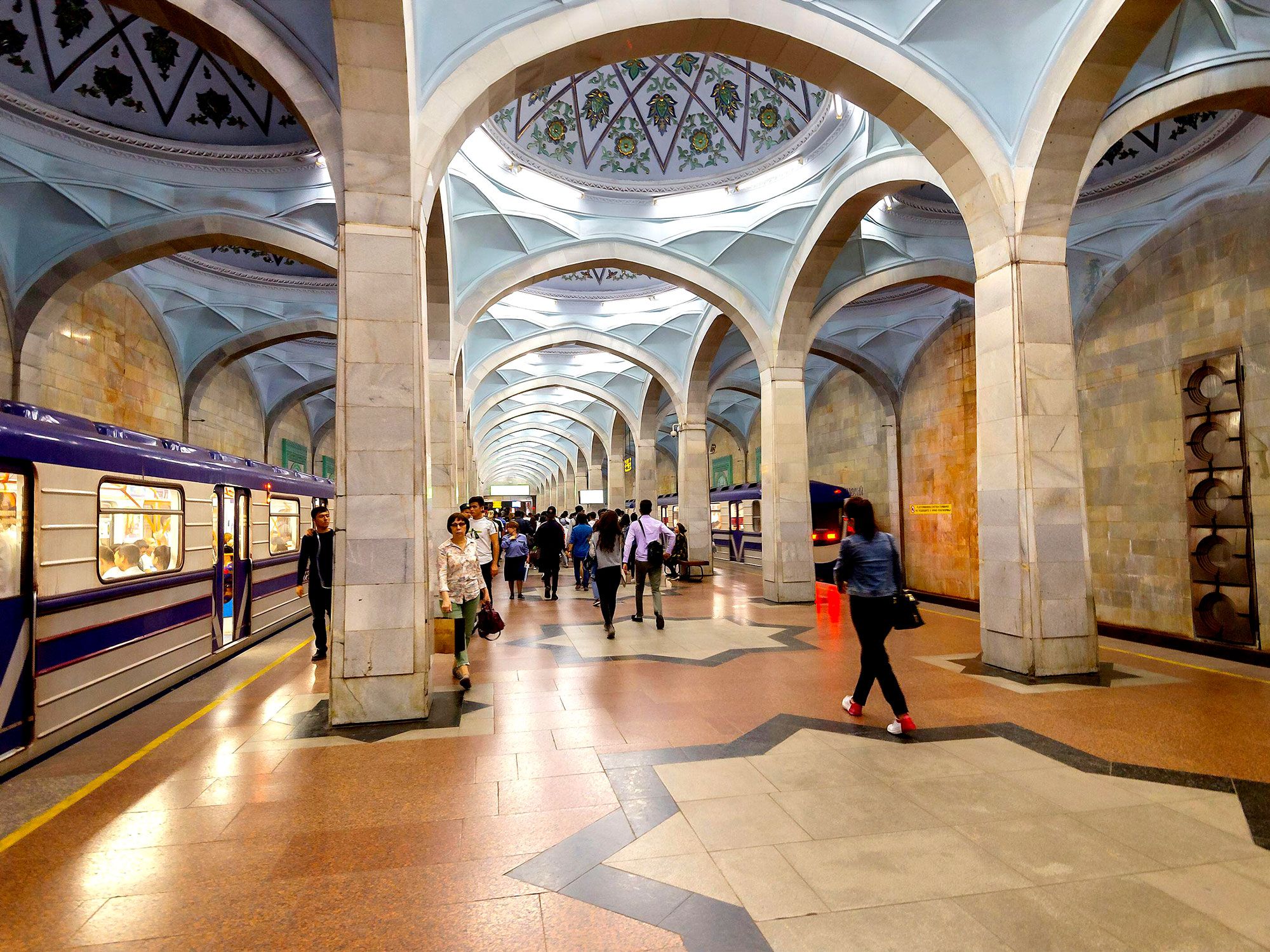
Serving Uzbekistan’s capital city of Tashkent, Alisher Navoiy Station was named after the great 15th-century Uzbek poet who laid the groundwork for the development of the modern Uzbek language. Much like the poetry of Alisher Navoiy, this station is renowned for its beauty, highlighted by its marble columns that line the main platform and extend upwards. The main platform’s roof is even grander, with floral-decorated domes that are reminiscent of Silk Road-era mosque designs that were built long before the railway existed.
The station’s halls are lined with a series of turquoise ceramic murals that depict scenes from Navoiy’s poetry collections, including images of mythical figures, ancient scholars, and legendary musicians. Alisher Navoiy Station first opened in 1984, though it took until 1997 for work to be completed.
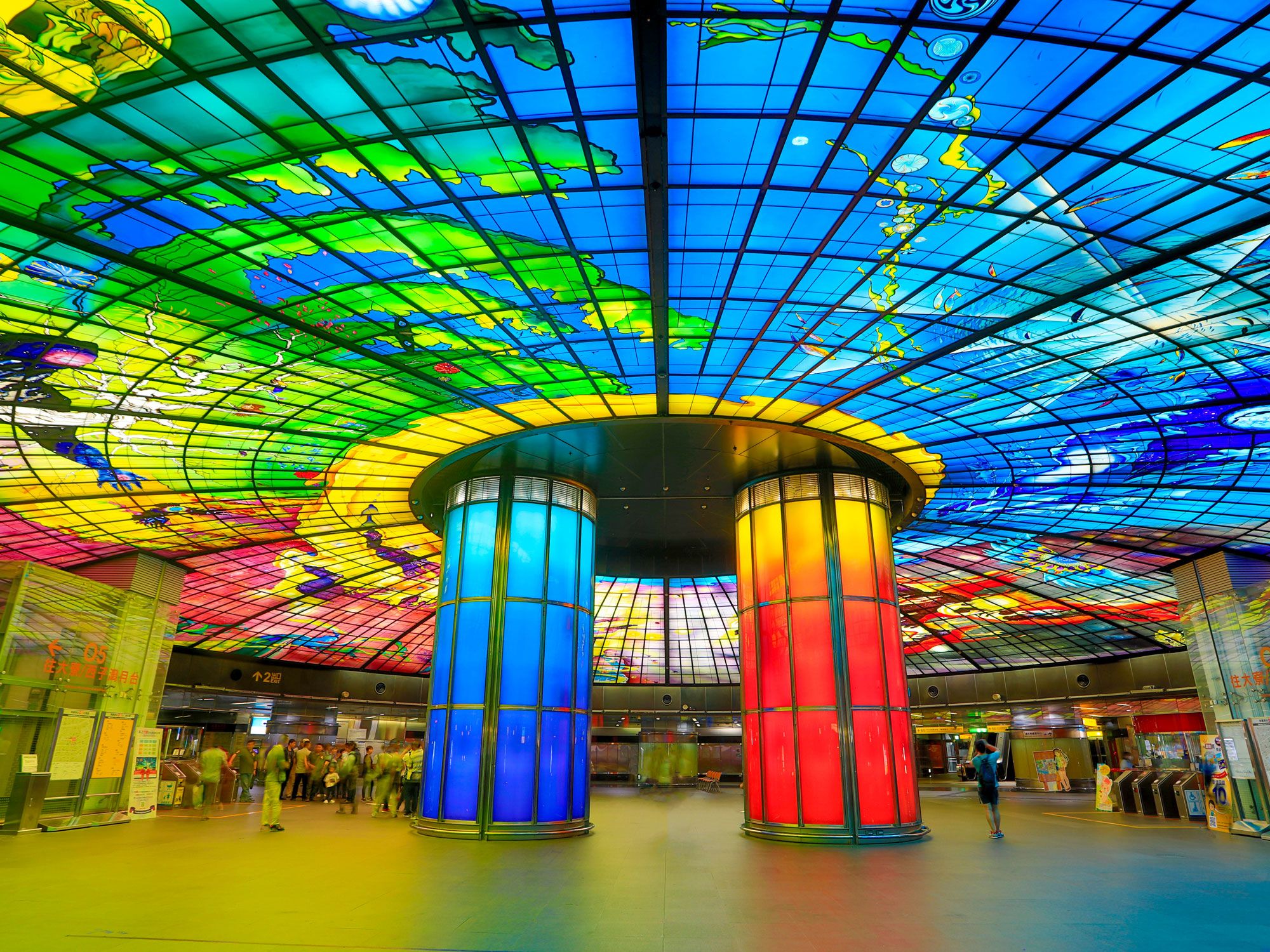
A miraculous Dome of Light looms above Formosa Boulevard’s transit station, which serves the Taiwanese city of Kaohsiung. The station opened in 2008 after four years of painstaking development and design by artist Narcissus Quagliata. The artist used 4,500 glass panels to cover an area of 7,100 square feet — impressively, 1,152 of those panels are hand-painted.
The Dome of Light — one of the world’s largest works of glass art — showcases four elements of human life: water, earth, light, and fire. It can be viewed for free by commuters and art lovers alike. A point of pride for Kaohsiung, the station’s opening catalyzed a city-wide cleanup effort that helped revitalize and rehabilitate the community.
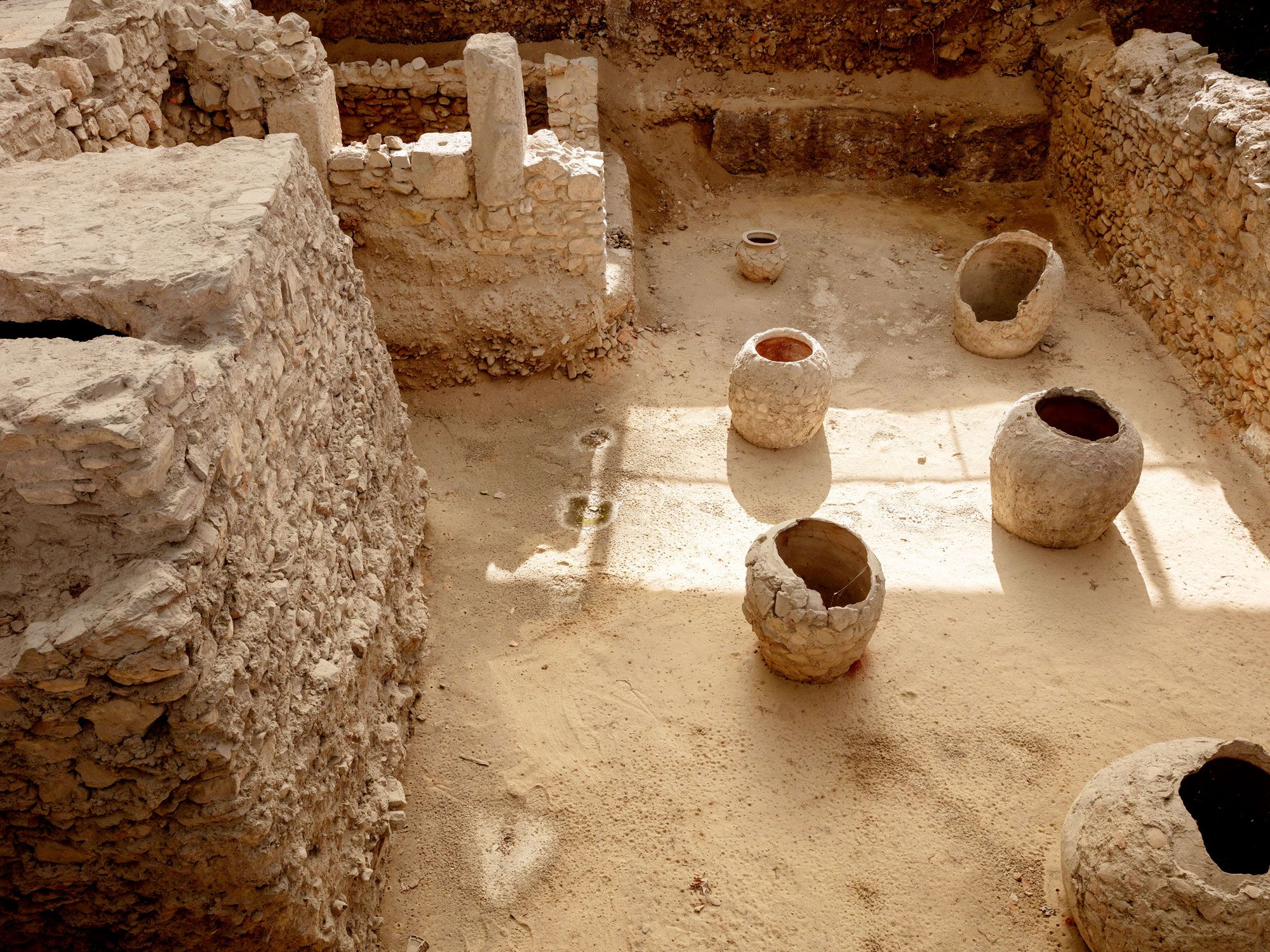
While perhaps lacking the same visual wow factor as other metro stops on this list, the Syntagma metro station in Athens is unique for its archeological value. The station is home to a free museum containing ancient Greek relics that date as far back as the fourth century BCE.
Among the many highlights is a column that once stood within an ancient Greek temple and was later repurposed as a gameboard after the temple’s destruction. Other notable pieces include terracotta vessels from the third century BCE and perfume vessels from the second century BCE. It’s not just ancient works: Modern Greek art is found around every corner, including a clock sculpture from acclaimed Greek sculptor Thodoros Papadimitriou. Syntagma is among the city’s busiest metro stations, which has been the case since it first opened in 2000 as part of a revitalization effort in anticipation of the 2004 Athens Olympic Games.
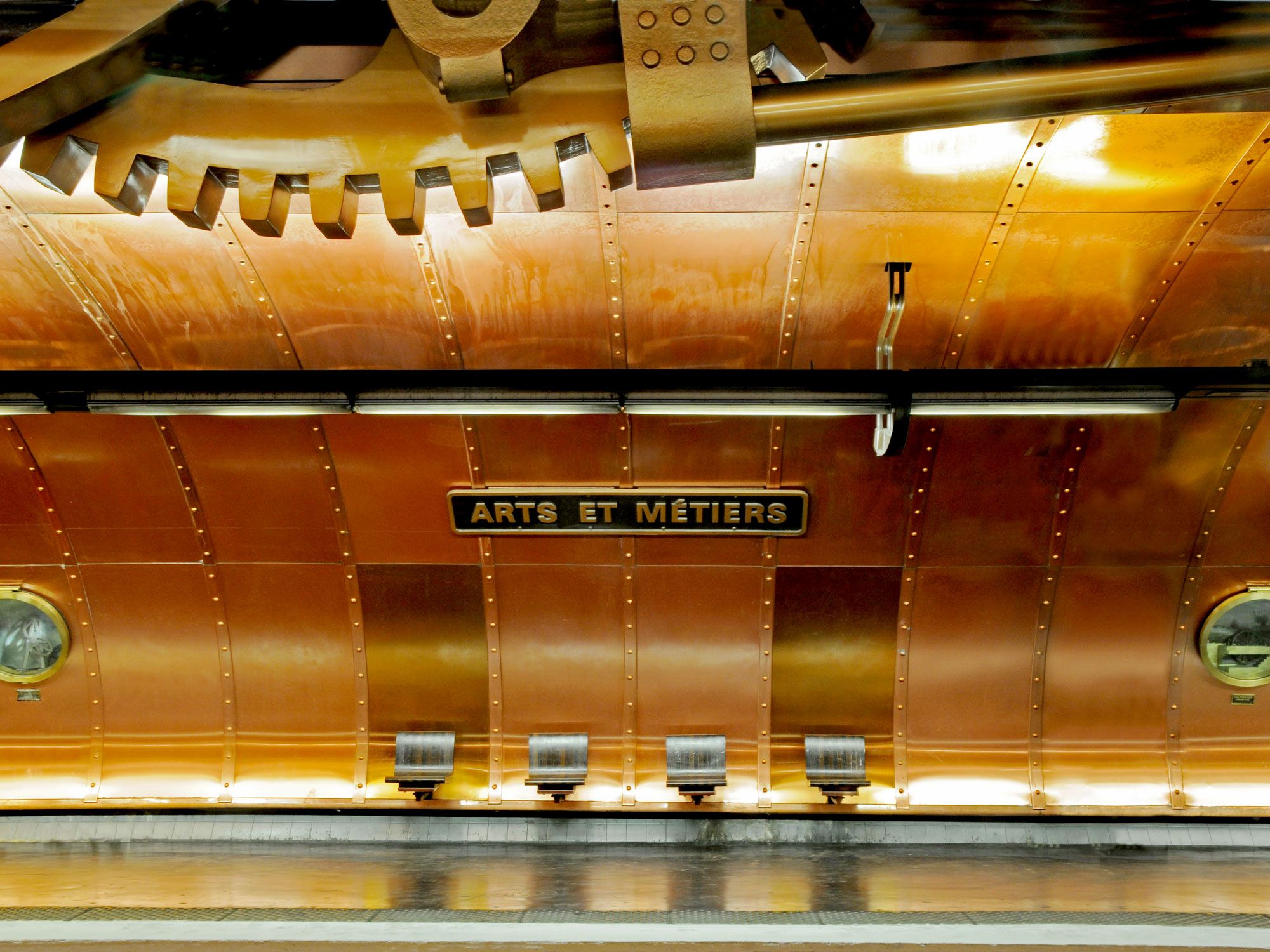
Prior to 1994, the Paris metro station Arts et Métiers wasn’t much to write home about. But that year, the station underwent a massive renovation that transformed it into a scenic steampunk paradise. Under the watchful eye of Belgian comic artist François Schuite, the station was outfitted with copper paneling throughout. The platform was also lined with portholes that commuters can look through, each of which contains fantastical scenes straight out of a Jules Verne novel — from flying airships to steampunk style compasses.
Gazing up at the ceiling, it’s hard not to be left in awe by the cogs and wheels hanging downward that make it seem like you’re in a working steampunk submarine. This scene can be found on platform number 11 at the Arts et Métiers station.
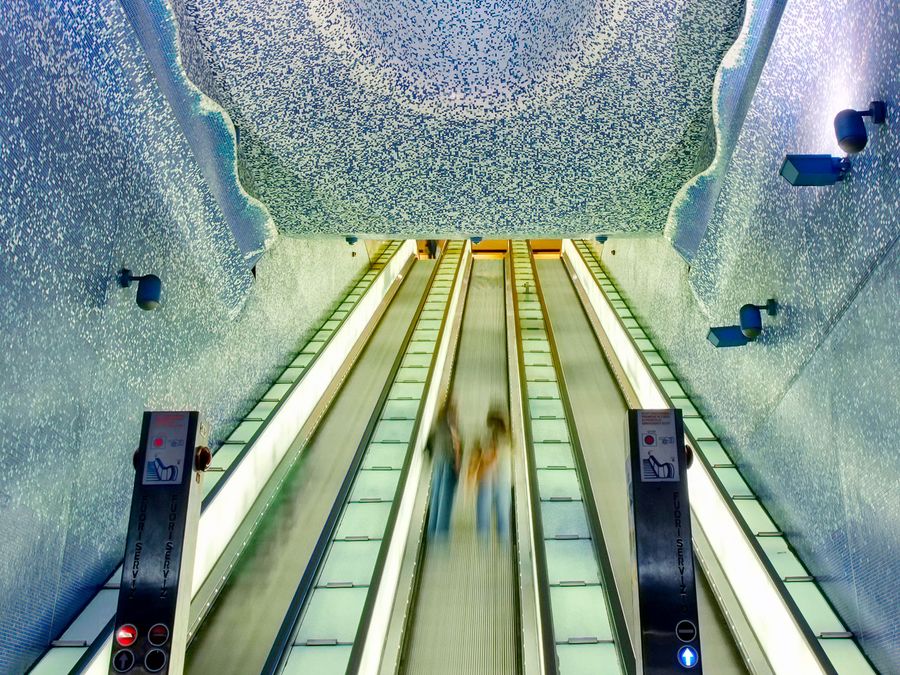
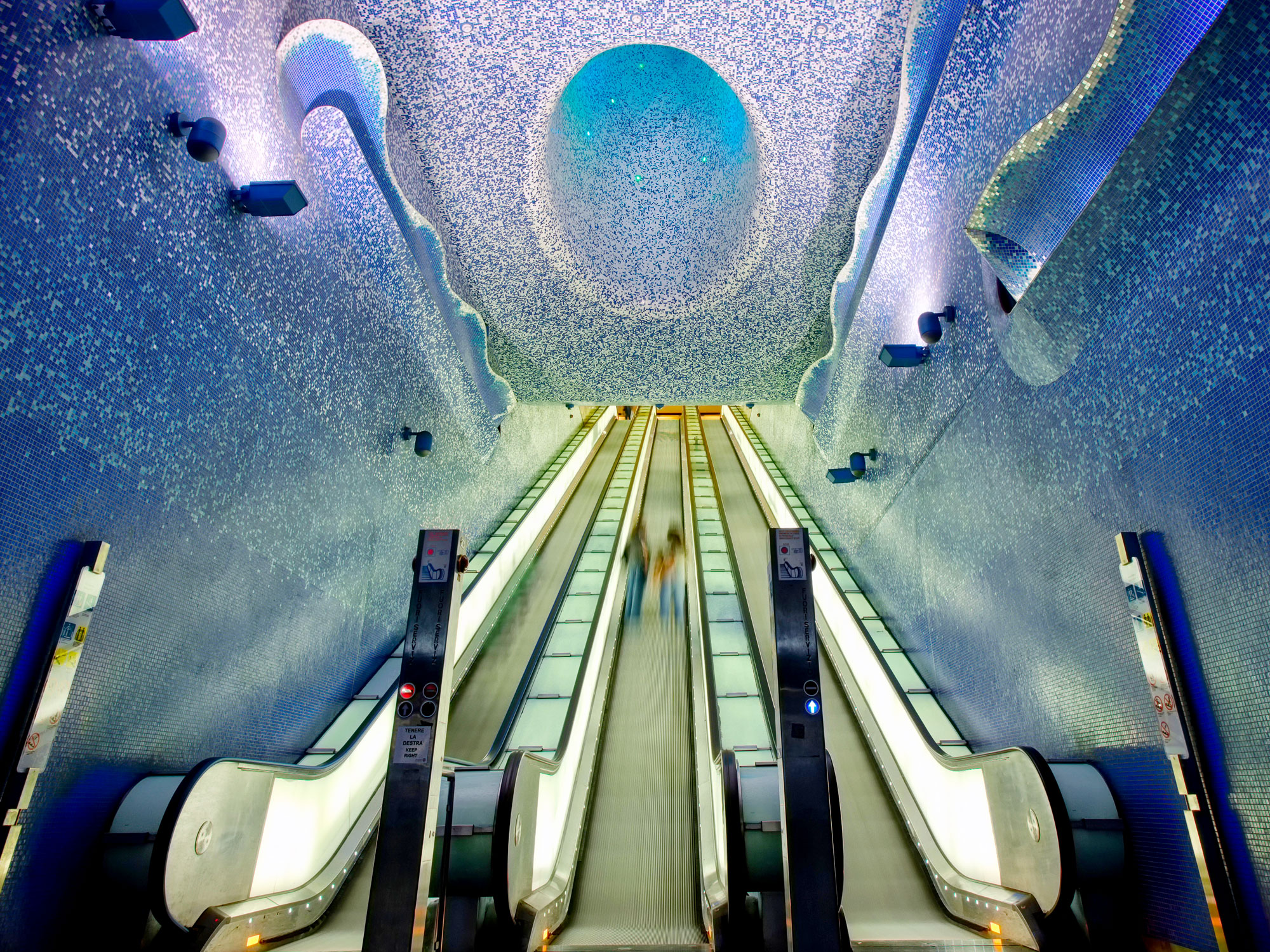
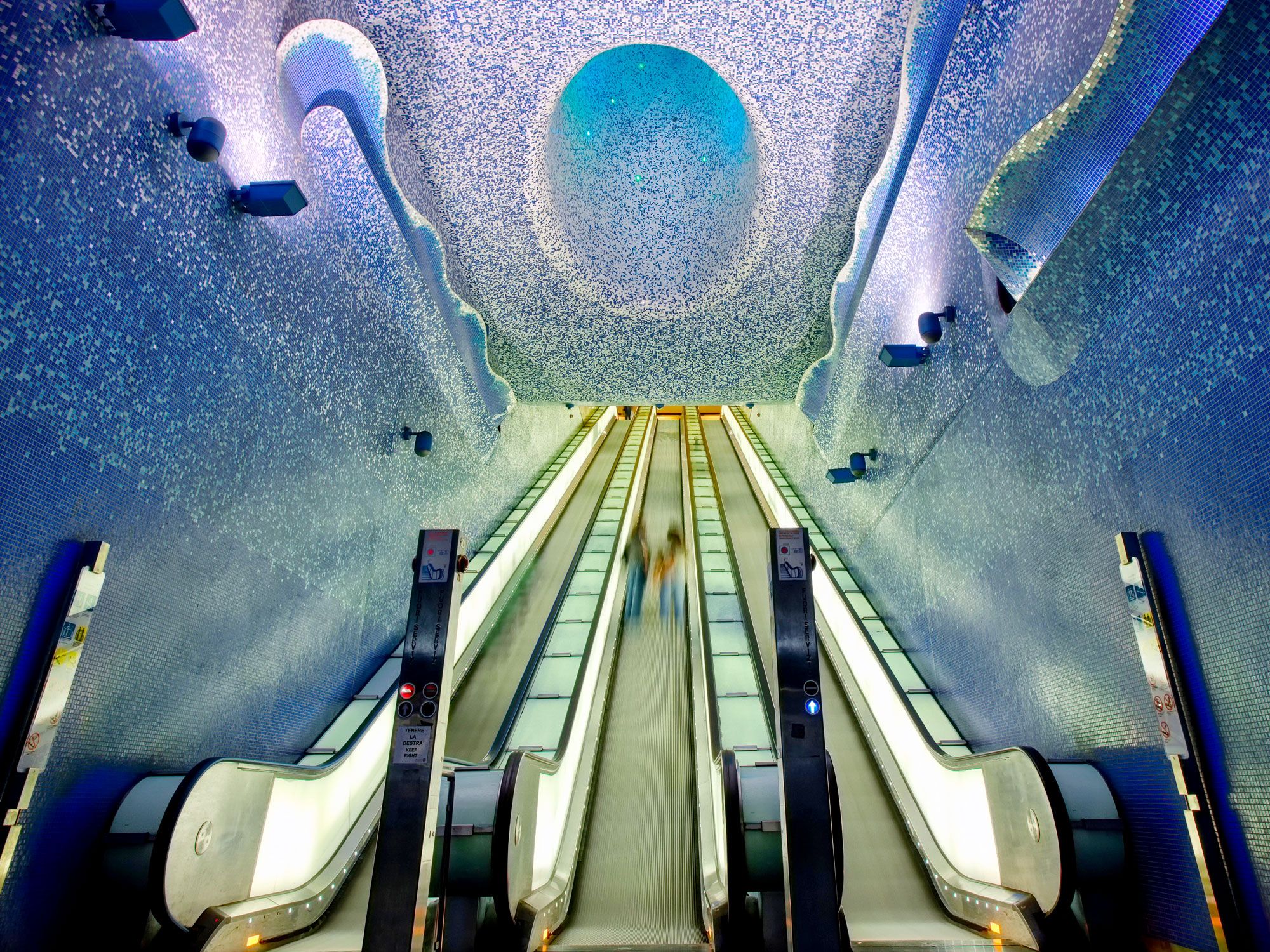
The redesigned Toledo metro station in Naples resulted from the citywide Stazioni dell’Arte project, in which contemporary Italian artists transformed several transit stations. Toledo’s station was freshly adorned with work from artists William Kentridge and Robert Wilson, who worked alongside architect Oscar Tusquets Blanca to redesign the space.
At the top of the station are black walls that reflect the asphalt of modern civilization. The further you sink into the station, those colors transform to ochre and yellow, reflecting the natural beauty of the region’s sun-soaked terrain. At the station’s lowest level, two LED light boxes create a wavelike effect as the colors transform to blue and green, reflecting the sea. The station’s centerpiece is a striking art installation called Crater de Luz (cone of light). Looming above the escalators, this bright, funnel-shaped mosaic structure draws light into the station, and is enhanced by an accompanying LED installation titled Relative Light from Robert Wilson.
Advertisement
More from our network
Daily Passport is part of Inbox Studio, an email-first media company. *Indicates a third-party property.
Fiona has spent her career exploring the world and working in the travel industry, turning her lifelong passion into a profession. From planning custom trips to sharing stories as a travel writer for publications such as The Discoverer, she’s all about helping others experience the world in a deeper, more meaningful way.
America’s big cities tend to draw the attention of travelers, but often overlooked are the many dark and isolated corners of the country that provide ideal conditions for one of nature’s most pleasurable pursuits: stargazing. In particular, many national parks — famous for their breathtaking landscapes and incredible wildlife — lay claim as the darkest places in the country, making them the ideal environment for stargazing. Looking to feel humbled by the vast size and beauty of the universe? Here are six great stargazing spots to visit in the U.S..
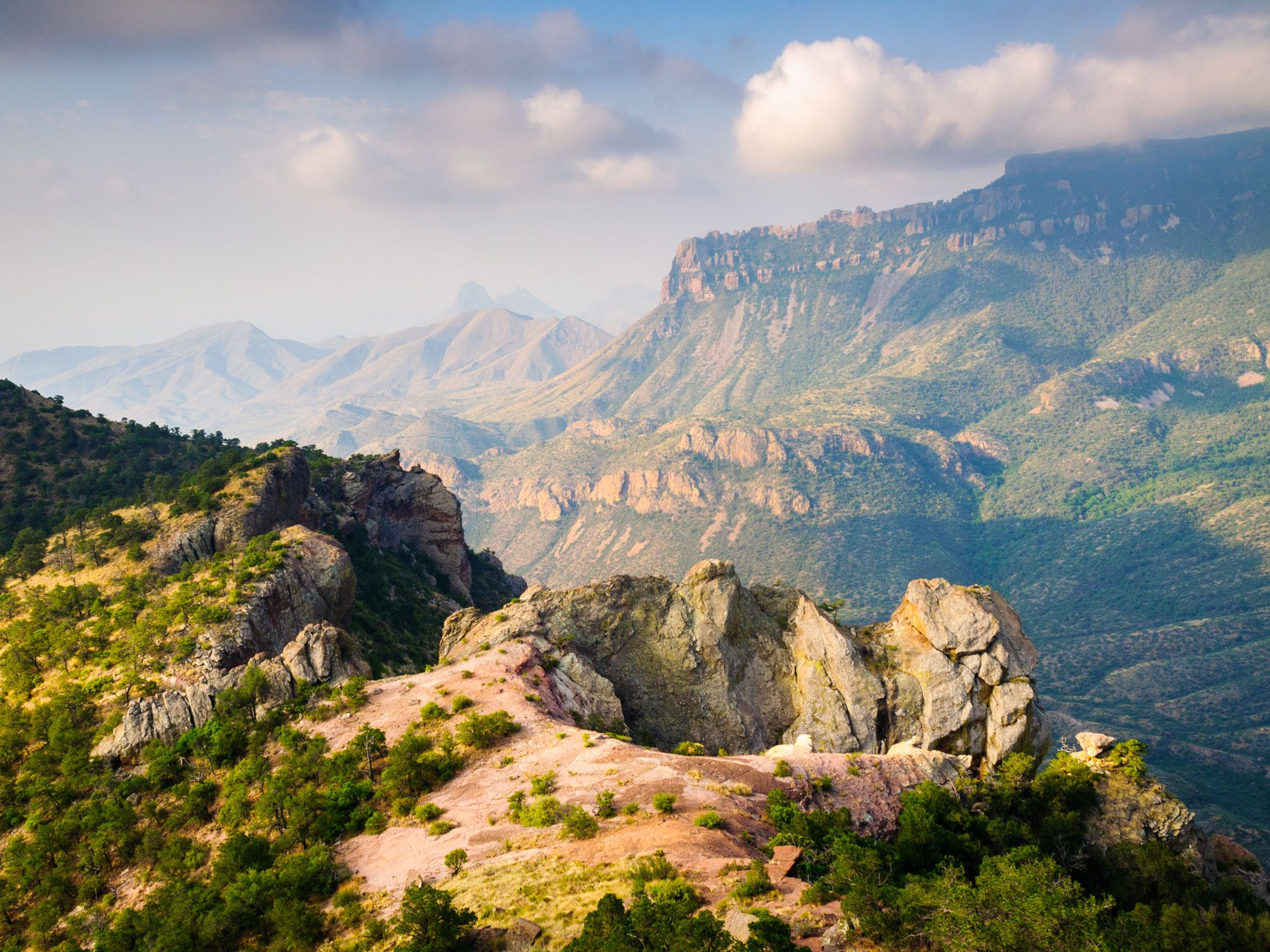
Big Bend National Park — covering over 800,000 acres in West Texas — has the lowest level of light pollution of any national park in the lower 48 states. The park forms part of the 9-million-acre Greater Big Bend International Dark Sky Reserve — the largest such protected area for stargazing in the world. Contributing to the optimal stargazing in this wild and isolated corner of the country is the lack of human population, ruling out the chance of seeing a glowing light from a house or nearby town. With just a pair of binoculars (or even the naked eye), visitors can spot meteor showers, constellations, and much of the Milky Way Galaxy. October to April is the park’s dry season and the most popular time to visit the park.
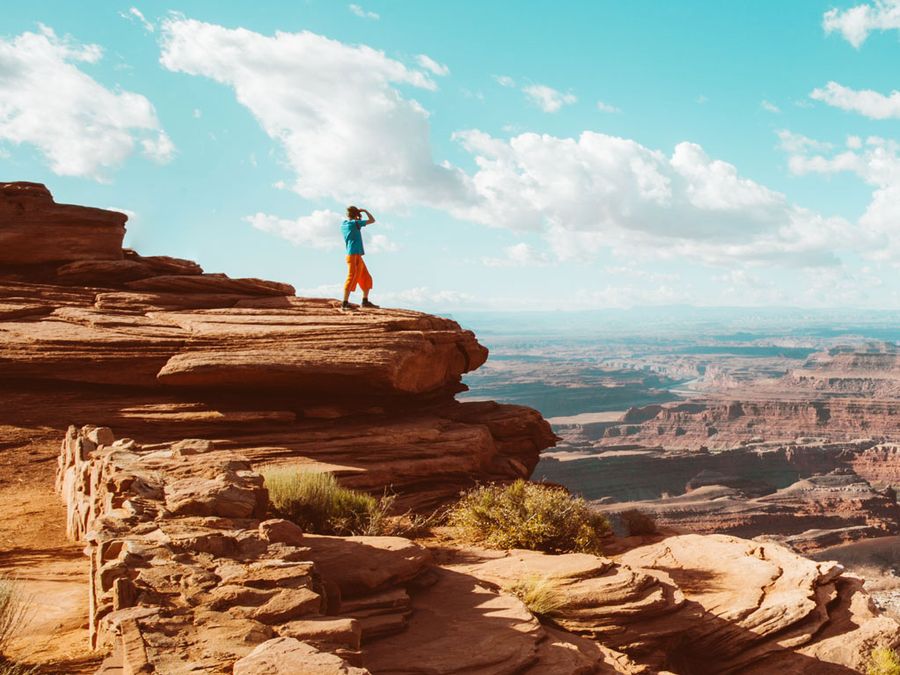
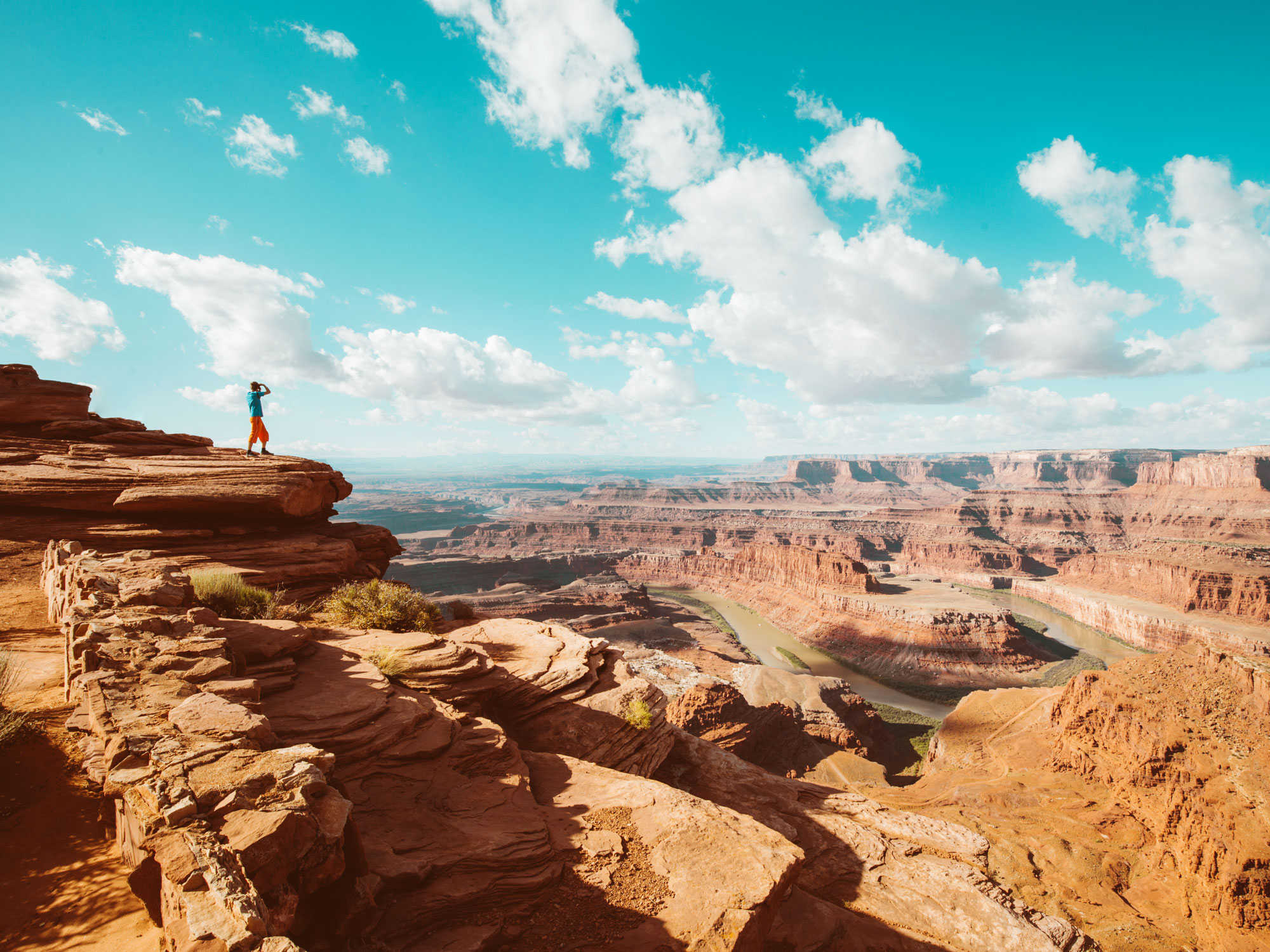
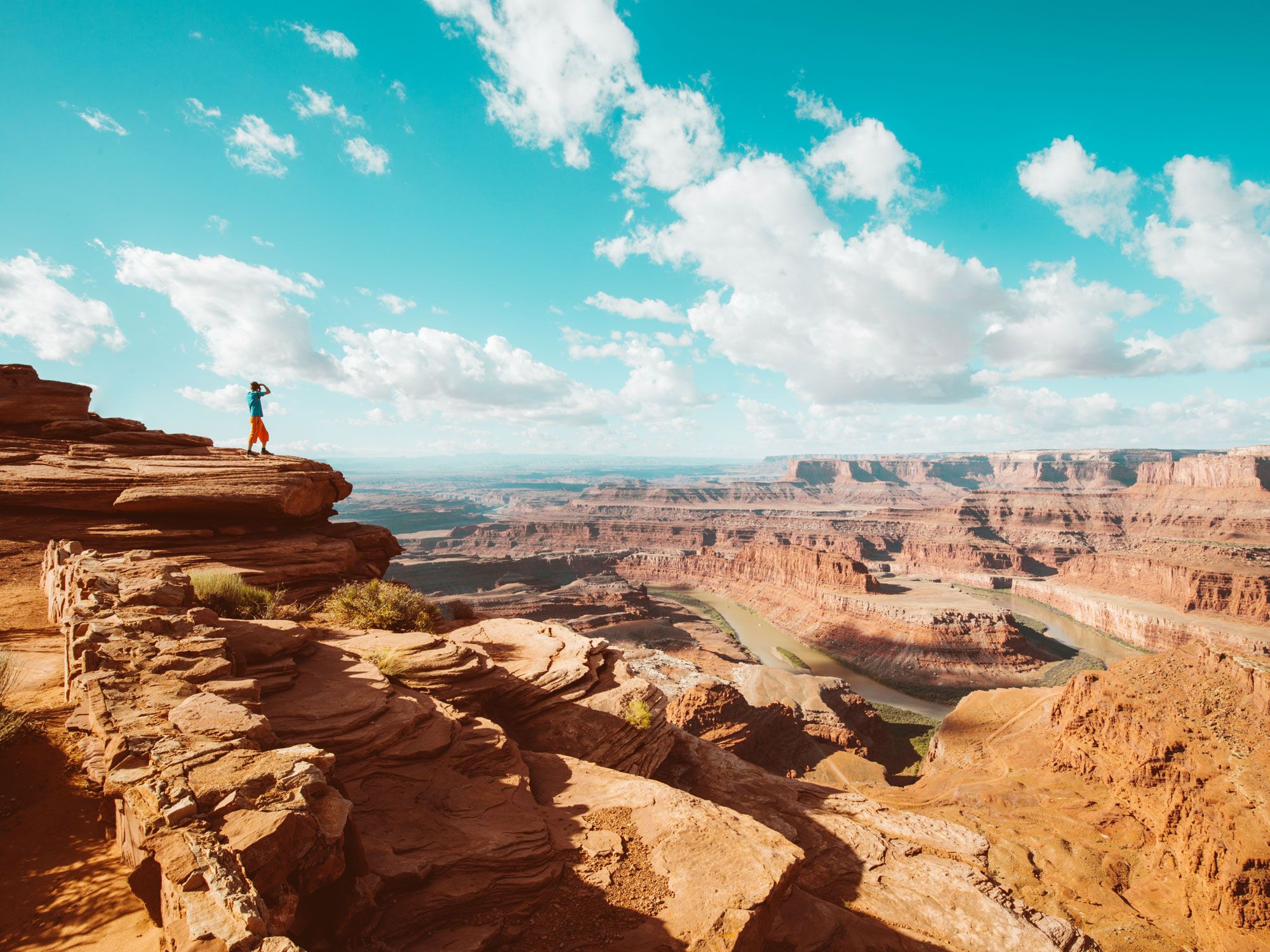
Canyonlands National Park is another certified International Dark Sky Park, which means it has “an exceptional quality of starry nights and a nocturnal environment that is specifically protected for its scientific, natural, educational, cultural heritage, and/or public enjoyment,” according to the organization that set out “to preserve and protect the nighttime environment and our heritage of dark skies.” Located in southeastern Utah, Canyonlands is famous for its dramatic rock formations. It also joins the ranks with Big Bend National Park with one of the darkest skies in the contiguous U.S. — on the darkest, clearest nights, roughly 15,000 stars can be seen from the park (compared to 500 by the average city-dweller). On a moonless night, binoculars can even be enough to see the rings of Saturn.
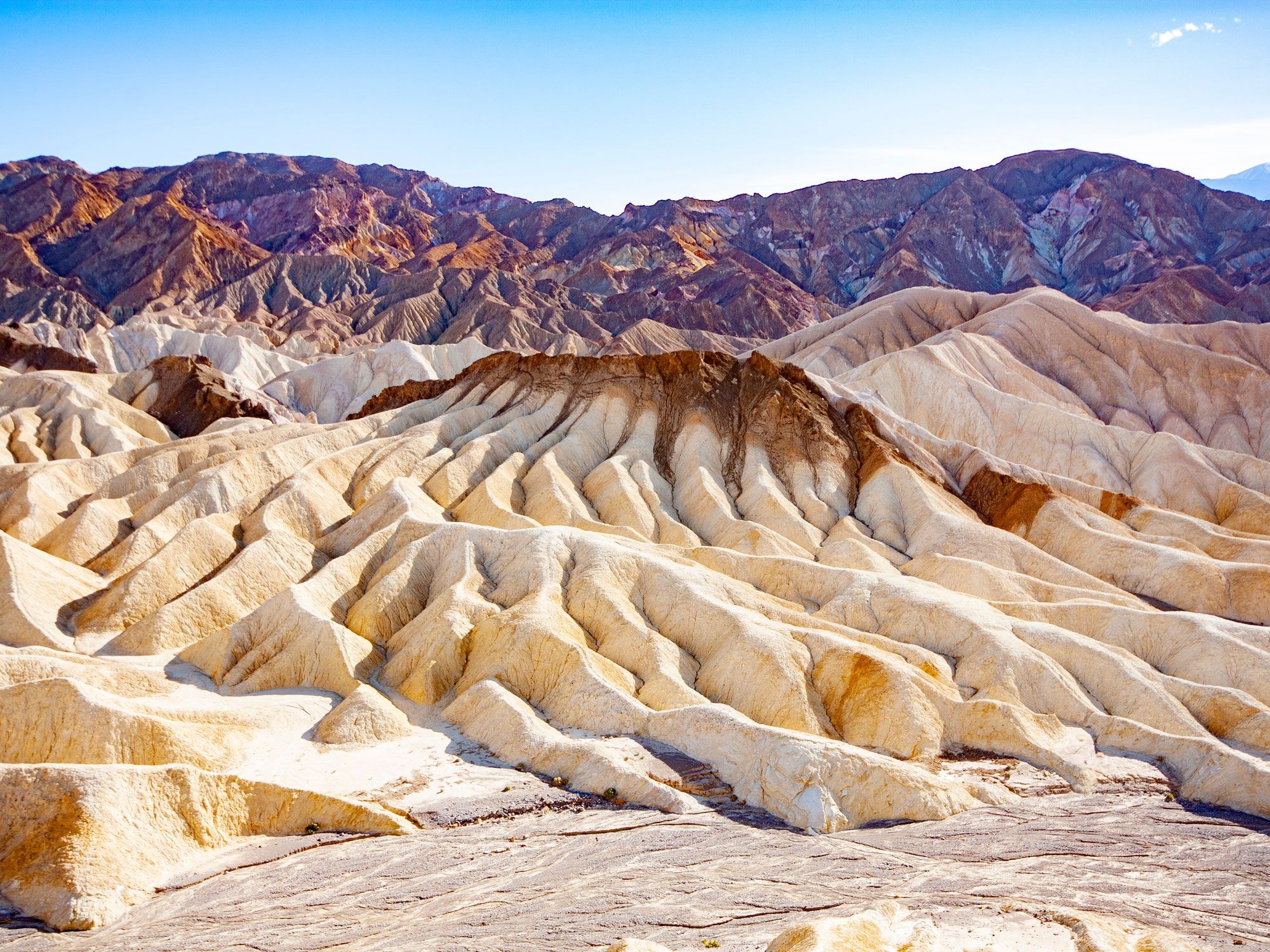
Spanning 3.4 million acres, Death Valley National Park is the largest national park in the lower 48. With all that wide open and undeveloped land (which means no light pollution in sight), the area is prime for stargazing. Skies above the park are so dark that Death Valley was designated a “Gold Tier” Dark Sky Park, the organization’s highest rating in darkness, allowing stargazers to see astronomical objects that can be seen from few other locations on the planet. Death Valley’s arid desert climate also leads to a high number of clear nights with a pleasantly cool temperature. There are many places throughout the park that are dark enough to sit back and enjoy the show, but Mesquite Flat Sand Dune, Harmony Borax Works, Badwater Basin, and Ubehebe Crater are a few of the more popular spots.
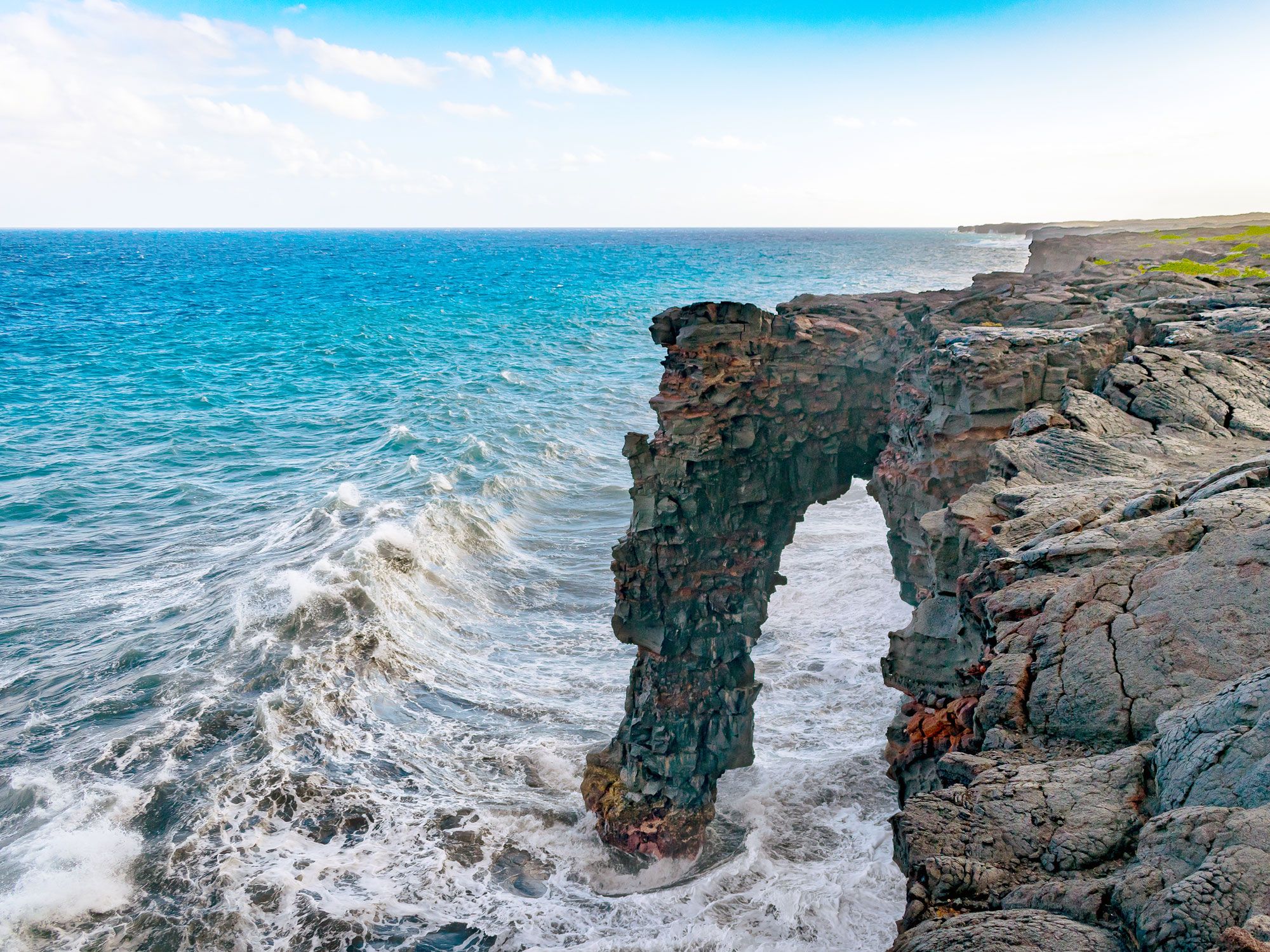
Hawaiʻi Volcanoes National Park is home to two of the world’s most active volcanoes, Kilauea and Mauna Loa. This UNESCO World Heritage Site and International Biosphere Reserve protects one of the world’s most unique geological landscapes, which also happens to be spectacularly free of light pollution. The park is open 24 hours a day, seven days a week, and there are plenty of places to post up in the park to gaze up at the sky — the Kulanaokuaiki Campground and Kipukapuaulu parking area offer spectacular viewing platforms on clear nights.
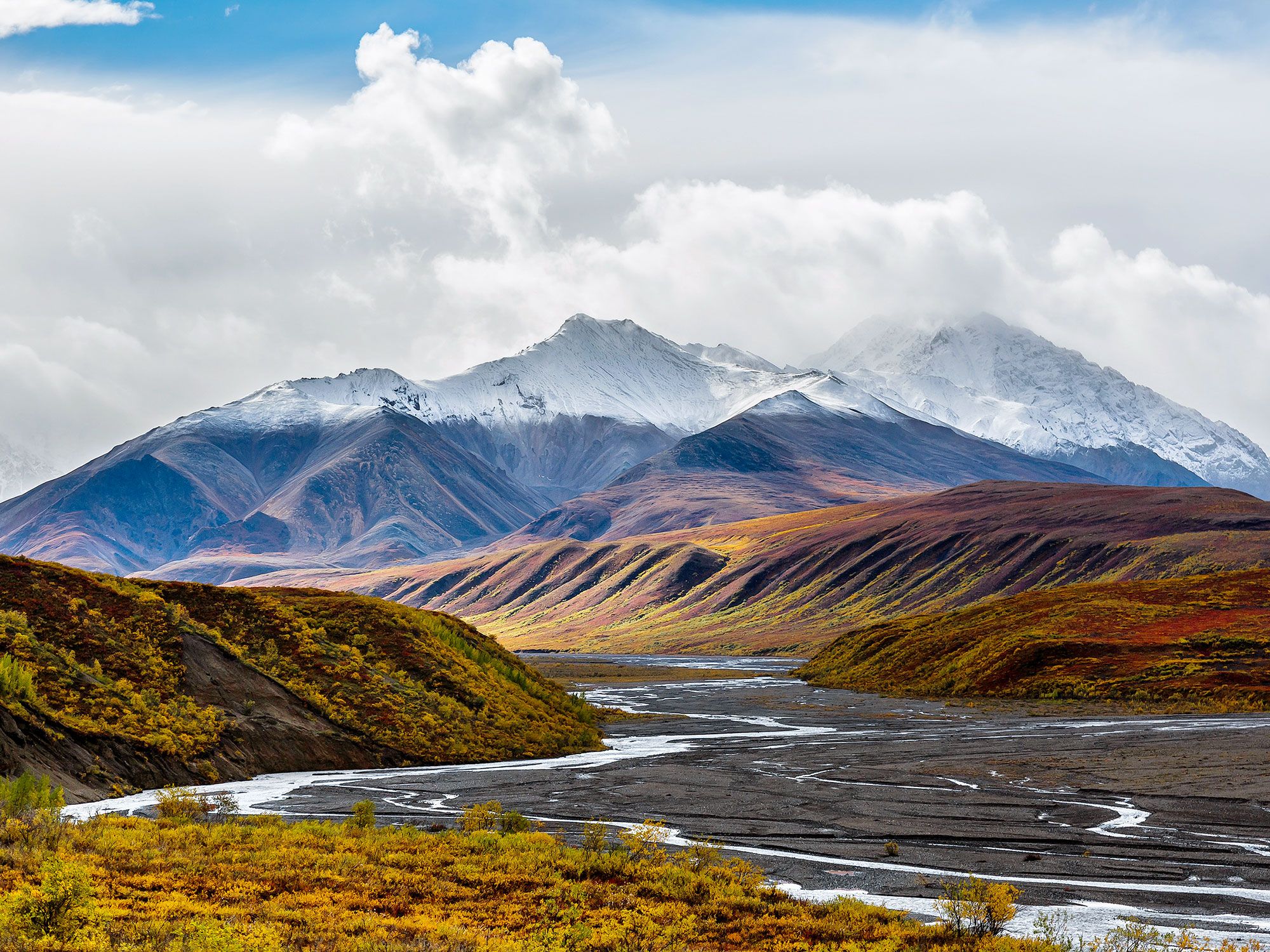
In Alaska, fall, winter, and early spring experience long hours of darkness. Coupled with the fact that the surrounding area has very little light pollution, it’s the perfect recipe for incredible stargazing. Indeed, it doesn’t take much effort to see the stars in Denali — one of the most common and accessible routes is along the first 15 miles of Denali Park Road. You can drive your own car and choose where you want to pull over to gaze up at the sky. Riley Creek Campground is open year-round and is also a great place to spend the night enjoying the stunning night skies of Alaska. Lucky visitors to the park will also sometimes catch a glimpse of the northern lights.
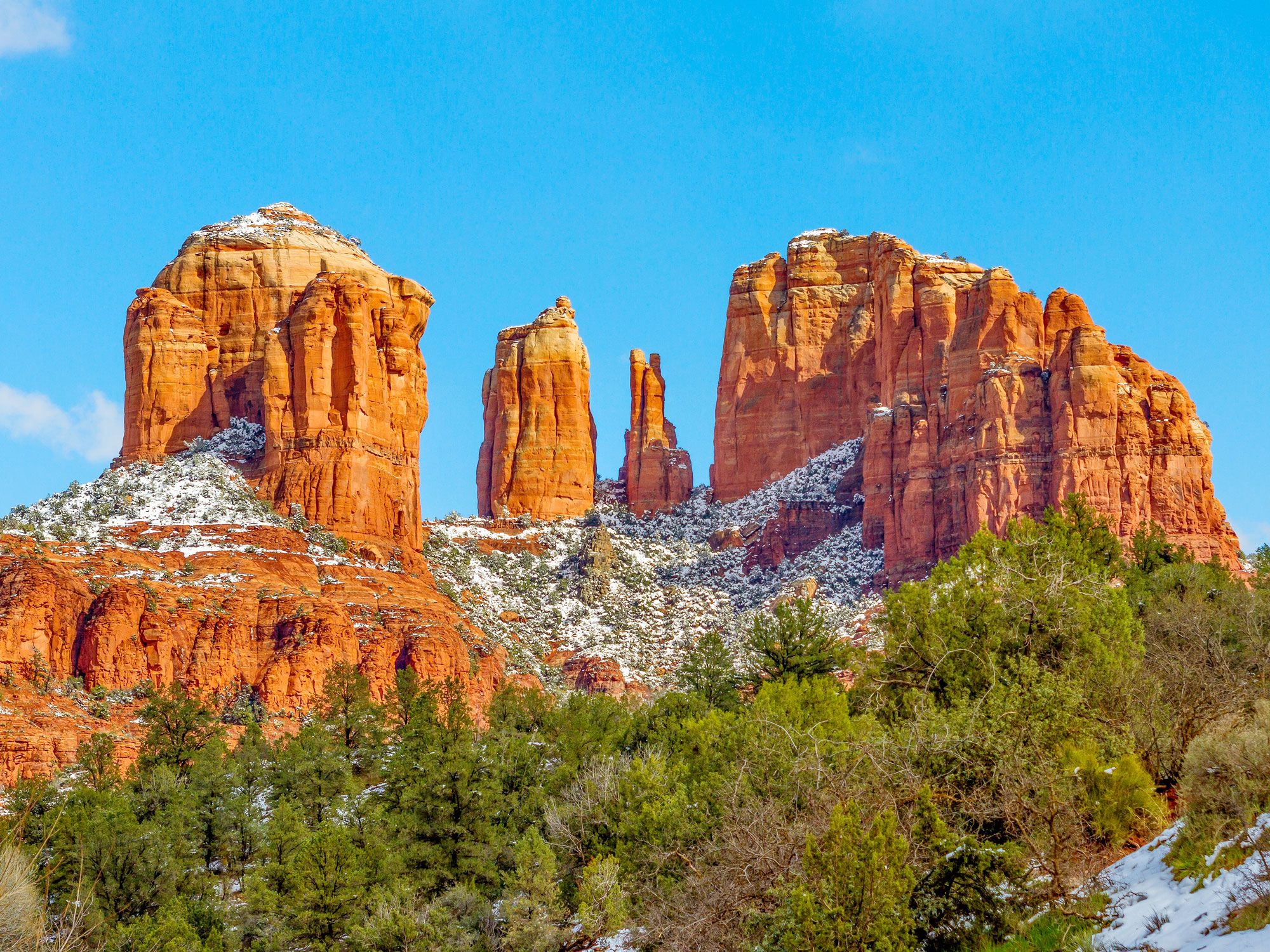
The best part about visiting this charming northern Arizona town — about halfway between Phoenix and the Grand Canyon — is that you don’t have to completely abandon civilization and electricity to get a good look at starry night skies. In 2014, Sedona was designated an International Dark Sky Community, thanks to a city ordinance that helped reduce light pollution. Dozens of trails crisscross the iconic red rock landscape surrounding Seoda, creating a truly magical environment for stargazing. Once you’ve had your fill of twinkly stars, discover Sedona’s stunning natural parks, spiritual wellness scene, and vibrant culture.
Advertisement
More from our network
Daily Passport is part of Inbox Studio, an email-first media company. *Indicates a third-party property.
Jersey is a travel and lifestyle writer whose work has appeared in publications such as Condé Nast Traveler, Business Insider, and Bust. When she’s not exploring her adopted home state of Maine, she’s likely planning her next big trip.
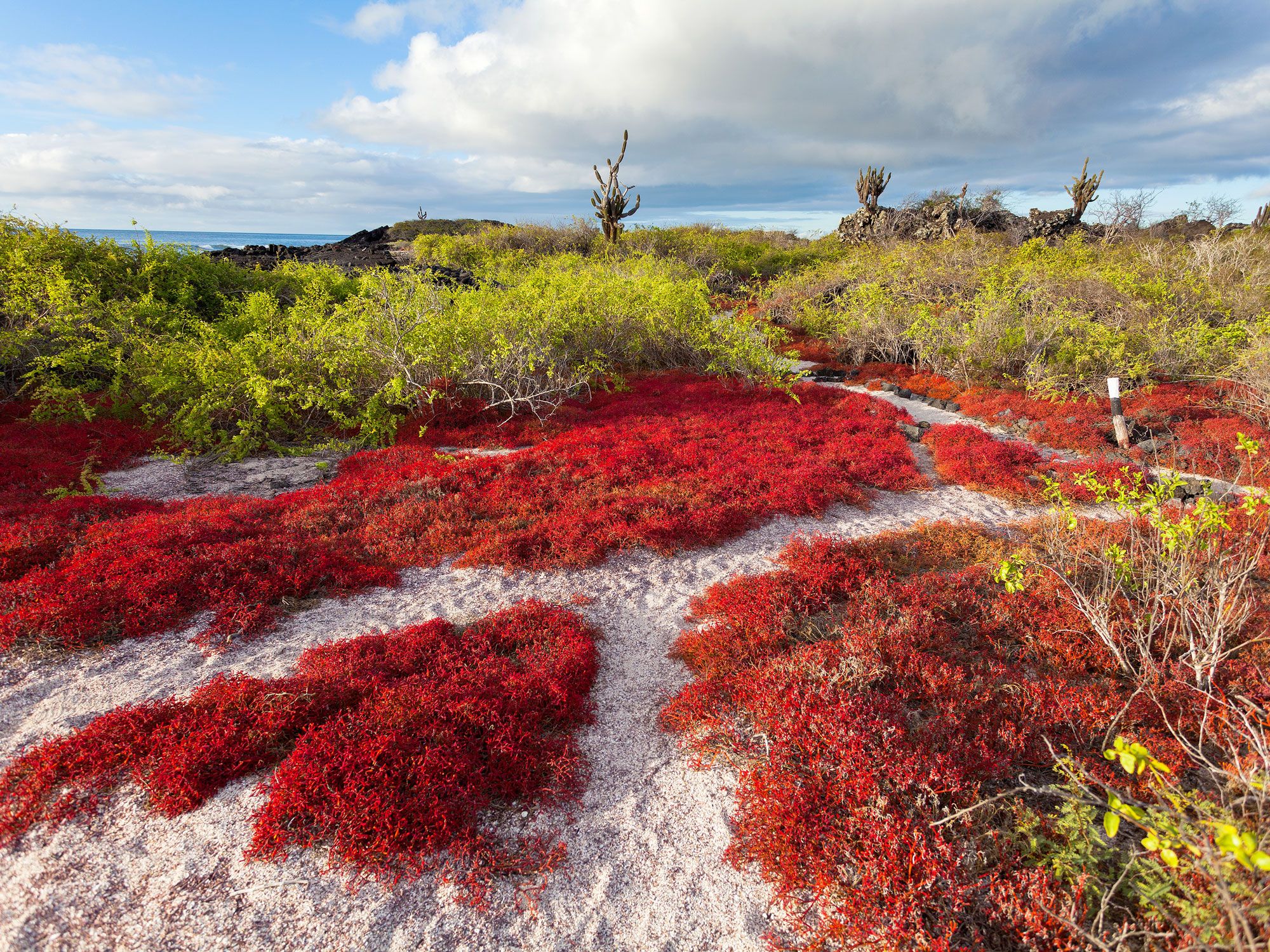
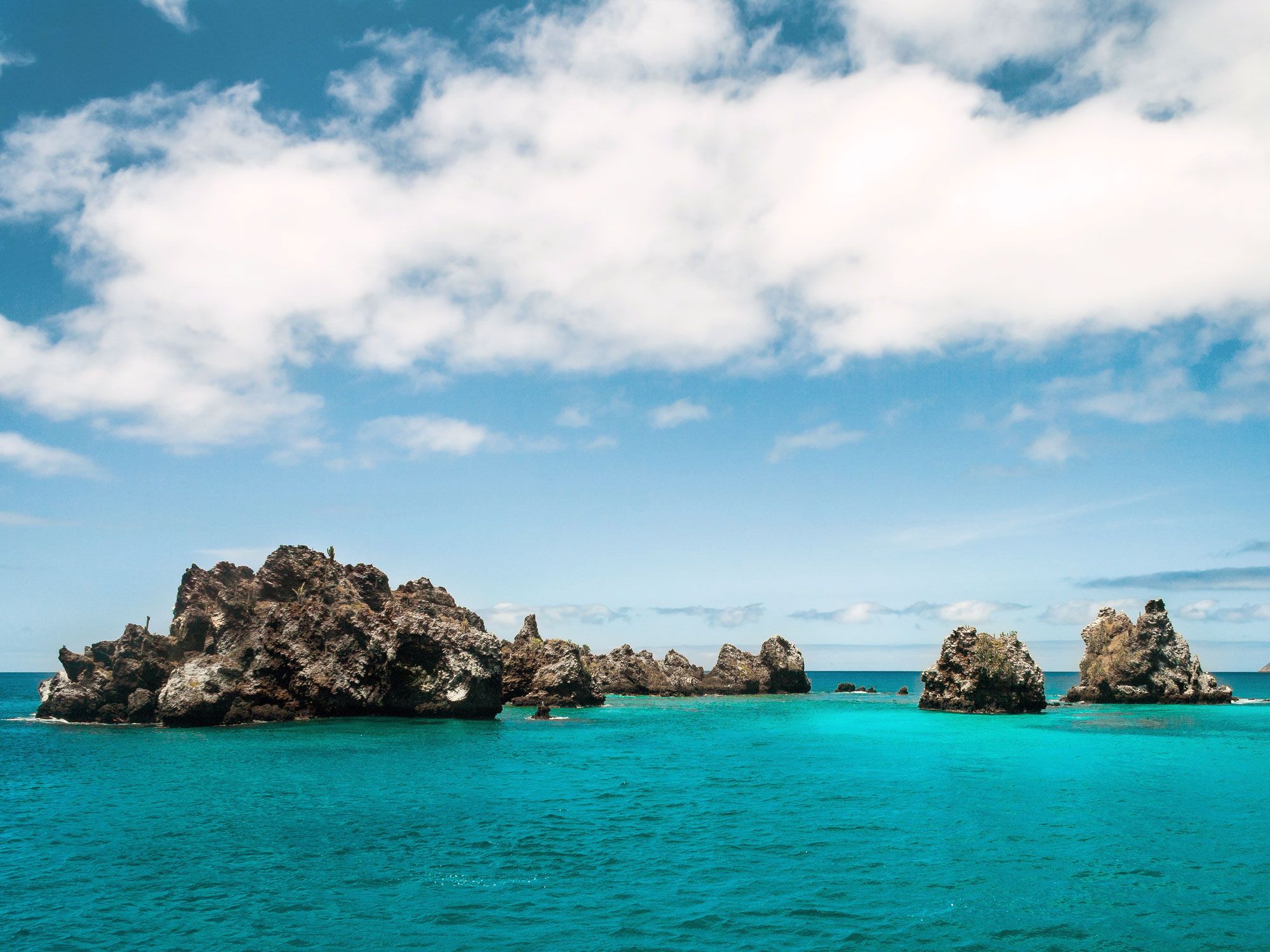
Straddling the equator 500 miles west of Ecuador in the Pacific Ocean, the Galápagos Islands are, quite simply, unlike anywhere else on Earth. Home to over two dozen endemic species of land and marine life, the isolated volcanic archipelago provides some of the best wildlife viewing in the world — just ask Charles Darwin. Learn more about the islands’ wildlife, history, and conservation efforts through these nine fascinating facts.
When famed naturalist Charles Darwin visited the Galápagos Islands in 1835 to observe the local flora and fauna, he soon became fascinated by the physical variations of the archipelago’s endemic island species, particularly finches. Through his observations, Darwin hypothesized that species change over time in order to adapt to their environment, which led to the theory of evolution by natural selection. To honor his special relationship with the Galápagos, a statue of the famous naturalist has been erected on the island of San Cristóbal.
The archipelago was fittingly named for its most iconic resident — the giant tortoise. The word galápago is derived from an old Castillian word that translates to “riding saddle,” a reference to the saddle-like shell of a tortoise. Although these turtles can live up to 100 years of age, they are still endangered due to being over hunted by sailors in the 18th century, which led to the extinction of various species.
The Charles Darwin Research Station on Santa Cruz Island is an ideal spot to learn more about efforts to conserve these fascinating creatures and to witness them in their natural habitat.
To conserve this unique region of the world, a whopping 97% of the Galápagos Islands’ land mass is dedicated to Galápagos National Park. Established in 1959 and encompassing 3,040 miles, the park aims to protect the 56 species (27 of which are endemic) that call the archipelago home. The unique species aren’t just limited to land animals — the waters surrounding the islands are a UNESCO Biosphere Reserve, home to 500 species of fish and almost 800 species of mollusks.
As of 2023, the Galápagos Islands are officially home to 108 islets and rocks, plus 19 large islands — four of which are inhabited. However, since the Galápagos are considered one of the most volcanically active places in the world, these numbers are subject to change. With 21 active volcanoes and 50 eruptions in the last 200 years, the number of islands is constantly fluctuating, with different formations emerging or disappearing due to heightened volcanic activity.
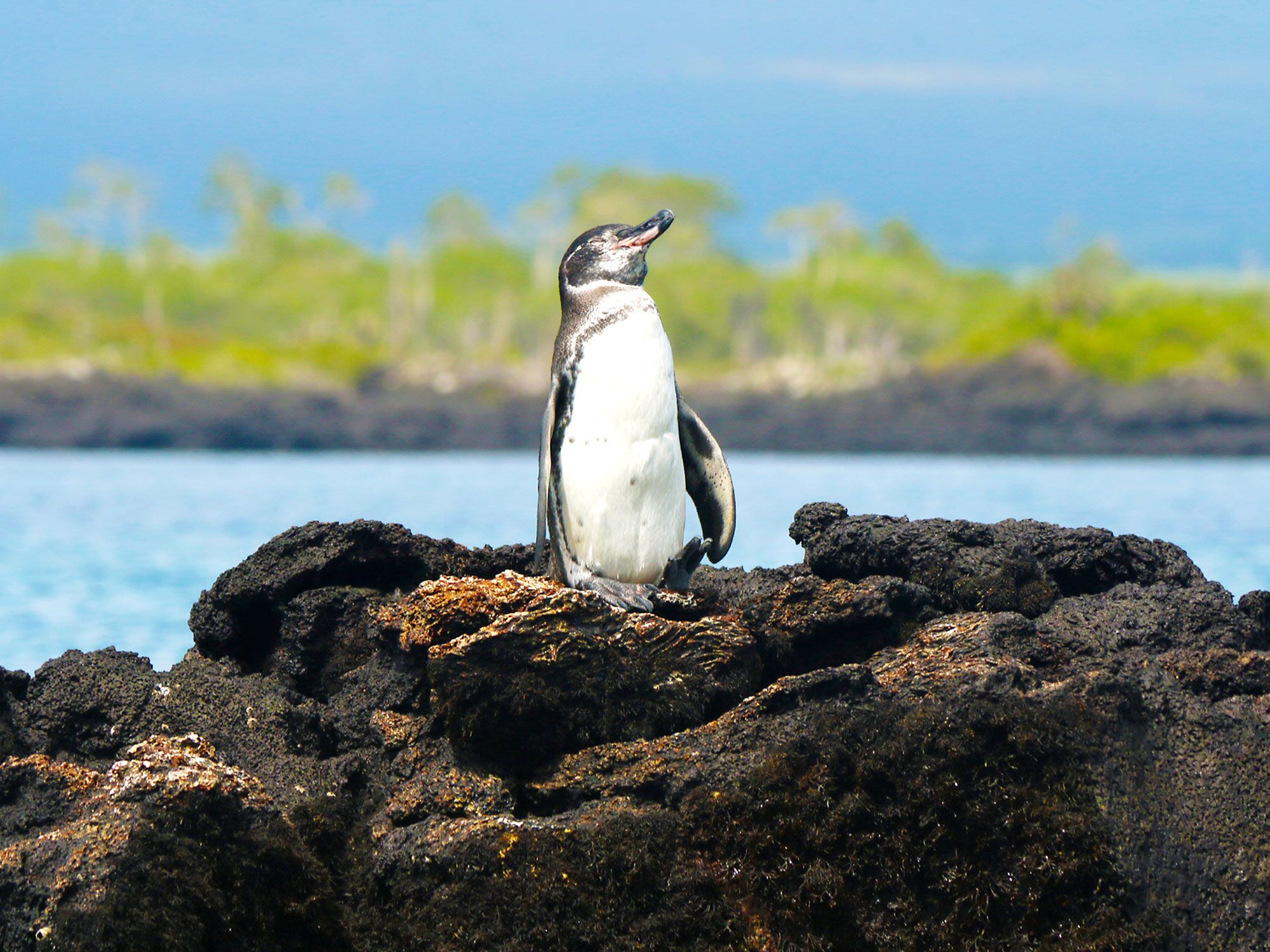
The only species of penguins found in the Northern Hemisphere, Galápagos penguins are native to the islands for which they are named. They are also the smallest penguins on the planet, which makes them agile and avid hunters beneath the water.
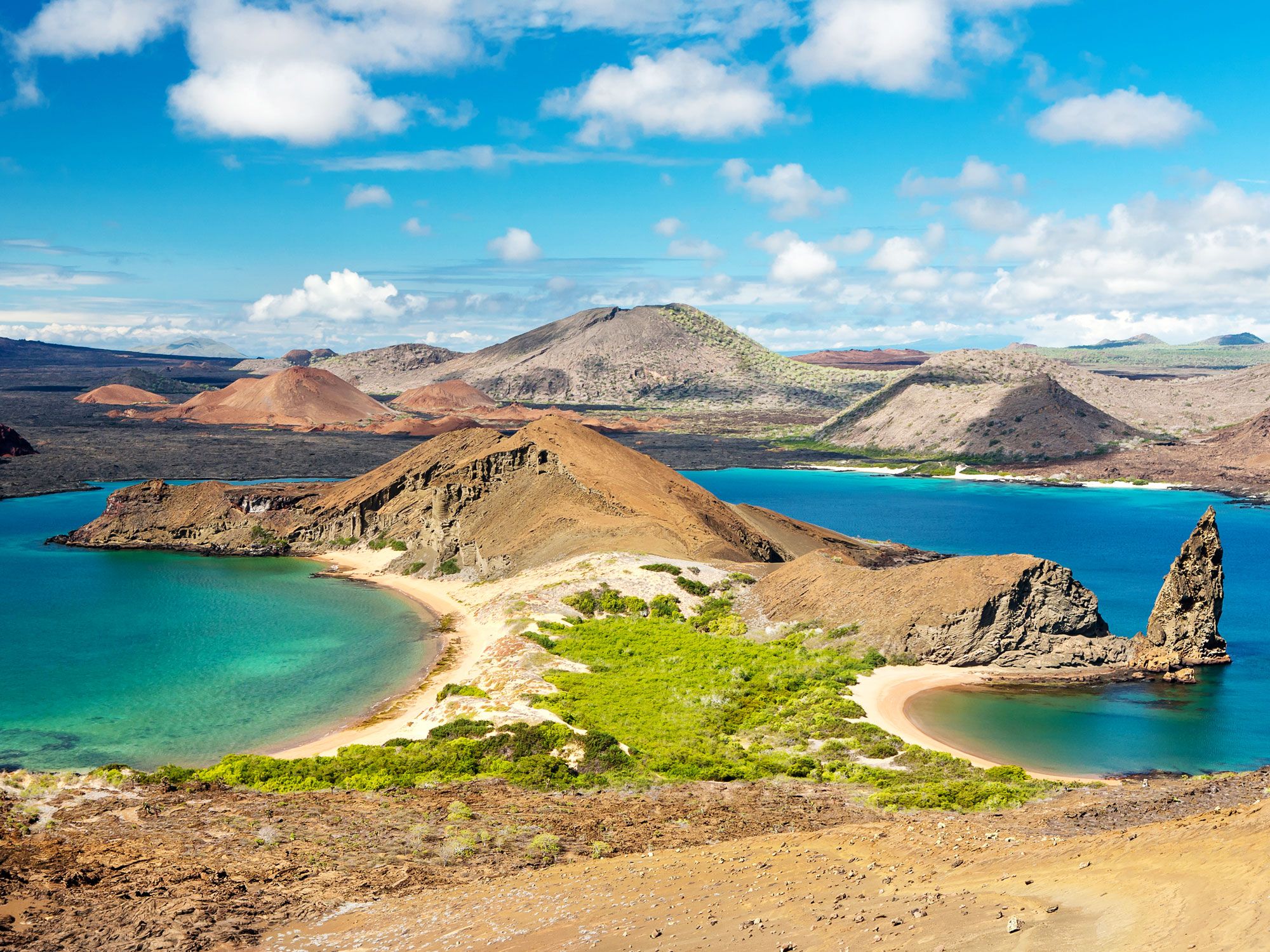
With a current population of 2,000, these birds make their homes in caves and coastal crevices and are known to mate for life. They most often reside on Isabela and Fernandina Islands but can often be spotted swimming around Pinnacle Rock on Bartolome.
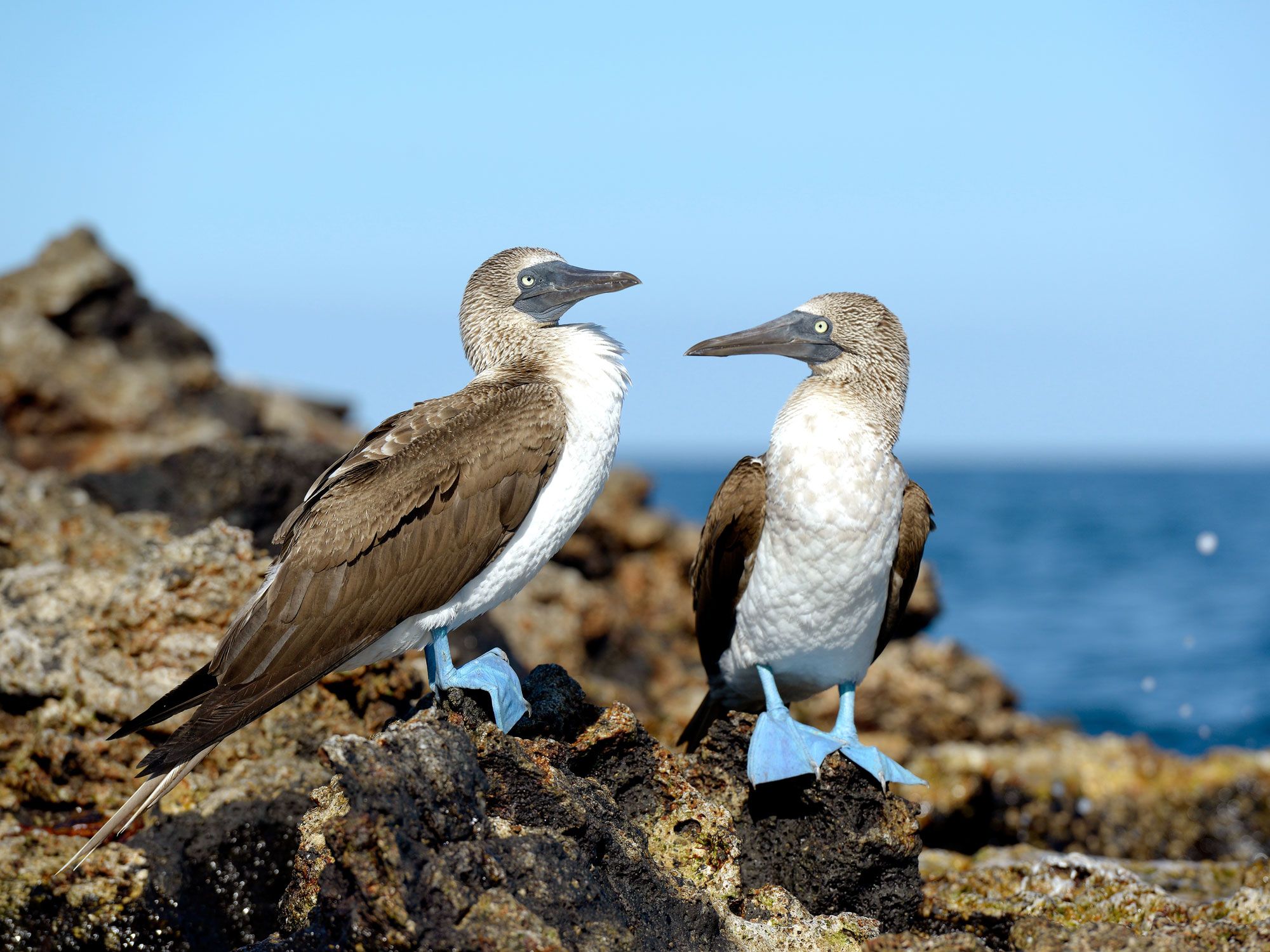
Named by Spanish sailors who believed these birds to be clumsy “bobos,” boobies are alsoendemic to the Galápagos Islands. There are three different species — identified by their colorful markings — which inhabit the various islands. The smallest of the three are the red-footed boobies, known to be agile fliers, while blue-footed boobies are larger and more adept at diving underwater. The Nazca booby is recognized for its black-and-white plumage but does not share the brightly colored feet of the rest of the booby population.
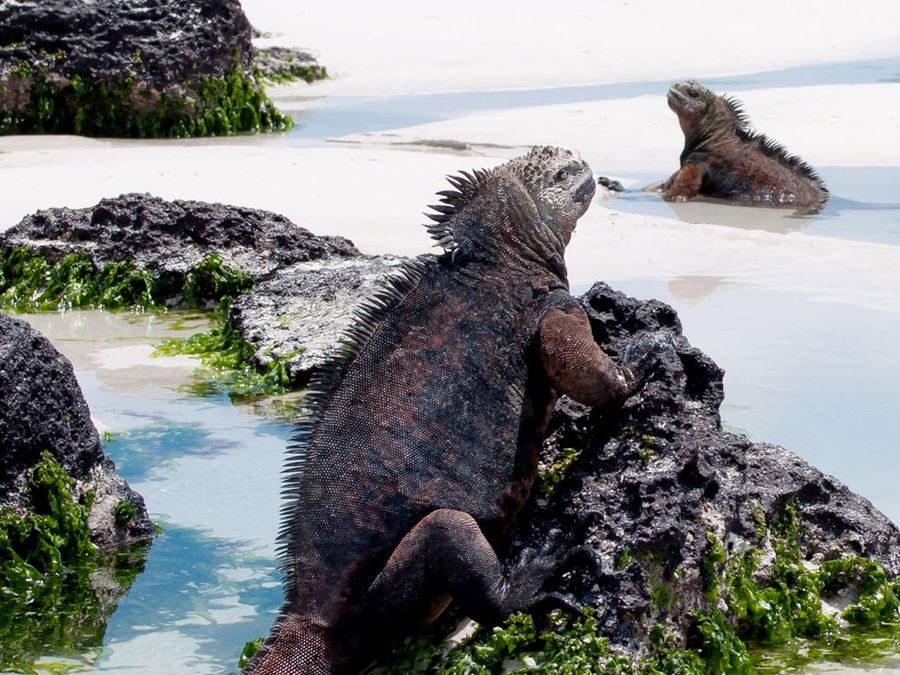
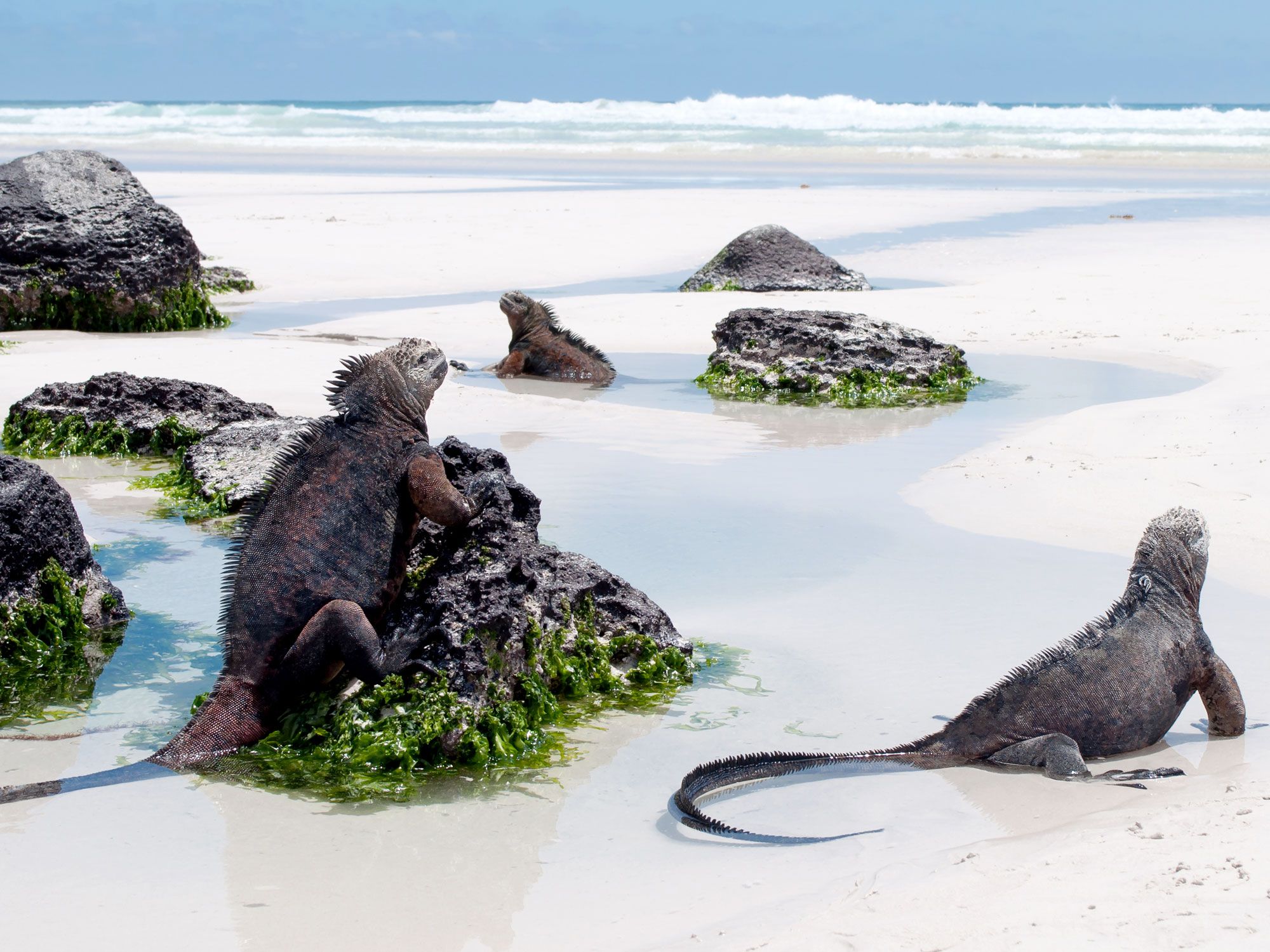
It’s the Only Place on Earth Where Marine Iguanas Exist
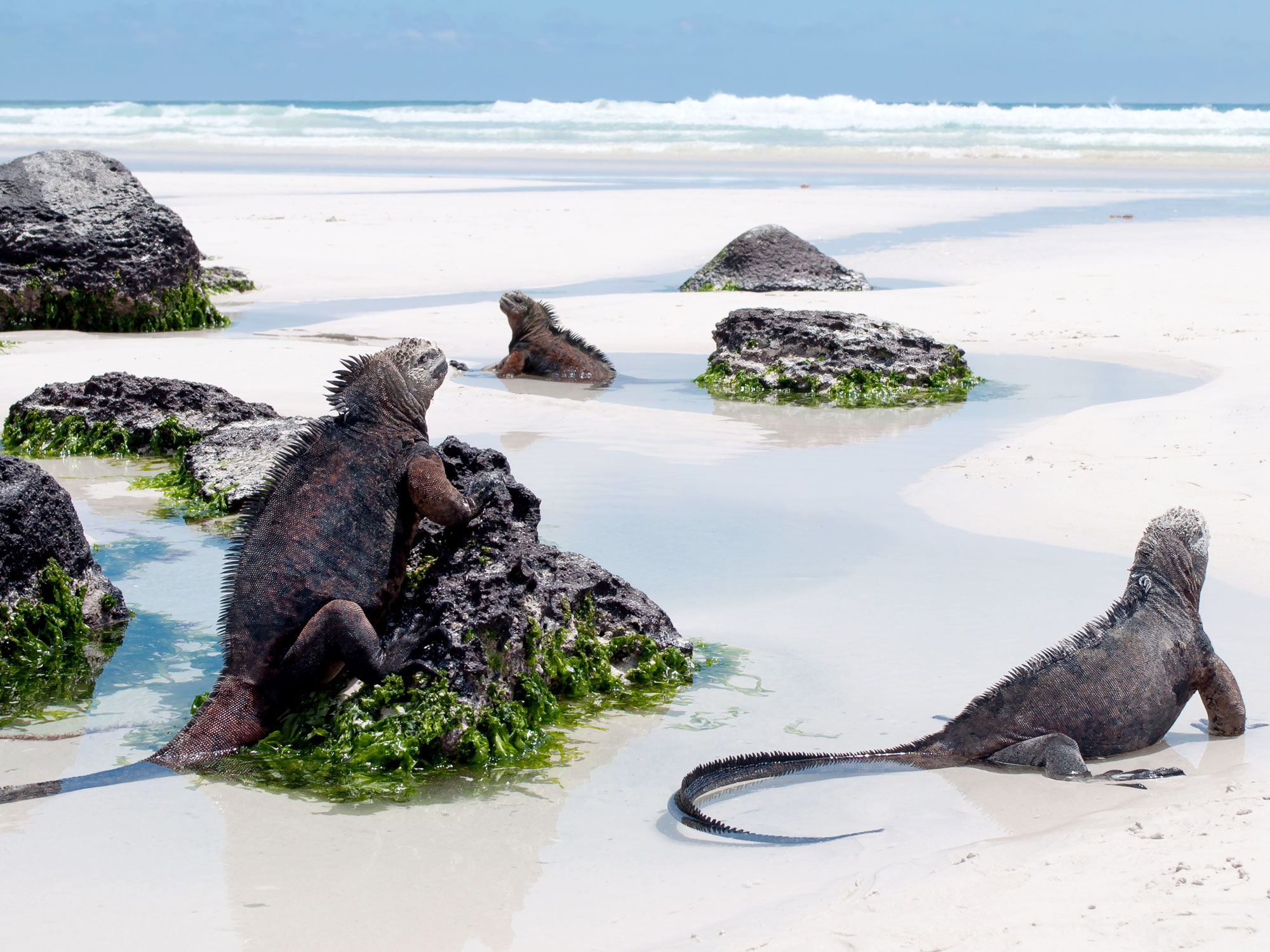
Native to the Galápagos, marine iguanas are the only lizards in the world that can swim. Unlike other land-bound reptiles, these sea-faring iguanas are able to relocate between islands, swimming distances as far as 40 miles. Referred to by Charles Darwin as the “imps of darkness,” marine iguanas dive under the water to forage for algae on the ocean floor, while employing their claws to cling onto rocks.
Post Office Bay on Floreana Island earned its name from homesick 18th-century whalers who devised a unique system to send letters home. They use a floating barrel as a makeshift post office, allowing whalers departing the region to sift through the messages and hand-carry mail back home for delivery — no postage stamp required. The system continues to be in operation today, with visitors simultaneously dropping off or picking up letters for delivery to a final destination.
The Galápagos Contain the Largest Shark Biomass on the Planet
As a designated marine sanctuary, the Galápagos Islands is home to a rich and diverse array of marine wildlife, including 30 species of sharks. In fact, these waters contain the largest shark biomass on the planet, measuring 12.4 tons per hectare. The region is most famous for whale sharks, scalloped hammerhead sharks, Galápagos sharks, and whitetip reef sharks — and snorkel and shark diving tours are available for adventurous visitors.
Advertisement
More from our network
Daily Passport is part of Inbox Studio, an email-first media company. *Indicates a third-party property.
Daily Passport writers have been seen in publications such as National Geographic, Food & Wine, CBC, Condé Nast Traveler, and Business Insider. They're passionate about uncovering unique destinations and sharing expert tips with curious travelers.
From bubblegum pink lakes to rainbow-hued hot springs and glowing neon blue bays, there are many places on Earth that look like they might belong on another planet. While the photos below might look more like a CGI movie backdrop or surreal works of art, the places depicted in these breathtaking images are actual places you can visit. Don’t believe us? Take a look for yourself at these 20 photos of places on Earth that don’t look real.
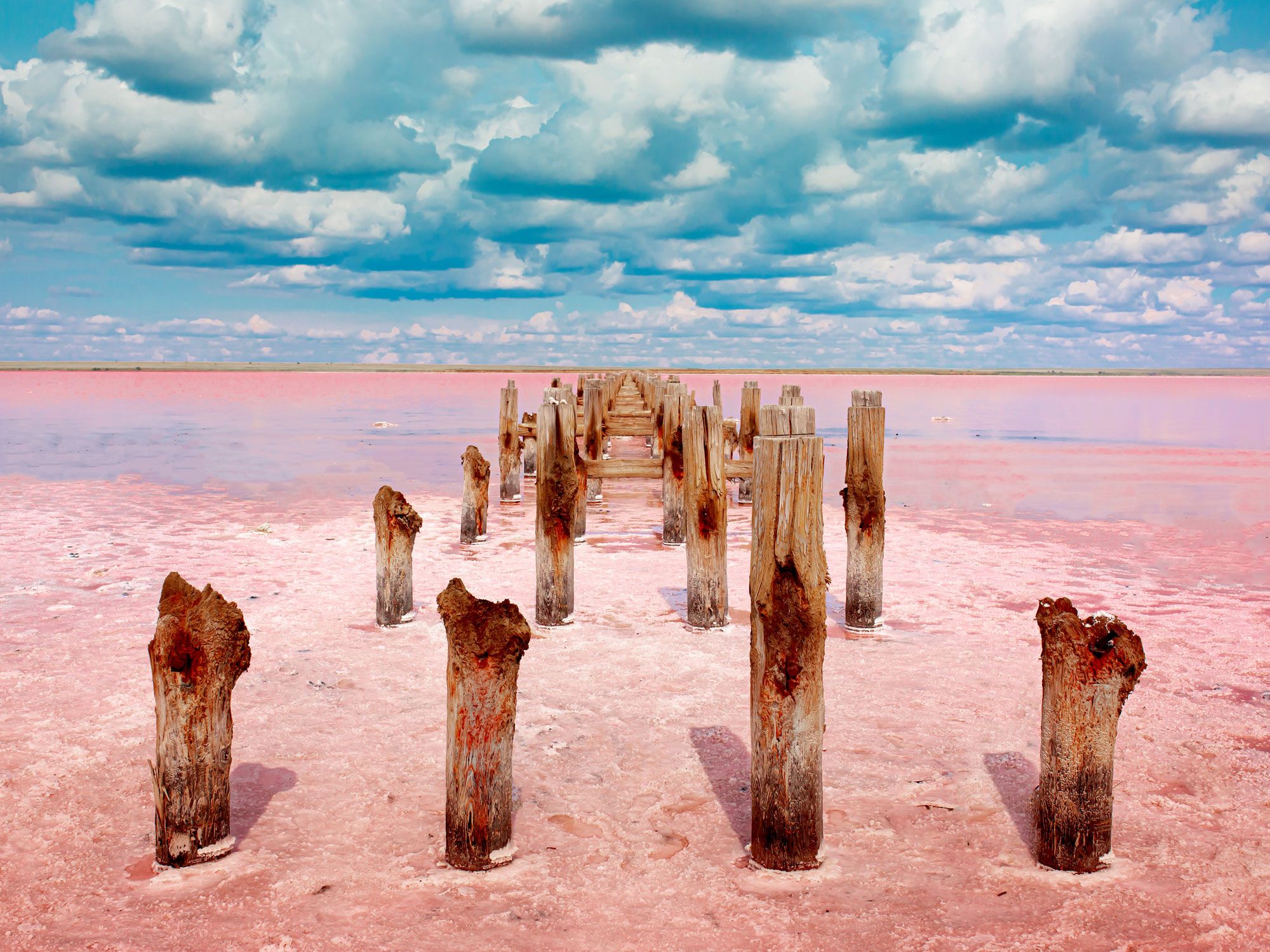
You might do a double take when you first see this lake, which looks more like a puddle of bubblegum ice cream than an actual body of water. The stunningly pink Lake Hillier sits on Middle Island, part of a nationally protected reserve on an archipelago off the coast of Western Australia. Its color is likely a result of micro-algaes, such as Dunaliella salina, that thrive in the lake’s salty water. These microorganisms produce beta-carotene, a pigment found in carrots, which is believed to be the cause of the lake’s unforgettably pink hue.
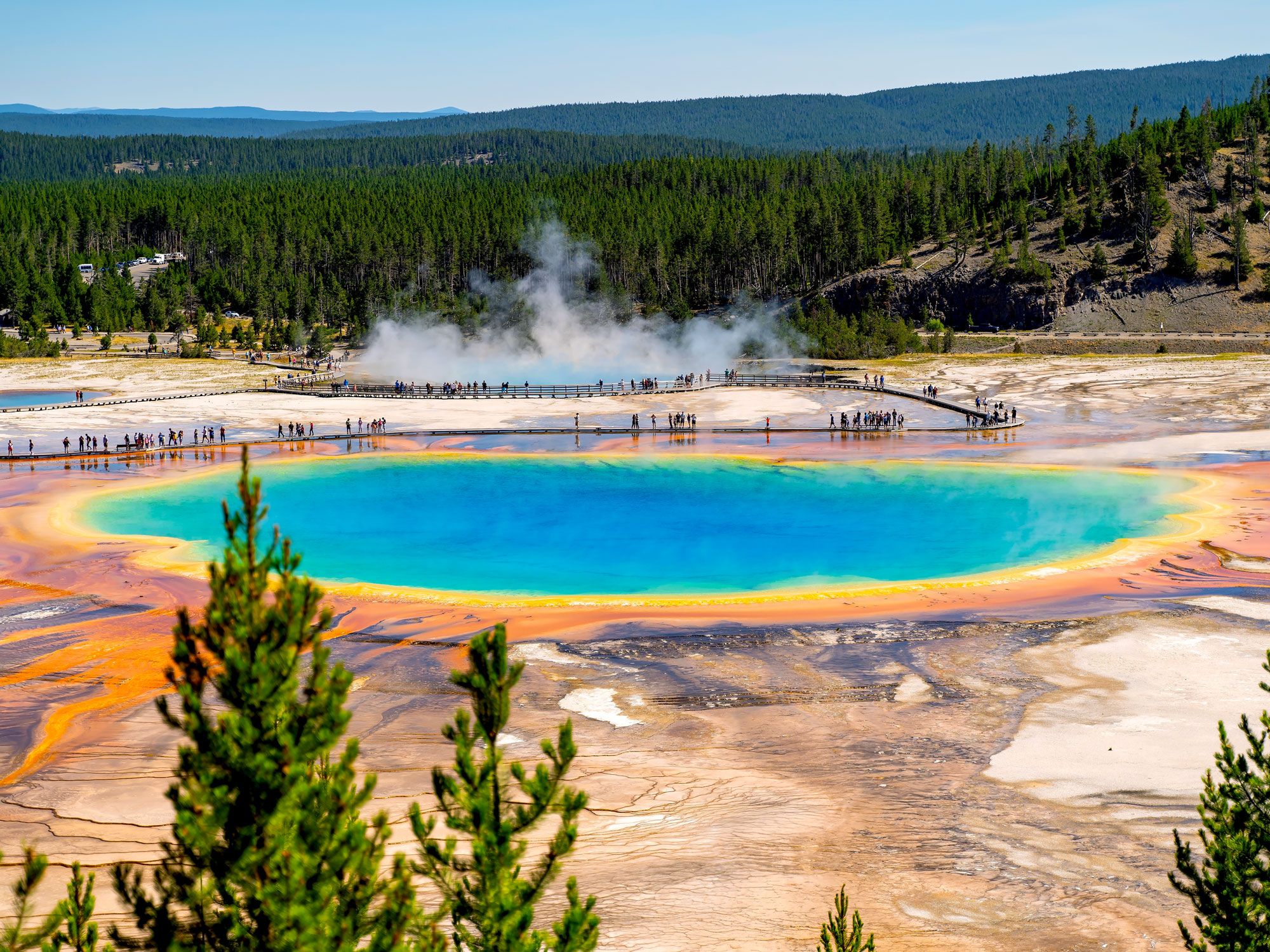
The Grand Prismatic Spring adds a splash of tie-dye color to the beauty of Yellowstone National Park. It’s the third-largest spring in the world and also the most photographed thermal sight in Yellowstone.
The varying bands of color around the spring result from the presence of thermophilic, or heat-loving, bacteria. Hot water moves from the center of the Earth’s crust to the surface of the spring. It cools at the edges of the spring, and the bacteria there create the rainbow of colors that draws thousands of visitors each year.
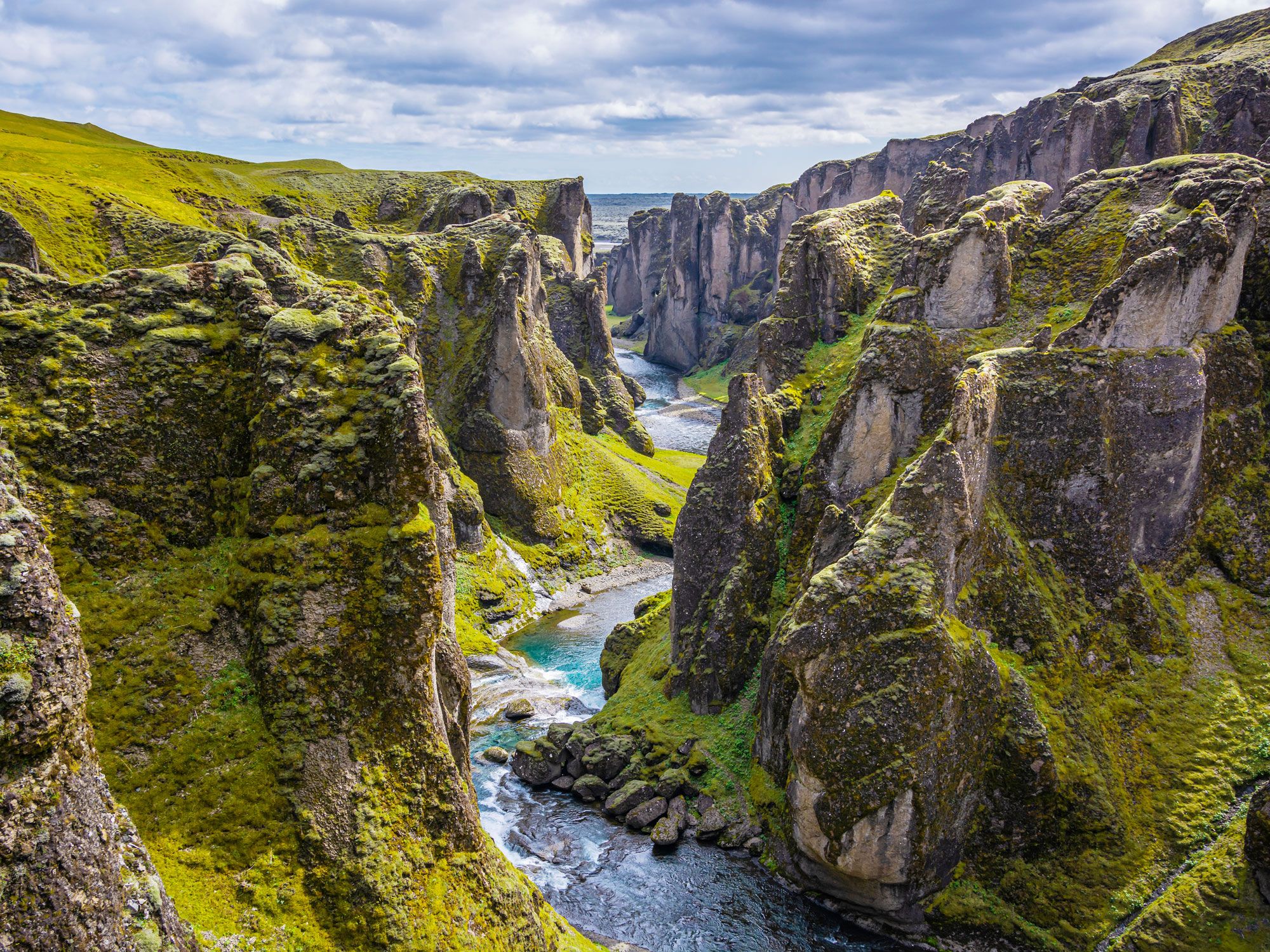
We’ll forgive you if you can’t pronounce this canyon’s name, because the view alone will probably leave you speechless. Fjaðrárgljúfur formed about 9,000 years ago and remained a hidden gem until Justin Bieber filmed a music video there in 2015, bringing this magnificent spot to the world’s attention.
After being flooded with an influx of visitors in the following years, the Environmental Agency of Iceland temporarily closed the canyon in 2019. The country is now focused on reducing the effects of climate change and building the necessary infrastructure to support year-round visitors. Once it’s open to the public again, you can marvel at the 300-foot-high canyon walls that wind like a serpentine through the southern part of the island.
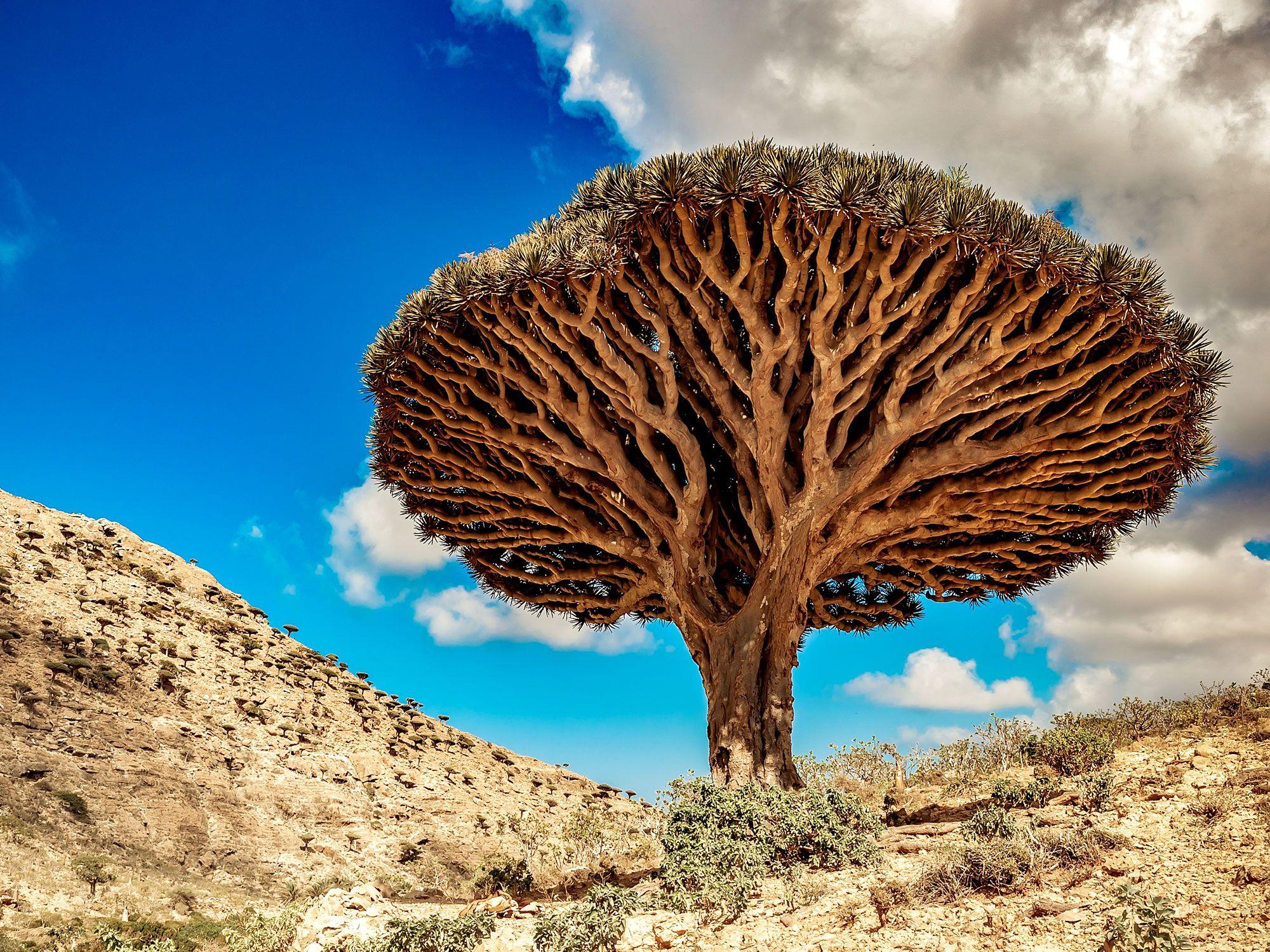
This isolated, four-island archipelago in the Indian Ocean is home to a variety of plants and animals you won’t find anywhere else on Earth, which is how it earned its place on the UNESCO World Heritage list. Approximately 37% of Socotra’s plants (including the superbly named dragon’s blood tree, pictured here), 90% of its reptiles, and a whopping 95% of its land snails are endemic to the archipelago.
Despite its remote location, Socotra is home to about 50,000 human residents, too. Many of them fish, dive for pearls, and raise crops and animals. The island’s famous exports include frankincense, fish, and ghee.
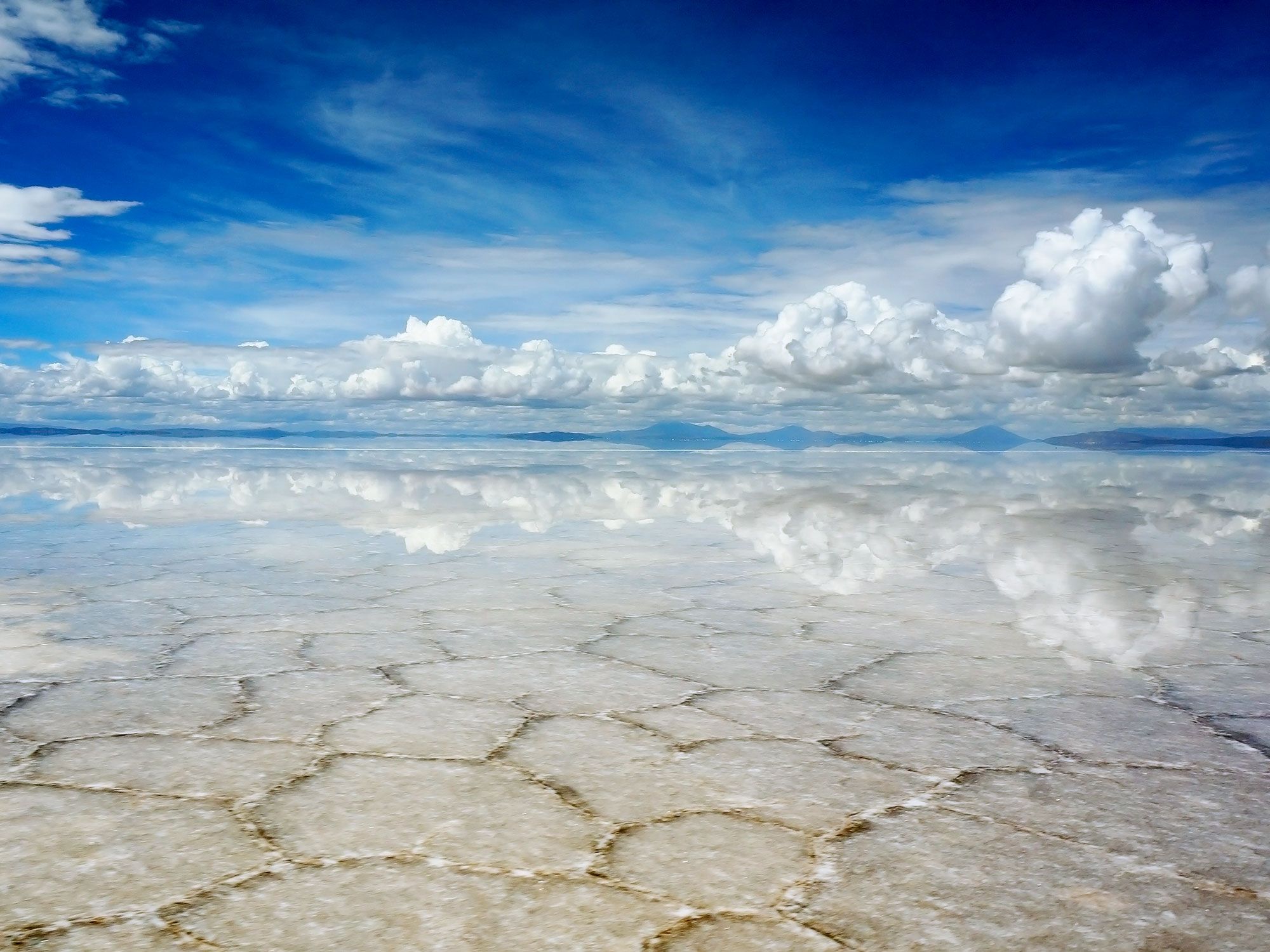
Stretching more than 4,000 square miles across the Andes of Southwestern Bolivia, the Uyuni Salt Flat contains an estimated 10 billion tons of salt. Within the layers of salt lies 70% of the world’s lithium reserves, making this area particularly important for the manufacturing industry, as lithium is used to make batteries for laptops, cellphones, and electric cars.
For travelers, however, the area’s appeal lies in the unique hexagonal formations on the surface, as well as the mirroring effect that’s created when a thin layer of water covers the salt flat on a sunny day. Though local legends have different takes on how the area came to be, scientists tell us that the salt flat formed over 40,000 years ago, when an evaporated lake left behind a thick crust of salt.
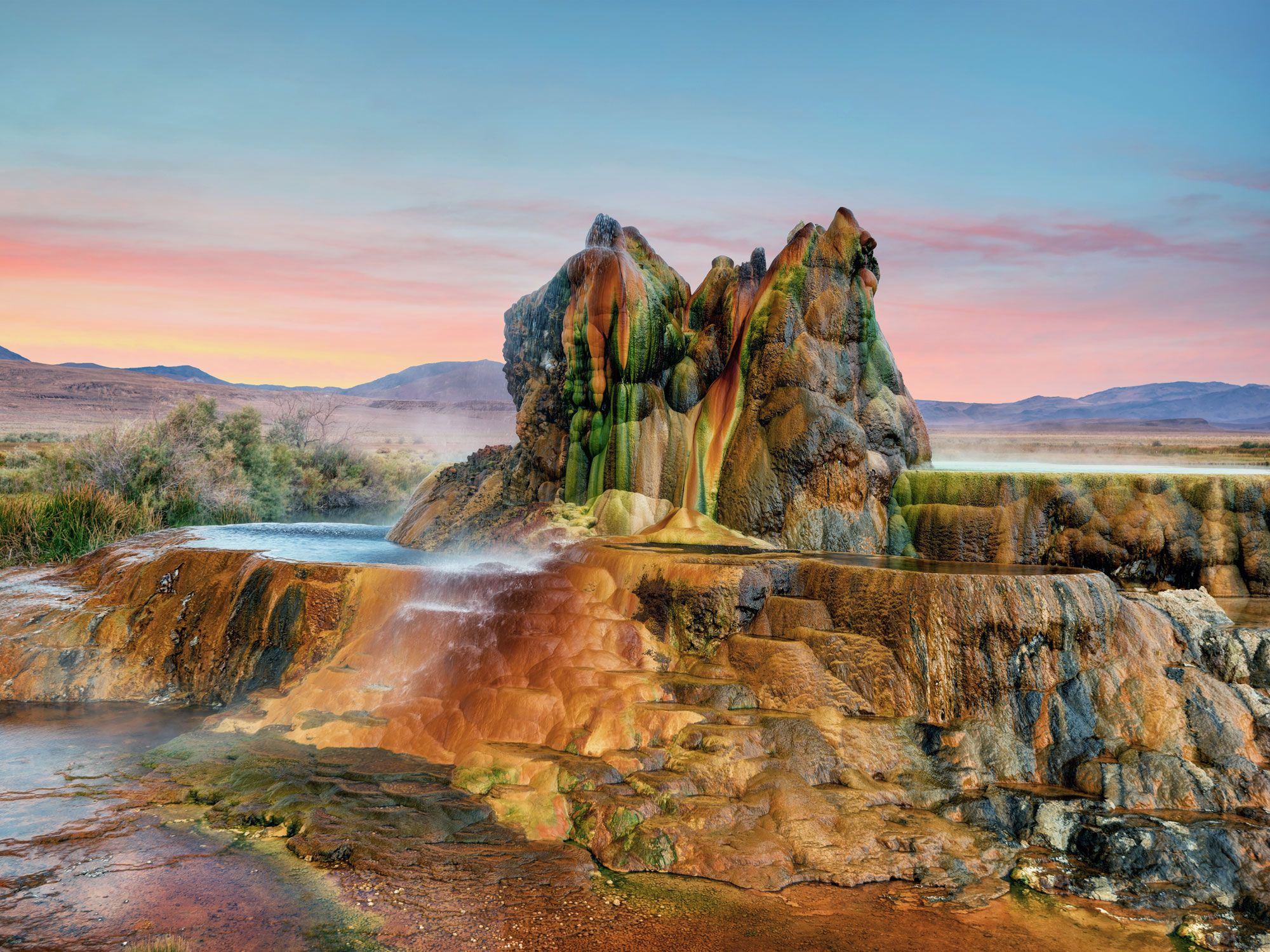
The Fly Geyser consists of three strange misshapen mounds of Earth rising from the northern Nevada desert. But these mounds are actually the result of human actions, rather than nature.
The first geyser formed here in 1916 when residents in the area dug a well, only to discover that, at 200 degrees Fahrenheit, the water was too warm to be useful. About five decades later, a geothermal power company drilled a test well on the site. Because the well had been improperly sealed, hot water spewed forth. Over time, mineral deposits formed and eventually grew into the multicolored green and red cones we see today.
Notably, the insides of the cones contain quartz, which typically doesn’t start forming inside geysers until at least 10,000 years have passed, making these geysers even more unusual than they appear.
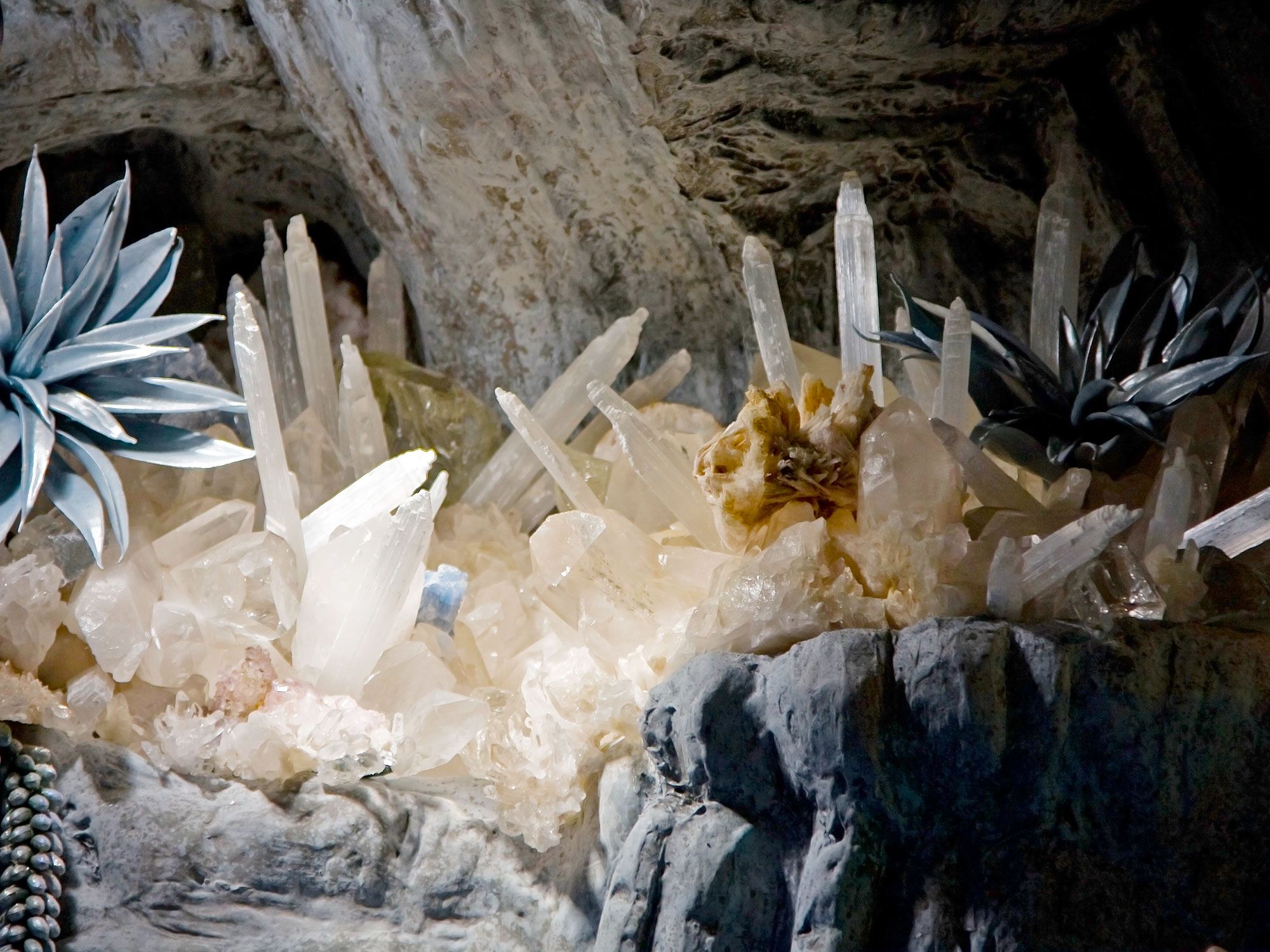
In Mexico, the Cave of the Crystals within Naica Mine looks like a supersized salt shaker you can climb right into. This cave is home to the largest crystals in the world, which were remarkably discovered only 20 years ago.
The conditions inside the cave are ideal for growing crystals since the air is acidic, humidity is high, and no natural light enters. As a result, the crystals inside the cave have reached lengths of up to 36 feet. The largest crystal is believed to have been growing for approximately 500 years. Unsurprisingly, the ideal conditions for growing crystals aren’t so ideal for humans, so you can’t enter the cave without wearing a special suit.
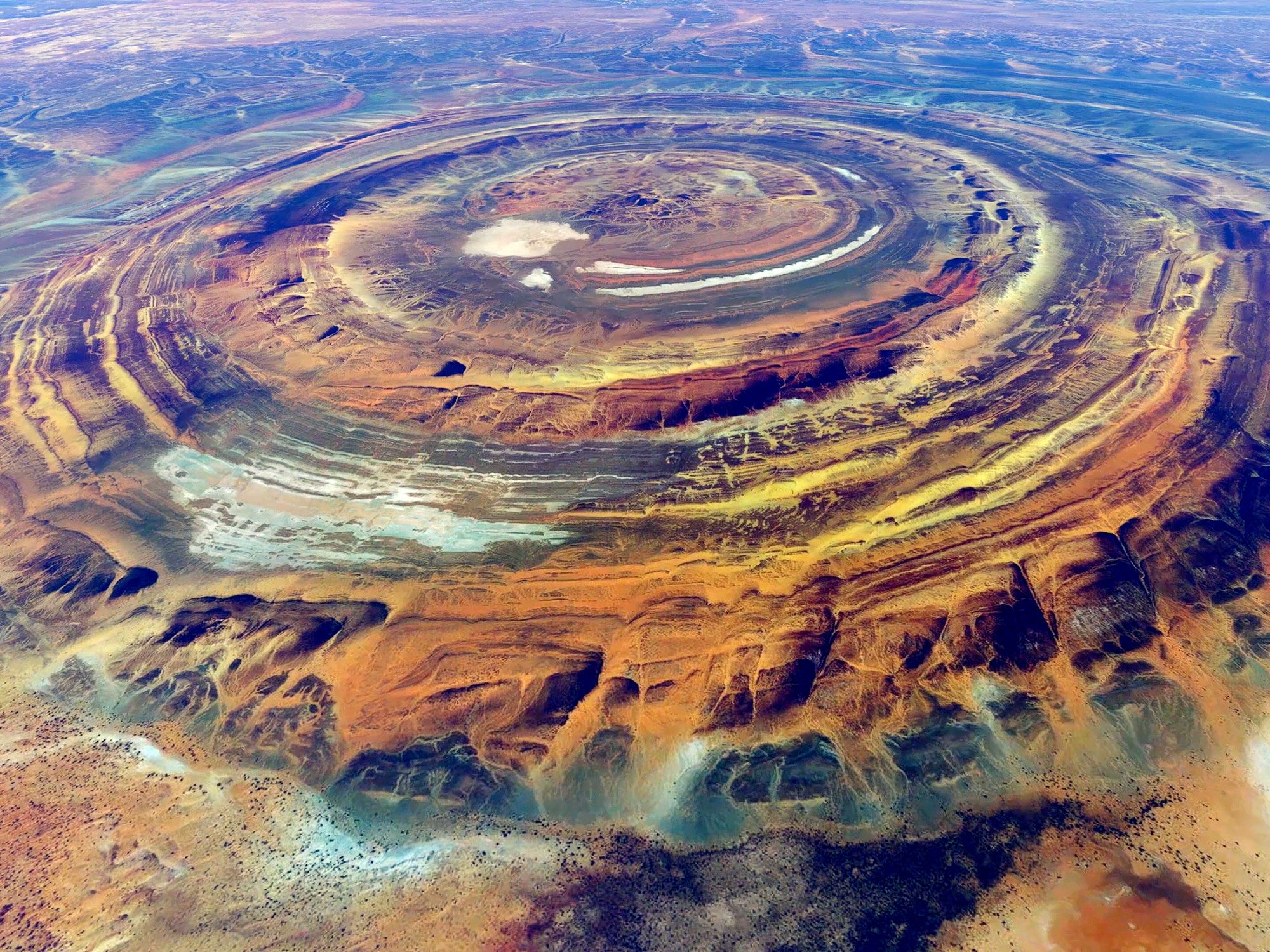
Unlike other sites on this list, this structure doesn’t offer much to see at ground level. In fact, you may even have trouble finding it, despite its 28-mile diameter. From space, however, this formation looks like a giant bullseye or a landing site for flying saucers, which has earned it the “Eye of the Sahara” nickname. Its unique appearance has long captured the imagination of astronauts, but alas, the geological feature does have origins here on Earth.
The Richat Structure consists of what geologists call a domed anticline that has been eroded by the elements over 100 million years, revealing layers of older igneous and sedimentary rocks surrounded by newly formed rocks.
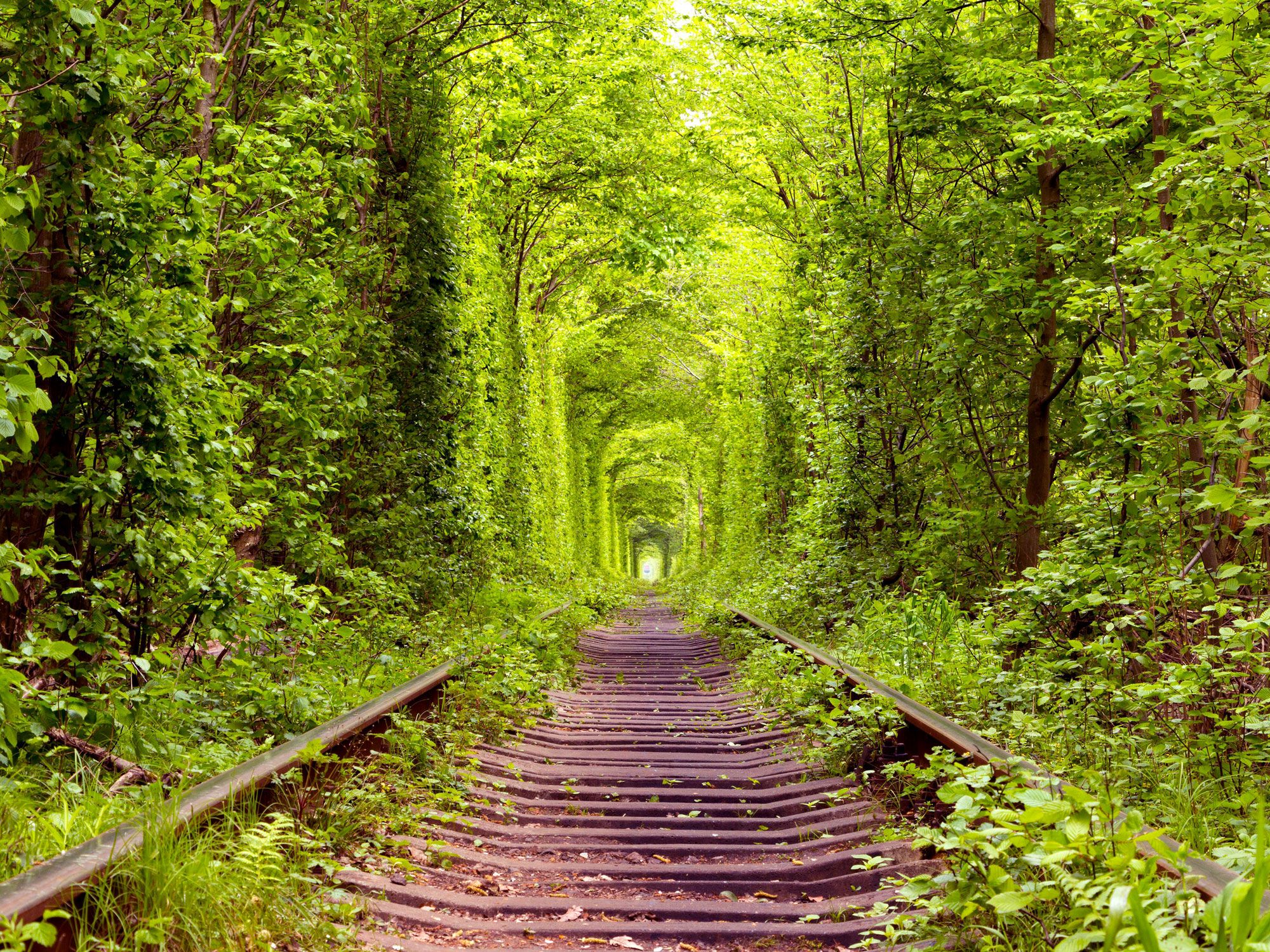
An industrial train track wouldn’t normally make a list of incredible places to visit, but the Tunnel of Love is a notable exception. Just outside of Klevan, Ukraine, this two-mile tunnel is formed from trees growing over the tracks, their branches and leaves creating a brilliant green canopy overhead.
The tunnel dates back to the Cold War, when trees were planted around the tracks to hide the transporting of war materials to and from a nearby military base. Since then, the Tunnel of Love has undergone quite the rebranding. Today, it’s believed that couples who make sincere wishes during their visit will see their hopes and dreams come true.
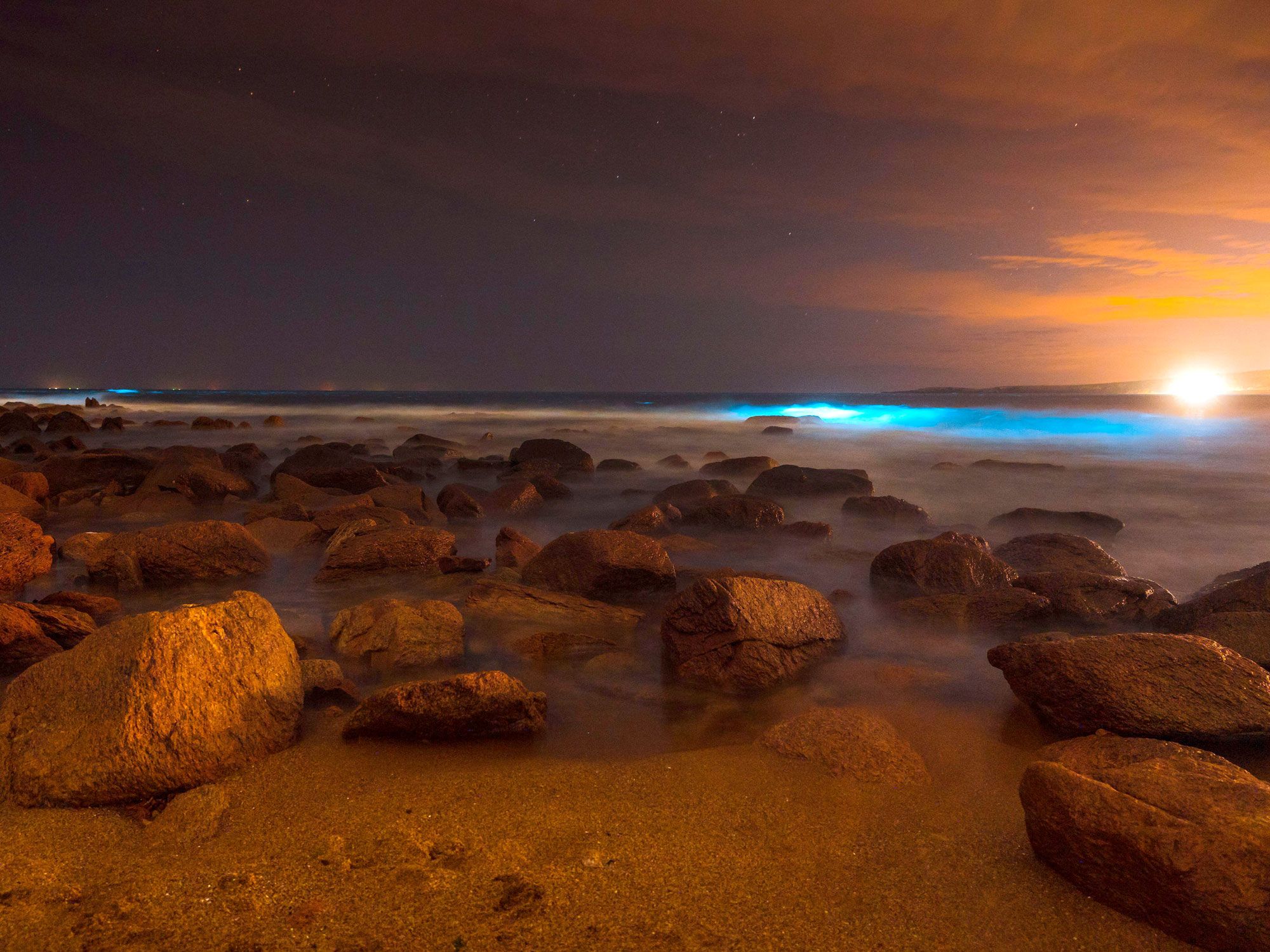
Mosquito Bay is the world’s brightest bioluminescent bay, located off the island of Vieques. The bay gets its dazzling neon blue color from microscopic organisms in the water that capture light energy from the sun and glow when agitated or touched.
Though these microorganisms live in the ocean, you can only find them in a few rare spots on Earth, which makes Mosquito Bay even more special. Their large concentration produces a visible glow-in-the-dark effect in the bay’s waters. For a truly otherworldly experience, visit during a new moon, when the dark night sky will further illuminate their glow.
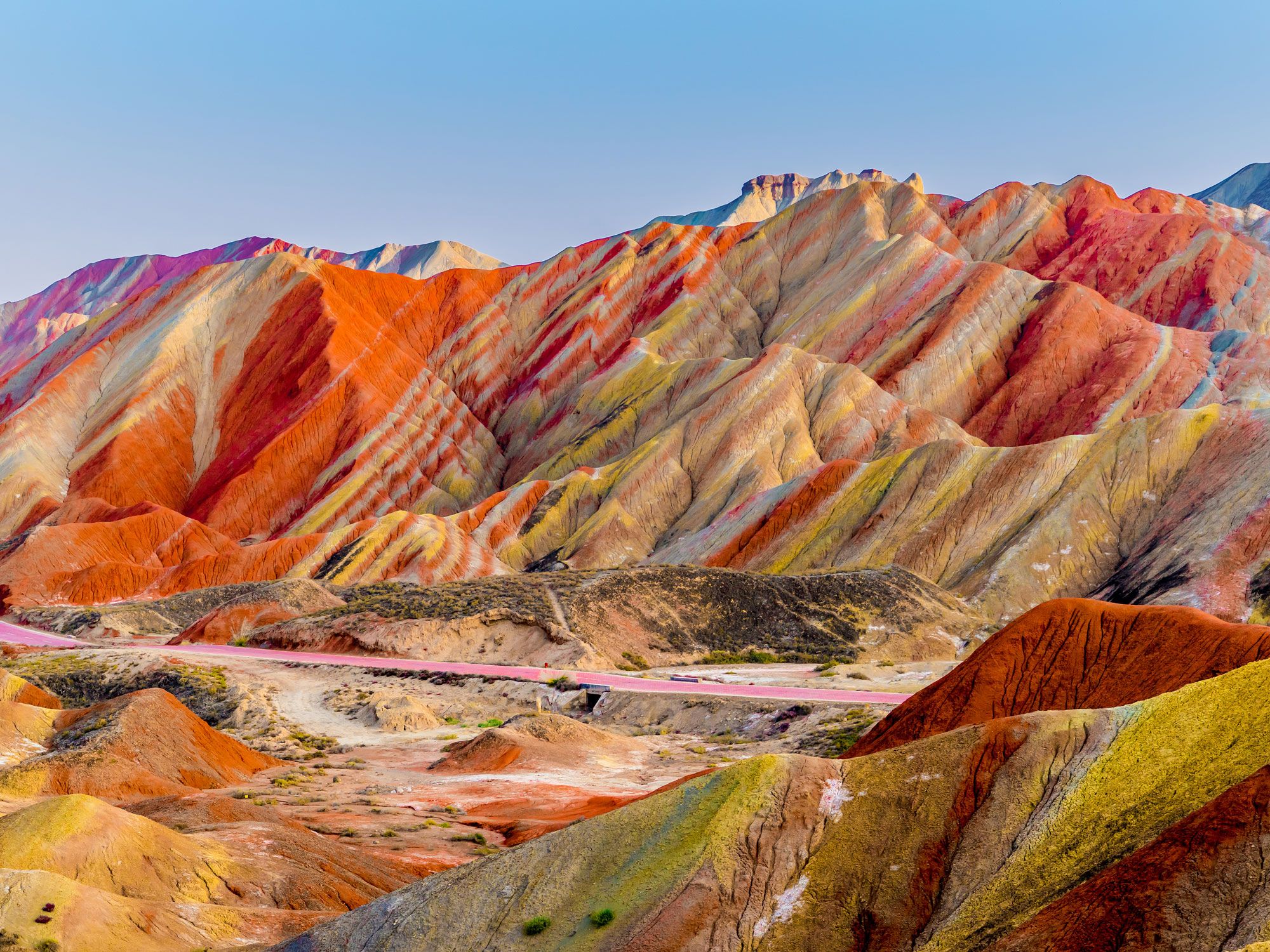
Also known as the Rainbow Mountains, these colorful peaks offer one of the most surreal sights in the world. Known as a Danxia landform, meaning “red cloud,” the site covers approximately 19 square miles in China’s Gansu province and has become a popular UNESCO World Heritage Site.
The colorful stripes are reflective of how the mountains formed. The land was once flat, containing layers of different minerals. When the tectonic plates collided millions of years ago, the land was pushed up and the various layers were revealed — creating an array of colors that attract visitors from all over the world.
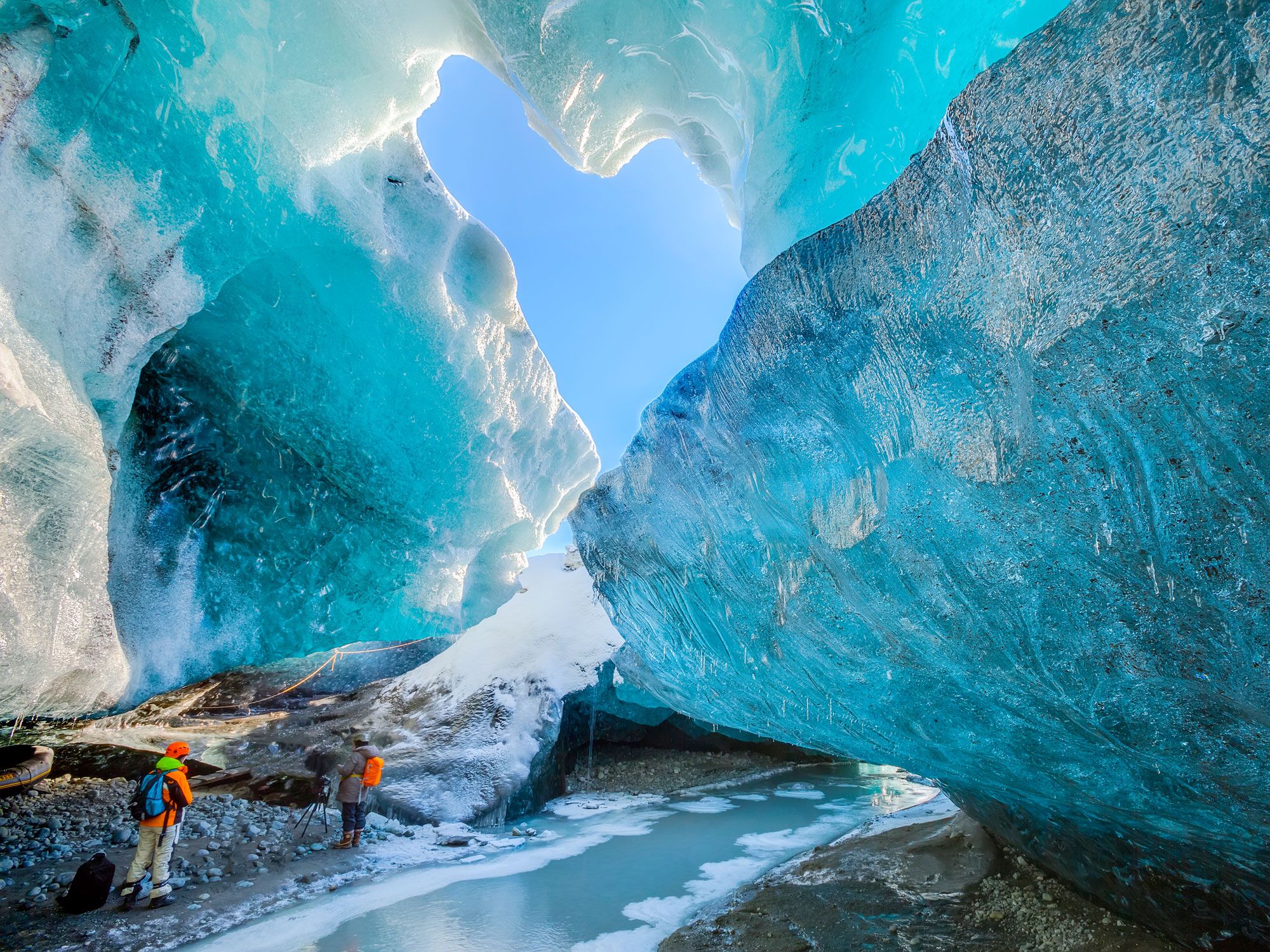
For those willing to brave bone-chilling temperatures, the tunnels of blue ice formations in the Mendenhall Ice Caves are a worthy payoff. Located about 12 miles outside of Juneau, Alaska, the Mendenhall Glacier stretches another 12 miles into the Mendenhall Valley, and its partially hollow interior allows for easy exploration.
Unfortunately, climate change has had a negative impact on the glacier, causing it to recede nearly two miles over the last 60 years. If the ice melts and the caves continue to shift, they may eventually become inaccessible to humans. But for now, the stunning blue hues of the ice caves leave an indelible mark on anyone who makes the trek inside.
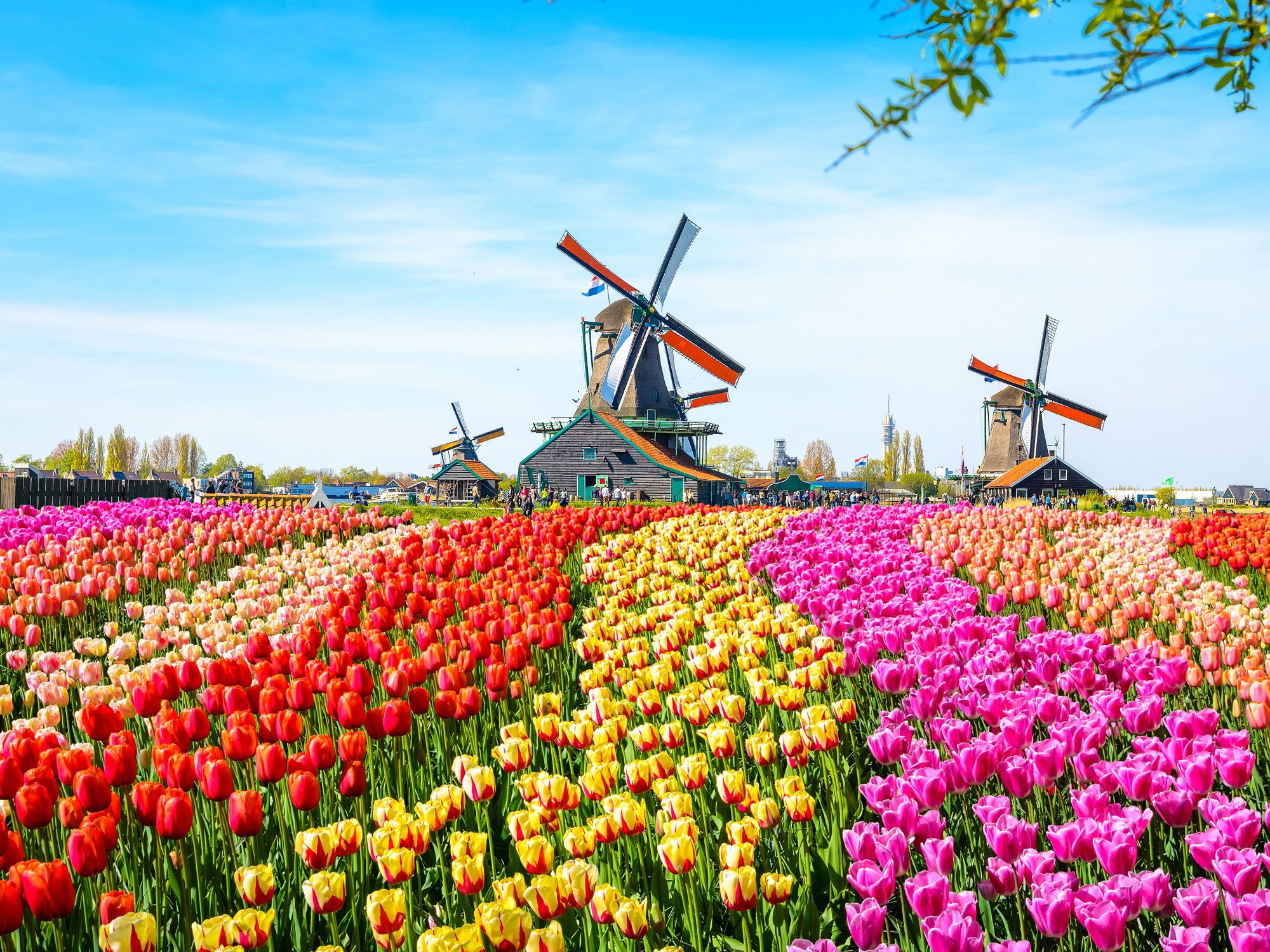
With rows of blooms in vibrant colors, the seasonal tulip fields in the Netherlands look like a postcard come to life. Here, the flowering season begins in March, with crocuses and tulips in full bloom from mid-April through the first week of May. Though there are a number of fields across the country, the largest and most famous are at Keukenhof.
Every autumn, more than seven million bulbs are planted, turning the area into an enormous patchwork quilt of kaleidoscopic colors. Keukenhof is located just 25 miles southwest of Amsterdam — which makes it a convenient destination for your springtime travels.
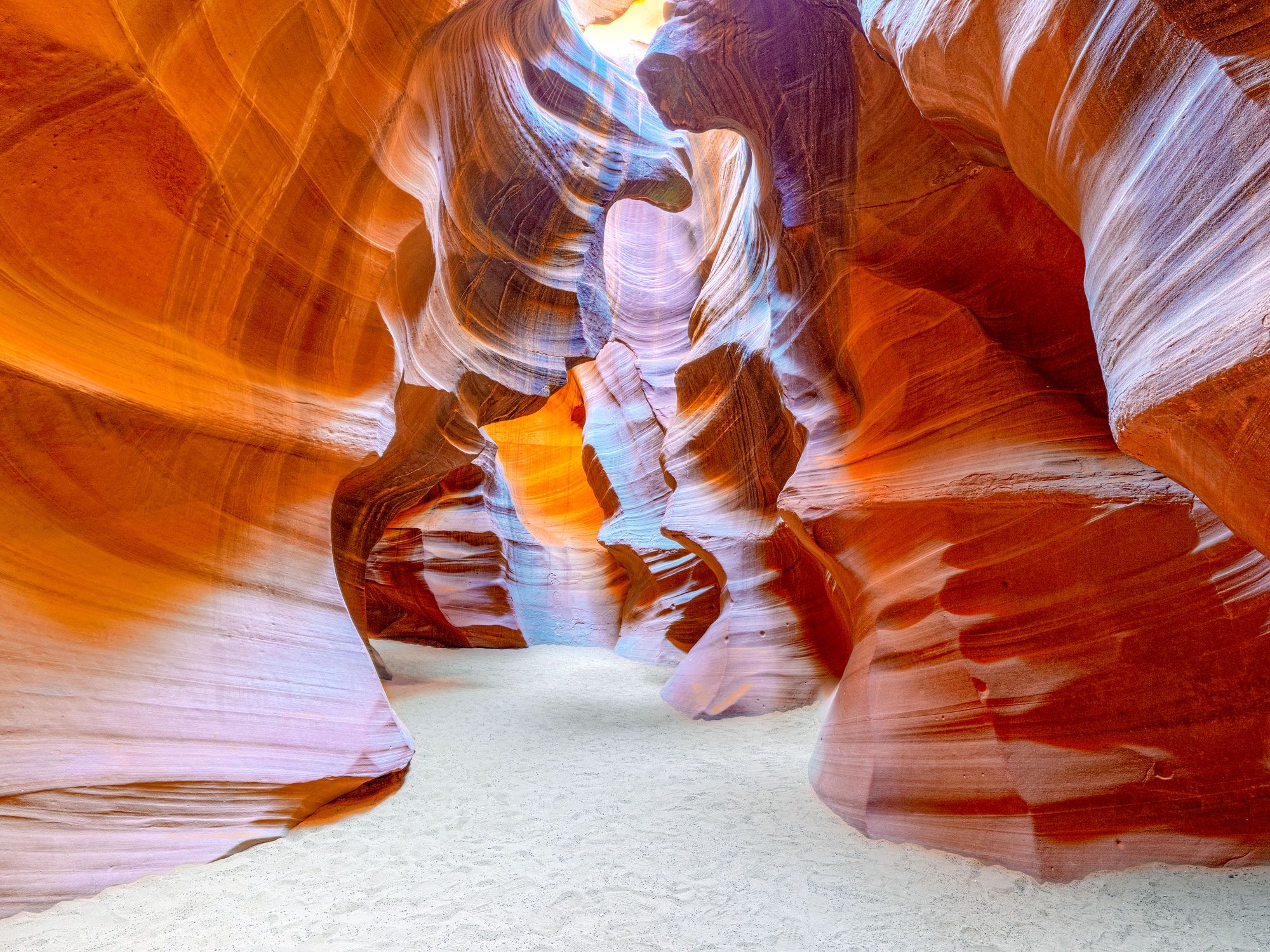
The smooth red sandstone slopes of the canyon consist of multihued striations, artfully sculpted by wind and water over 190 million years. Located in Arizona on Navajo land, this famous slot canyon is divided into Upper Antelope Canyon and Lower Antelope Canyon, both of which can be accessed only by guided tours.
The upper canyon is particularly popular with tourists. There, visitors can see shifts of cascading sunlight grazing the 120-foot rock walls, creating incredible photo ops that make it one of the most photographed places in the Southwest. The hike through the lower canyon is more physically demanding but offers equally memorable scenery.
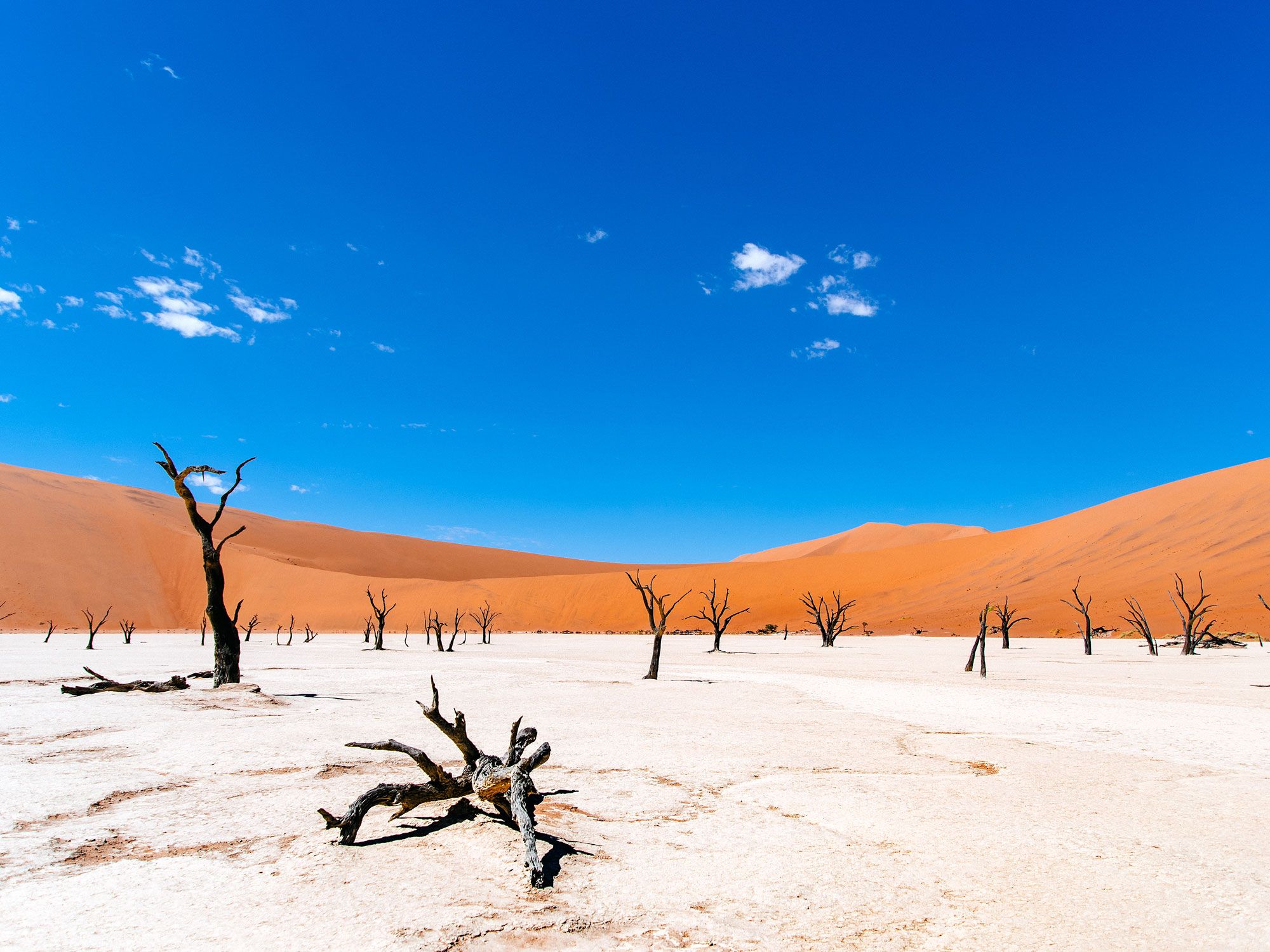
Located on the western edge of Namibia, the landscape at Dead Vlei looks like a surrealist painting, with its starkly contrasting red-orange sand dunes set behind apocalyptic trees and the dried white clay pan of the desert floor..
The trees began to grow when the area was flooded by a nearby river. In later centuries, however, newly formed sand dunes cut off the water supply. Though the trees here are around 900 years old, they haven’t yet decomposed due to the extreme dryness of the climate — leaving them intact in all their bleak, barren beauty.
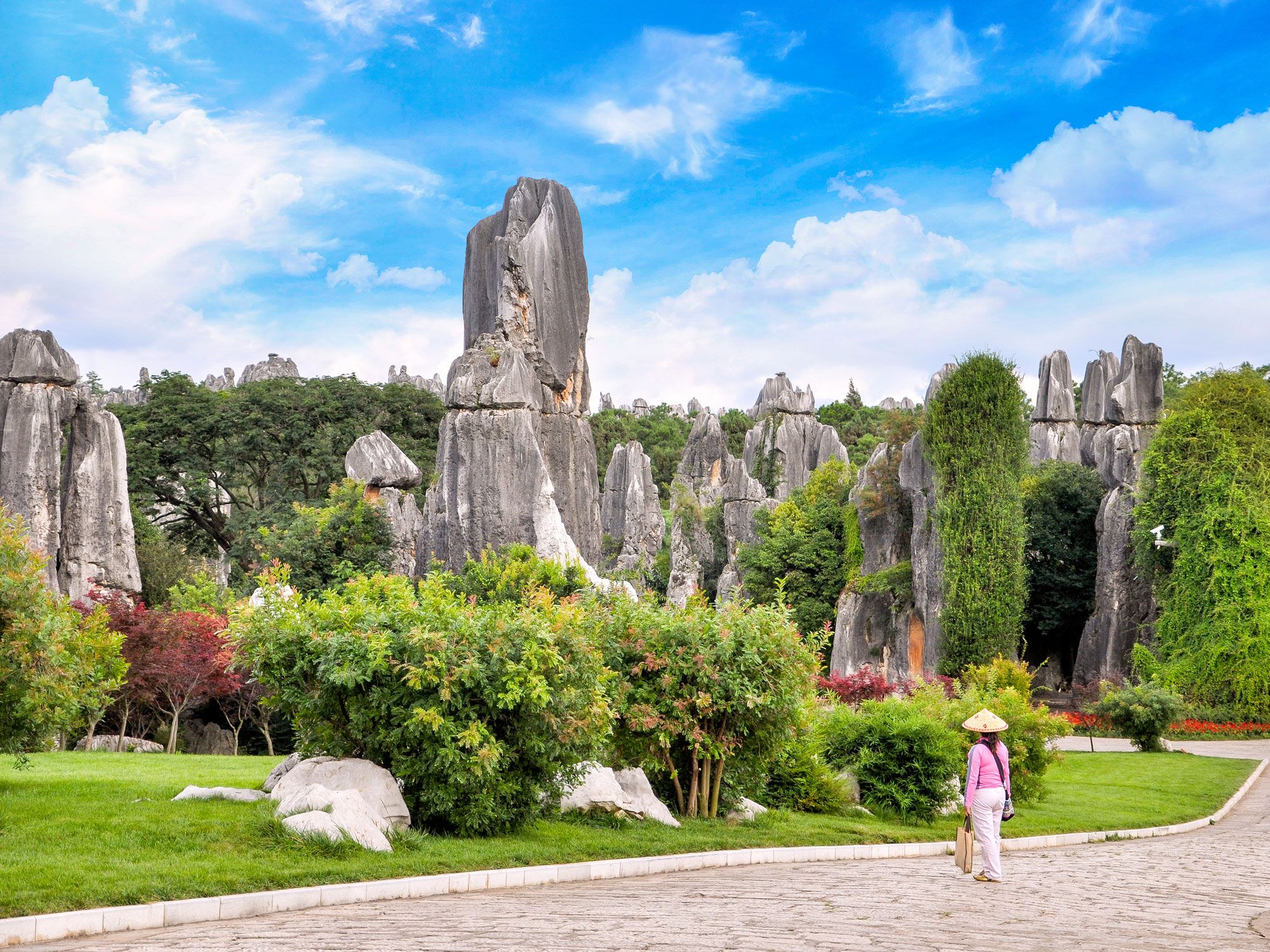
While touring China, you won’t want to miss Shilin, also known as the Stone Forest. Its towering karst landforms have earned it a place on the UNESCO World Heritage list. The landscape began forming 270 million years ago and today covers approximately 150 square miles in the Yunnan Province. In addition to the labyrinth of limestone towers and ridges, the Stone Forest is home to caves, lakes, waterfalls, and even an underground river.
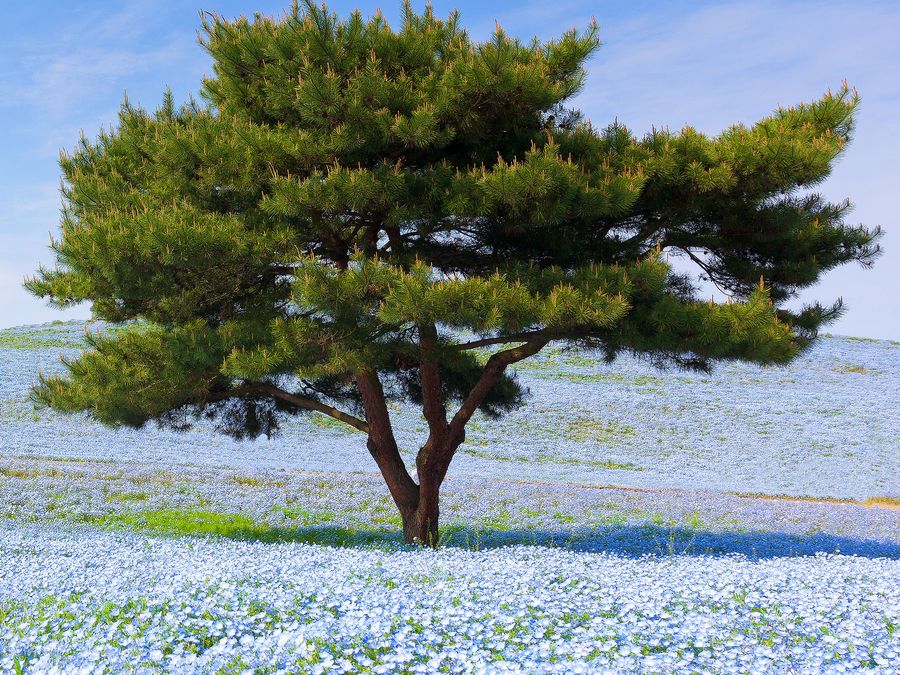
The beautiful trails of Japan’s Hitachi Seaside Park wind through flower beds lined with millions of daffodils, tulips, roses, red Kochia, and baby-blue Nemophila that seem to stretch as far as the eye can see. Flowers bloom in every season, making it a popular year-round attraction which you can explore on foot or bike.
There’s also an amusement park on site, complete with a Ferris wheel and roller coaster, so you can enjoy a little adrenaline rush after admiring the flowers.
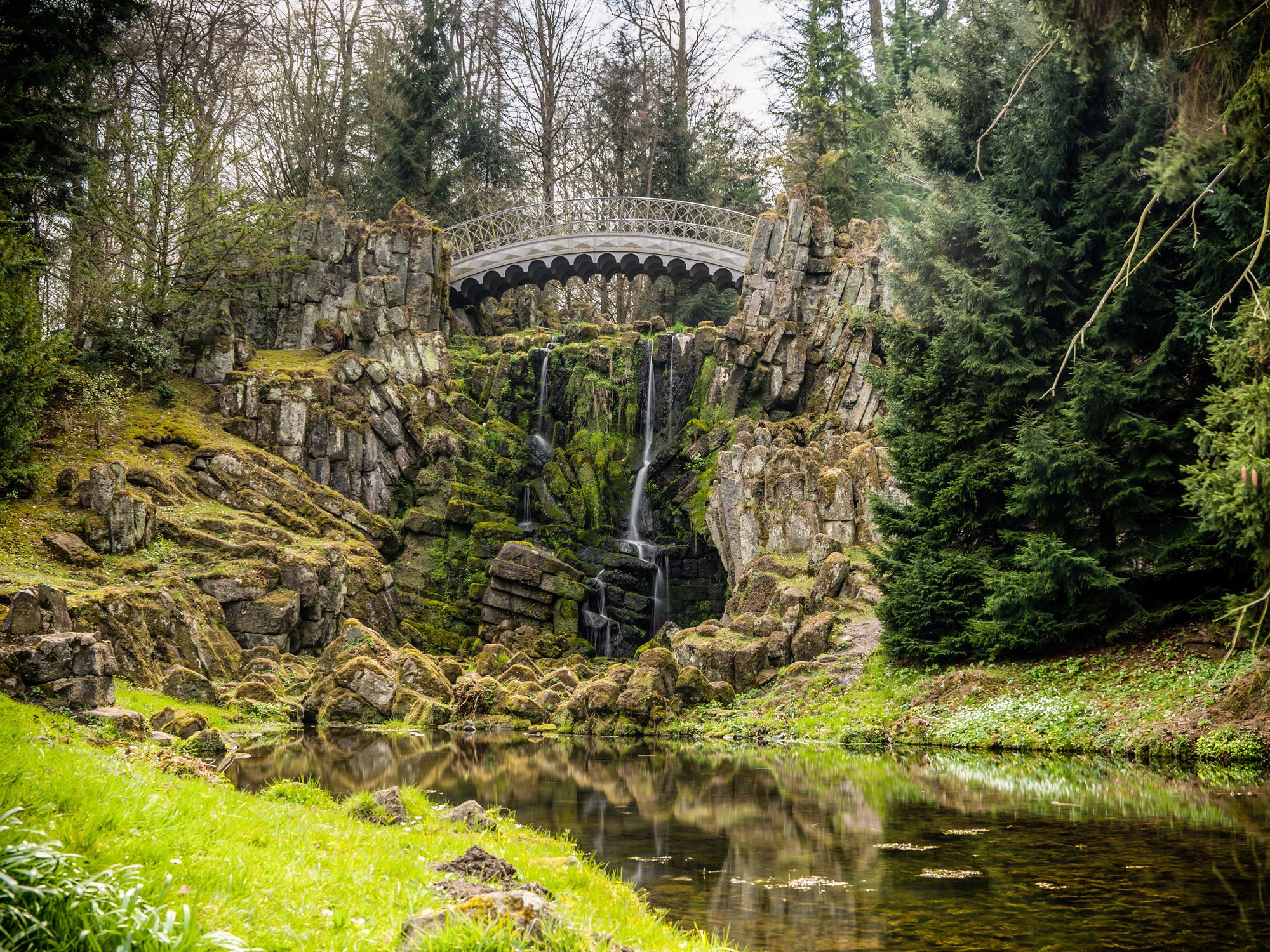
Combining ornate Baroque architecture with waterfalls and overgrown gardens, Bergpark Wilhelmshöhe evokes thoughts of a fairytale castle. Europe’s largest hillside park offers a mix of unexpected sights, from a Chinese pagoda to a towering statue of Zeus.
The park is located in the city of Kassel in central Germany. Its construction began in 1696; over the following centuries, various features such as gardens and fountain displays were added to the park.
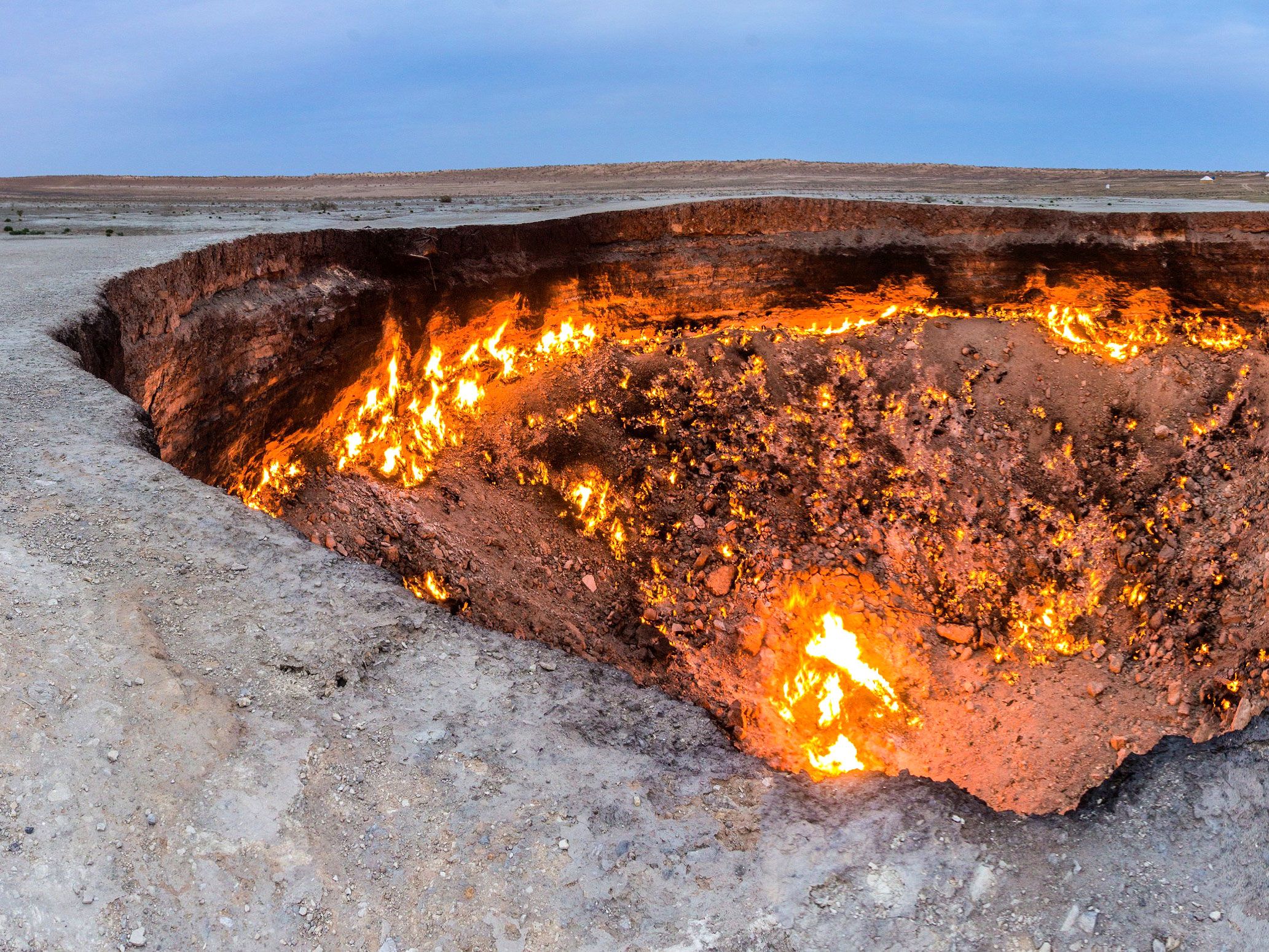
The Darvaza gas crater has been burning in a Turkmenistan desert for about five decades, earning it the nickname of “The Gates of Hell” or “The Door to Hell.” Approximately 226 feet in diameter and 98 feet deep, the pit is located in a natural gas field. This gives it all the fuel it needs to light up the desert like the world’s biggest campfire.
According to most accounts, the crater was first discovered in 1971, when geologists thought they had found an oilfield. Instead they were drilling on top of a large pocket of natural gas, which collapsed under the weight of their equipment. Since the high quantity of methane in natural gas can make it hard to breathe, the scientists set the pit on fire in order to protect the area’s wildlife. They hoped to burn off the gas in a few short weeks, but their plan failed. Since it’s difficult to tell exactly how much gas there’s left to burn, the Gates of Hell could stay open for a while.
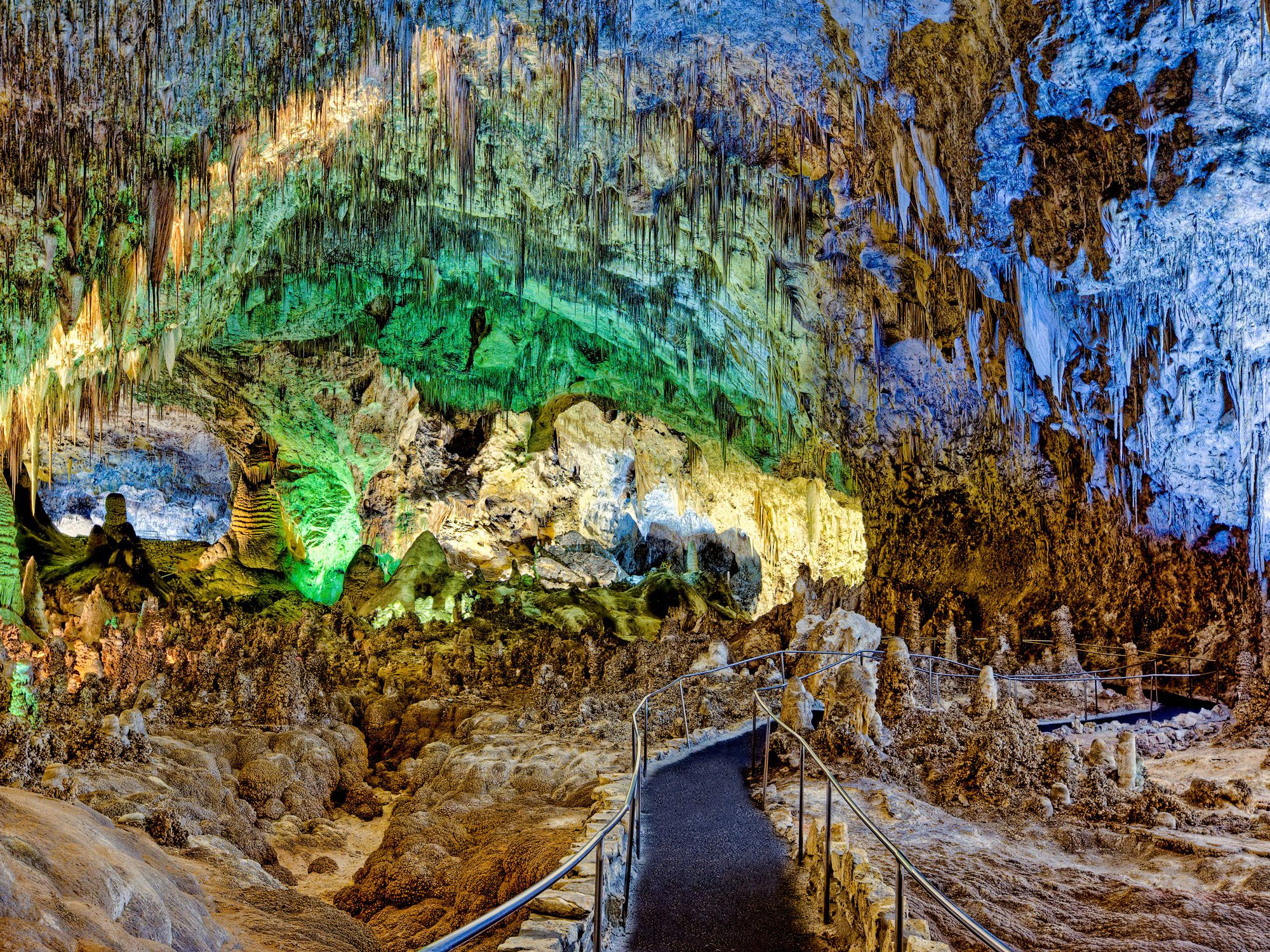
The stalactites and stalagmites, underground pools, and rippled limestone walls give the 100 caves that make up the Carlsbad Caverns an otherworldly appearance.
One of the oldest cave systems in the world, estimated to have formed 3.9 million years ago, the caverns are also biologically diverse ecosystems with bat colonies and other habitats. Each of the various chambers — such as the Temple of the Sun, the Big Room, and the Hall of the Giants — has unique geological features that were formed over centuries.
Advertisement
More from our network
Daily Passport is part of Inbox Studio, an email-first media company. *Indicates a third-party property.