These Gadgets Will Help You Fall Asleep on Any Plane
By
Bennett Kleinman
Read time: 4 minutes
July 22, 2024
Updated: February 19, 2025
These Gadgets Will Help You Fall Asleep on Any Plane
Tips •July 22, 2024•Updated: February 19, 2025
By Bennett Kleinman
Author
Bennett Kleinman
Bennett is a New York City-based staff writer for Daily Passport. He previously contributed to television programs such as the Late Show With David Letterman, as well as digital publications like the Onion. Bennett has traveled to 48 U.S. states and all 30 Major League Baseball stadiums.
Between turbulence, chatter from other passengers, and in-flight announcements, falling asleep on a plane can be difficult. But getting rest is critical, both to pass the time and to help prevent jet lag. If you’re one of the many flyers who struggle to fall asleep in the air, plenty of products are available that may be able to help. The gadgets below fit into any carry-on bag and are TSA-approved, so there should be no difficulties in getting them onboard. Here are seven gadgets that will help you fall asleep more easily on your next flight.
Note: All featured products and deals are selected independently and objectively by the author. Daily Passport may receive a share of sales via affiliate links in content.
Loop Quiet Earplugs
Credit: Milko/ E+ via Getty Images
Noise-canceling headphones are a popular choice for flights, but they aren’t always the most relaxing option, as some people struggle to fall asleep while listening to music. These noise-reducing ear plugs from Loop help to limit cabin noise to a barely noticeable hum. The plugs are extra soft, come in a variety of sizes to comfortably fit any ear, and are hypoallergenic if you have sensitive skin. They’re also reusable and last for up to five years. Plus, the ear plugs still allow the tiniest bit of noise to come through, so you’ll be able to tell if there’s an important in-flight announcement being made.
Portable Sound Machine
Credit: urbazon/ E+ via Getty Images
This portable white noise machine easily fits into any carry-on bag and contains a headphone jack, so you don’t have to worry about disturbing other passengers. The device is programmed with 25 relaxing sounds — including sea waves, campfire, and rain — and comes with 32 adjustable volume levels. It’s also battery-powered, so there’s no need to take up valuable outlet space. When you’re ready to sleep, just strap the attached rope around your wrist, set the auto-off timer for as long as you like, and allow yourself to be lulled to sleep.
Long plane journeys often result in foot swelling and leg discomfort, but elevating your feet can improve circulation and prevent that. This foot hammock hangs off the tray table in front of you and provides a spot for you to rest the soles of your feet or your calves, depending on your leg length. It’s adjustable, easy to install, and won’t disturb the passenger in front of you. The hammock’s slight elevation cuts down on the risk of sore legs and an achy lower back during your flight, which should allow any traveler to fall asleep more comfortably.
Inflatable Travel Pillow
Credit: Beton studio/ iStock via Getty Images Plus
This inflatable travel pillow is extremely compact when uninflated, so you can just tuck it into your carry-on when packing. Unlike standard neck pillows, this product features a unique hollow design that allows for smooth breathing and a space to rest your arms. You can place the pillow on the tray table in front of you and lean forward, or place it on your lap to rest your chin.
3D Sleep Mask
Credit: anouchka/ E+ via Getty Images
Standard sleep masks often let too much light through, and often, the tight strap creates too much pressure for comfort. But that can be avoided with this luxurious 3D sleep mask made of plush memory foam. It’s easily adjustable and able to conform to any head shape. The mask fits tightly yet comfortably around your eyes, stopping any light from creeping in. Its design also features deep spaces around the eyes, preventing unwanted pressure from building.
2-in-1 Travel Pillow and Blanket
Credit: Antonio Hugo Photo/ Moment via Getty Images
Bringing both a pillow and blanket onboard can eat up valuable space in any carry-on, but you don’t have to worry with this 2-in-1 travel pillow and blanket. This product easily tucks into any bag, and it also has a built-in sleeve that you can strap around any suitcase handle while navigating through the airport. Once aboard, you can choose to use the product as a pillow and rest your head against the plush fabric. Or, unzip the pillow and remove a comfy blanket, which is large enough to provide warmth to you as well as any traveling companion.
Calming Pillow Spray
Credit: mihailomilovanovic/ E+ via Getty Images
Science has proved that pleasant odors can help people relax and fall asleep faster. This deep sleep pillow spray is an ideal product for helping you wake up feeling refreshed after a long plane journey. The solution contains hints of lavender, chamomile, and vetivert — all of which are said to encourage relaxation and promote deeper sleep. Just spray it onto your travel pillow or blanket and allow the pleasant odors to help you relax and doze off. Plus, the tube is just 2.5 fluid ounces, which is well below TSA’s 3.4-ounce limit for liquids.
Advertisement
More from our network
Daily Passport is part of Inbox Studio, an email-first media company. *Indicates a third-party property.
7 Cities Hiding Secret Ruins Underneath Their Streets
By
Rachel Gresh
Read time: 6 minutes
July 22, 2024
Updated: July 22, 2024
7 Cities Hiding Secret Ruins Underneath Their Streets
Culture •July 22, 2024•Updated: July 22, 2024
By Rachel Gresh
Author
Rachel Gresh
Rachel is a Washington, D.C.–based travel and lifestyle writer with roots in the Great Lakes region. When she’s not writing for publications such as The Discoverer and Interesting Facts, you’ll find her wandering through museums or exploring destinations off the beaten path.
In many travel destinations, what you see is what you get. Postcard-perfect attractions — such as the Eiffel Tower in Paris or the Colosseum in Rome — are easy to find and therefore uber-popular. But not every city’s most fascinating attractions are so obvious. In such places, there is much more than meets the eye, and to find it, you’ll have to go somewhere unexpected: underground. The thrill of discovering these hidden treasures, secret ruins, forgotten cities, and landmarks beneath modern-day towns is an adventure in itself. Here are seven cities with secret underground ruins to explore.
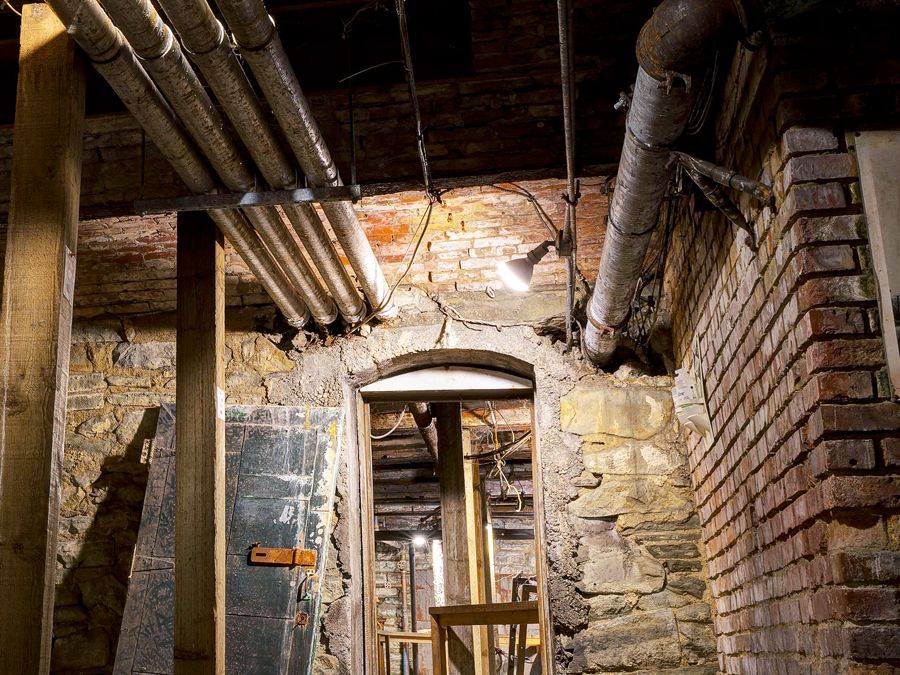
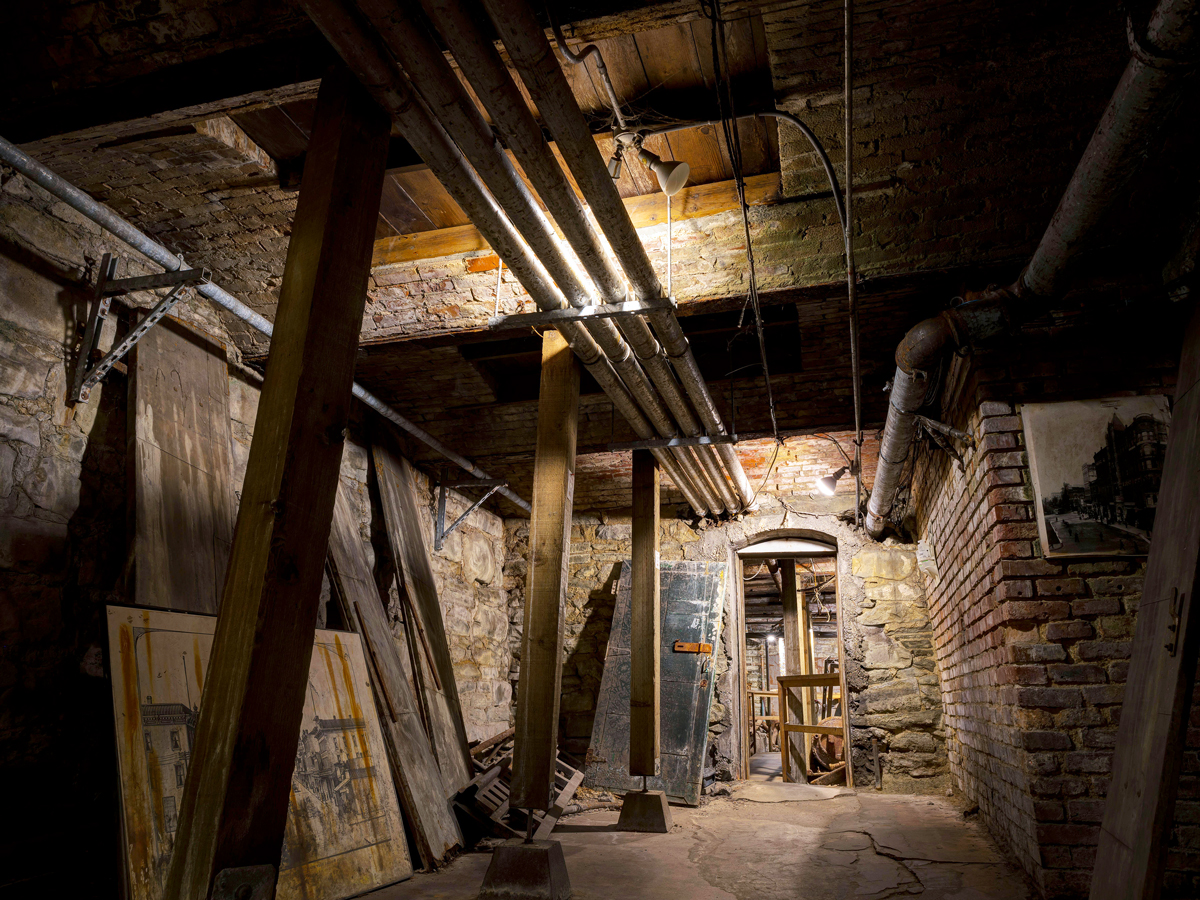
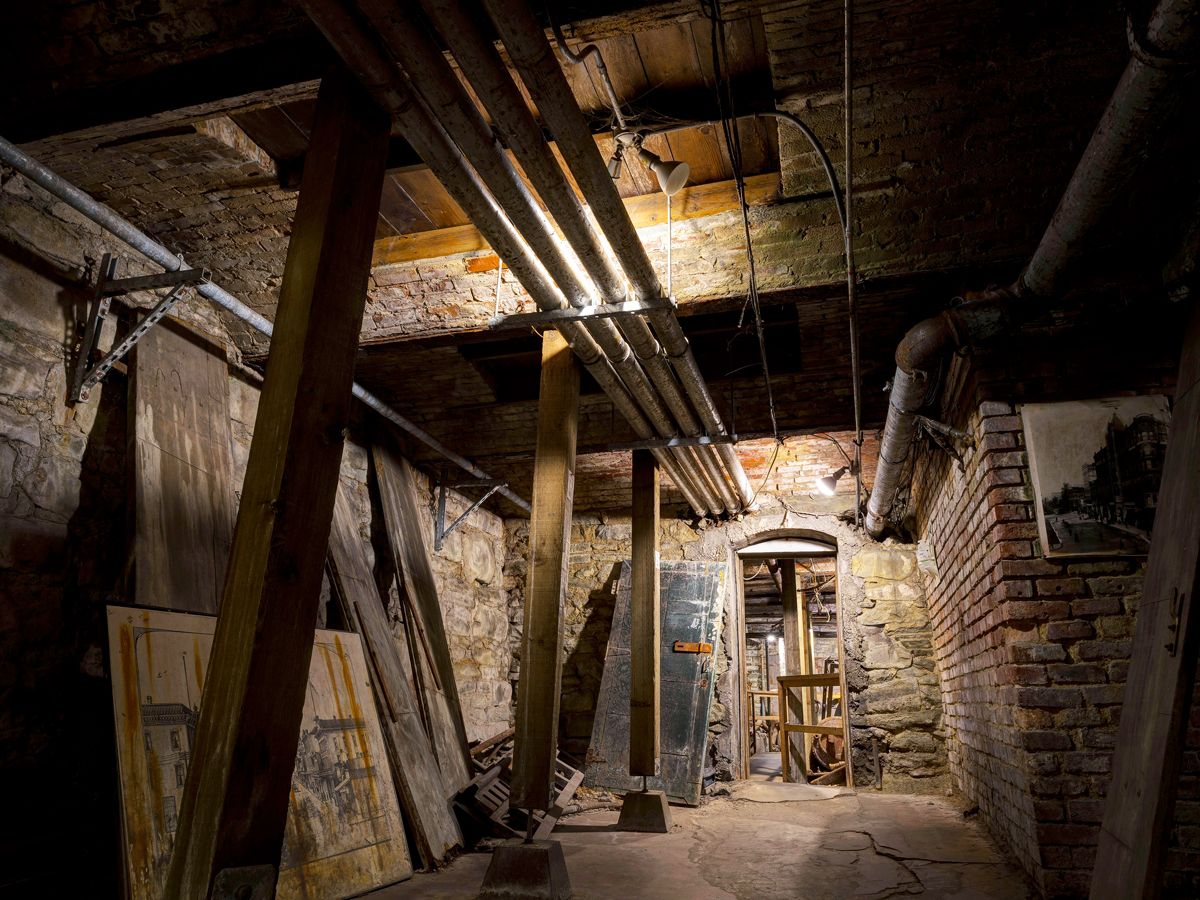
After the Great Fire of 1889 devastated downtown Seattle, the city needed a major infrastructure overhaul. Faced with constant flooding on the mud flats of Puget Sound (where most businesses were located), the city rebuilt on top of itself, encapsulating the old storefronts and sidewalks beneath layers of brick, steel beams, and soil. Some businesses continued to use the now subterranean levels of their buildings, but most built on top of them.
By the early 20th century, most of these basements in the Pioneer Square neighborhood were abandoned. But as the decades passed, store owners and tour operators realized they had a compelling tourist attraction on their hands. Now, visitors can tour some areas of this mysterious underground city while walking alongside crumbling storefronts and 100-year-old artifacts, offering a glimpse into Seattle’s fascinating past.
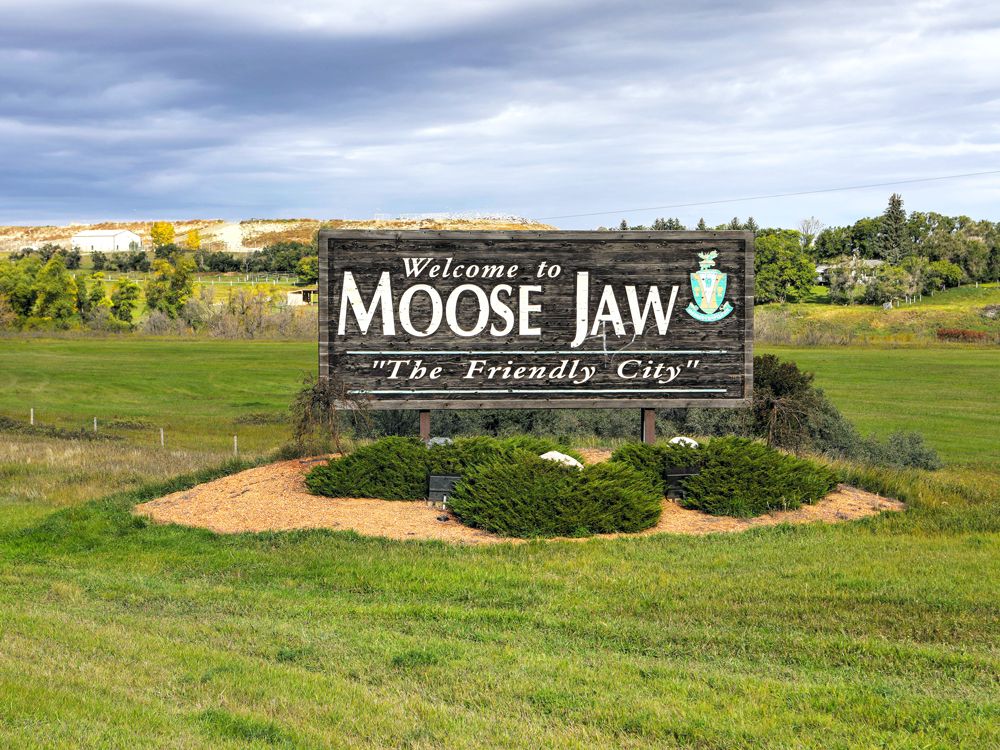
Situated along the Trans-Canada Highway in Saskatchewan, Moose Jaw harbors tales from early Chinese immigrants and legends of Al Capone’s Prohibition-era smuggling ring. These stories have one thing in common — they were rumored to use underground passageways beneath downtown. No one knows for sure who built the passageways, but one reasonable guess is that Chinese rail workers constructed them during the early 1900s. It is said that some workers lived underground for fear of their safety in the midst of racism. Others say that Al Capone enlisted his cronies to build the underground network to store and ship bootlegged liquor.
Today, there are two popular tours of the tunnels for tourists. One highlights the story of Chinese settlers; the other speculates on Al Capone’s illegal enterprise in the city. Although the tours aren’t always true to fact, the underground passageways are genuine and steeped in history and mystery, offering a glimpse into the unique heritage of Moose Jaw.
Lava Caves – Auckland, New Zealand
Credit: Robin Bush/ Photodisc via Getty Images
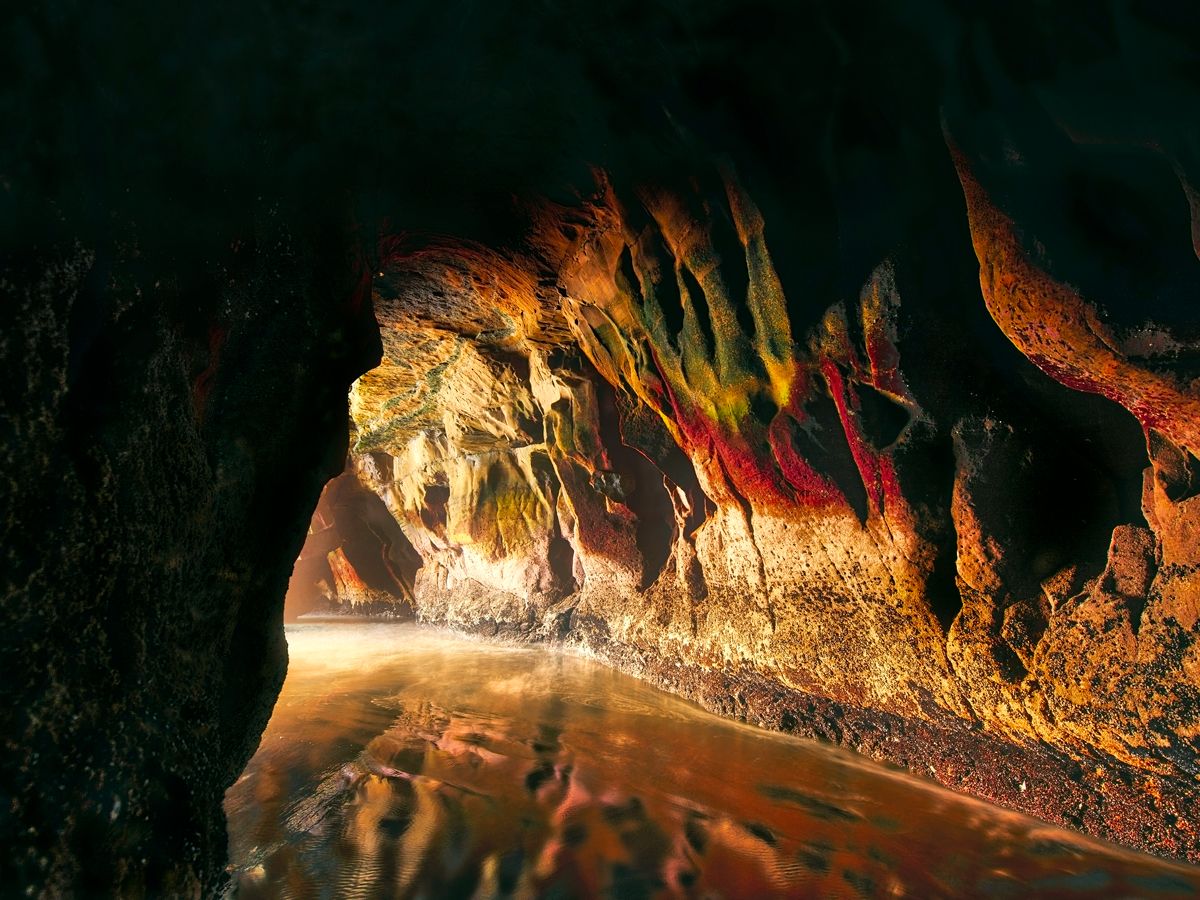
New Zealand is no stranger to volcanic eruptions. Over many millennia, these eruptions have created lava tubes, which are winding underground tunnels formed by oozing molten material following an eruption. Hundreds of tubes lie beneath Auckland, New Zealand’s largest city. More caves are discovered yearly — some in remote fields, others in private backyards — and archaeologists are working to map and preserve them.
Much to the surprise of early researchers, however, the caves weren’t empty. The Māori peoples began using them as burial sites for humans when they first settled in New Zealand in the 13th century. During World War II, members of the Communist Party occupied the caves and operated a covert printing press. While many of central Auckland’s caves are closed to the public for safety and conservation reasons, just outside the city are the Rangitoto Island lava caves, which are open for hikers to explore.
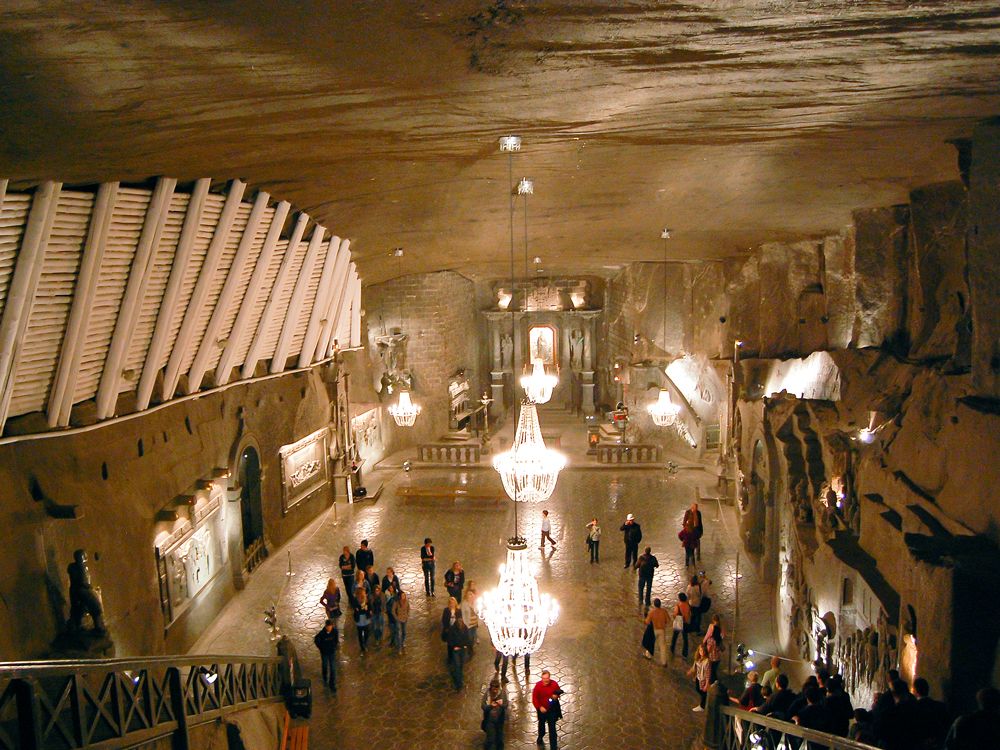
Salt has been mined in southern Poland since Neolithic times, and the first underground mine shaft at the Wieliczka Salt Minewas constructed sometime at the end of the 13th century. The lucrative salt mine not only made Poland’s king, Casimir III, very wealthy but also attracted people from around the region to see the impressive feat. The first documented tourist was famous astronomer and mathematician Nicolaus Copernicus in 1493; a statue of him lies along the Tourist Route in the mines today.
The mine expanded greatly between the 16th and 18th centuries, and curious scientists, diplomats, and ordinary travelers continued to visit. At the time, visitors needed a special royal permit to enter and participate in the mine’s activities, including underground train rides, boat tours, and orchestra performances. Nowadays, mining has ceased, but its subterranean remnants are open to all tourists. Chandeliers light the way as you descend into the depths of the mine while walking along saline lakes. There’s even an underground Polish eatery, along with the impressive St. Kinga’s Chapel.
Vietnam War Tunnels – Ho Chi Minh City, Vietnam
Credit: Giles Clarke via Getty Images News
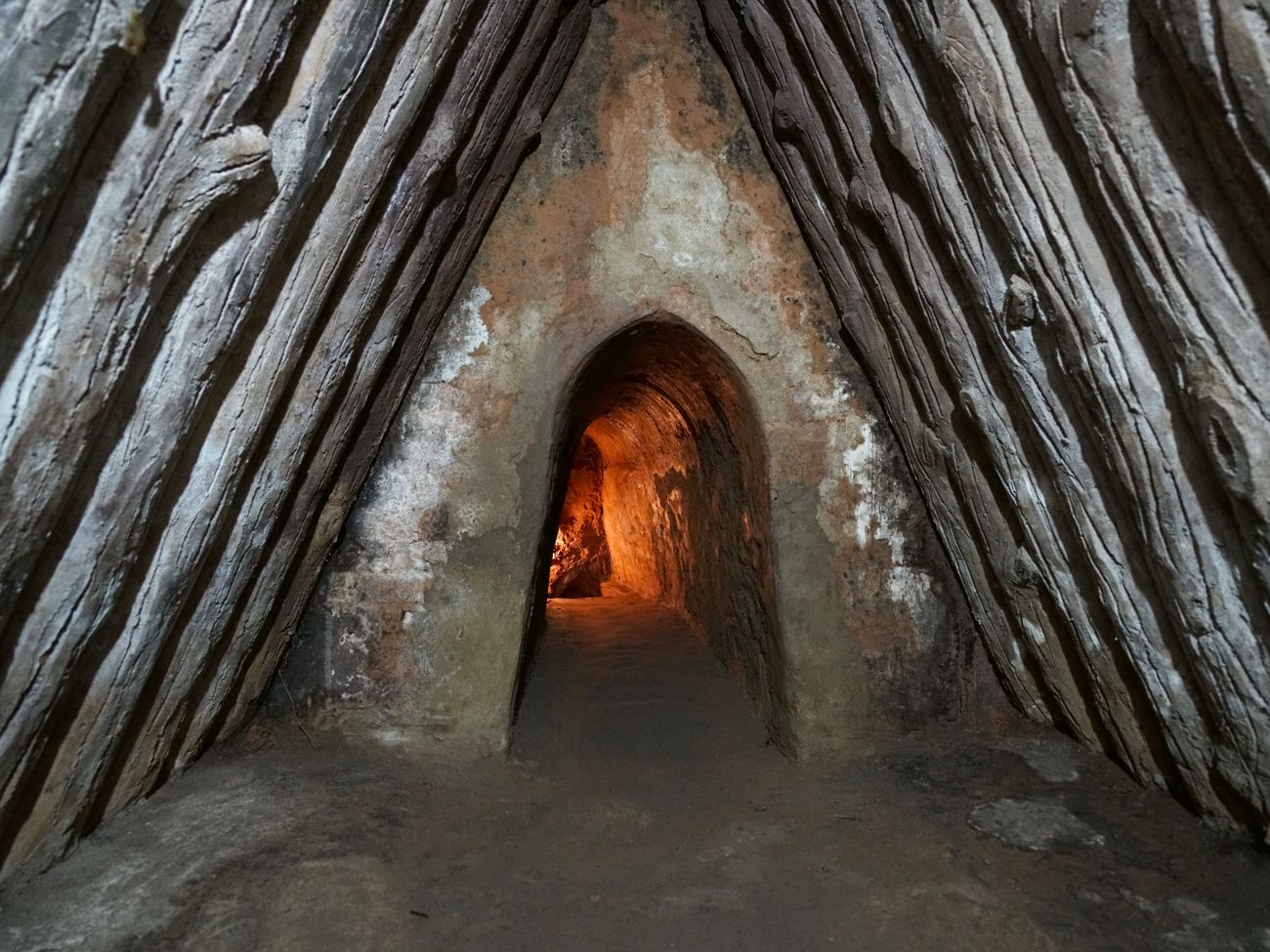
Just outside of Ho Chi Minh City in the district of Cu Chi are some of the best-preserved tunnels from the Vietnam War, which were once used by the Viet Cong to deter American and South Vietnamese forces. Thousands of miles of winding tunnels cross the region, dating to as early as the 1940s. Troops not only used the tunnels to set booby traps and transport supplies, but also lived in them during the height of the war.
Today, these passageways are a popular tourist attraction where guests can learn more about the war’s devastating impact on the region. Visitors can crawl through tunnels and see defunct command centers and booby traps. The Vietnamese government has preserved these tunnels to encourage visitors to explore and honor the lives lost in the war.
Secret Canals – Cape Town, South Africa
Credit: searagen/ iStock via Getty Images Plus
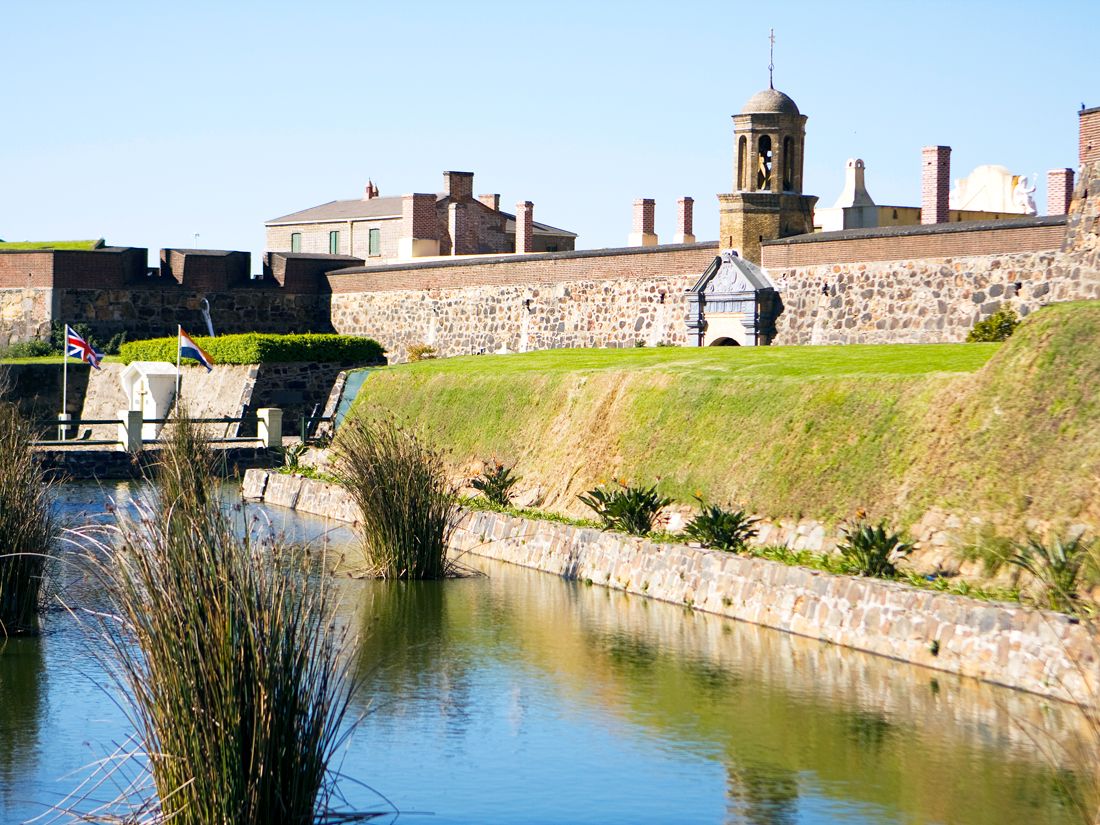
A few yards below the Castle of Good Hope and the cobbled streets of Cape Town are a series of canals once used for defense and irrigation. Dutch settlers created most of the canals as early as the 17th century to direct water from Table Mountain downhill and through the city to tend to gardens and transport supplies. The canals were sealed off in the mid-19th century for hygiene reasons, and the city was built over them. Today, visitors can walk the web of brick passageways underneath downtown Cape Town — at times wading through ankle-deep water — as guides explain the region’s colonial history.
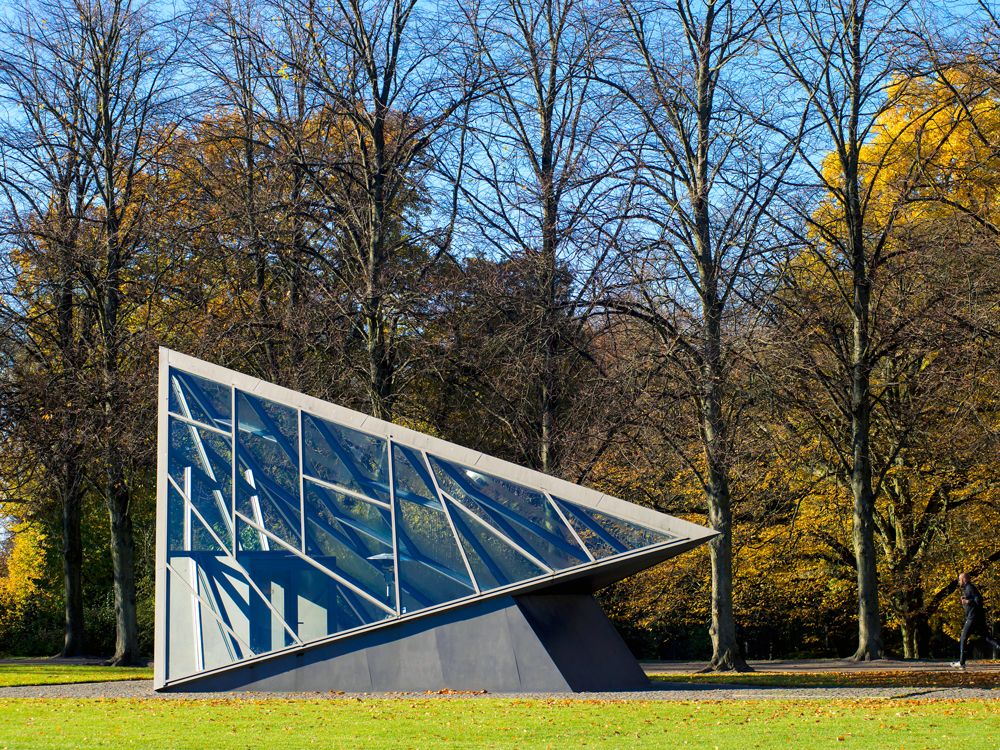
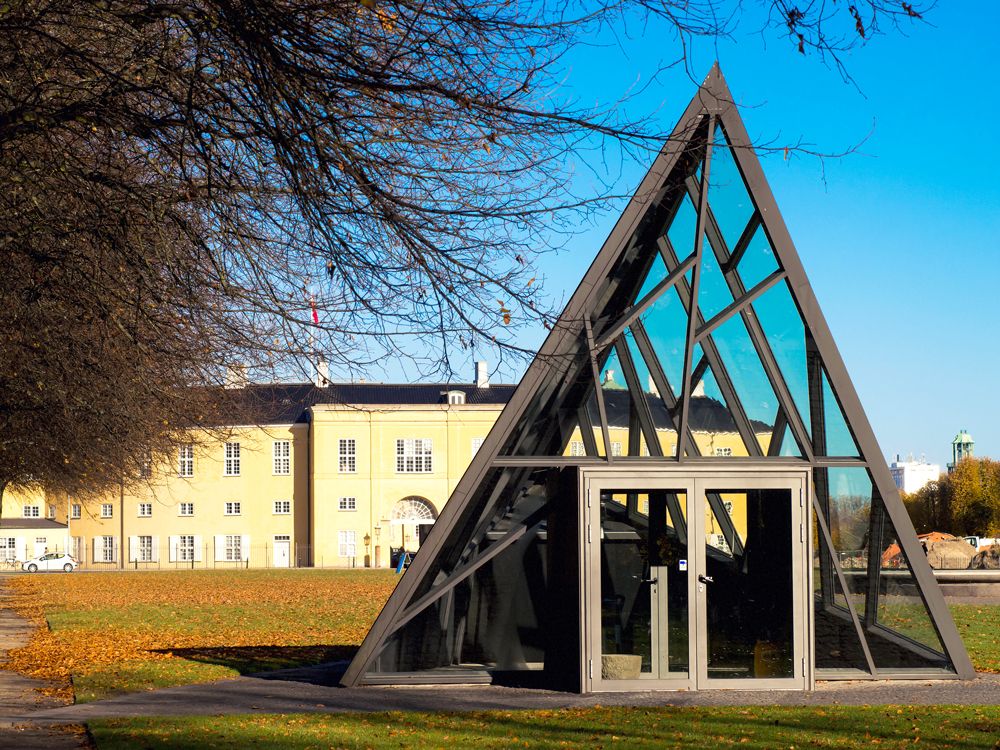
A relaxing stroll through Søndermarken park outside of Copenhagen can turn into a real adventure — if you dare to head underground. Two glass pyramids stand in a grassy area of the park, but unknowing passersby would have no idea there is a subterranean world waiting to be discovered. Beyond the doors are the ruins of a 19th-century water reservoir that has been transformed into a modern event space.
Called Cisternerne, this massive cave once held drinking water for the residents of the Danish capital city. It was active from the mid-19th century to the mid-20th century but was drained in 1981. Today, the Frederiksberg Museums use the reservoir’s empty hull as a unique art exhibition and installation space, blending history and modern art for all to enjoy.
Advertisement
More from our network
Daily Passport is part of Inbox Studio, an email-first media company. *Indicates a third-party property.
10 of the Most Beautiful U.S. National Park Drives
By
Daily Passport Team
Read time: 9 minutes
July 18, 2024
Updated: August 13, 2025
10 of the Most Beautiful U.S. National Park Drives
Outdoors •July 18, 2024•Updated: August 13, 2025
By Daily Passport Team
Author
Daily Passport Team
Daily Passport writers have been seen in publications such as National Geographic, Food & Wine, CBC, Condé Nast Traveler, and Business Insider. They're passionate about uncovering unique destinations and sharing expert tips with curious travelers.
America’s 63 national parks were established to preserve the country’s most remarkable landscapes and ecosystems — as well as to provide spaces for people to connect with nature. And connect people they do: More than 300 million people visit national parks each year for hiking, sightseeing, camping, and some of the most scenic drives in the country. From mountain ranges and homesteads in the American West to craggy coastlines and unbeatable foliage in the East, here are 10 of the most beautiful national park drives in the U.S.
Trail Ridge Road – Rocky Mountain National Park, Colorado
Credit: RondaKimbrow/ iStock via Getty Images Plus
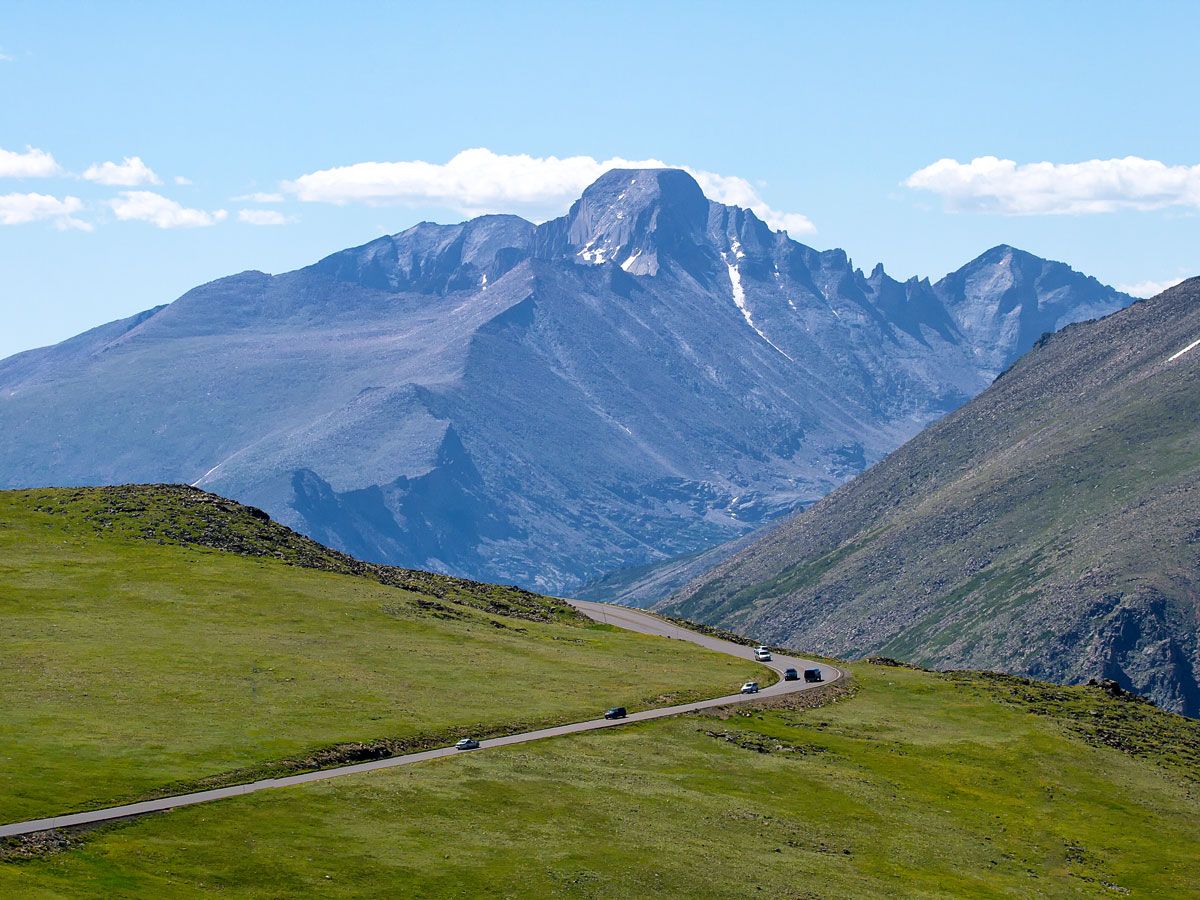
Climbing to 12,183 feet at its summit, Trail Ridge Road is the highest continuous paved road in the United States — and one of the most unforgettable ways to experience the Rockies. The 48-mile stretch connects Estes Park to Grand Lake, rising quickly above the tree line along continuous curves that offer panoramic mountain vistas. On clear days, you can see for hundreds of miles across the jagged peaks and ancient glacial valleys.
Wildlife sightings are also common here, with elk, bighorn sheep, and marmots making regular appearances along the way. Several pullouts and short trails, including the Alpine Ridge Trail near the visitor center, allow for a break from your car and an even closer look at the park’s unique high-altitude ecosystem. Be sure to dress in layers — even in summer, the temperature up top can be 20 to 30 degrees Fahrenheit cooler than in the valleys below. As winter transitions into spring and early summer, you might also encounter some icy roadways at higher elevations.
Rim Drive – Crater Lake National Park, Oregon
Credit: JeffGoulden/ E+ via Getty Images
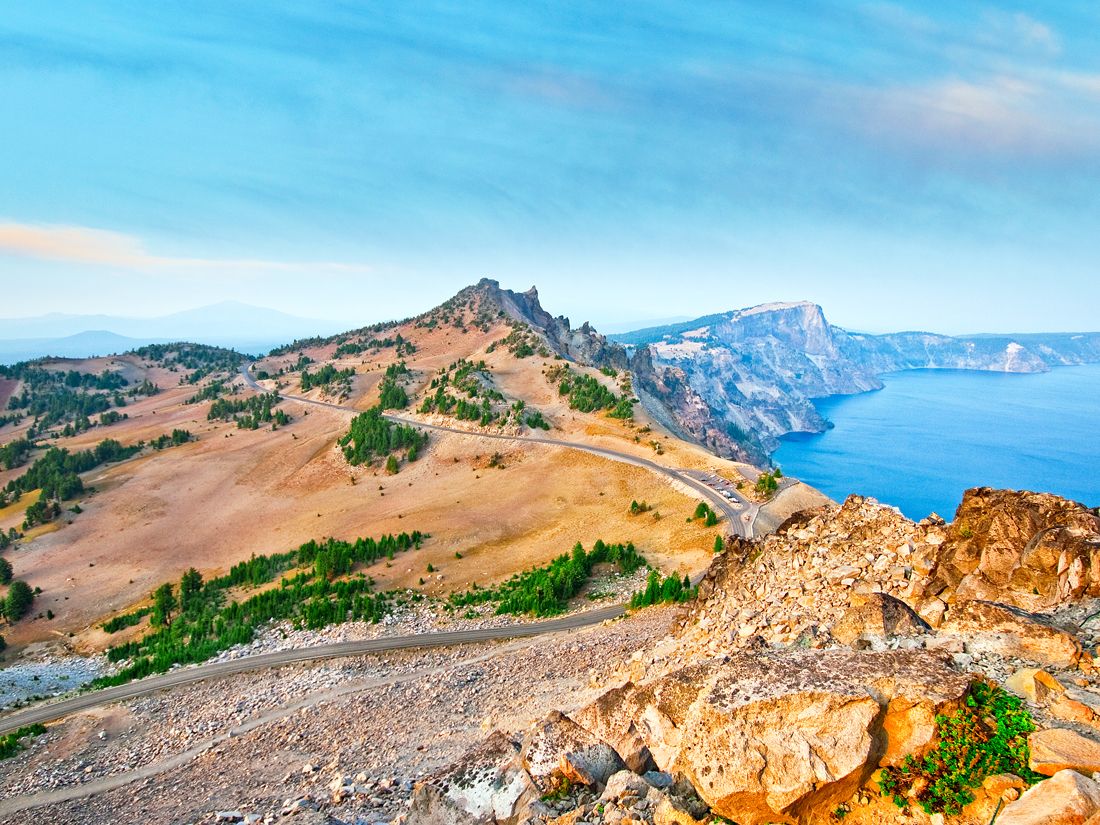
Crater Lake National Park’s 33-mile Rim Drive encircles a caldera that was formed over 7,700 years ago. When the volcano erupted and collapsed, it resulted in a crater that became the deepest lake in the U.S. and the seventh-deepest in the world.
The Rim Drive offers wide-open vistas of the lake’s deep blue waters and surrounding mountains, including the park’s two highest peaks, Mount Scott and Hillman Peak. Visitors can pull over at 30 designated lookouts that were designed to highlight specific views. These include distinct geologic formations, like the Wizard Island cinder cone, or the region’s subalpine meadows, some of which bloom in bright red fleece flowers in the short summer season. The high altitude makes this one of the snowiest places in the inhabited U.S., so it’s best to check park conditions for frequent road closures before planning your trip.
Cathedral Valley Loop Drive – Capitol Reef National Park, Utah
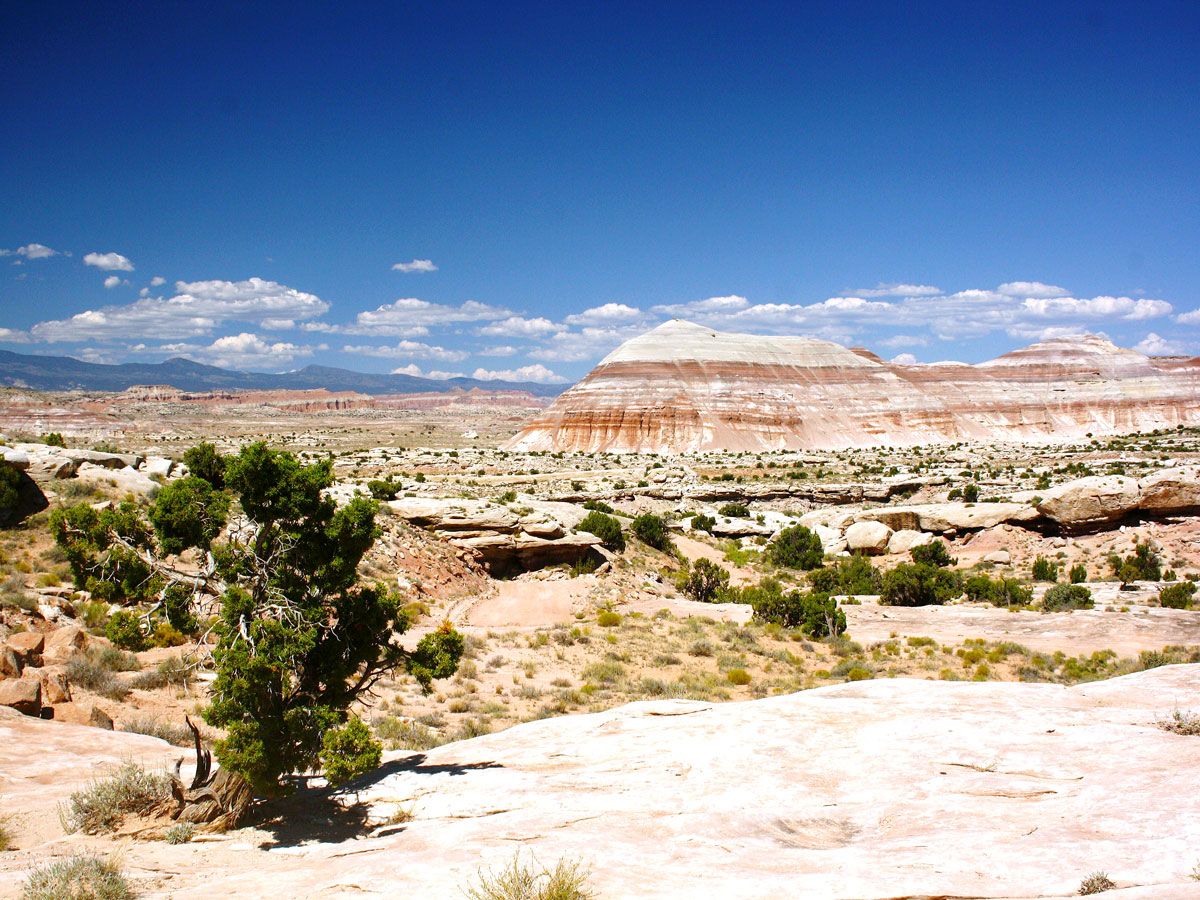
Remote, rugged, and at times otherworldly, the Cathedral Valley Loop Drive is one of Capitol Reef National Park’s best-kept secrets. This 58-mile unpaved loop showcases some of the park’s most striking rock formations, including the Temple of the Sun and Temple of the Moon — towering red sandstone monoliths that seem to rise straight from the flat, dry desert floor.
Because of the rough road conditions and a foot-deep drive through the Fremont River, a high-clearance vehicle is recommended. If you have one or can rent one — check out several nearby truck rental spots if needed — you’ll take in colorful Bentonite Hills badlands, a giant gypsum sinkhole, and vast, crowd-free panoramas that feel almost alien in scale.
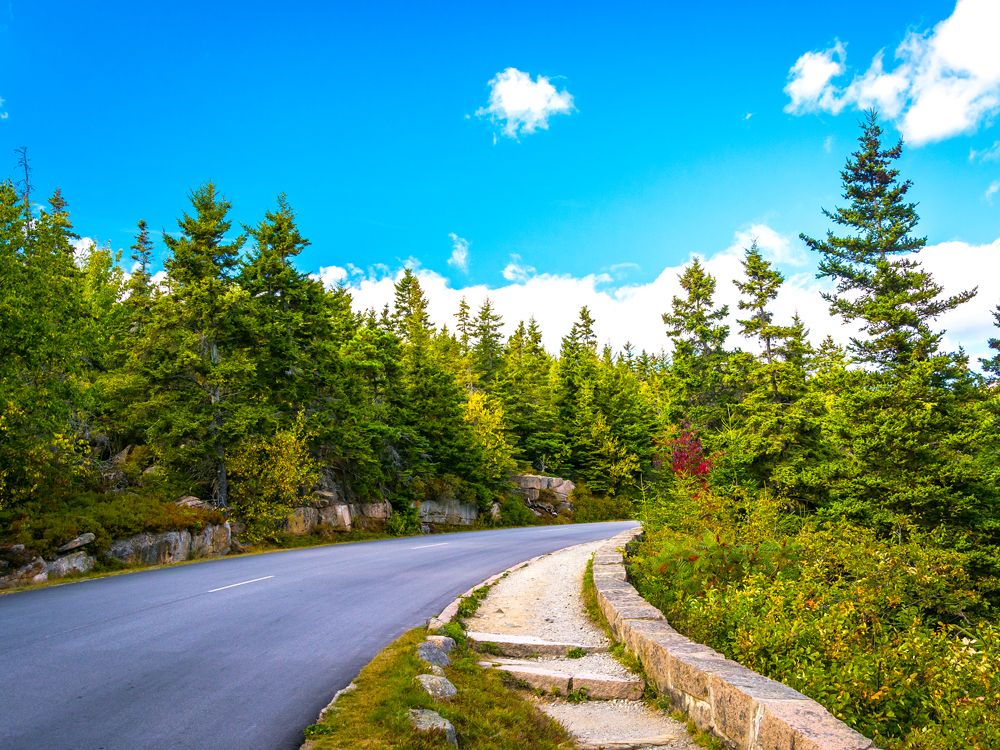
Acadia National Park’s rustic carriage road system — built in the early 1900s by John D. Rockefeller Jr. — may offer a more intimate experience of the park, but driving Park Loop Road highlights many of its most stunning sights. Starting near Hulls Cove Visitor Center, the 27-mile road travels through some of Maine’s trademark natural features. Drive through spruce and fir trees, set against dramatic granite cliffs, and alongside rugged Atlantic coastline, home to must-sees such as Thunder Hole — where the changing tide and surging waters create an unforgettable natural roar.
The route also offers easy access to plenty of hiking trailheads and passes by beautiful Sand Beach, where the sands are warm and the water is beautiful but cold. It’s also easy to reach the summit of Cadillac Mountain from the Park Loop. This marks the highest point on the U.S. Eastern Seaboard, and visitors often flock here to witness America’s first sunrise of the day from October 7 until March 6.
Desert View Drive – Grand Canyon National Park, Arizona
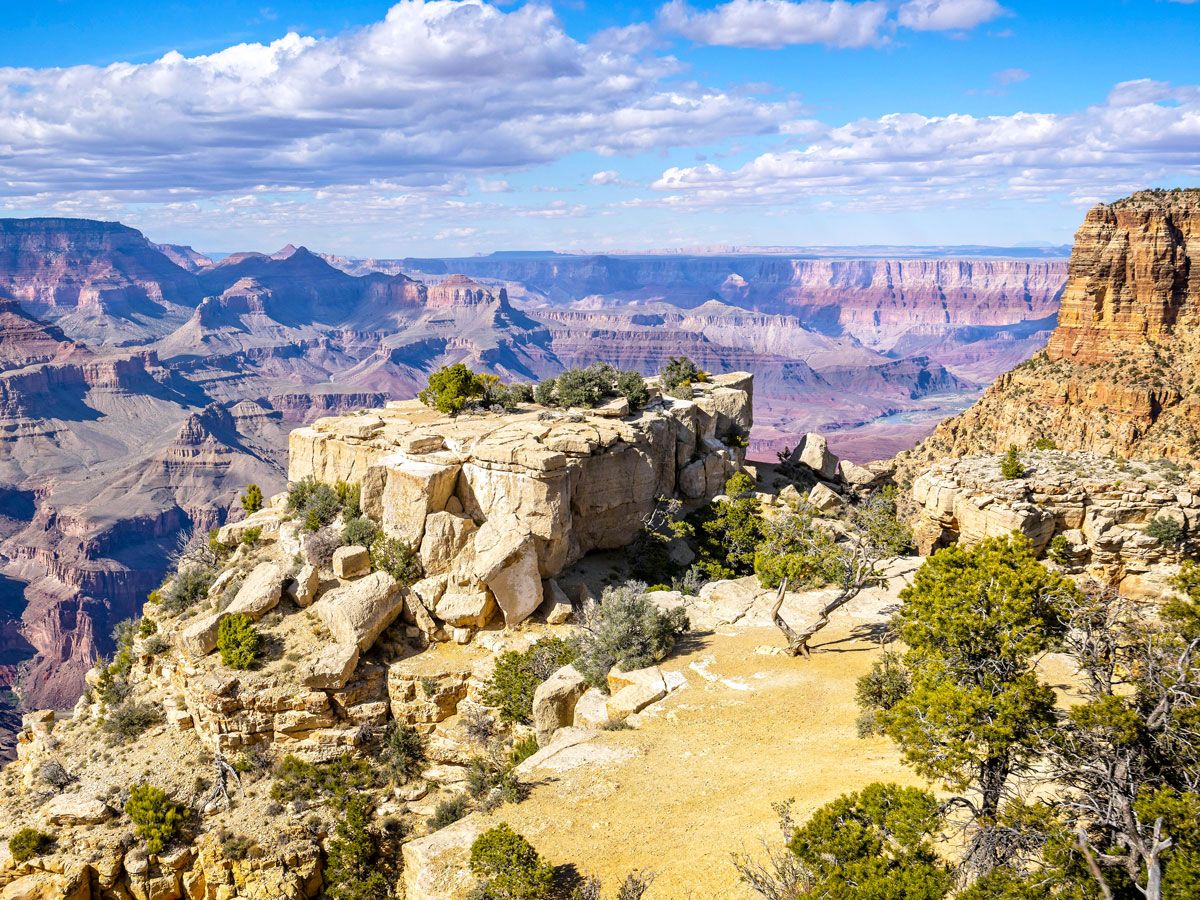
While Grand Canyon Village hosts a bulk of the park’s South Rim traffic, Desert View Drive offers a more contemplative, but no less stunning way to experience the canyon’s natural wonders. Stretching 23 miles along the South Rim, from the village to the park’s east entrance, this drive offers picnic spots and other lookouts where you can take your time gazing at the canyon’s layered geological history.
Navajo Point, at more than 7,400 feet, is the highest overlook on the South Rim. It offers views not only of the Colorado River but also of the famous colorful Painted Desert stretching beyond the park’s borders. Lipan Point is a favorite for sunsets, with its orange hues and dramatic shadows, and at the road’s eastern end, hop out of the car for your best views of the mighty Colorado River from the Desert View lookout. (That’s not to be confused with the 70-foot Desert View Watchtower, designed in 1932 by architect Mary Colter, which offers 360-degree views and features murals by Hopi artist Fred Kabotie.)
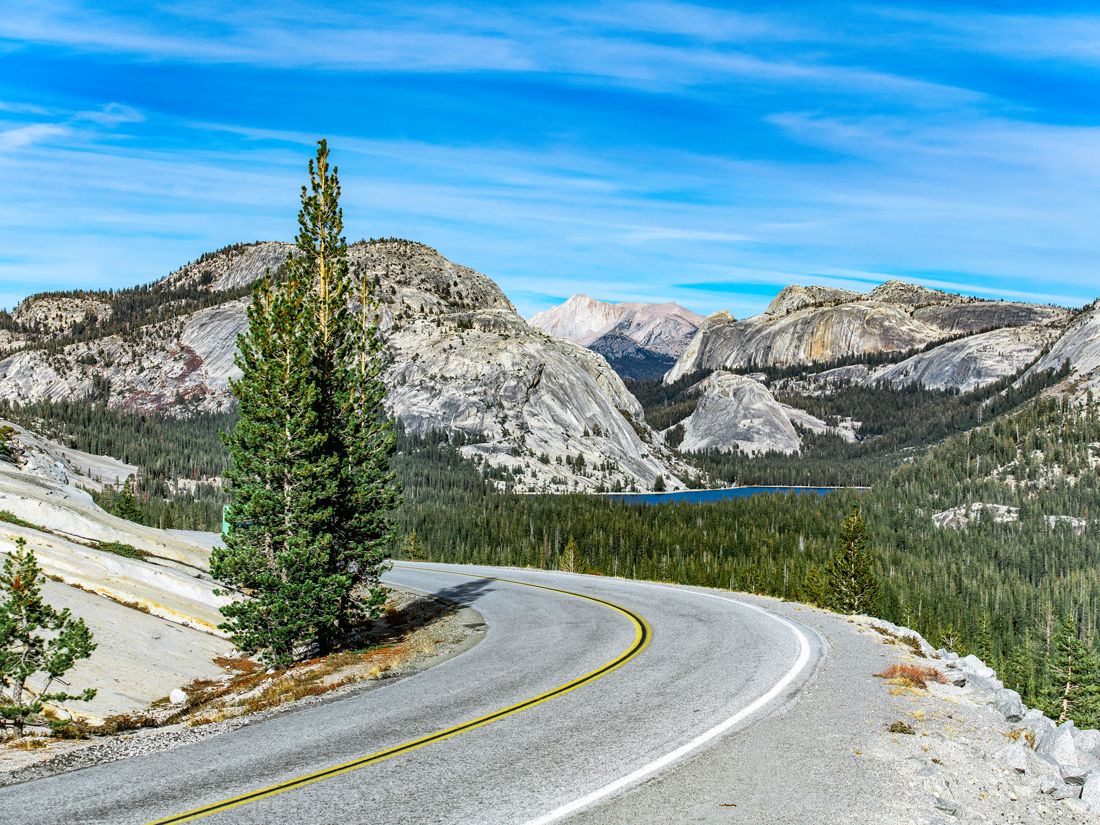
Closed for much of the year due to snow, Tioga Road is a scenic wonderland in the short few summer months that it’s open. The 46-mile drive offers breathtaking views of Yosemite’s dynamic topography at almost every turn. It winds from the Crane Flat campground to Tioga Pass, the highest highway pass through the Sierra Nevada mountains — and in all of California — at an elevation of 9,943 feet. The high altitude offers a unique perspective of the park’s beauty, with panoramic views of monstrous cliffs, lush valleys, waterfalls, and pristine lakes.
Make sure to stop at Olmsted Point, famous for its view of the iconic Half Dome (and, often, its adventurous climbers). The Tuolumne Meadows, a vast subalpine area surrounded by dense evergreens and granite domes and peaks, are another highlight. During the peak summer months, the meadows come especially alive with wildflowers, providing a colorful pop against the stark rocky backdrop.
Scenic Loop Drive – Theodore Roosevelt National Park, North Dakota
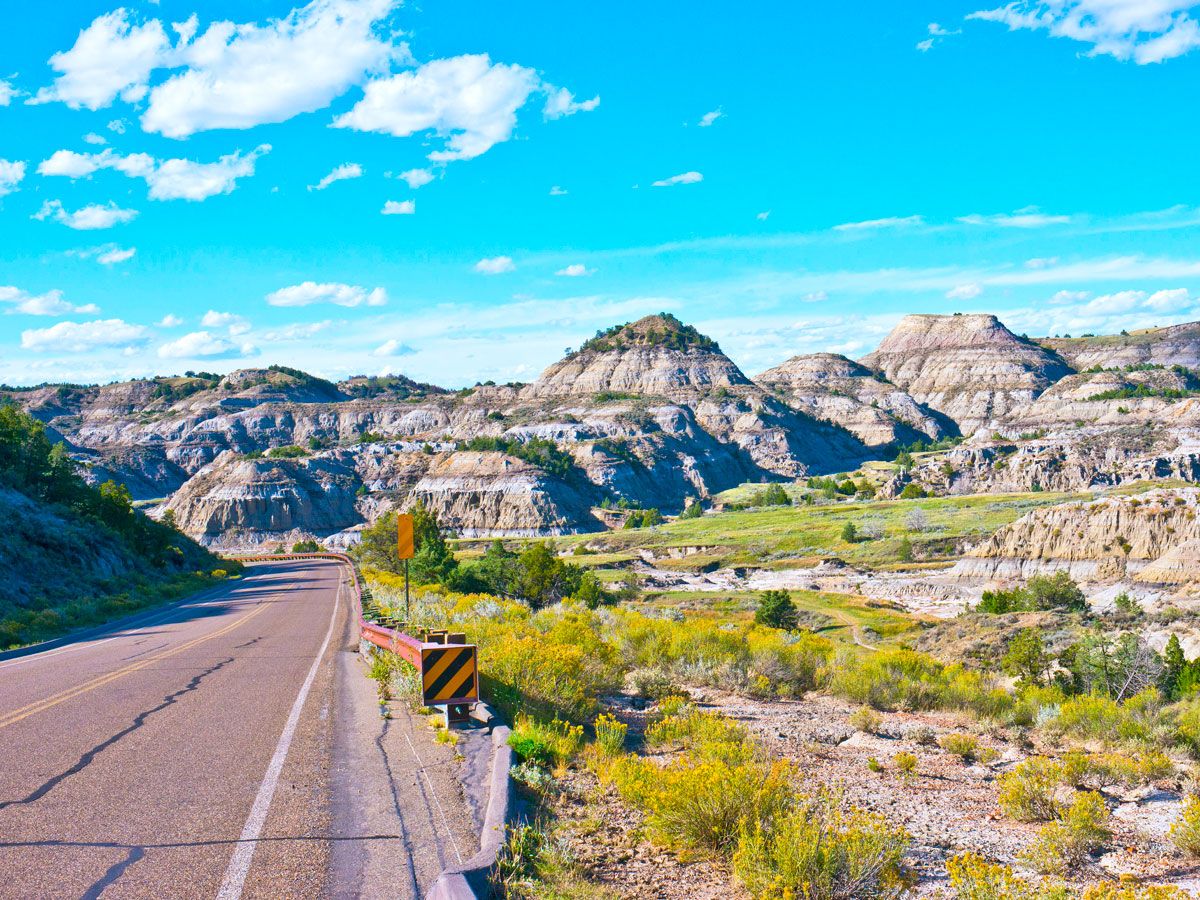
The 36-mile Scenic Loop Drive in the South Unit of Theodore Roosevelt National Park winds through the landscapes that helped inspire the 26th president’s lifelong dedication to conservation. The road cuts through colorful badlands, prairie dog towns, and wide-open grasslands where bison, elk, and wild horses descended from the ranch stock of the past roam freely.
Marked overlooks, such as Buck Hill and Wind Canyon, provide excellent views of the continuously eroding hills and the Little Missouri River valley. The loop also passes through the Coal Vein Trail, where a 1951 lightning strike sparked a fire that smoldered underground for 26 years, heating the surface and baking rocks into a hard, red substance known as clinker.
Grand Loop Road – Yellowstone National Park, Wyoming, Montana, and Idaho
Credit: Dave Collins/ iStock via Getty Images Plus
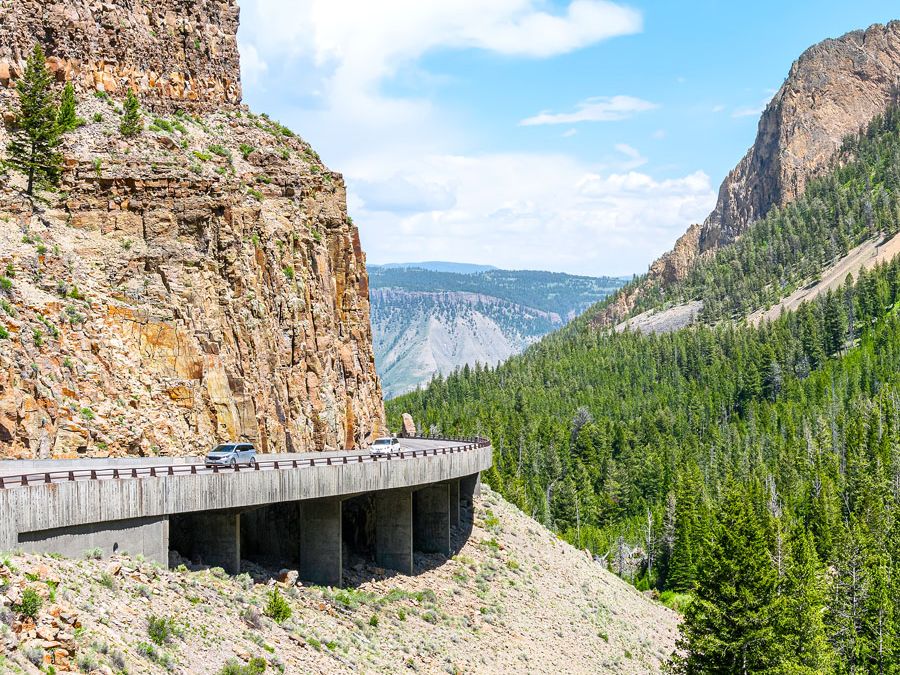
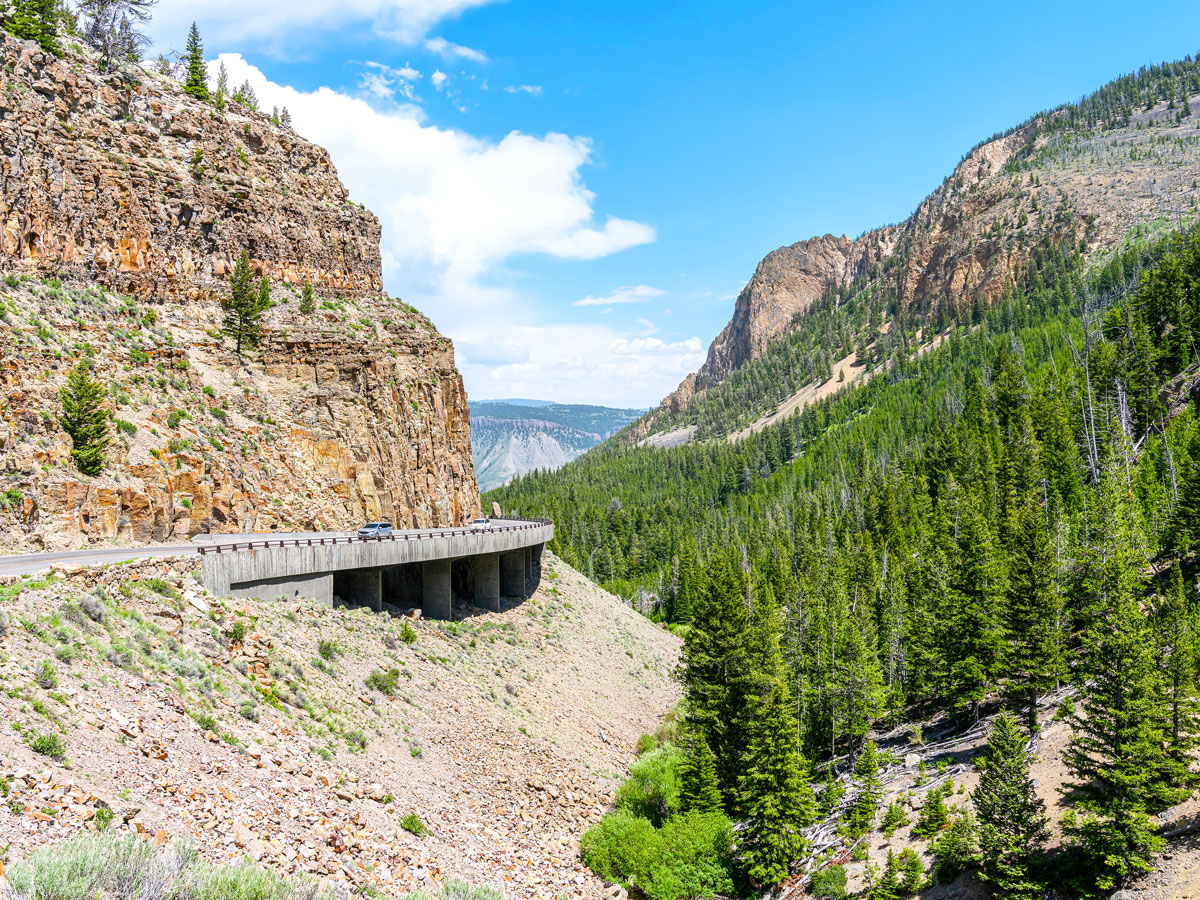
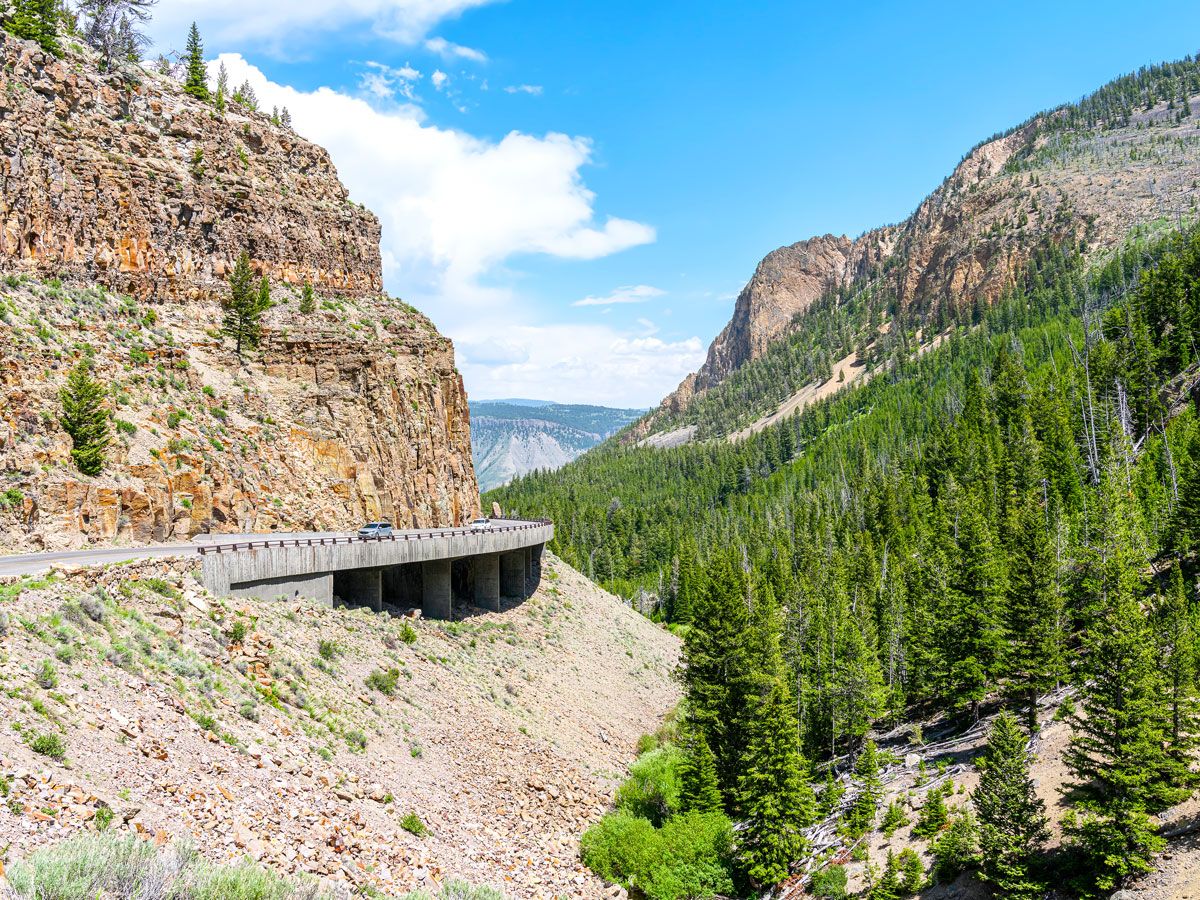
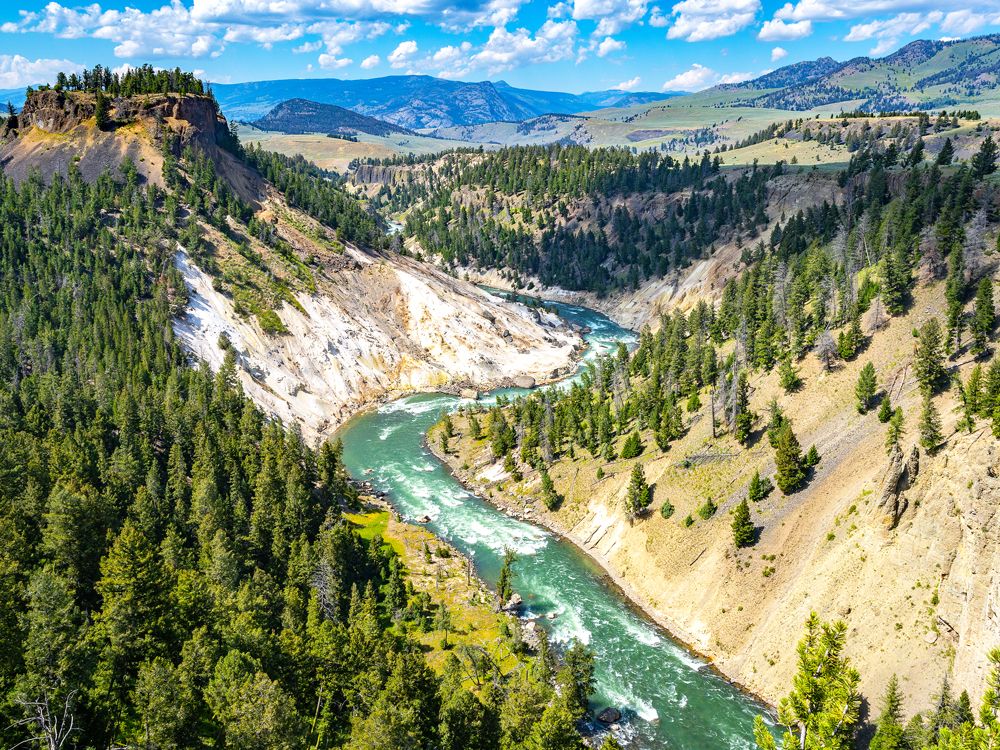
Yellowstone’s Grand Loop Road isn’t just a scenic drive — it serves as the backbone of the entire park. Visitors can join the 142-mile, figure-eight-shaped route from any of the park’s five entrances. It connects nearly all of Yellowstone’s major attractions. Follow it clockwise or counterclockwise; either way, it will lead you to must-see highlights such as Old Faithful, the Grand Prismatic Spring, the Grand Canyon of Yellowstone, and Hayden and Lamar valleys (the latter of which are often called the American Serengeti for their abundance of bison, bears, eagles, and elk).
Because the loop covers so much ground, it’s best tackled over a few days, with plenty of stops to explore on foot. Summer is peak season, but early fall is worth considering for fewer crowds and pops of golden foliage. Just be sure to make it there before November 1, as most of the Grand Loop Road closes for winter. The exception is the section between the north and northeast entrances, which remains open year-round.
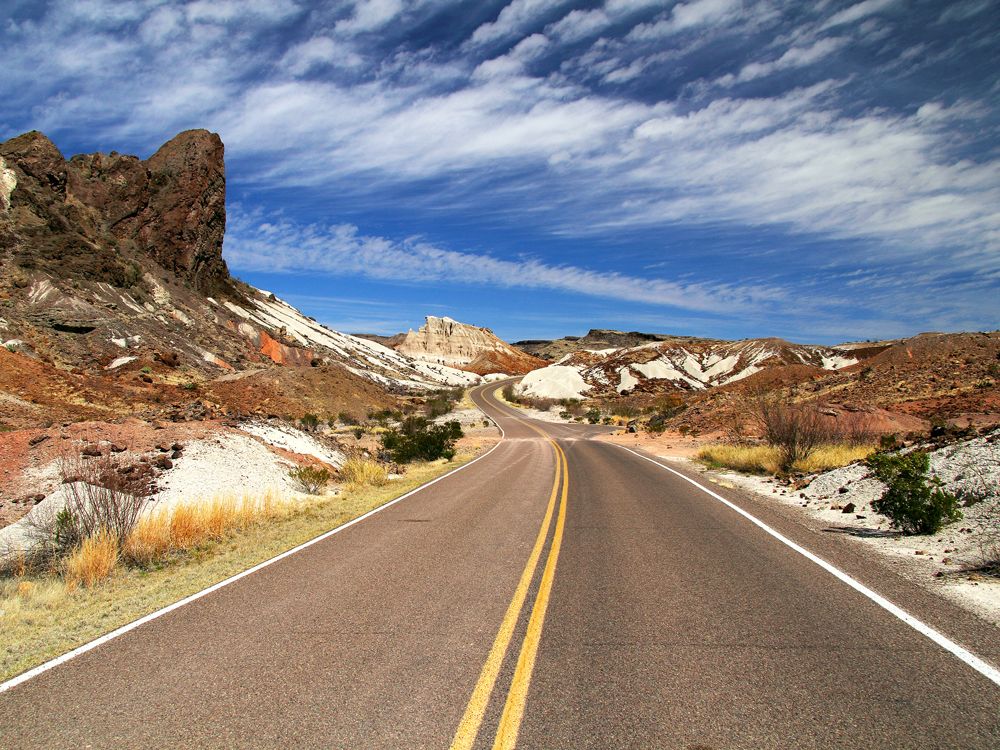
The Ross Maxwell Scenic Drive, named for Big Bend’s first superintendent, reveals the rugged beauty and historical significance of this Texas park’s western region. The 30-mile route weaves through some of the Lone Star State’s most iconic natural features: arid badlands, towering volcanic formations, and impressive canyons along the Rio Grande, seen from several lookouts along the way.
The Sotol Vista Overlook is a must-stop on the drive. Here, you’ll be rewarded with an unparalleled view of the mighty Santa Elena Canyon and a horizon that stretches into Mexico. The historic Sam Nail Ranch, a remnant of bygone homesteading days, is another popular attraction thanks to its iconic windmill. And the Cerro Castellan butte, perched at over 3,200 feet above sea level, stands tall as an unforgettable highlight on this drive — especially when surrounded by blooming bluebonnets and bathed in burning red from the setting sun.
Scenic Drive Loop – Grand Teton National Park, Wyoming
Credit: Oleg Shabunin/ 500px/ via Getty Images
It’s not often found on official national park driving maps, but the 42-mile Scenic Drive Loop promises breathtaking views of the towering Tetons — some of the oldest rocks in North America. This incredibly scenic drive also boasts sweeping plains, unspoiled glacial lakes, historical homesteads, and up-close views of wildlife. A must-see is the Snake River Overlook. In 1942, Ansel Adams immortalized this winding river set against the iconic Teton Range on film, and today, many years of greenery growth have updated the view for your own photographic keepsake.
The loop also includes a stop at the historic Mormon Row, where the well-preserved Moulton Barns offer a glimpse into the area’s frontier history. Further along, the Signal Mountain Summit Road offers a short detour to a lookout with sweeping views of Jackson Hole and Jackson Lake. This is one of the longest detours along the way — approximately 5 miles each way from the main loop road — but it’s worth the extra time. Along the drive, it’s also possible to spot some of the wide variety of animals that call the park home, from bears to pronghorn, moose, elk, and bald eagles. Wildlife is most active at dawn and dusk, but you could get lucky and spot some during a midday drive.
Marissa is a cheap airfare aficionado who loves exploring offbeat destinations with her husband. Based in Los Angeles and Joshua Tree, Marissa has been featured in publications such as San Diego Magazine, Palm Springs Life Magazine, 303 Magazine, and Mountain Living.
For those craving a hassle-free vacation with sun, surf, and afternoons sipping tropical cocktails from a poolside lounger, a cruise is often the ideal choice. But if you aren’t interested in beaching it and prefer cooler climates, a voyage to the Bahamas or Jamaica probably isn’t your cup of tea. Just under 13 million tourists booked a Caribbean cruise in 2023, so if you wish to escape the crowds and have a different kind of cruise experience, these unexpected cruise itineraries may be for you.
New England to the Canadian Maritime Provinces
Credit: PaulMcKinnon/ iStock via Getty Images Plus
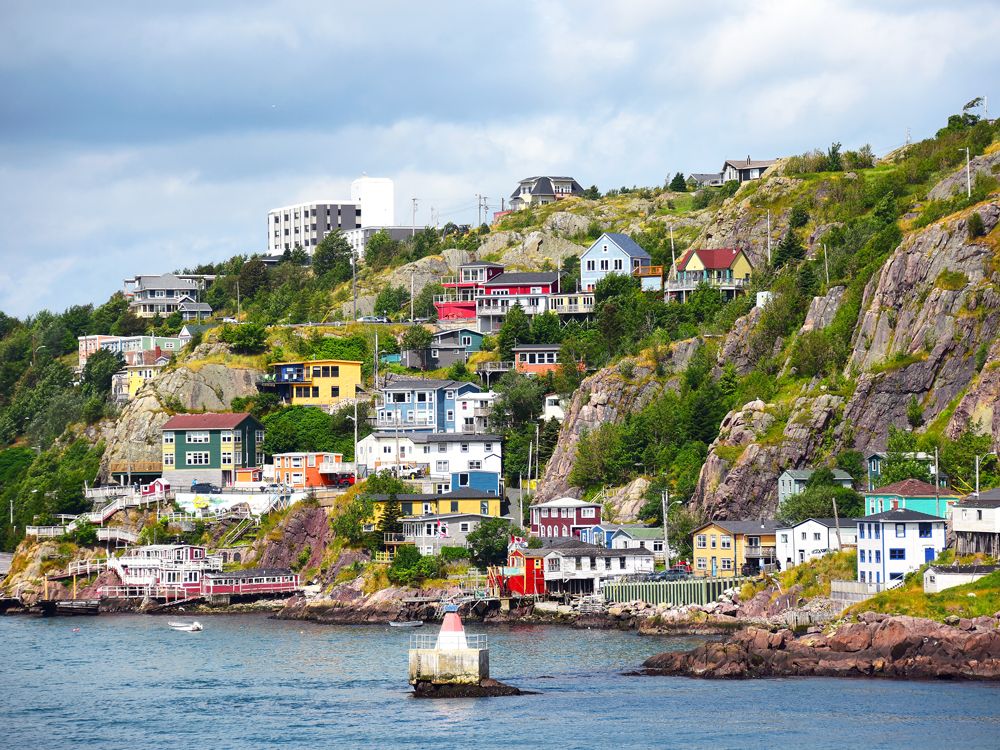
Sailing through the rocky harbors of Maine and the untamed wilderness of the Nova Scotian coastline is likely not the first cruise itinerary that comes to mind. However, there are a number of sailingss that cross the North Atlantic and stop in New York, Massachusetts, Maine, New Brunswick, Prince Edward Island, Nova Scotia, and oftentimes eastern Québec and Newfoundland. These voyages are especially exciting in summer, when you can expect clearer skies and warmer temperatures that are ideal for exploring the region’s many quaint fishing villages, historic lighthouses, and stunning natural landmarks.
As of 2024, Royal Caribbean offers a seven-night cruise departing from Boston with stopovers in Portland, Maine; Saint John (Bay of Fundy), New Brunswick; Sydney, Nova Scotia; and Halifax, Nova Scotia. Cruise Canada New England is a great resource for discovering some of the popular ports in the region and itinerary recommendations.
Iceland to Greenland
Credit: Thomas H. Mitchell/ 500px Prime via Getty Images
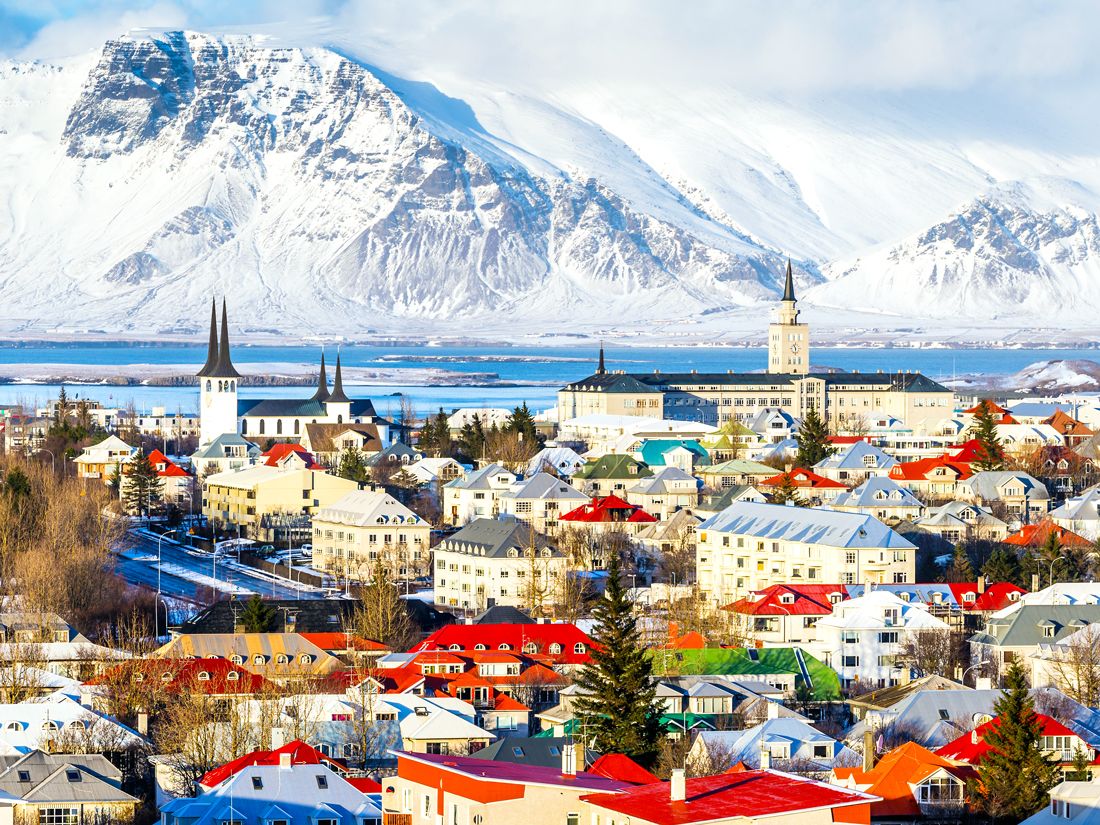
If you’re interested in colder weather (even in summer), then the icy passage between Greenland and Iceland likely won’t intimidate you. The dramatic fjords, colorful Scandinavian towns, and glaciers are easily viewable from the deck of a ship. Plus, cruising to these destinations will save you money on car rentals and airfare, which are often costly in this region.
Celebrity Cruises offers a 12-day expedition with stops in Reykjavík, Iceland; Isafjordur, Iceland; Akureyri, Iceland; and Qaqortoq, Greenland. Meanwhile, Atlas Ocean Voyages goes farther north — with ships departing Reykjavík bound for even more remote outposts in Greenland, such as Qaqortoq, Narsarsuaq, Paamiut, Nuuk, Akulleq Island, Sisimiut, and Kangerlussuaq. After all, it’s not every day you get to sail to the Arctic Circle.
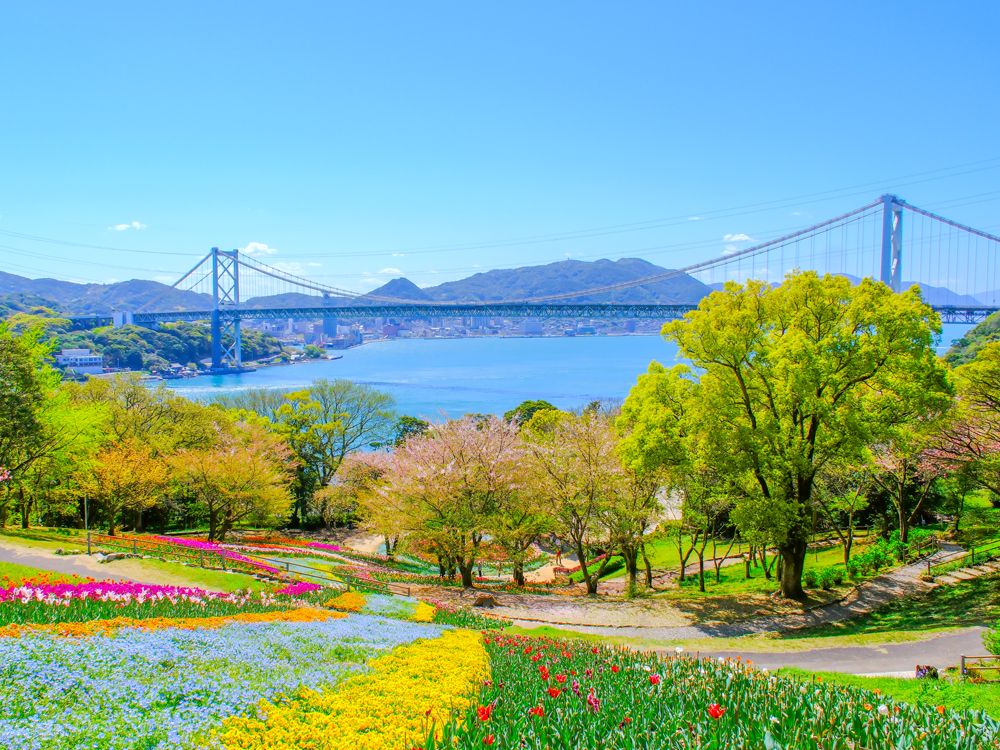
While the cerulean waters of Thailand and Vietnam are often top cruise destinations in Asia, sailing the Kanmon Strait from Japan to South Korea is an equally exciting alternative many Americans don’t consider. Major cities such as Tokyo, Hiroshima, Nagasaki, Cheju City, and Incheon (near Seoul) are accessible from the coast, which means you won’t need to splurge on a rail pass or airfare. When you dock, you’ll be able to immerse yourself in the local culture of two countries hailed for their exceptional cuisine, riveting history, and long-standing cultural traditions.
Holland America Line offers a two-week voyage across the strait to Tokyo, Hiroshima, Nagasaki, Cheju City, and Incheon. Celebrity Cruises’ 12-night voyage includes even more cities — such as Kyoto, Kagoshima, and Fukuoka — as well as a stop near Mount Fuji in Japan and the Korean city of Busan.
British Isles to the Netherlands and Belgium
Credit: jenifoto/ iStock via Getty Images Plus
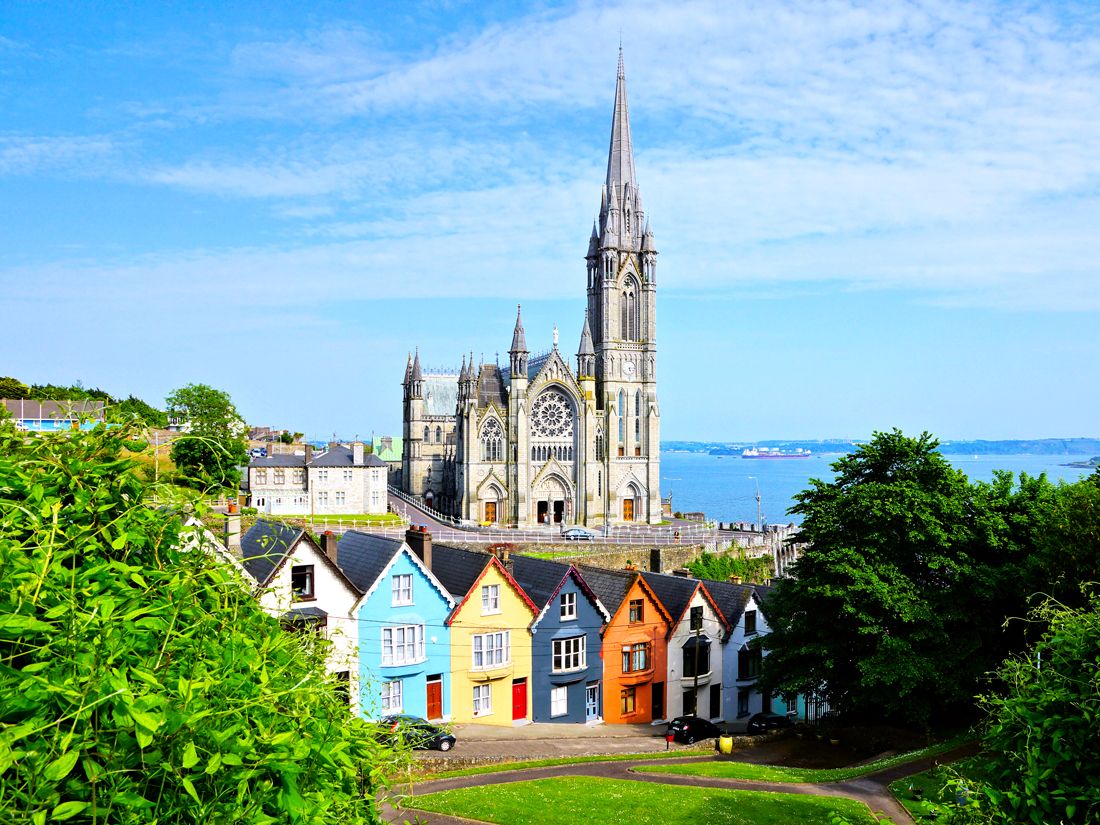
While train hopping is typically the most popular way to travel in Europe, many people forget that booking a cruise is another great way to explore numerous cities across the continent — without having to consider timetables. Journeying throughout the British Isles en route to the Netherlands allows visitors to experience an array of cultures and see more remote parts of Britain that are easily missed, such as the Shetland Islands in Scotland and the Isle of Wight in the English Channel.
Celebrity Cruises’ 12-night voyage embarks from Amsterdam and includes stops in Cork, Ireland; Waterford, Ireland; Liverpool, England; Holyhead, Wales; Belfast, Northern Ireland; Glasgow, Scotland; and Lerwick on the Shetland Islands. For a shorter journey, Ambassador Cruise Line offers an eight-day journey to ports of call such as IJmuiden in the Netherlands, Zeebrugge in Belgium, and St. Mary’s on the Isles of Scilly.
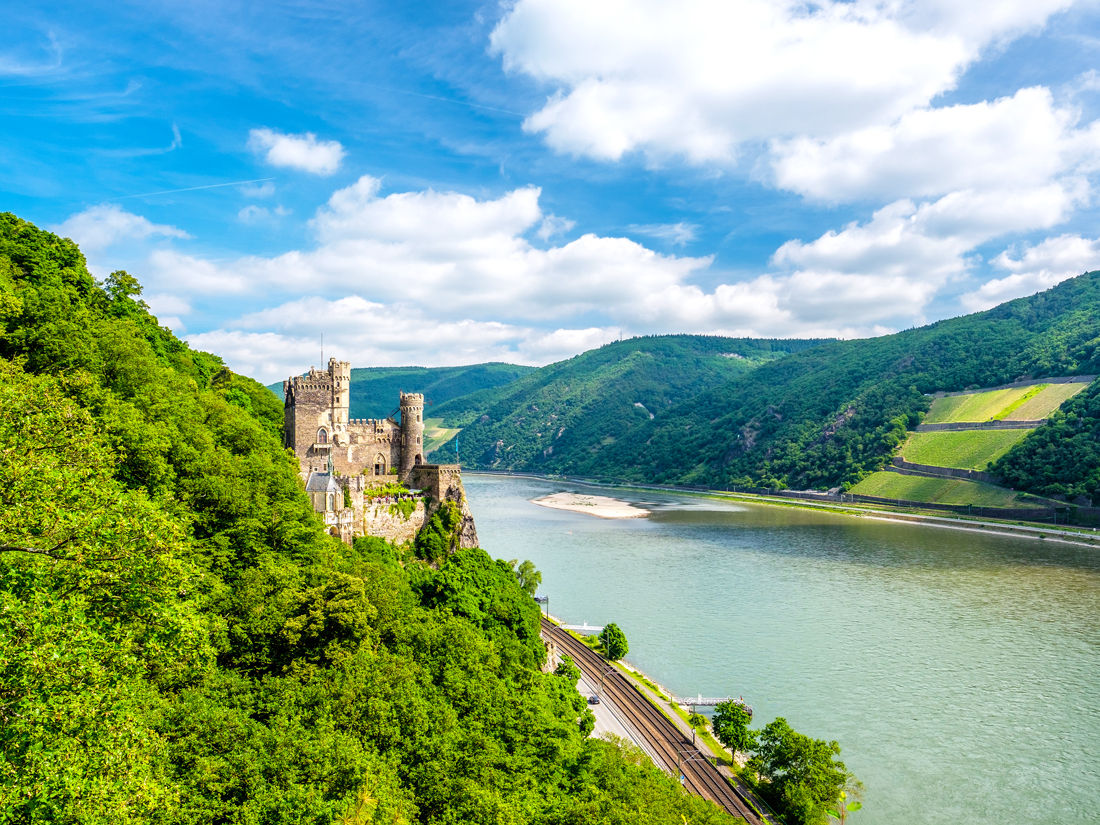
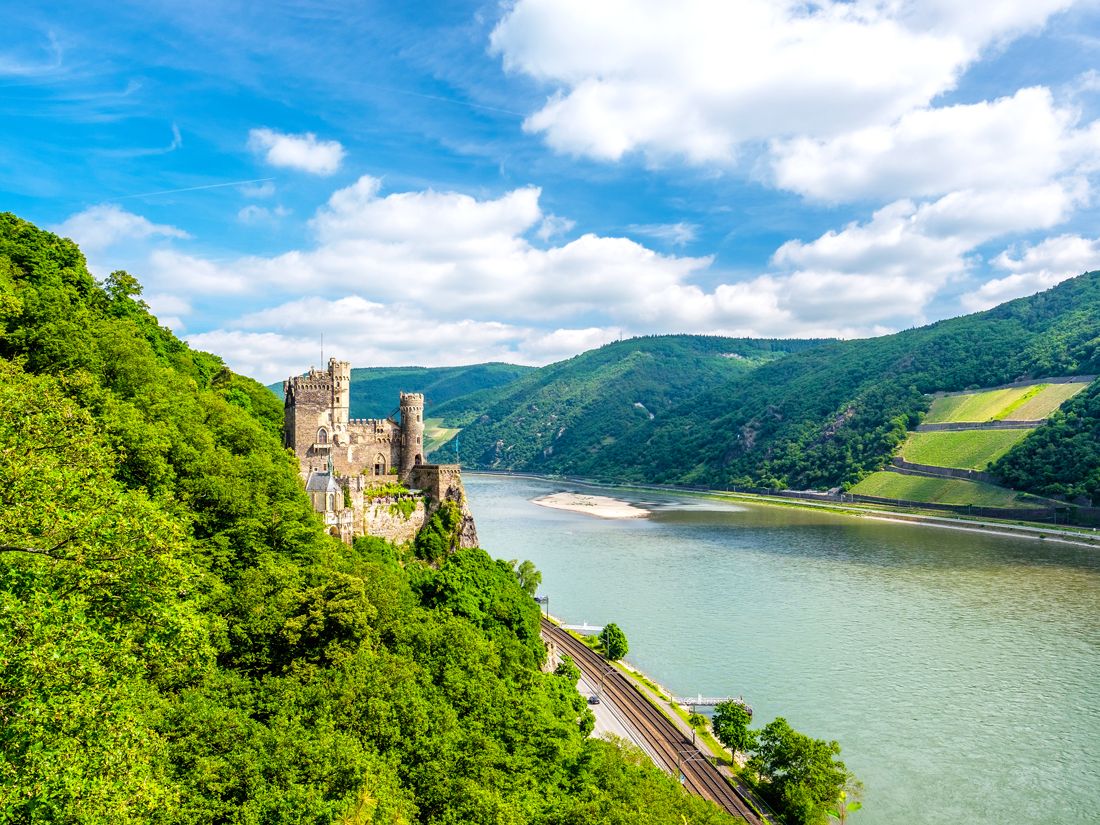
If you’re looking to check many European countries off your bucket list in one trip, also consider taking an epic cruise through the heart of the continent on the Rhine and Rhône rivers. You’ll experience the canals of Amsterdam, world-famous gastronomy in the French city of Lyon, the stunning scenery of Rhine Gorge (a UNESCO World Heritage Site), and Breisach, the gateway to Germany’s Black Forest, among other highlights.
Avalon Waterways offers many cruises both northbound and southbound along the Rhine and Rhône, but the two-week itinerary that includes both rivers often books quickly. Viking Cruises features a similar package, with numerous excursions to vineyards, monuments, and other cultural sites of interest.
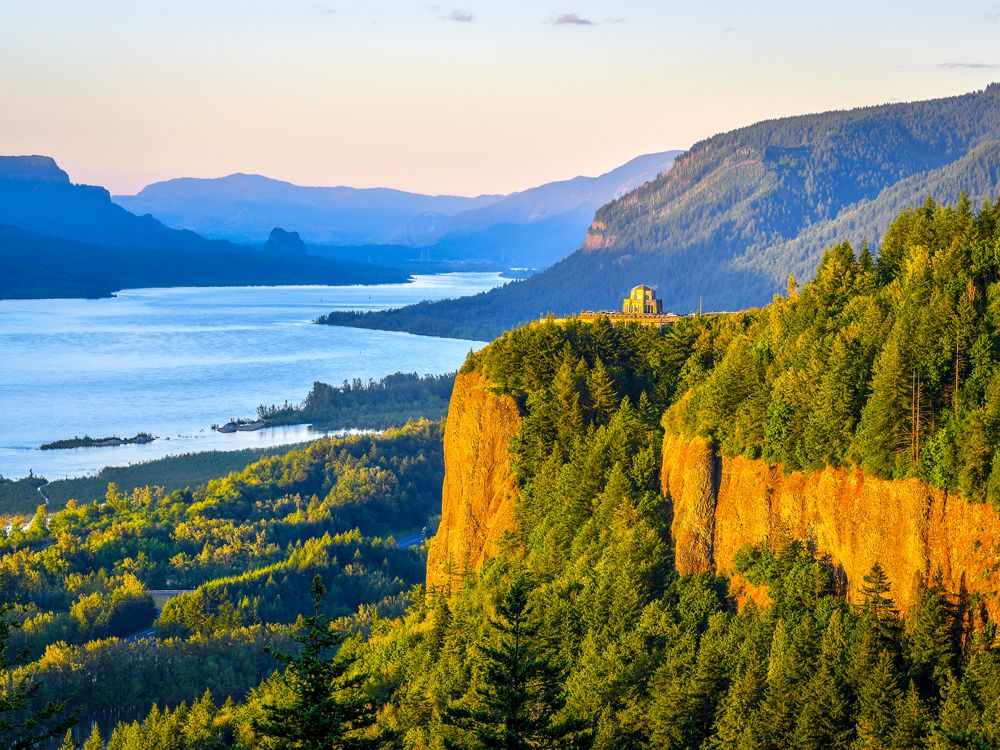
The cold waters of the Pacific off the coast of Oregon, Washington, and British Columbia aren’t ideal for swimming, but a cruise docking in ports across the Pacific Northwest may be more favorable. Journey the Columbia River Gorge and the Snake River or sail along the San Juan Islands to witness some of America’s most stunning landscapes, from emerald green river valleys to temperate coastal rainforests and snow-capped peaks.
AdventureSmith Explorations offers a six-day voyage through the San Juans, where you can spot whales and kayak in quiet coves. There’s also a six- or eight-day excursion in partnership with Food & Wine magazine that visits wineries, craft breweries, and award-winning restaurants in Portland, Oregon; Astoria, Oregon; and Walla Walla, Washington.
Argentina to Antarctica
Credit: Arpad Benedek/ iStock via Getty Images Plus
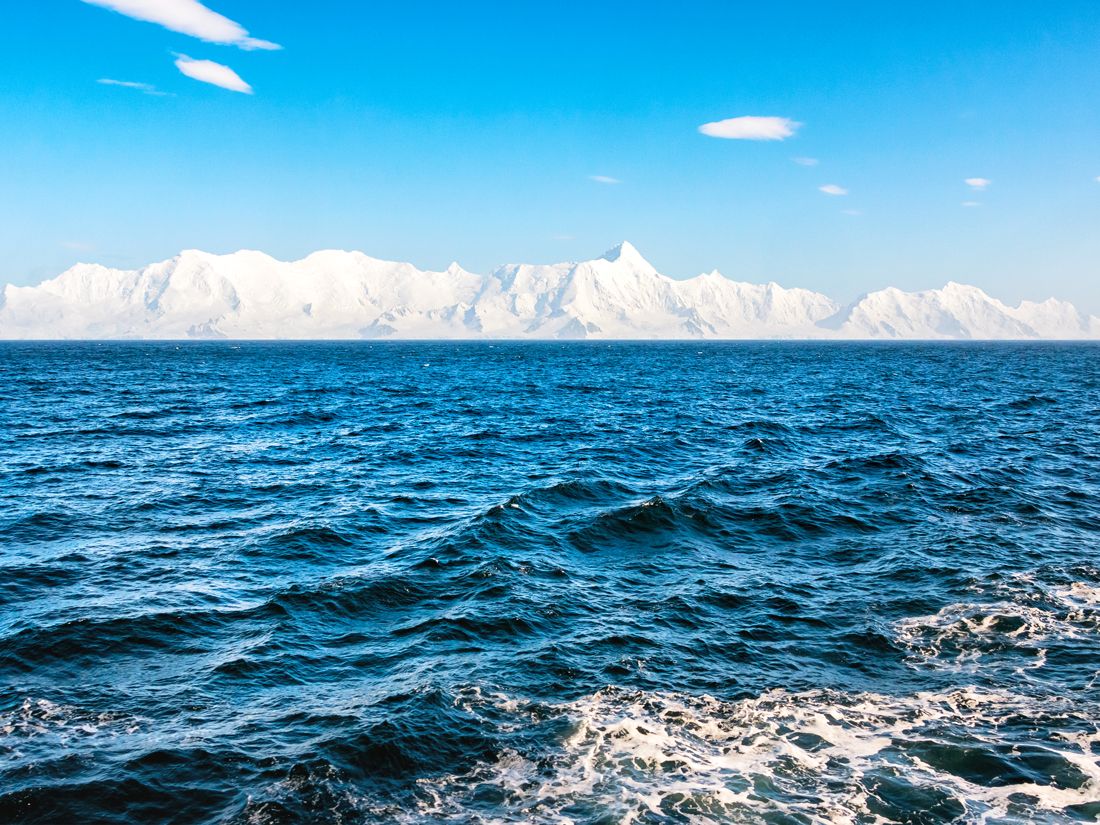
If you’re not prone to seasickness and can brave the infamous Drake Passage, a once-in-a-lifetime cruise to Antarctica may be in the cards for you. Depart from the southernmost city in the world — Ushuaia, Argentina — and cross the rough, frigid water to spot icebergs and wildlife such as Gentoo penguins, humpback whales, leopard seals, and other species. These cruises can be up to 20 days long, so prepare accordingly.
Many travelers choose to voyage to the South Pole with Lindblad Expeditions via National Geographic, a seasoned expedition team that led the first travelers to Antarctica five decades ago. Hurtigruten Expeditions is another experienced line that has been sailing to the continent for more than 20 years and prioritizes sustainable practices.
Advertisement
More from our network
Daily Passport is part of Inbox Studio, an email-first media company. *Indicates a third-party property.
Michael is a staff writer for Daily Passport and film critic who writes the weekly newsletter Movie Brief. His writing and criticism have also appeared in the Los Angeles Times, Variety, and the Washington Post, among others. A native Angeleno, his favorite countries to visit are Norway and Japan.
We tend to think of world capitals as being far away from one another, and most of them are. Mexico City is 1,883 miles from Washington, D.C.; Brasília and Asunción are 909 miles apart; and Beijing is 1,444 miles from Hanoi, to name just a few. However, there are some notable exceptions that are surprisingly close to each other. Here are some of the world’s closest capital cities.
Kinshasa, DRC / Brazzaville, Republic of the Congo
Credit: urbazon/ iStock via Getty Images Plus
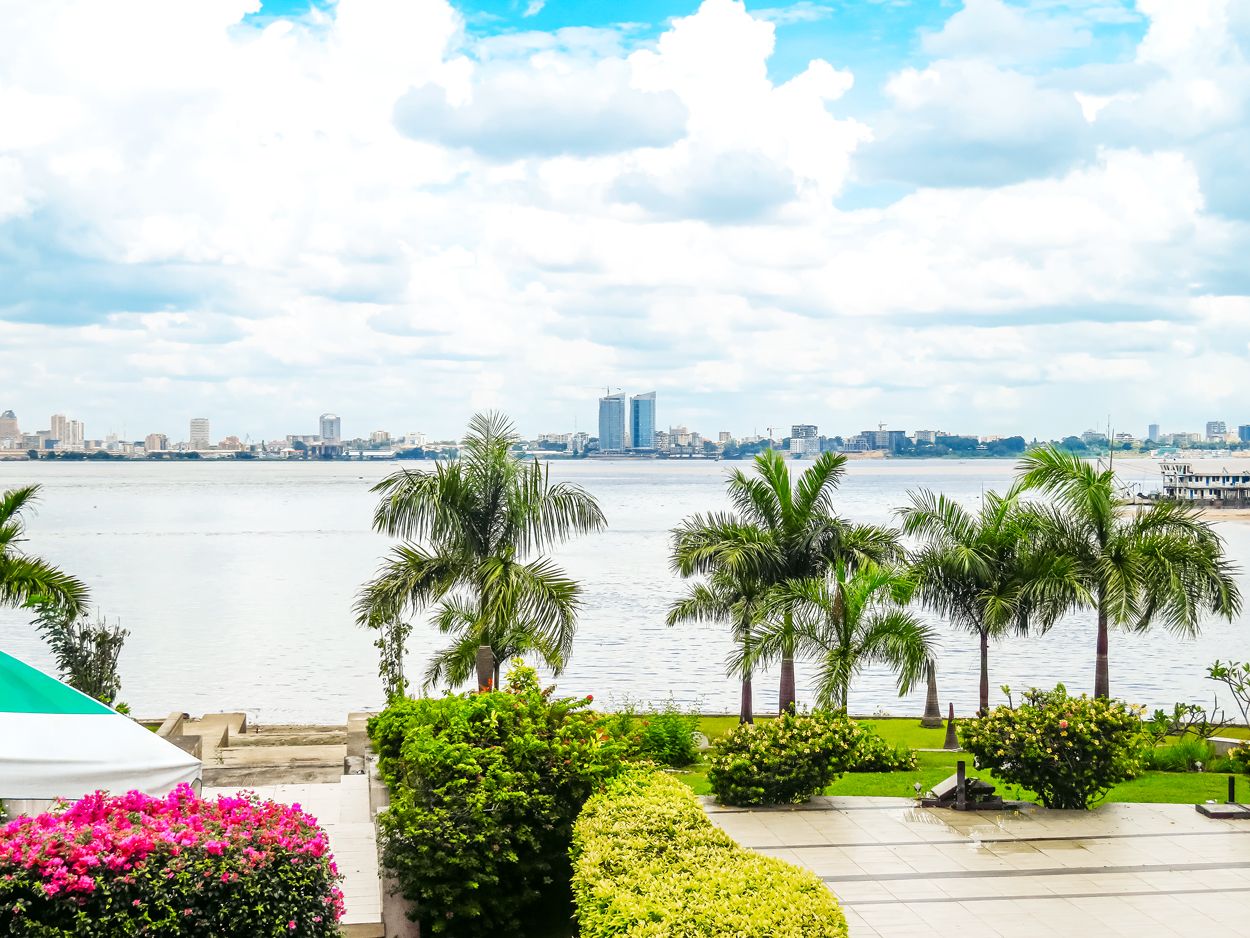
When someone refers to something nearby as “a stone’s throw away,” it’s usually an exaggeration. But in the case of Kinshasa and Brazzaville, someone with exceptional strength might just be able to pull it off. The capital cities of the Democratic Republic of the Congo (DRC) and the Republic of the Congo, respectively, are situated on opposite shores of the Congo River. Depending on how you measure that distance, Kinshasa and Brazzaville are just 2 miles apart — making them the world’s two closest capital cities.
However, getting from one to the other isn’t as straightforward as it sounds. ASKY Airlines has a five-minute flight that operates three times per week, but most travelers simply take a boat. A bridge linking the two cities has been in one stage of development or another for years now, but it has yet to materialize. Kinshasa — famous for hosting the 1974 Rumble in the Jungle between Muhammad Ali and George Foreman — is the bigger of the two capitals. Its population of more than 17 million is more than six times that of Brazzaville’s 2.7 million.
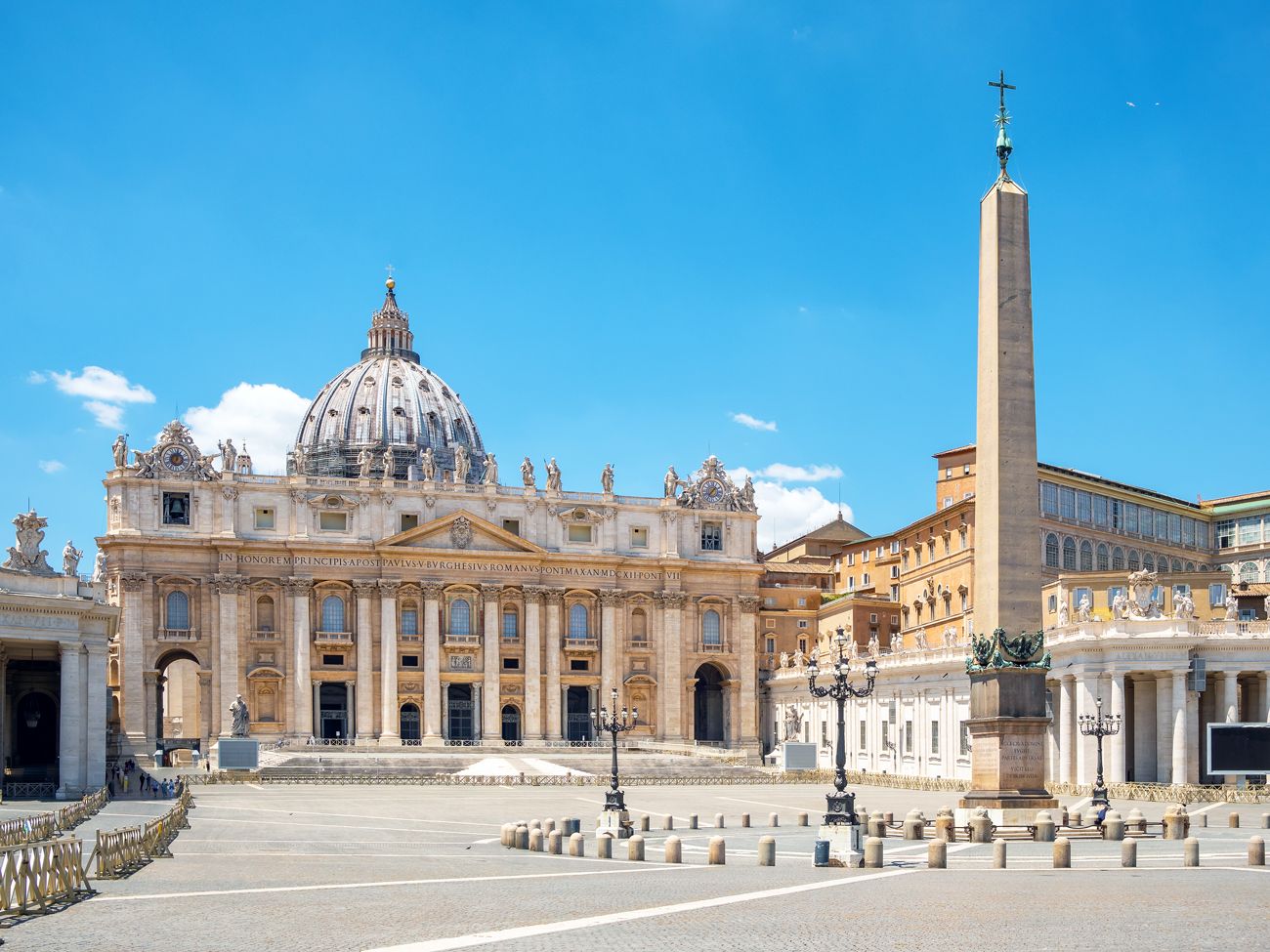
Technically, Vatican City is an enclave located entirely within Rome, but it’s still true that the microstate is essentially zero miles from the nearest capital city. As a city-state, the Vatican is its own capital. It became independent from Italy via the Lateran Treaty of 1929 and has “full ownership, exclusive dominion, and sovereign authority and jurisdiction” of the Holy See. The Vatican is also the world’s smallest country — and due to the fact that it’s only 0.17 square miles, Vatican City technically has 5.9 Popes per square mile.
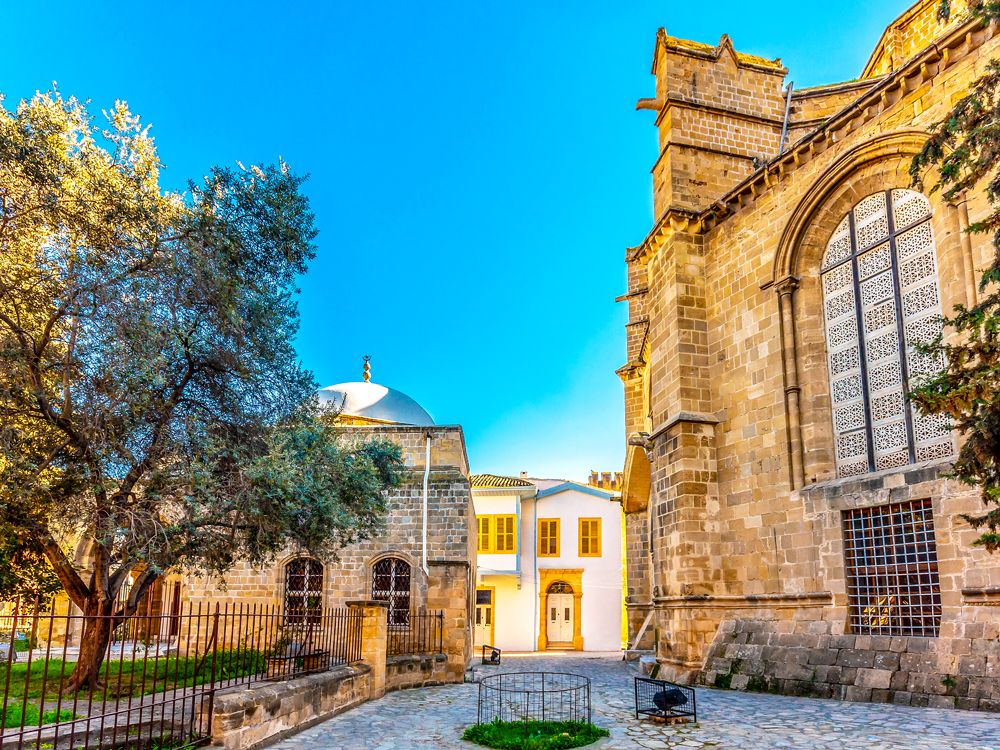
One city, two countries — that’s been the plight of Nicosia since Turkey invaded Cyprus in 1974 and the de facto state of Northern Cyprus was established. However, Turkey is the only nation that recognizes Northern Cyprus as an independent country — the rest of the world considers the Republic of Cyprus a single (if politically divided) sovereign state. Still, it remains the case that Nicosia and North Nicosia are in many ways two separate entities. Even if you include the United Nations buffer zone in your measurements, they still border one another.
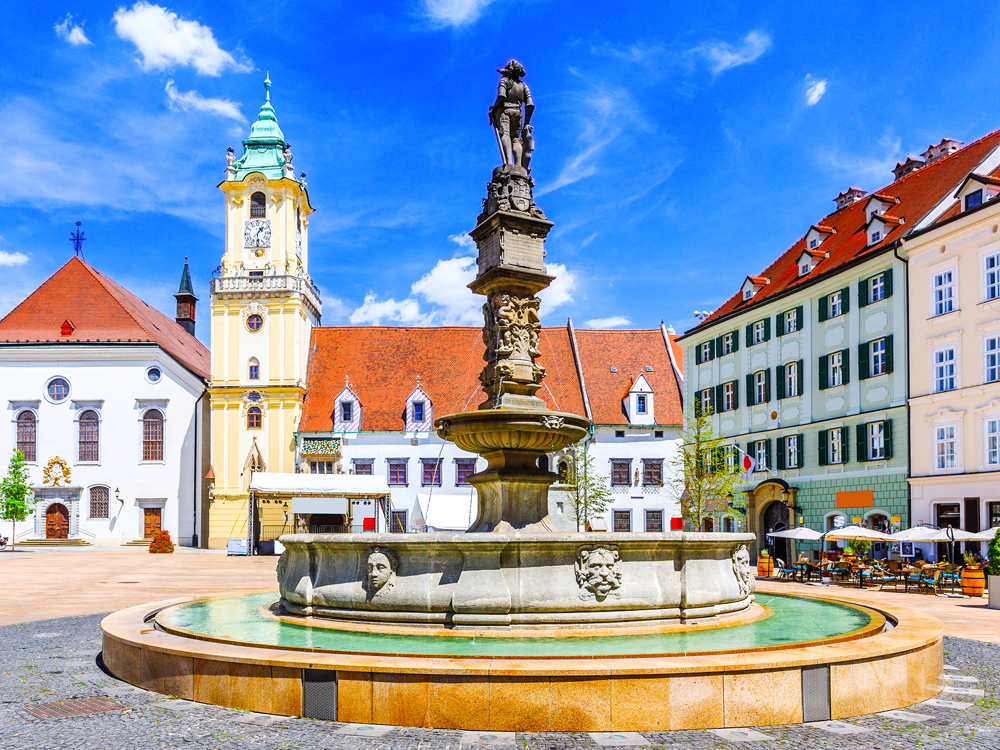
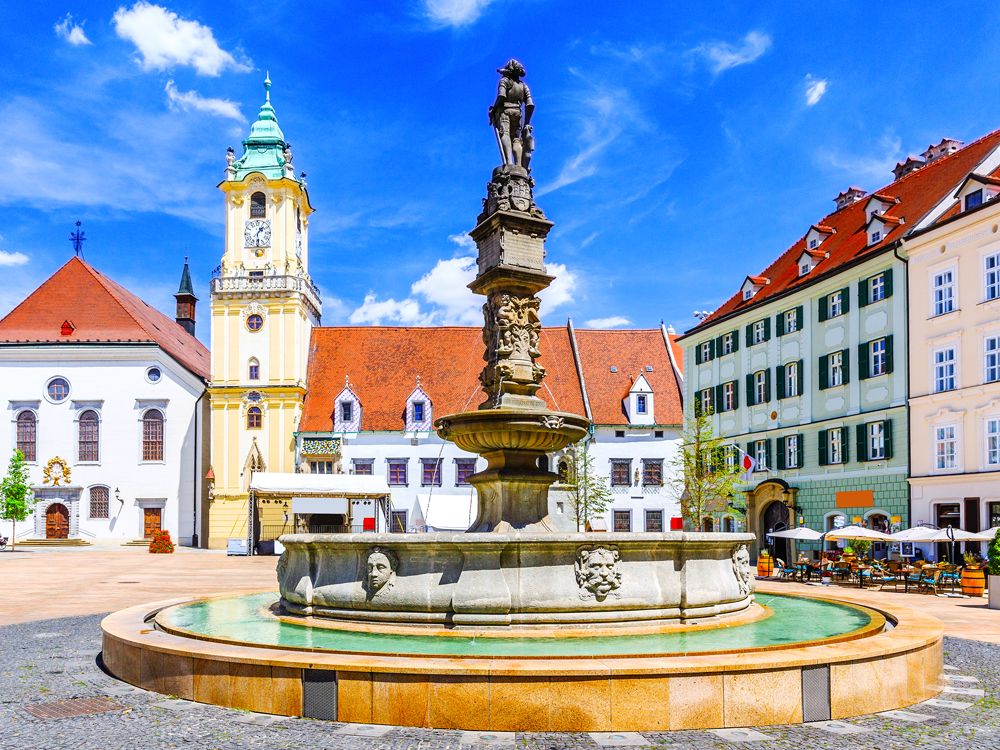
Bratislava is the only world capital to border two different countries: Austria and Hungary. Slovakia’s capital isn’t especially close to Budapest — about 130 miles depending on how you get there — but it’s only 34 miles from Vienna. And Bratislava and Vienna aren’t just close in terms of distance; the two “sister cities” are connected via history, culture, and the endearingly named Twin City Liner, a boat tour along the Danube River.
Long before it was the capital of Slovakia — which became a sovereign state after the dissolution of Czechoslovakia on December 31, 1992 — Bratislava was the capital of Hungary from 1526 until 1784. Vienna, meanwhile, has long been the capital, cultural center, and most populous city in Austria. Known as the “City of Music,” Vienna was home to such composers as Beethoven, Mozart, and Brahms in centuries past.
Damascus, Syria / Beirut, Lebanon
Credit: Kayihan Bolukbasi/ iStock via Getty Images Plus
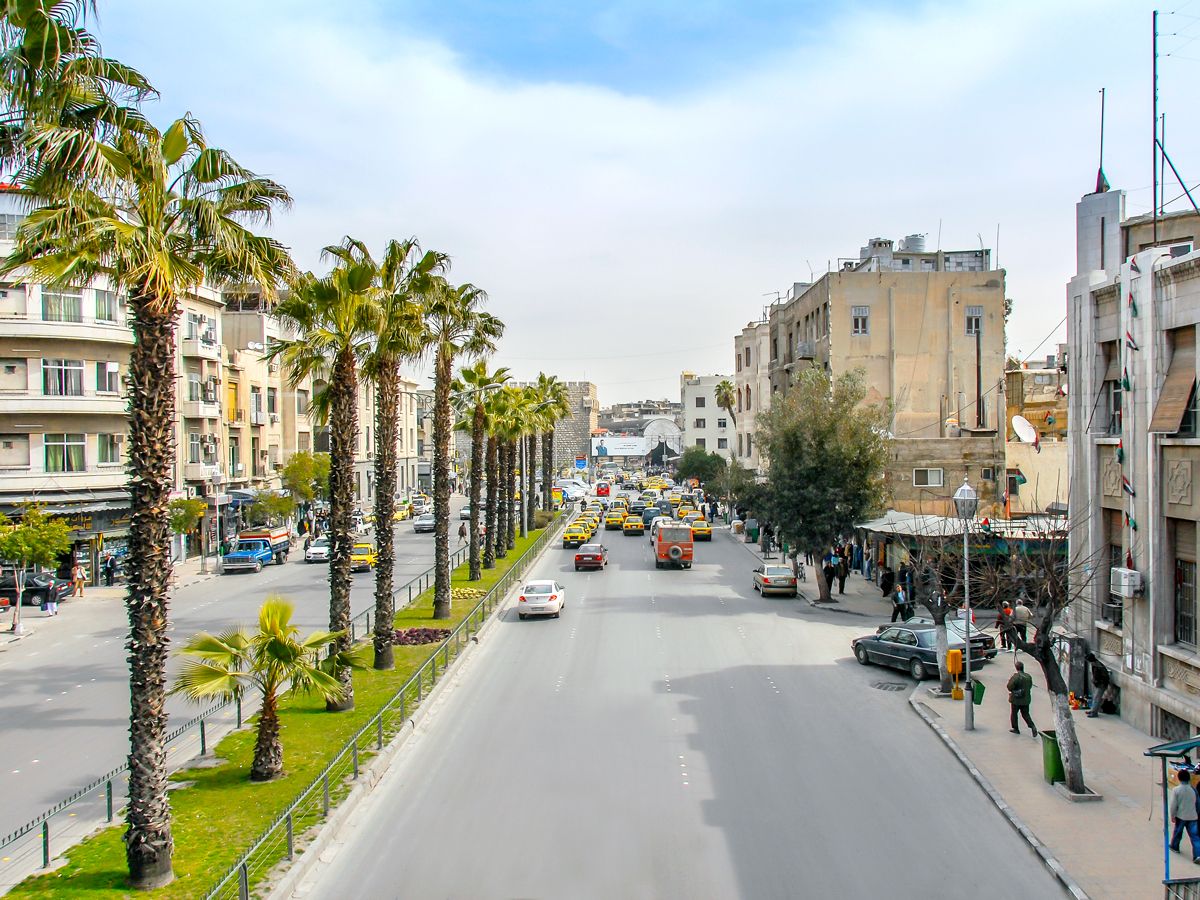
Located just 53 miles from one another, the capitals of Syria and Lebanon are practically neighbors. Damascus and Syria are also historic in their own right, with each ranking among the oldest cities in the world. Both have been inhabited for more than 5,000 years, and Damascus is the world’s oldest capital. They’re also among the most populous and important cities in the Levant, a region of the Middle East situated at the eastern edge of the Mediterranean. About 2.4 million people call Beirut home, and nearly 2.7 million live in Damascus. The latter is also home to the Umayyad Mosque, one of the holiest sites in all of Islam.
Advertisement
More from our network
Daily Passport is part of Inbox Studio, an email-first media company. *Indicates a third-party property.
Bennett is a New York City-based staff writer for Daily Passport. He previously contributed to television programs such as the Late Show With David Letterman, as well as digital publications like the Onion. Bennett has traveled to 48 U.S. states and all 30 Major League Baseball stadiums.
The idea of traveling solo may be scary to some, but it comes with many benefits. For one, it allows you to temporarily escape the life you know and truly immerse yourself in a new and unfamiliar culture — without distractions. You can eat what you want to eat, see what you want to see, and stay where you want to stay, all without going out of your way to accommodate another person. But being alone in a strange place also comes with its fair share of risks. With that in mind, here are 10 essential tips for traveling by yourself.
Do: Share Travel Plans
Credit: monkeybusinessimages/ iStock via Getty Images
Before you head out on your solo trip, be sure to send your travel plans to a trusted family member or close friend. This includes where you’ll be staying, the dates of your trip, and if you’re planning to meet up with anyone overseas. The more detailed you are, the more these loved ones will be able to assist if anything goes awry. For added peace of mind, you can also share your real-time location using Google Maps or Apple’s Find My app, both of which can accurately track any GPS-enabled phone. Lastly, set a regular time to check in and call or send a message letting that person know you’re safe.
Don’t: Trust Strangers Too Quickly
Credit: Alistair Berg/ DigitalVision via Getty Images
Chatting with strangers at a local restaurant or pub is a great way to get a feel for the culture of a place and connect with locals and other travelers. This can be especially tempting when you’re traveling solo and looking for someone to talk to. But keep in mind that you never know what someone’s true intentions may be. While most people have good intentions, scammers often put on pleasant personas in order to win the trust of unknowing tourists, only to take advantage once they let their guard down. So, stick with common sense: If anyone you meet invites you to an unfamiliar location or asks to “borrow” money, just say no and walk away — even if the request seems harmless on the surface.
Do: Act Confident
Credit: PeopleImages/ iStock via Getty Images Plus
Nothing screams “tourist” like walking around holding a big map or directions on your phone and gawking at all the surrounding landmarks. This can be even more noticeable if you’re alone, as you’ll stand out like a sore thumb. But if you project confidence and walk with purpose — even if you’re not entirely certain where you’re going — then you are less likely to attract attention from scammers or pickpockets. Each night, plan for the day ahead by looking up your walking route or public transportation options. People will be more likely to assume that you’re a local and just let you be.
It goes without saying that a nice Rolex watch or Gucci bag makes you a prime target for potential theft. Thieves may follow you around until they catch you alone on an unfamiliar street, with nobody around to help you. That’s why it’s best to keep prized possessions back home, or at least leave them at the hotel. When traveling solo, don humble accessories that don’t attract unwanted attention and are cheaper to replace if need be.
Do: Download Maps
Credit: Oscar Wong/ Moment via Getty Images
International data roaming can be expensive, and Wi-Fi or cell service can be inconsistent abroad. That can leave you lost and without any way to check the maps on your phone, which is especially worrisome if you’re traveling solo. Rather than risk losing service, take advantage of Wi-Fi at the hotel and download the maps you need before venturing out into the city. Both Google Maps and Apple Maps allow for their maps to be easily downloaded so you can consult them even without a signal. That way, you won’t have to ask any strangers for directions.
Don’t: Imbibe Too Heavily
Credit: urbazon/ E+ via Getty Images
Many people like to let loose on vacation, but having one too many glasses of wine with dinner and stumbling back to your hotel alone can quickly turn into a dangerous situation. Visibly drunk people are easy targets, especially if they’re alone. If you want to enjoy a few late-night drinks, consider doing so at the hotel bar or a nearby establishment, so you can safely return to your room afterward. And if you do imbibe while out on the town, always call a reputable taxi or ride-share service to take you back to your accommodation, rather than risk walking alone through dark and unfamiliar streets.
Do: Research the Destination
Credit: ciricvelibor/ E+ via Getty Images
The idea of arriving in a far-off destination without any itinerary may be tempting for spontaneous travelers, but the reality is that it can be impractical and unsafe. You should always do some basic research on your destination before you arrive, such as looking up safe areas for tourists or places that even locals avoid. But planning ahead is more than a safety issue — it’s also for your enjoyment. Rather than relying on generic guidebooks, consider consulting online message boards to hear directly from locals. Reddit is a great source for learning more about the place you’re traveling to, as each city generally has its own dedicated community full of tips and tricks.
Don’t: Defy Local Etiquette
Credit: Rockaa/ E+ via Getty Images
No matter where you’re traveling, it’s important to adhere to local customs. Being disrespectful — whether it’s intentional or not — can often lead to an undesirable or even risky situation. And if you’re traveling solo and accidentally step on somebody’s toes, you’ll have nobody there to help diffuse the situation. So, do some research before your trip about proper local etiquette and be sure to follow those customs to avoid attracting unwanted attention.
Do: Lie When Necessary
Credit: urbazon/ E+ via Getty Images
We’re told from a young age that lying is a no-no — and that’s true most of the time. But when traveling solo, a white lie can save you from a dangerous or unwanted outcome. If, for example, a stranger tells you to come check out their shop, tell them that you’re late to meet a friend for lunch, even if that’s not true. Or, if another person attempts to lure you back to their place, apologize and say that you have tickets to a show. Sometimes, these harmless lies can go a long way toward your safety and peace of mind.
You’ll probably want to take out some local currency when traveling abroad. And though you can take all the necessary precautions, unfortunately you might still end up a victim of pickpocketing or theft. It happens even to experienced travelers. First, consider investing in a cross-body bag that’s specifically designed with anti-theft protections. You should also keep extra cash or a spare credit card or bank card back in your hotel room instead of traveling with all your money on your person. This goes for identification, too — always keep copies of your passport and other important travel documents either virtually or back at the hotel. If the actual ones are stolen, those copies make getting a replacement far easier.
Advertisement
More from our network
Daily Passport is part of Inbox Studio, an email-first media company. *Indicates a third-party property.
Architecture •July 18, 2024•Updated: July 25, 2024
By Julia Hammond
Author
Julia Hammond
Julia is a U.K.-based travel writer whose work has been featured in The Independent, The Telegraph, The New Zealand Herald, and Culture Trip, among others. She’s an enthusiastic advocate for independent travel and a passionate geographer who has had the privilege of traveling to more than 130 countries in search of a story.
The world’s top architects often love to push boundaries. Sometimes, critics praise the end result as being extraordinarily striking, but radical design can also provoke a strong reaction on the other end of the spectrum. Take a look at seven structures that have been dubbed among the “ugliest” buildings in the world — and decide for yourself whether you love or hate them.
Hong Kong’s Monster Building — as locals have nicknamed it — is not one, but five buildings grouped together. Built in the 1960s in the Quarry Bay residential district, the complex comprises Oceanic Mansion, Yick Cheong Building, Fook Cheong Building, Montane Mansion, and Yick Fat Building. These densely packed apartments were erected due to the need for housing for a rapidly growing population — but, as some critics argue, with little heed to aesthetics.
However, thanks to its distinctive appearance, the complex has been featured in several movies, including 2007’s Transformers and 1995’s Ghost in the Shell. It has also become a magnet for photographers, despite access to the inner courtyard now being restricted. Nevertheless, the buildings are considered by many to be something of an eyesore.
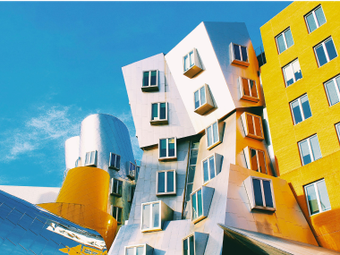
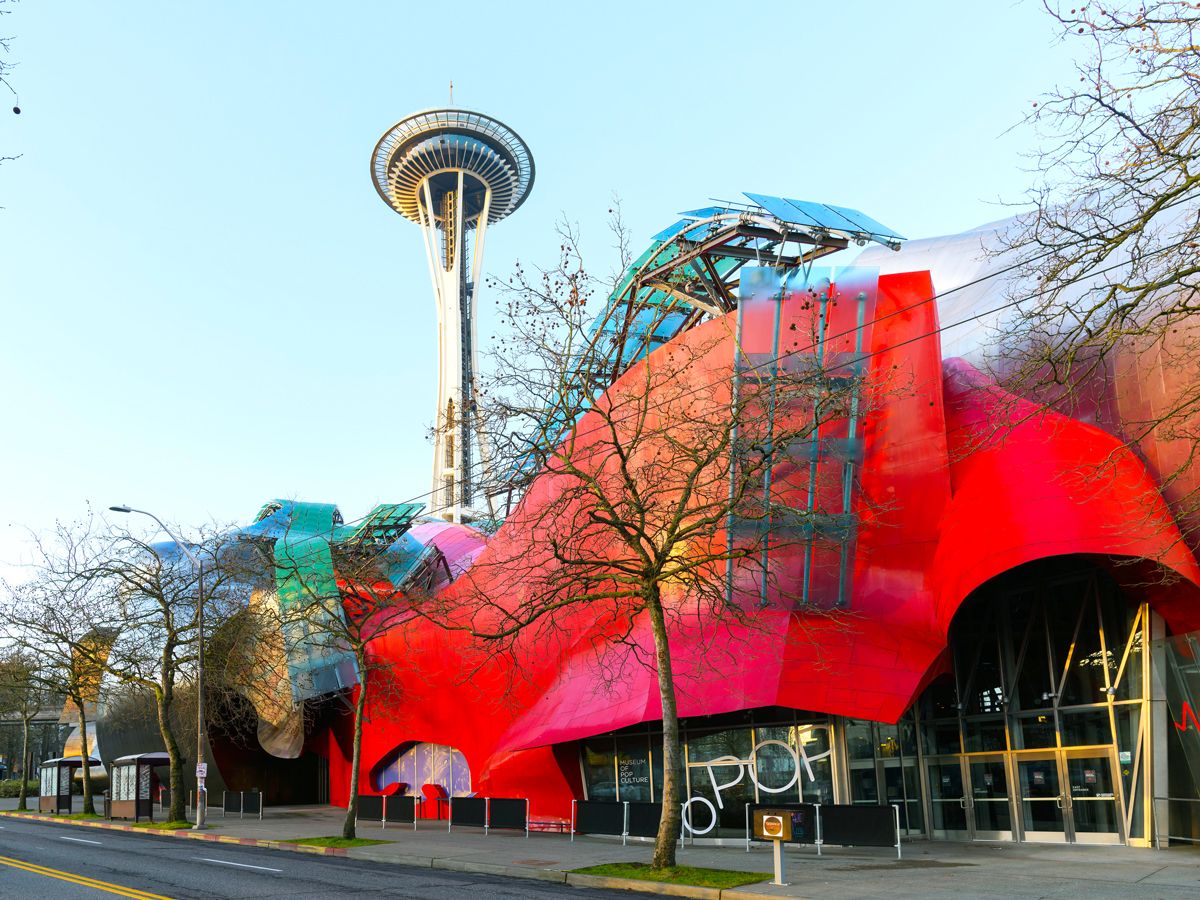
Located across from the iconic, slender form of the Space Needle, the Frank Gehry-designed Museum of Pop Culture attracts derision and delight in equal measure. The late Herbert Muschamp, architecture critic for The New York Times, famously referred to it as looking “like something that crawled out of the sea, rolled over and died.”
Yet, if you catch it on a sunny day — when the light reflects off its 21,000 individually cut aluminum and steel shingles — MoPop is remarkably photogenic. There’s an energy and playfulness about the structure, which is fitting for the subject matter you’ll find within its curvaceous walls. First impressions aren’t always correct, and close up, this strange building might not be as ugly as you initially thought.
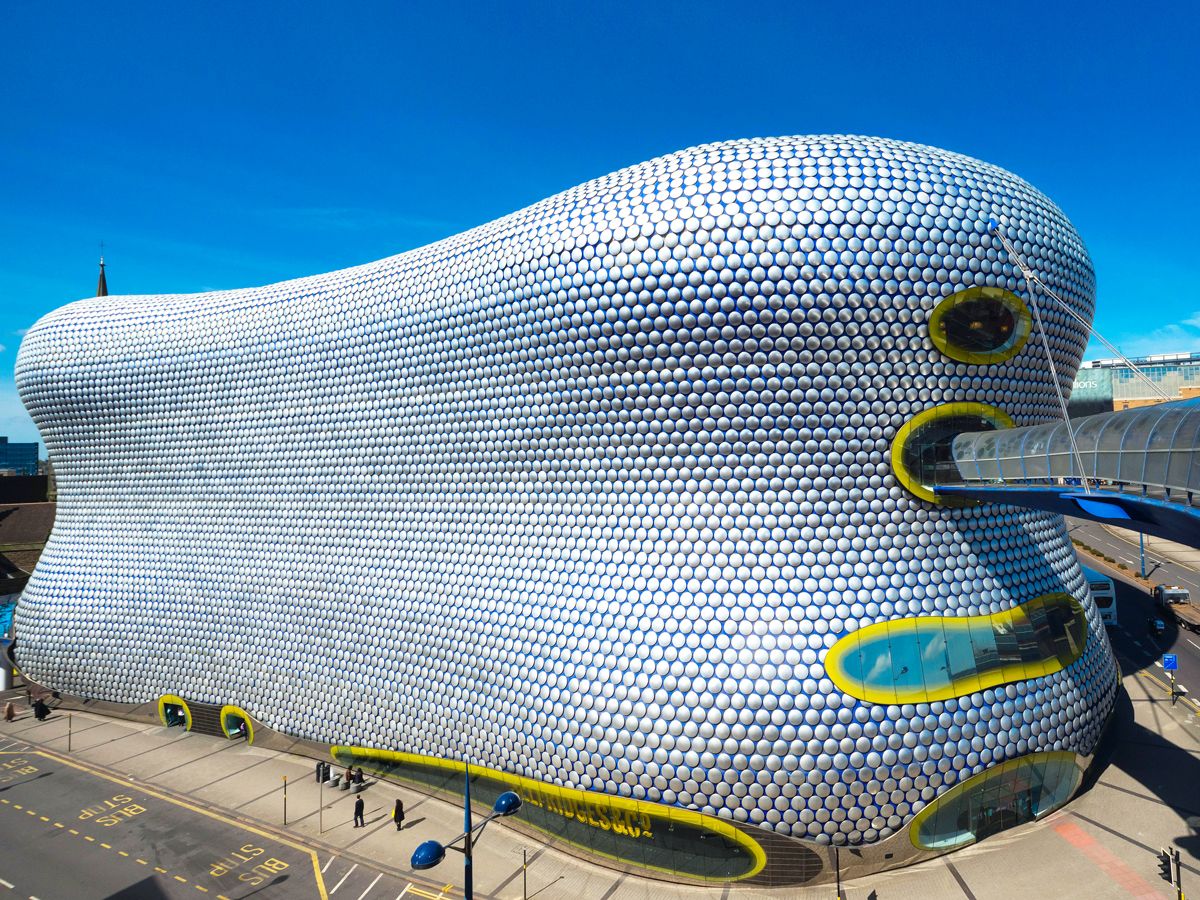
The excitement over plans for Selfridges to open its first department store outside of London was tempered with dismay over the building that would house it. Birmingham residents (nicknamed “Brummies”) were divided as to whether the Selfridges Building, completed in 2003, was an innovative piece of architecture that would shine a new spotlight on Britain’s second-largest city — or an outlandish monstrosity that would blight England’s West Midlands region for decades to come.
Some unkindly likened the building’s aluminum disc detailing to the bulging eyes of a fly, while others said it resembled medieval chainmail. Five years after it was completed, the building topped a 2008 poll on the U.K.’s ugliest buildings. However, a couple of decades on, this audacious, ambitious, award-winning project may finally be starting to grow on people.
This highly original building has proved highly divisive. Those who dislike the college building in Tokyo’s Shibuya district might claim it’s what you’d end up with if you cross a cockroach with a robot — and throw in a random splash of color for good measure. Opened in 1990, it’s the work of Japanese architect Makoto Sei Watanabe, who aimed to create something that was “capable of moving people’s hearts and giving them a physical thrill.”
Yet, for someone seemingly focused on emotional impact, the architect worked in an unusual way, using mathematical algorithms and computer models to design the structure. And although the building he designed to house Aoyama Technical College may not excite passersby in the way he hoped, it’s certainly a provocative talking point.
Les Espaces d’Abraxas – Noisy Le Grand, France
Credit: Westend61 via Getty Images
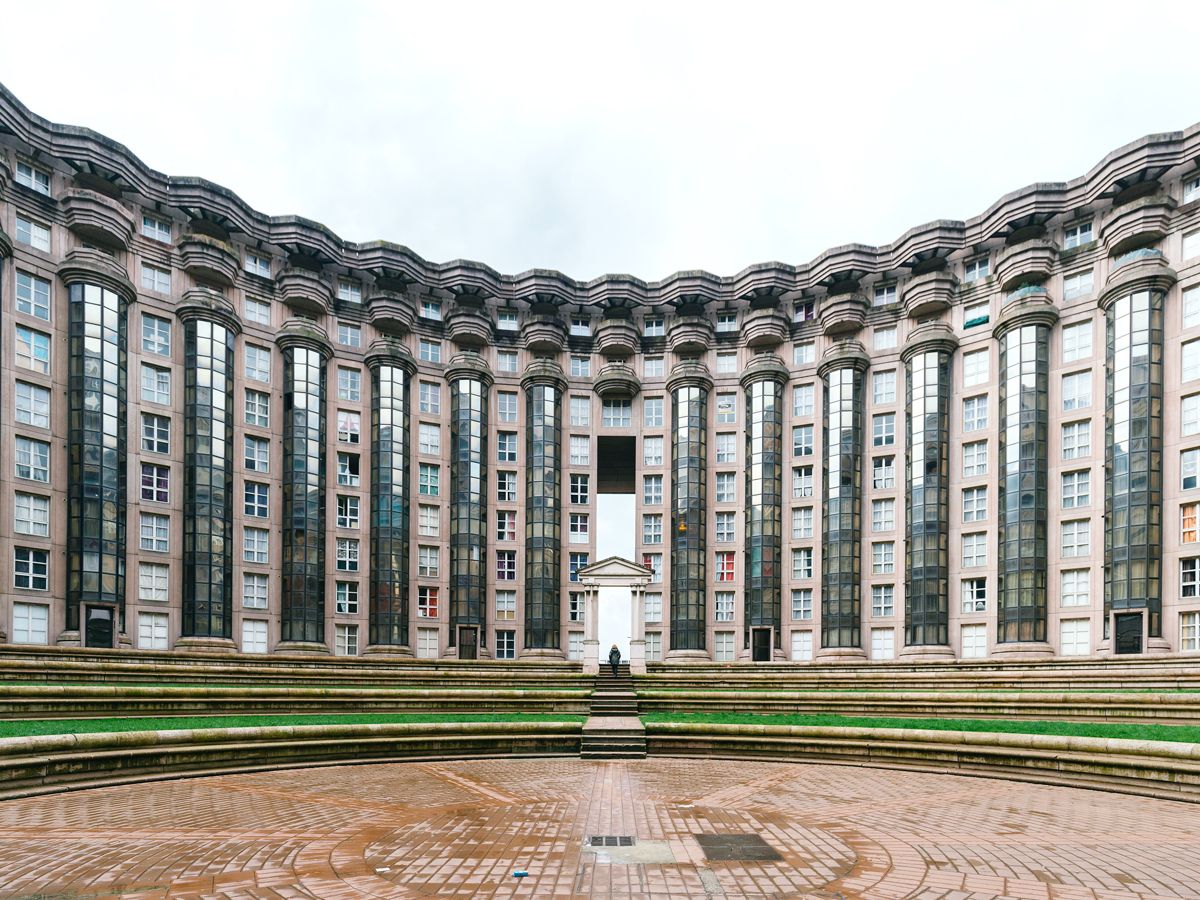
Les Espaces d’Abraxas is a postmodern residential complex in Noisy Le Grand, a neighborhood in the eastern suburbs of Paris. This estate was one of a number aimed at easing housing pressure on the French capital in the 1970s. Designed by architect Ricardo Bofill in 1978 and completed four years later, it features 591 apartments that span three buildings known as Le Palacio, Le Théâtre, and L’Arc.
The prefabricated concrete used in its construction, coupled with a reputation for crime, lends a somewhat dystopian quality to the complex, and the cramped site can feel claustrophobic given the height of the buildings. It’s no surprise, then, that many dismiss it as ugly. Yet, it’s impressively cinematic and was used as a filming location in The Hunger Games: Mockingjay Part 2.
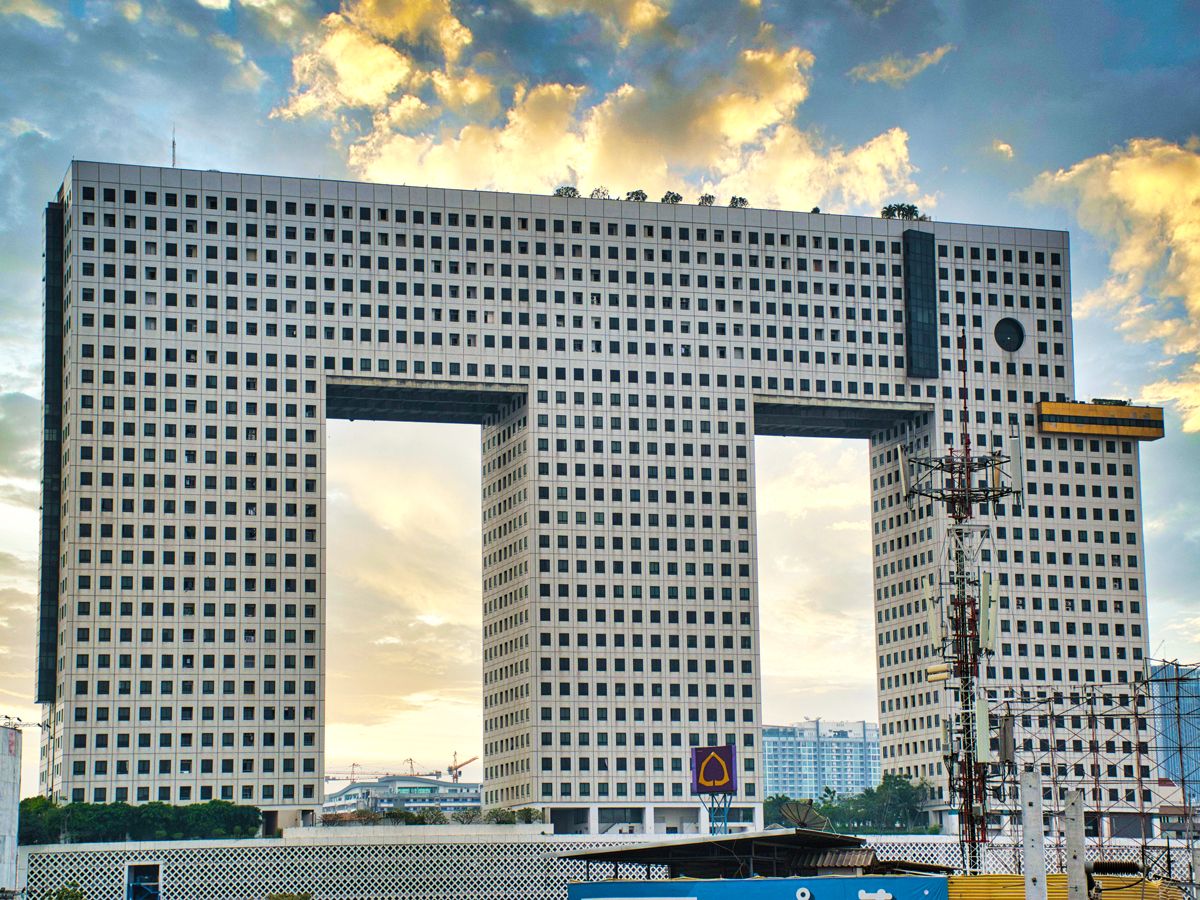
The Chang Building was a collaboration between real estate developer Arun Chaisaree and architect Ong-ard Satrabhandhu, who chose to design a structure that resembles an elephant. To the casual observer, it might look like something a child created out of building blocks, but the design has deeper meaning — it references the elephant’s significance in Thai culture and religion.
The Chang Building (commonly known as the “Elephant Building”) comprises three connected towers, two of which form the elephant’s legs and the other its trunk. But while some fans consider the architectural novelty fun and uplifting, it polarizes opinion and has sometimes appeared on lists of the world’s ugliest skyscrapers.
J. Edgar Hoover Building – Washington, D.C.
Credit: OlegAlbinsky/ iStock via Getty Images Plus
Seeing the beauty in Brutalism can be a challenge, which is perhaps why critics of the J. Edgar Hoover Building will argue it belongs in this list. This bulky behemoth, home to the FBI headquarters, cost a staggering $126 million to construct, going well over budget by the time it was finished in 1974. In its 2006 guide to the architecture of Washington, D.C., the American Institute of Architects (AIA) described it as “the swaggering bully of the neighborhood” and “ungainly, ill-mannered and seemingly looking for trouble.”
Five decades after it opened, the building hasn’t aged well and is, as one Washington Post headline unequivocally declared, “falling apart.” But its planned replacement in suburban Maryland will take more than a decade to come to fruition, so the J. Edgar Hoover Building will remain a D.C. landmark for some time yet, whether you consider it ugly or not.
Advertisement
More from our network
Daily Passport is part of Inbox Studio, an email-first media company. *Indicates a third-party property.
Marissa is a cheap airfare aficionado who loves exploring offbeat destinations with her husband. Based in Los Angeles and Joshua Tree, Marissa has been featured in publications such as San Diego Magazine, Palm Springs Life Magazine, 303 Magazine, and Mountain Living.
Art abounds in every major city around the world, but visitors don’t always need to visit art galleries and museums to find creative inspiration. Many alleyways, parking garages, building exteriors, streetboxes, and other liminal spaces in urban areas have been reinvigorated by street art, graffiti, and sculptures. And other, more unusual, places are following suit. From bathroom stalls to subway stations, these surprising places to see art will make your next city getaway one to remember.
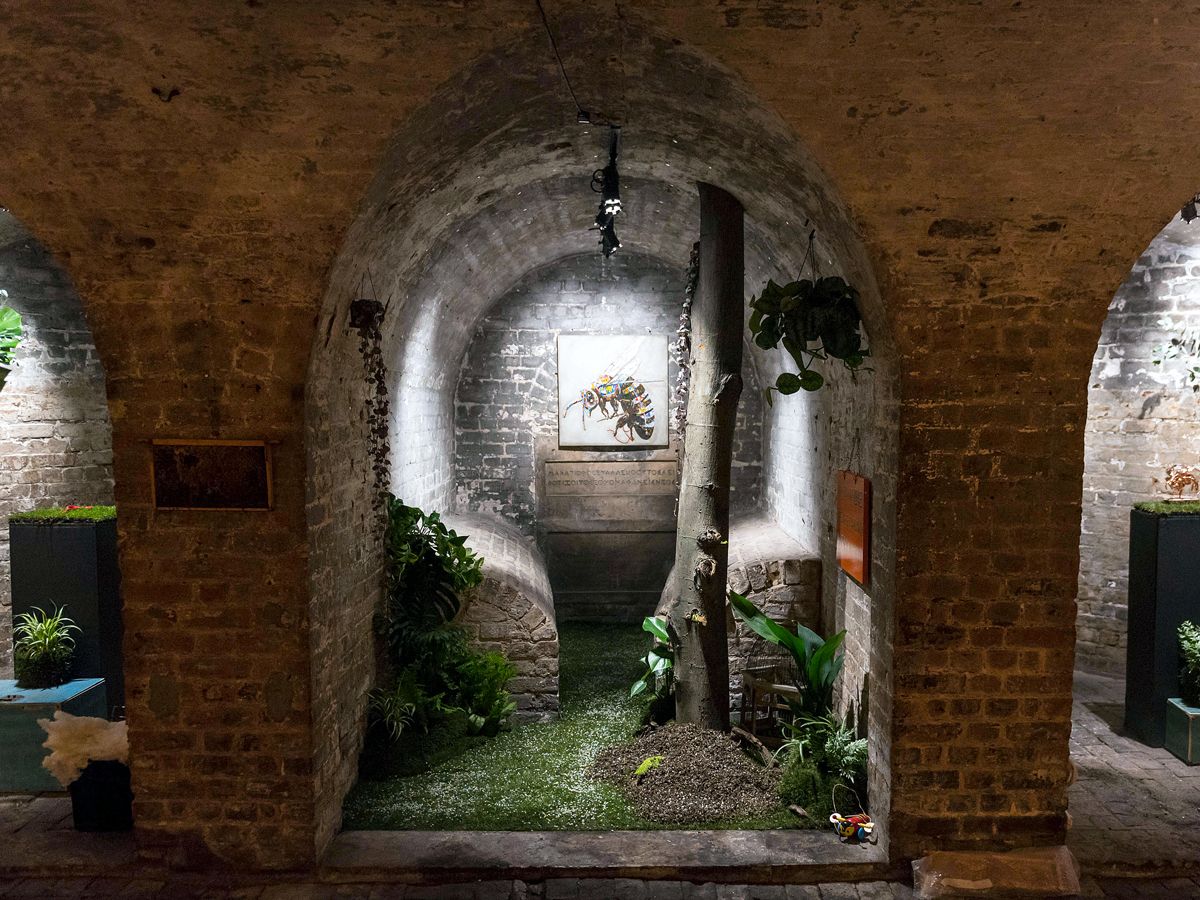
The dark, cavernous tunnels of the Cisternerne once formed a subterranean reservoir that stored some 4 million gallons of water for Greater Copenhagen from 1859 to 1891. The reservoir, located beneath Frederiksberg Hill, was permanently closed due to contamination in 1933, but it earned new life as an art museum in 2001.
The only indication of the Cisternerne’s presence below is the pair of modern glass pyramids that serve as entrance and exit points. Once you descend beneath the park, you’ll explore a fascinating world of contemporary art exhibits and immersive installations that are open to the public year-round. Even the air inside — consistently 47 degrees Fahrenheit, with humidity near 100% — is unusual. The chambers are also not particularly well lit, so be sure to watch your step as you explore this unique collection.
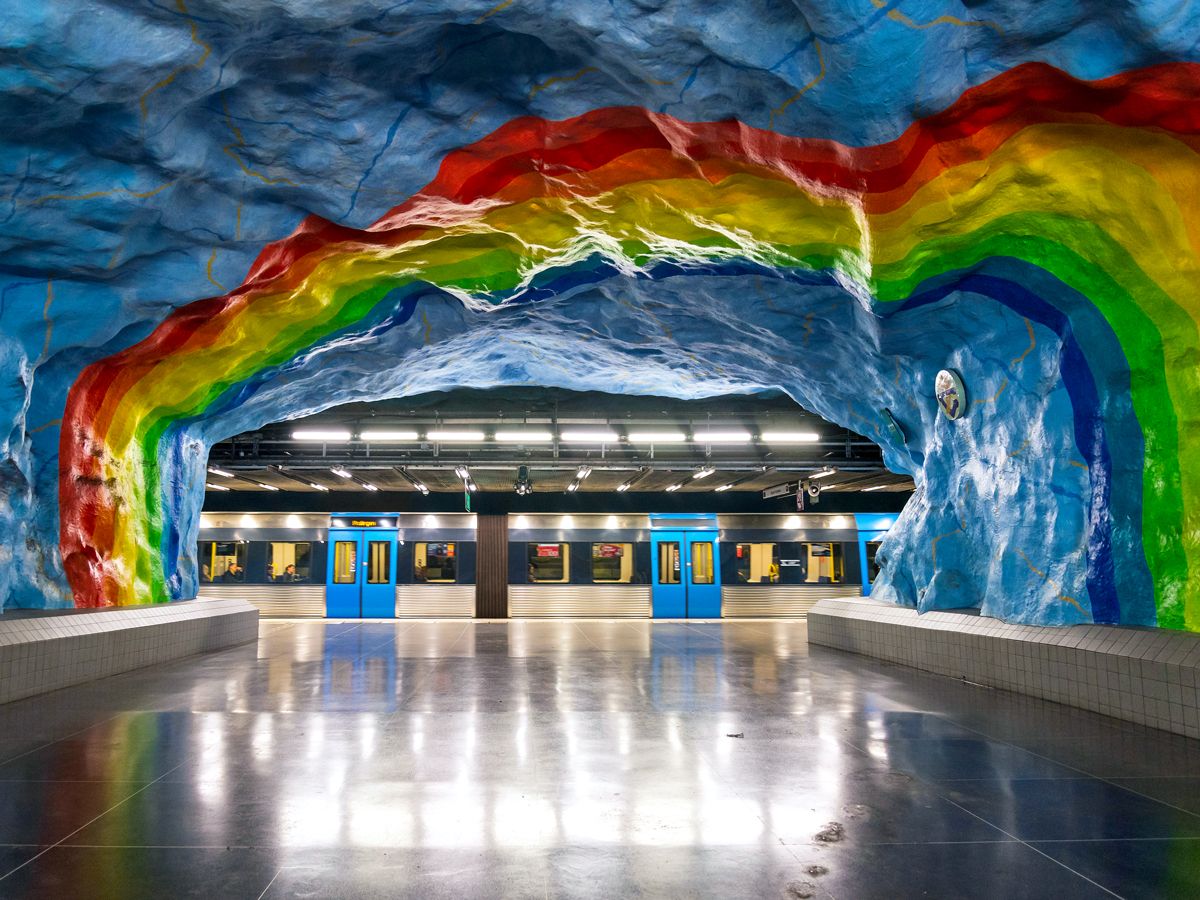
Each of Stockholm’s 100 metro stations is a work of art, and together they form what many consider to be the longest art gallery in the world — 68 miles, to be exact. Since 1957, artists have illustrated and installed pieces through the underground tunnels, stairwells, and platforms, and even the city’s older stations have received a creative restoration.
Some of the most striking stations include T-Centralen, adorned with blue flowers and vines painted by artist Per Olof Ultvedt, and Kungsträdgården, with walls featuring red, green, and white whimsical shapes painted by Ulrik Samuelson. The latter is lined with statue replicas of the exterior art at Makalös Palace, which burned down in 1875 and was converted into one of Stockholm’s most famous parks.
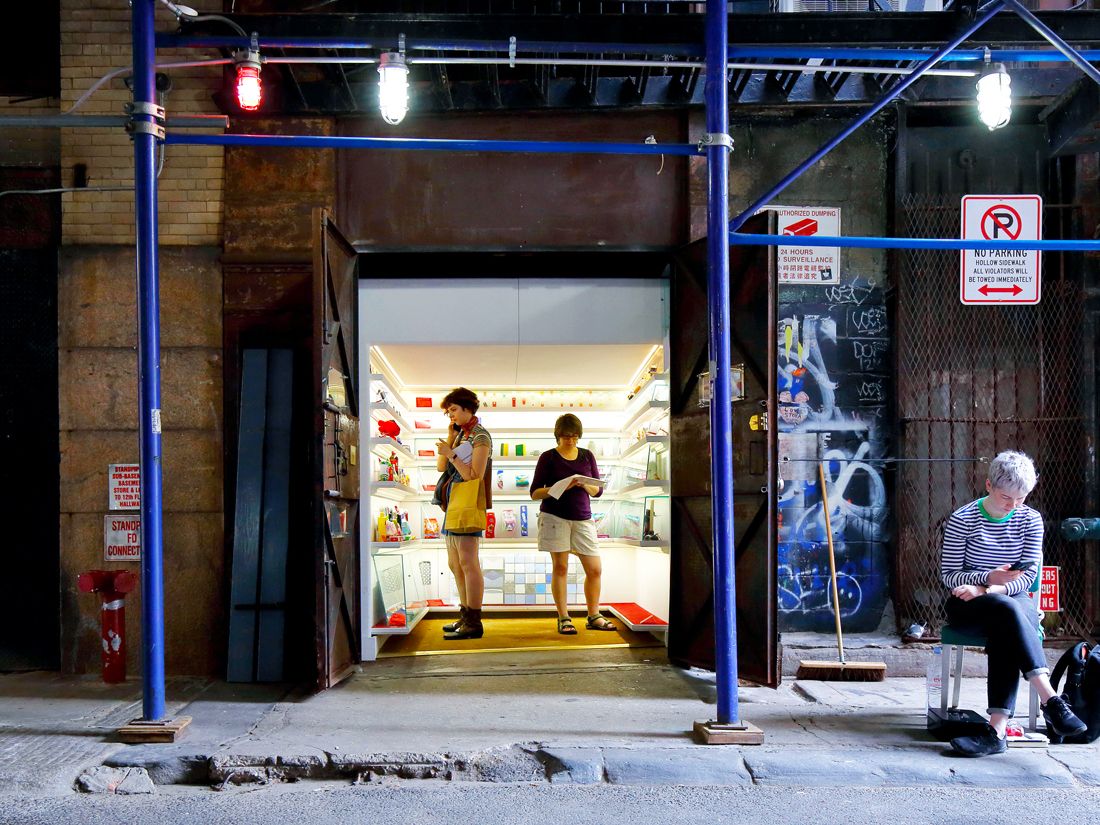
Dedicated to exploring the modern world and the human condition, Mmuseumm in Tribeca may be the world’s only official art museum located in a former freight elevator shaft. Featuring shelves of curiosities, the 36-square-foot space is officially open Fridays to Sundays, but it is also accessible 24 hours a day via peepholes in the front door. The exhibits within Mmuseumm rotate seasonally, so New Yorkers and anyone visiting the Big Apple can obtain a new perspective with each repeat trip.
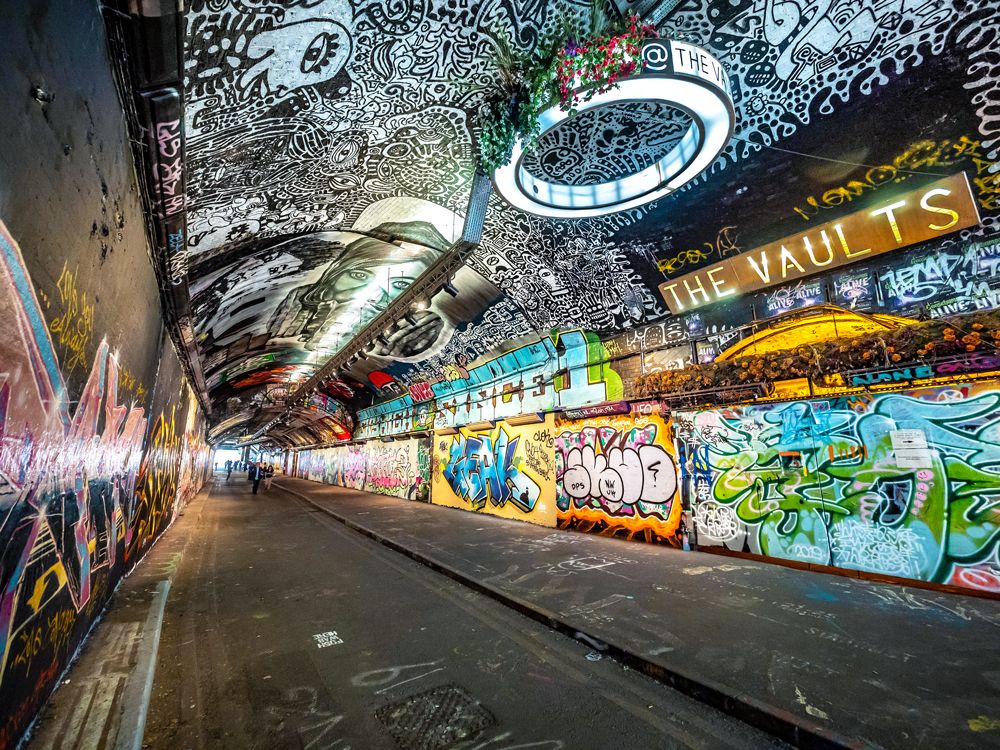
Beneath the Waterloo Tube station in London, a maze of former railway arches has become an immersive theater and alternative arts space. Known as the Vaults, the space includes the Leake Street graffiti tunnel, which was founded by the famous anonymous artist and political activist Banksy. Its large-scale works rotate often, and the tunnel has become one of the most popular places to experience the street art scene of Britain’s capital.
Sammlung Boros – Berlin, Germany
Credit: ullstein bild Dtl./ ullstein bild via Getty Images
Sammlung Boros in Berlin is a bit different from your typically opulent art gallery. It’s housed within a former Nazi bomb shelter erected in 1943 that also served as a prisoner-of-war camp after Germany fell to the Russian Red Army in 1945. However, the structure’s fortified walls don’t overshadow the impressive private collection owned by German entrepreneur Christian Boros. The space was converted into an exhibit to display his art in 2008, and the collection features works solely by international artists dating from 1990 to present-day. It is open to the public by appointment only.
The former Crypt of London’s St. Pancras Parish Church once served as an air raid shelter during both world wars, but it has an entirely different purpose today. In 2002, the final resting place of 557 people was converted into a gallery space for contemporary 21st-century artists. The exhibit might seem spooky at times, but the contemplative works are sure to calm viewers who venture underground to wander these mesmerizing passageways.
Bathrooms at John Michael Kohler Arts Center – Sheboygan, Wisconsin
Perhaps the last place you’d expect to see a work of art is behind a toilet, but at the John Michael Kohler Arts Center in Sheboygan, Wisconsin, you’ll find just that. In the late 1990s, the art museum — known for its impressive collection of works from Wisconsin artists — commissioned six artists to transform its public restrooms into works of art. With tiled walls, carefully designed plumbingware, and other unique features, each stall showcases a creative and seamless blend of fine art and utilitarian design.
As the largest contemporary art museum in Europe,the Palais de Tokyo holds many wonders within its walls, but the Lasco Project is perhaps one of the most riveting exhibits. Designed to showcase urban art in the form of graffiti and murals, the subterranean corridors are a nod to Paris’ eclectic art scene. Part of the exhibit is not even open to the general public and is for private viewing only. It contains pieces by renowned photographer and street artist JR and duo Os Gemeos, among other works.
Built in 1886, the Friendship Baptist Church in southwest Washington is one of D.C.’s oldest African American congregations. It received a colorful makeover by artist HENSE in 2013 and is now known as Culture House. A unique events venue with rotating contemporary exhibits, the former place of worship has become a beacon of creativity and community in this D.C. neighborhood.
Advertisement
More from our network
Daily Passport is part of Inbox Studio, an email-first media company. *Indicates a third-party property.
Fiona has spent her career exploring the world and working in the travel industry, turning her lifelong passion into a profession. From planning custom trips to sharing stories as a travel writer for publications such as The Discoverer, she’s all about helping others experience the world in a deeper, more meaningful way.
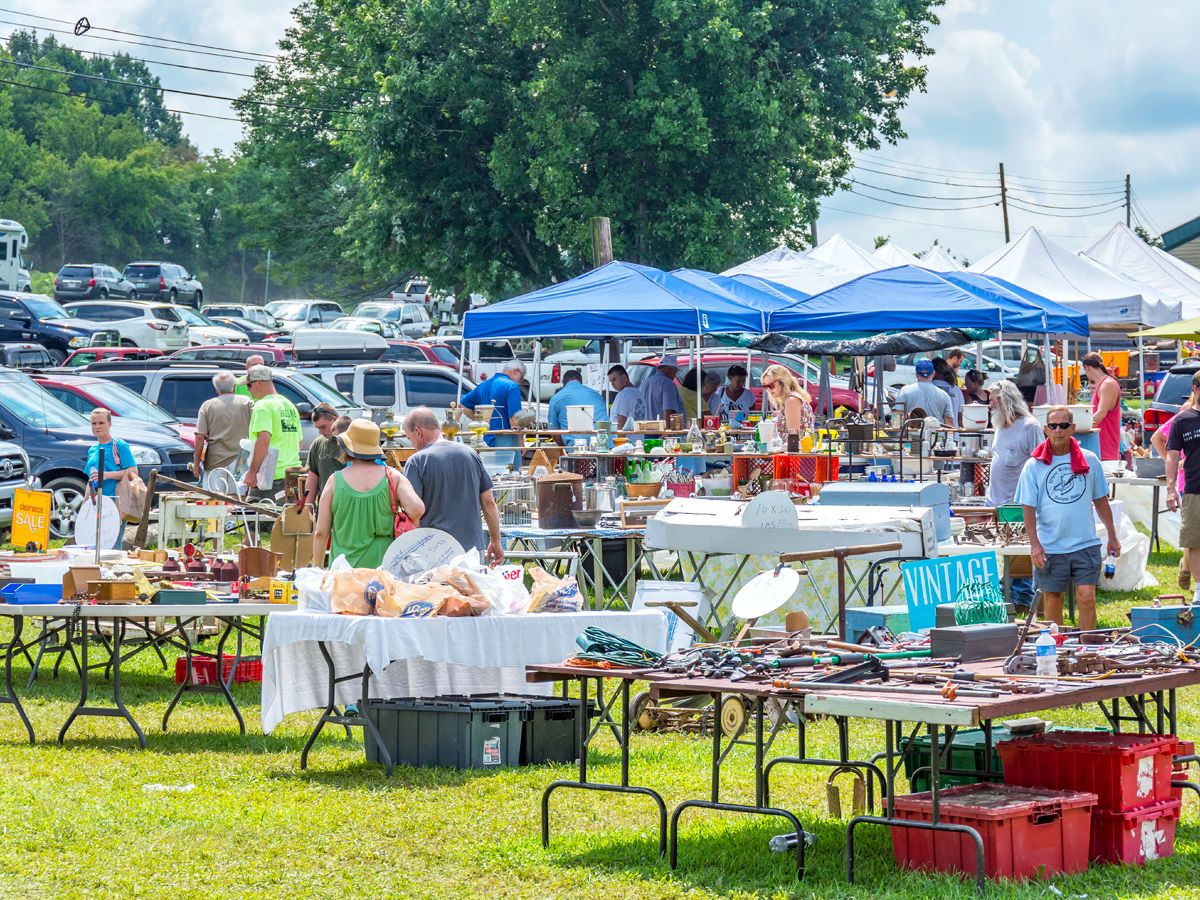
Do you love hunting for vintage goods and antiques? You probably already know you often have to hit the road to find the best treasures, and luckily, there are dozens of annual yard sales to explore from coast to coast. Some of these shopping events even span multiple states, drawing thousands of antique hunters in search of one-of-a-kind items. And as an added benefit, you’ll be able to explore some of the country’s most charming small towns during your search. So, gather your cash and jump in the car to check out six of the best yard sales across the U.S.
127 Yard Sale – Alabama to Michigan
Credit: Education Images/ Universal Images Group via Getty Images
The world’s longest yard sale spans six states and covers 690 miles from Addison, Michigan, to Gadsden, Alabama. Taking place the first Thursday to Sunday of August each year, the event transforms stretches of rural highway into a haven of antiques and vintage treasures. The 172 Yard Sale isn’t just a shopping event — it’s a cultural and social phenomenon, drawing veteran vendors with fascinating stories and histories, as well as thousands of eager shoppers. To make the most of your shopping experience, pinpoint which regional items most appeal to you before you hit the road. Also consider planning your bargain hunting around other local tourist attractions to round out your visit once you’ve finished shopping.
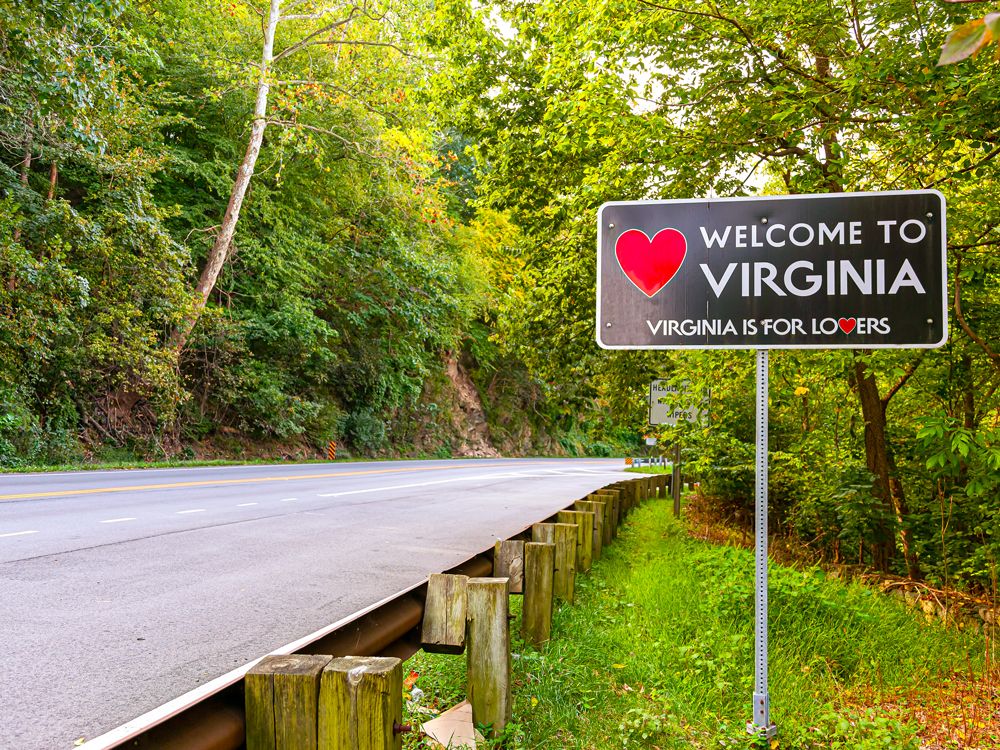
On the first Saturday of July, Virginia hosts its highly anticipated 110-Mile Yard Sale, drawing enthusiastic crowds from across the region. Established in 2009, this sale has steadily gained popularity in the years since, extending beyond Route 360 to include neighboring towns. The result is a meandering route, so download a map to keep yourself on course. While the focus is on antiques and vintage treasures, vendors offer a diverse array of other goods for sale, too.
Historic Highway 80 Sale – Georgia to Texas
Credit: halbergman/ E+ via Getty Images
Hundreds of vendors gather along historic U.S. Route 80 in this annual highway yard sale that runs across five states from Mesquite, Texas, to Savannah, Georgia. The East Texas Tourism Association has hosted the sale for 25 years running, and turnout in the Lone Star State is especially strong. Look for stalls set up in fields, churches, and parking lots along the route, and keep your eyes peeled for signs pointing to off-highway sales. Within the 400-mile stretch, you’ll find a host of antiques, collectibles, farm equipment, tools, houseware, furniture, toys, vintage goods, and other handmade crafts. The biannual event takes place during the third weekends of April and October.
301 Endless Yard Sale – North Carolina
Credit: Image courtesy of Johnston County Visitors Bureau
North Carolina’s biggest annual yard sale covers a 100-mile stretch of U.S. Route 301. Hundreds of vendors flock to sell their antiques and vintage wares across five North Carolina counties, spanning from Weldon to Dunn. Held annually since 2013 on the third weekend in June, the 301 Endless Yard Sale is an ideal place to find vintage Americana goods, in addition to baby and children’s clothing and toys, antiques, collectibles, and crafts. The event was originally put together to promote travel, tourism, and economic development in many of the participating rural towns along U.S. Route 301. Today, the annual sale draws shoppers from around 20 states, while boosting hotel and restaurant sales all along the route.
50-Mile Garage Sale – New York
Credit: Image courtesy of Tour Cayuga
Set in the picturesque Finger Lakes region of New York, the 50-Mile Garage Sale along U.S. Route 90 is the state’s largest yard sale. Held annually on the last weekend of July along the shores of Cayuga Lake, this event has been a local tradition since 1987, when founders Connie Reilly and Barbara Noden recognized the potential of uniting individual garage sales across New York state’s small towns into one coordinated event along Route 90. Today, the sale draws treasure hunters from California to Canada. A wide array of items, including antiques, handcrafted goods, household items, and even vehicles are all on offer.
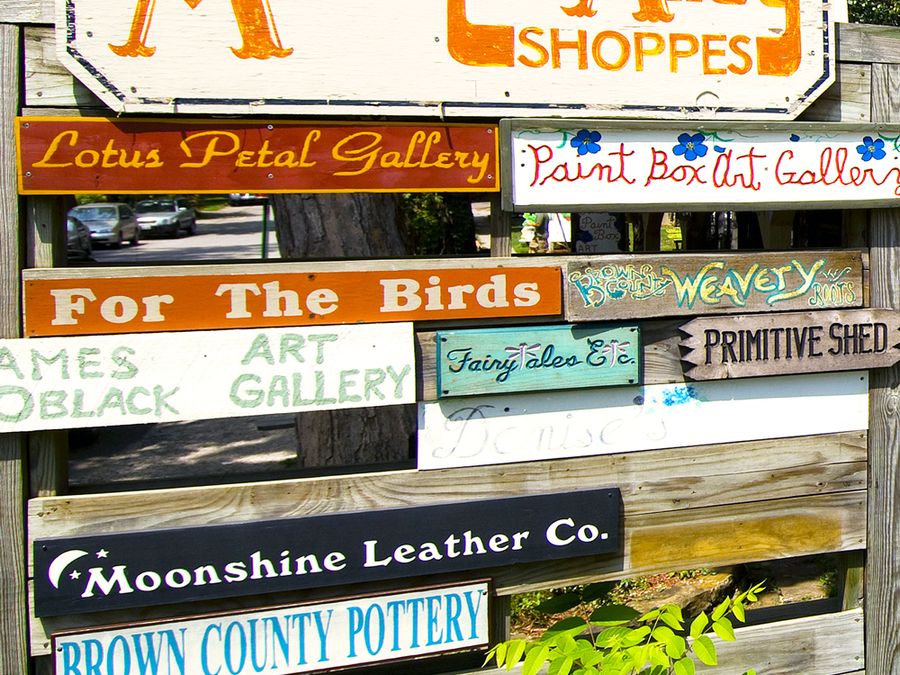
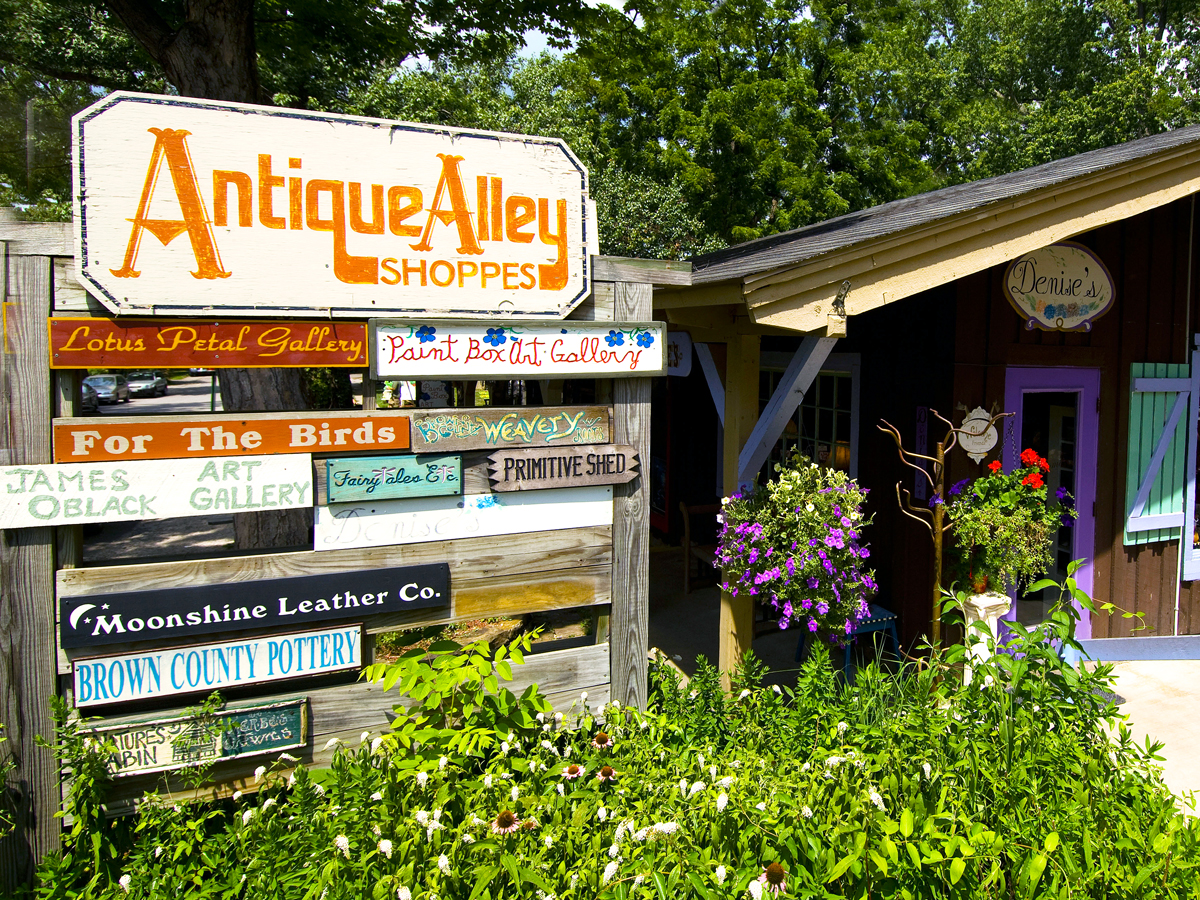
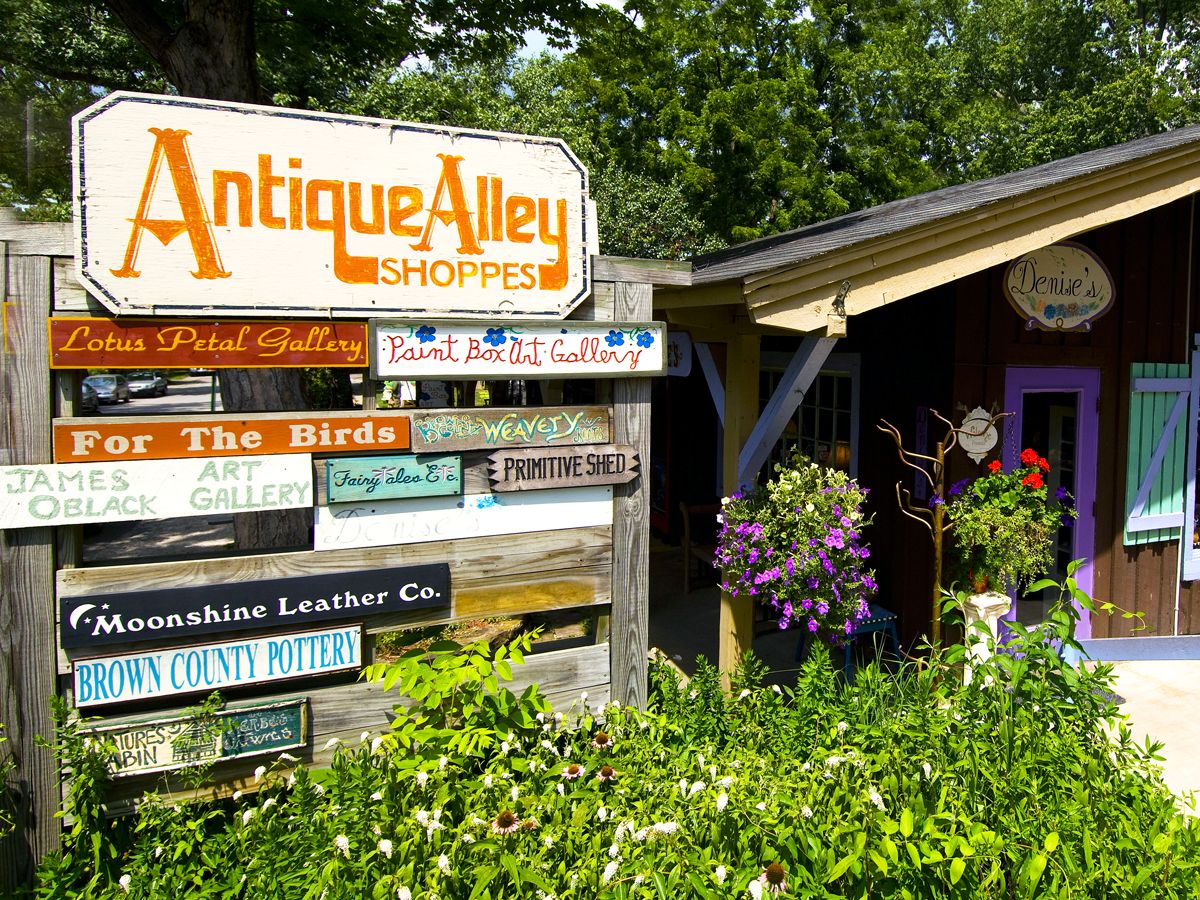
If your timing doesn’t align with the above garage sales, antique enthusiasts can always visit Antique Alley, Indiana’s year-round destination for vintage treasures. Two interlocking loop trails host hundreds of dealers offering their one-of-a-kind goods throughout the towns of Cambridge City, Centerville, and Richmond in Indiana, along with Lewisburg in Ohio. Cambridge City is considered the main hub of Antique Alley, with over a dozen antique vendors and several malls in a two-block radius, but visitors should follow the map to ensure they hit the shops they want. Expect to find handcrafted wood items, stained glass pieces, vintage clothing and furniture, glassware, and more.
Advertisement
More from our network
Daily Passport is part of Inbox Studio, an email-first media company. *Indicates a third-party property.
19,000 Miles, 14 Countries: What It’s Like to Drive the World’s Longest Road
By
Bradley O'Neill
Read time: 6 minutes
July 16, 2024
Updated: July 16, 2024
19,000 Miles, 14 Countries: What It’s Like to Drive the World’s Longest Road
Culture •July 16, 2024•Updated: July 16, 2024
By Bradley O'Neill
When conversations about road trips come up, famous journeys along the Pacific Coast Highway, Route 66, and Australia’s Great Ocean Road are often mentioned. But for an epic road trip adventure to beat all others, there’s really only one option: the Pan-American Highway. The world’s longest motorable road stretches for a whopping 19,000 miles across the Americas, starting in Prudhoe Bay, Alaska, and ending in Ushuaia, Argentina. Below, discover the fascinating history of the Pan-American Highway and the highlights you shouldn’t miss on your epic road trip.
The History of the Pan-American Highway
Credit: zodebala/ iStock via Getty Images
The concept for the Pan-American Highway dates back to the First International Conference of American States in 1889. At the event, U.S. officials put forward an idea to build a transcontinental railroad to provide closer transport links and facilitate trade between neighboring countries. However, nothing came of the proposal until it was reintroduced as a motorable road at the Fifth International Conference, held in Chile in 1923. The idea was eventually approved in Cuba in 1928, and the participating nations signed the Convention on the Pan-American Highway in 1937.
Rather than being one official continuous road, the Pan-American Highway is an interconnected network of national highways in 14 countries. Starting in Alaska, it crosses through Canada, the lower 48, Mexico, Guatemala, El Salvador, Honduras, Nicaragua, Costa Rica, Panama, Colombia, Ecuador, Peru, and Chile, before ending in Argentina’s southern Patagonia region. The first completed section was the 3,400-mile-long Inter-American Highway that connects Nuevo Larredo, Mexico, with Panama City, Panama.
Since the highway’s inception, adventurous travelers have been lured by the opportunity to drive all the way from the Arctic Circle to the edge of Antarctica. While some take it slow, others take on the challenge of getting from the start to end in record-breaking times. In 2003, Tim Cahill and Garry Sowerby drove from south to north in 23 days, 22 hours, and 43 minutes. It is often cited as the record for the fastest trip by car. In 2018, Austrian cyclist Michael Strasser completed the journey on bicycle in 84 days, 11 hours, and 50 minutes — a Guinness World Record. Perhaps even more impressive is George Meegan, who walked the entire length from Ushuaia to Prudhoe Bay in a record 2,426 days.
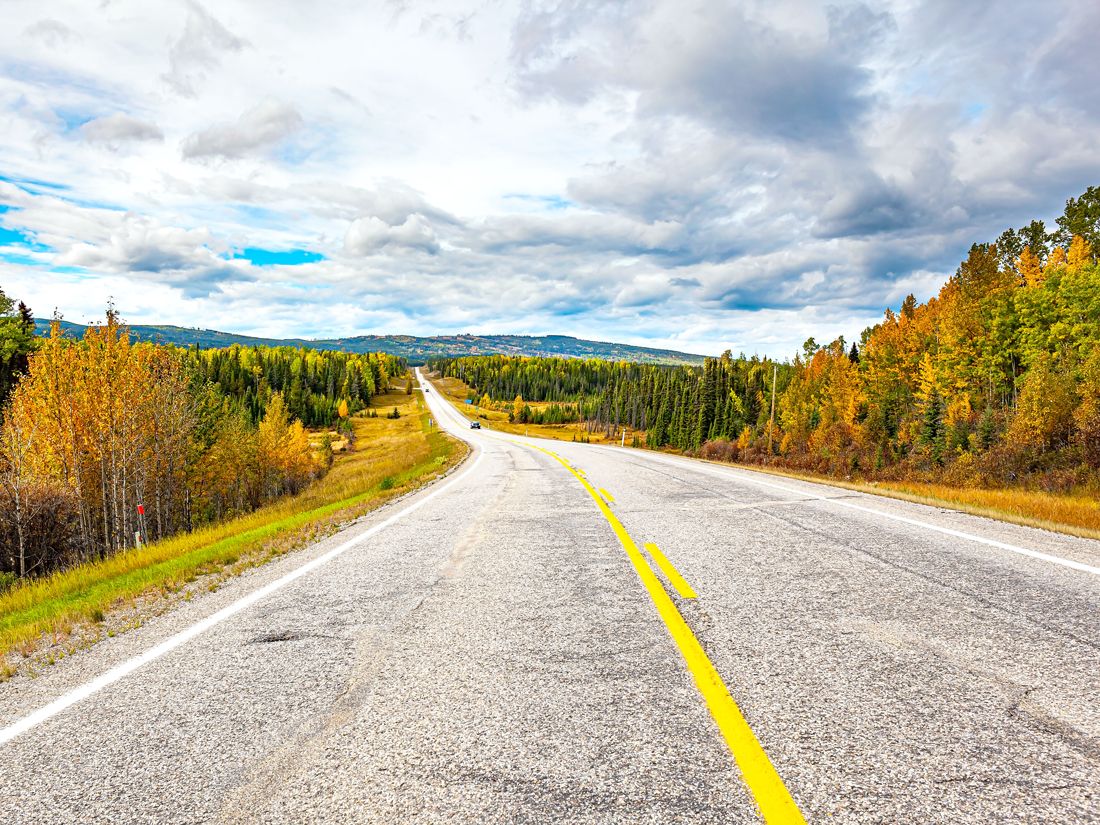
The beauty of traveling the Pan-American Highway is the ability to discover a huge variety of natural and urban landscapes along the way, along with myriad cultures, climates, and ecosystems. Among these many highlights are the glaciers and icefields of Alaska and Canada’s Yukon Territory, and major cities such as Albuquerque and Denver. Farther south, there are dramatic Andean peaks, verdant jungles, and the world’s driest nonpolar desert. The highway also passes through Quito, one of the world’s highest capitals.
An end-to-end road trip isn’t without its limitations, however. The Pan-American Highway terminates abruptly in Yaviza, in southern Panama, before picking up again 60 miles south in Turbo, Colombia. The space between these two locations is called the Darién Gap. It’s a region of difficult terrain — swampland and thick forested jungle — that is home to communities of Indigenous groups such as the Embera-Wounaan and Kuna peoples. There are no paved roads here, thus no vehicle access, and it’s also notorious for criminal gangs and smuggling. Instead, drivers have to ship their vehicle in a container and fly between Panama and Colombia.
Those tackling the entire highway have one other water crossing to navigate: In southern Chile, it’s necessary to cross the Strait of Magellan, which separates the mainland from the island of Tierra del Fuego. Fortunately, it’s a short 30-minute crossing, and the ferries are vehicle-friendly.
5 Must-See Highlights of the Highway
Credit: kavram/ iStock via Getty Images Plus
Whether you’re planning to cruise down a short portion of the Pan-American Highway or it’s on your bucket list to tackle the whole route, here are five stops you shouldn’t miss along your journey.
Whitehorse – Yukon Territory
Credit: Dale Fornoff/ iStock via Getty Images Plus
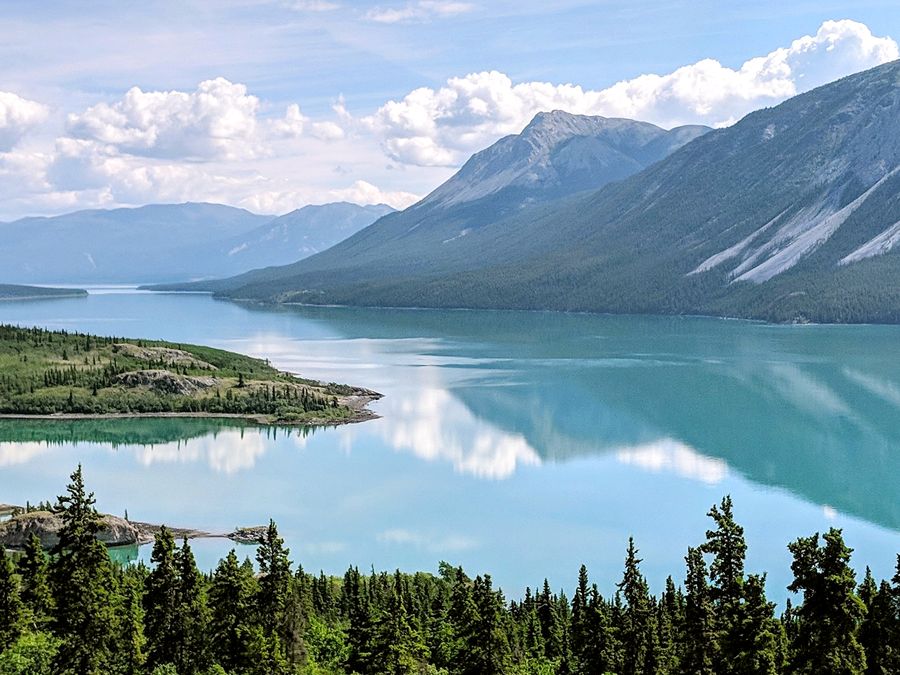
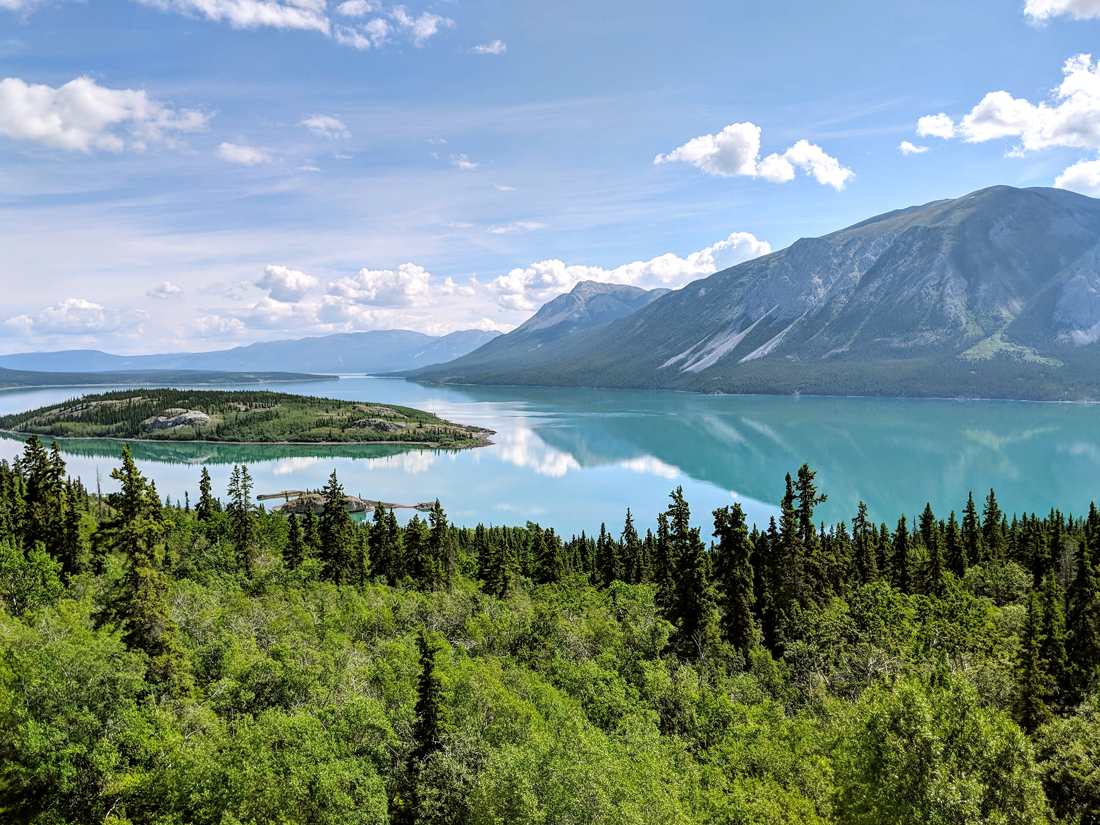
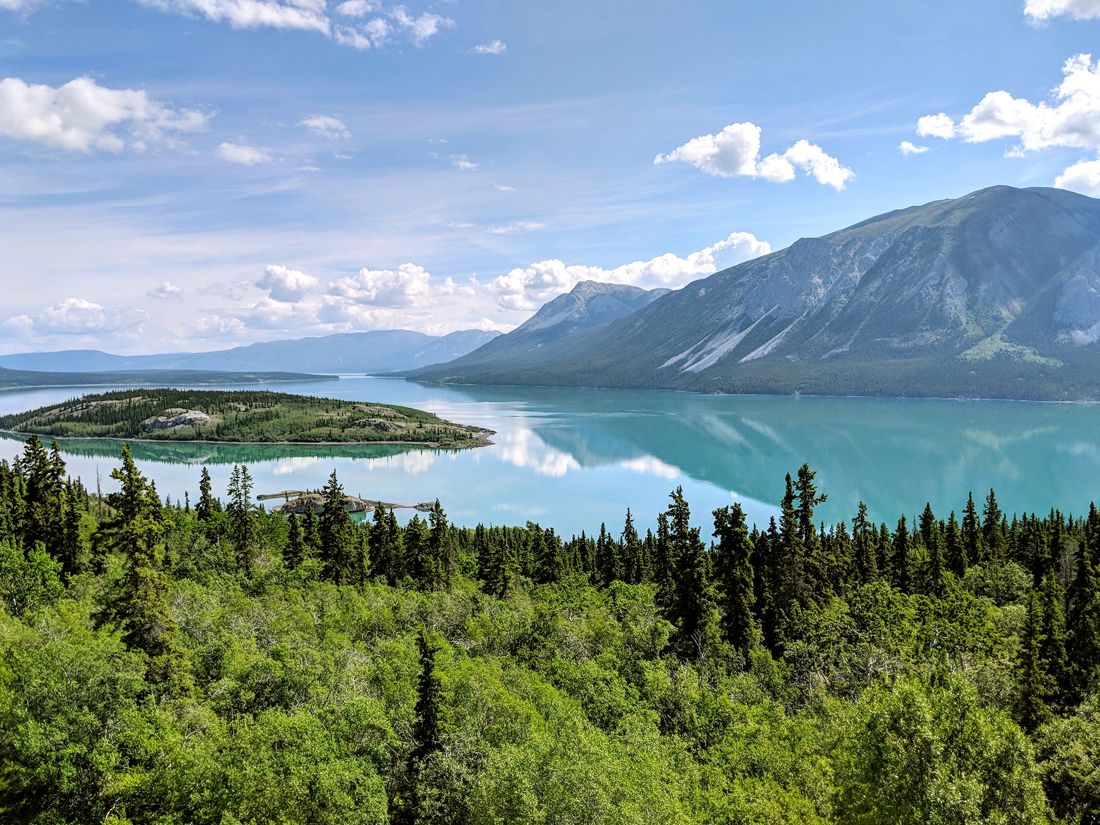
After crossing the glacier and mountain-filled backcountry of Alaska, the highway enters the remote wilderness of Canada’s Yukon Territory. Whitehorse, the capital of the territory, offers insights into the daily lives of those who call these barren landscapes home. It was once an important stop during the 1898 Klondike gold rush, and legend states that the town got its name when prospectors mistook the rapids of Miles Canyon for horses. Paddle the Yukon River or follow the Yukon River Loop Trail to the decommissioned steamwheeler at the S.S. Klondike National Historic Site. Surrounding Whitehorse are 435 miles of hiking trails and more than 50 miles of cross-country ski trails.
Cerro de la Muerte – Costa Rica
Credit: Wirestock/ iStock via Getty Images Plus
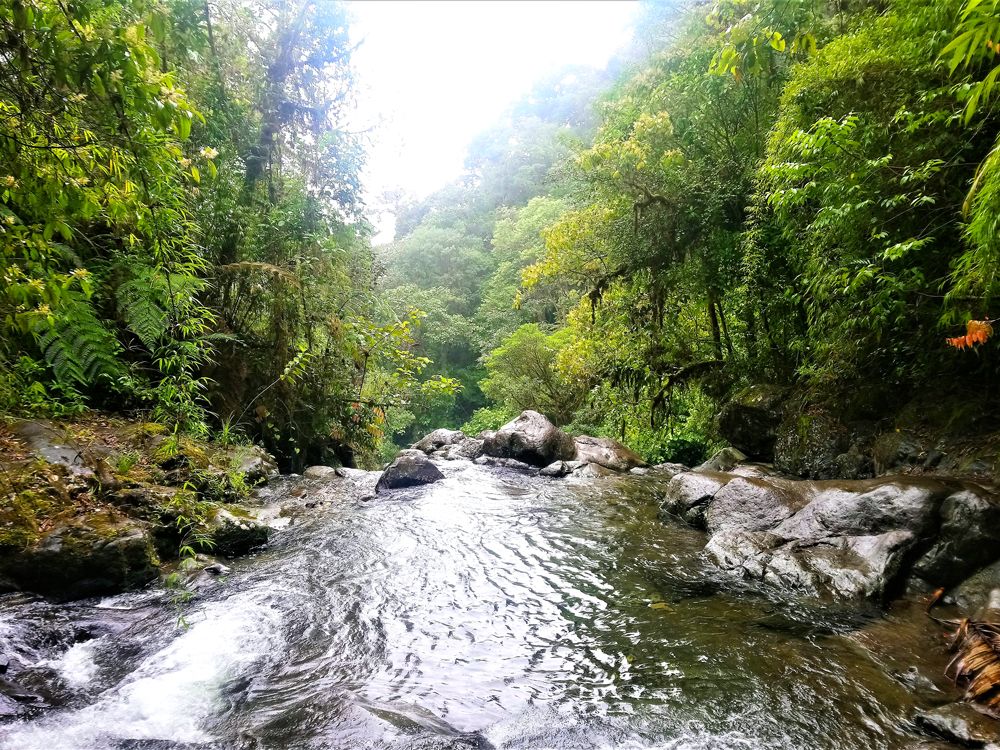
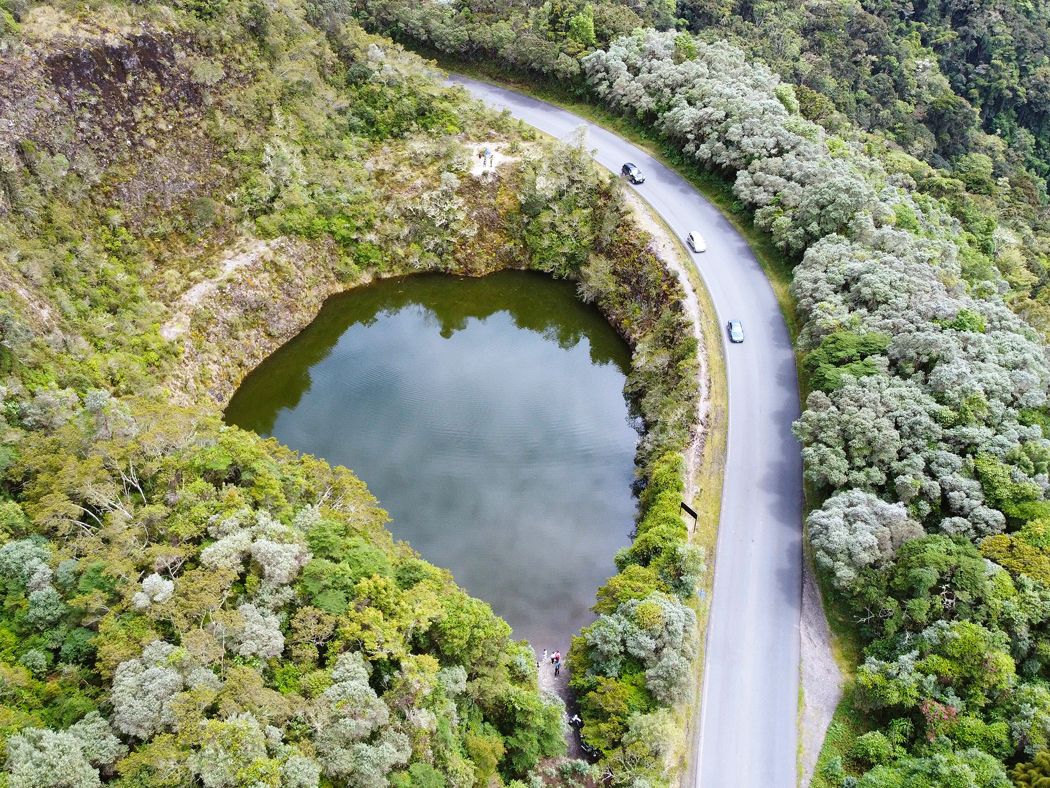
At almost 11,000 feet above sea level, the zigzagging mountain pass that climbs over Cerro de la Muerte (Hill of Death) marks the highest elevation on the Pan-American Highway. Nestled amid the Talamanca Mountain Range, it’s named after the perilous crossings that were once made on foot, which were often hindered by dramatic temperature changes and landslides. Driving the pass entails navigating steep curves and switchbacks, but along the way are a number of pullouts and viewpoints, where you can gaze over the jungle-clad Talamanca mountains toward the Pacific Ocean. The region is also rich in birdlife, notably emerald toucanets and quetzals.
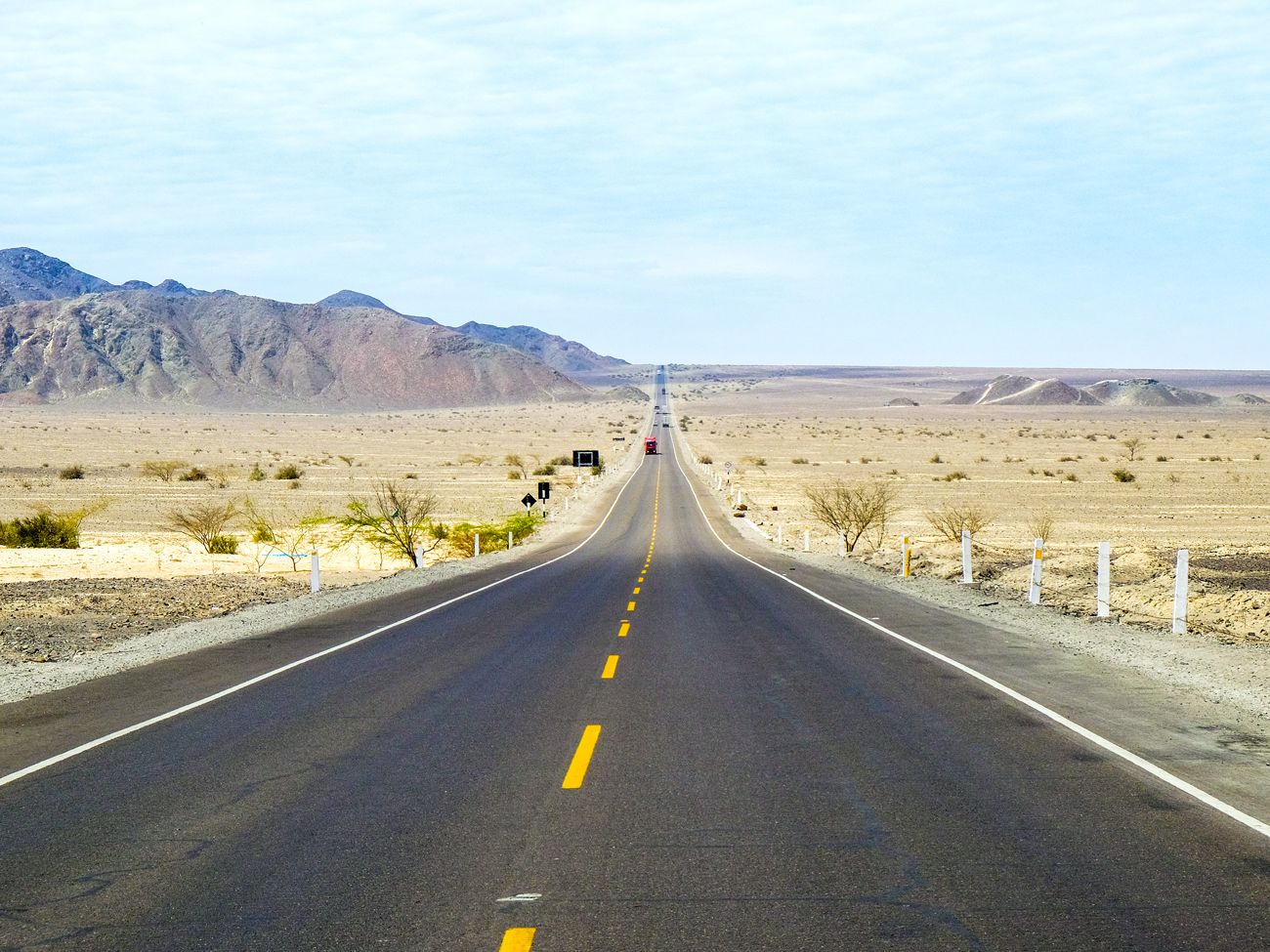
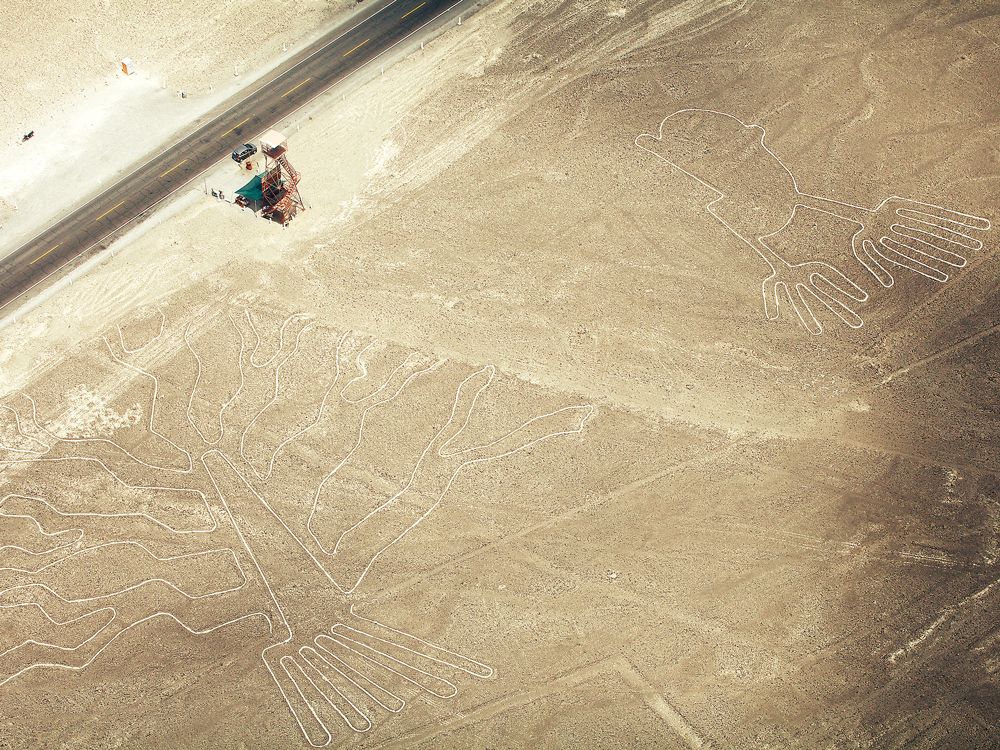
In the desert lands of southwestern Peru, the highway passes one of South America’s most mysterious sites. The UNESCO-listed Nazca Lines are a collection of hundreds of giant geoglyphs that were etched into the sand sometime between 500 BCE and 500 CE. Measuring up to 985 feet in length, these geoglyphs depict everything from birds, flowers, and trees to a monkey and a fishermanlike figure. Who made them remains unknown, which only adds to their magical aura. One of the best ways to see them is from an observation tower located roughly 15 miles from the city of Nazca. Another way is to take a 35-minute scenic flight over 13 of the most important geoglyphs.
Atacama Desert – Chile
Credit: Ignacio Palacios/ Stone via Getty Images Plus
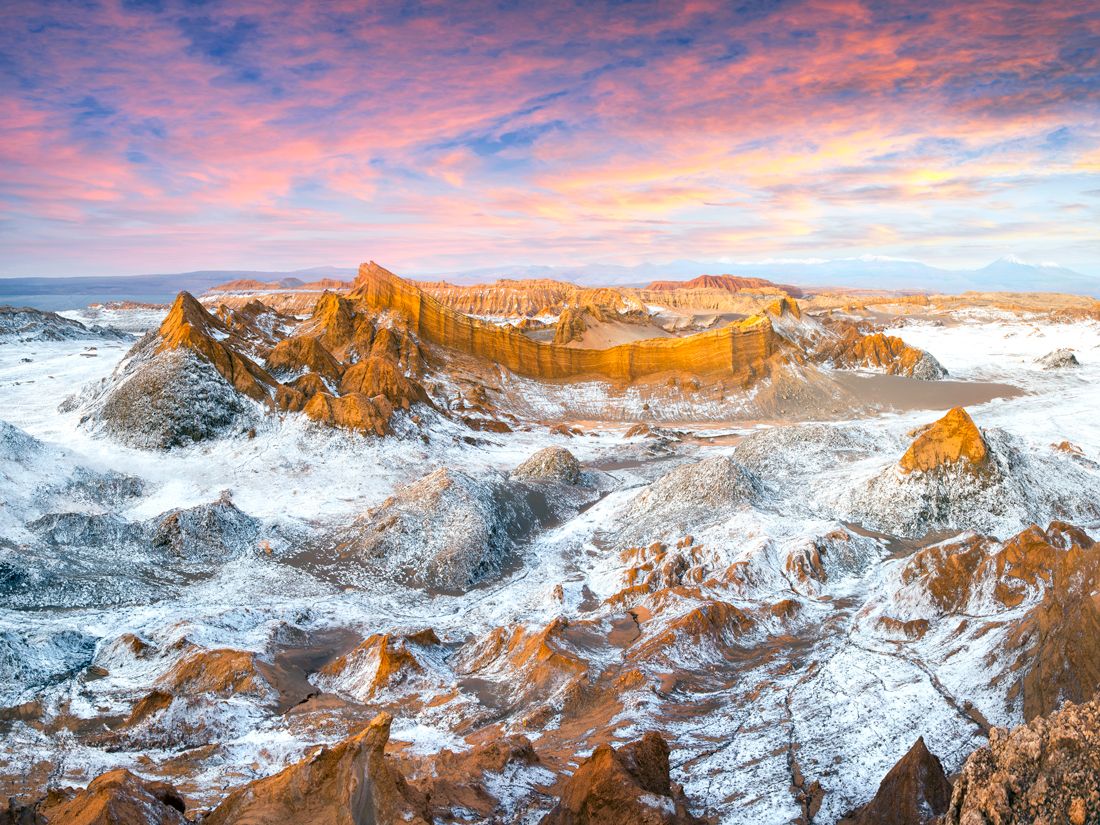
From the Peruvian border, the highway continues into Chile and the Atacama Desert. Bounded by the Andes to the east and the Pacific Ocean to the west, the desert sits at around 8,000 feet above sea level and is one of the driest places on Earth. Cruising through the 600 miles of this region involves long, lonely drives past ethereal, often inhospitable landscapes that resemble something from another planet. (In fact, NASA used the region for testing to replicate conditions on Mars.) Humberstone — a ghost town that was once a thriving saltpeter mining community — is now home to abandoned grocery stores, a hotel, and a theater that sit isolated beneath the scorching desert heat. Farther south, Chañaral is a gateway to penguin watching in Pan de Azucar National Park and surfing at Portofino Beach and Balneario Flamenco.
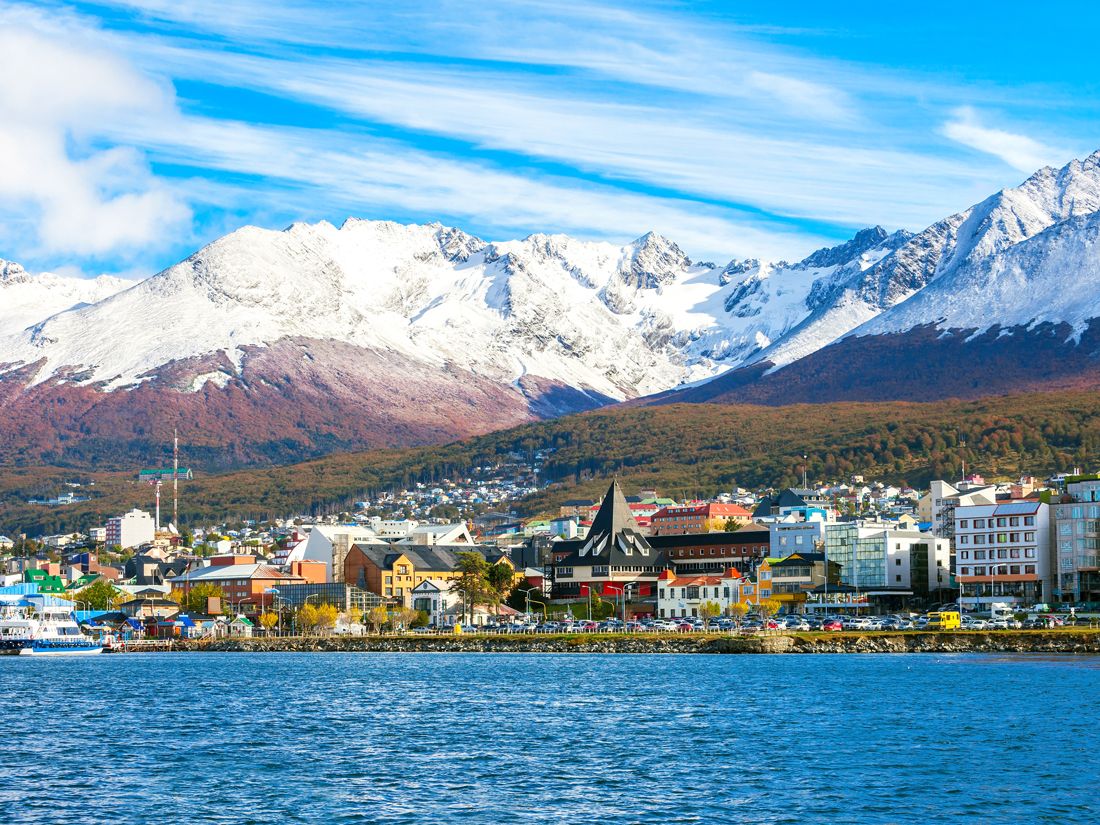
The journey on the longest road in the Americas reaches its terminus in Ushuaia, which proudly calls itself the Fin del Mundo (End of the World). Considered the world’s southernmost city, Ushauia sits on a hillside above the shores of the Beagle Channel at the bottom of Tierra del Fuego Province. It honors its extreme southerly location with a set of unique attractions such as the End of the World Train and Cerro Castor, the southernmost ski resort in the world. Visitors can also access nearby Patagonian forests and glacier lakes in Tierra del Fuego National Park and wildlife-spotting cruises on the Beagle Channel. Ushuaia is also a starting point for arduous sea voyages across the Drake Passage to Antarctica.
Advertisement
More from our network
Daily Passport is part of Inbox Studio, an email-first media company. *Indicates a third-party property.