The French Village With a History of Living in Upside-Down Boats
By
Julia Hammond
Read time: 5 minutes
September 29, 2023
Updated: September 29, 2023
The French Village With a History of Living in Upside-Down Boats
Culture •September 29, 2023•Updated: September 29, 2023
By Julia Hammond
Author
Julia Hammond
Julia is a U.K.-based travel writer whose work has been featured in The Independent, The Telegraph, The New Zealand Herald, and Culture Trip, among others. She’s an enthusiastic advocate for independent travel and a passionate geographer who has had the privilege of traveling to more than 130 countries in search of a story.
The seaside commune of Équihen-Plage lies on a section of France’s northern coast called Côte d’Opale (Opal Coast), near the port city of Boulogne-sur-Mer. While the relaxed town draws in holidaymakers with its serene beaches, Équihen-Plage has a far more unusual claim to fame: its houses made out of upside-down boat hulls, known locally as quilles en l’air (which translates to “keels in the air” in English). If you’re wondering how these decommissioned fishing boats became unconventional abodes — and later unique accommodations for travelers — dive into the unique history of Équihen-Plage’s upside-down boats.
In the 19th and early 20th centuries, Équihen-Plage was a thriving fishing community. However, the sea here has a significant tidal range, and Équihen-Plage is an example of a port d’échouage, a port that has no water at low tide. Rather than drop anchor offshore, traditionally village fishermen would beach their boats and haul them up the sand by hand (though these days, you might see a tractor being used instead).
Their vessels, called flobarts, are traditional to northern France and have a number of characteristics that make them especially suited to places like Équihen-Plage. They were designed to be capable of floating in just a foot or so of water. Their wide bow was well equipped to deal with strong waves, while the flat stern could be slid into the water on logs whenever it needed to be launched.
More than a century ago, money was tight for many in Équihen-Plage, and nothing was wasted. Boats that were no longer seaworthy were salvaged so they could be repurposed as homes, providing shelter for entire families at minimal cost. First, a low wall was constructed so that the finished dwelling would have sufficient headroom. A doorway-sized opening was then cut from the side of the boat, along with a small window or two. Builders then flipped the vessel over and lifted it on top of the wall. Many were tucked against the hillside, providing some protection against the elements on this wild and often windy coast. But in their original state, the boats would have been drafty and leaky.
The interiors of the quilles en l’air were also fairly basic, lacking adequate ventilation, natural light, and running water. Often simply and sparsely furnished, the boats had an open floor plan to maximize the space. Still, they rarely reached 26 feet long, often resulting in a tight squeeze, given the average family size of the time. But for many of these impoverished families, having an affordable roof over their heads would have been a blessing.
By the time World War II broke out, the days of the quilles en l’air were sadly numbered. In Équihen-Plage, the Quartier des Quilles en l’Air — the district that contained around 20 upturned boats — was a casualty of the bombing raids that flattened many of the buildings in this part of France. The last boat to be occupied was used as a studio by a painter named Paul Christol. It was the only boat to survive this era, albeit with significant damage.
Though the quilles en l’air were gone, they weren’t forgotten. By the 1990s, a desire to resurrect this old tradition arose. Local authorities decided to build new boat houses and rent them out to visitors vacationing in Équihen-Plage. Several decades later, they’re as popular as ever — and often fully booked well in advance.
How to Visit the Upside-Down Boats of Équihen-Plage
Today, the quilles en l’air are located within Camping La Falaise at the south end of Équihen-Plage. If you’re driving, follow Rue Charles Cazin to the main beach parking lot and walk back up to the campsite.
Aside from admiring the boats and their role in the region’s unique cultural history, visitors can also book them for a unique overnight stay. The replica boats are finished to a higher standard than the originals would have been and provide a comfortable, yet simple place to spend the night. In high season (July and August), rentals are only offered on a weekly basis, from Saturday to Saturday. Outside of peak season, visitors can reserve for shorter periods. Prices vary according to both season and size: Two of the eight boathouses sleep only two people, while the others can accommodate parties of up to five people. One is also accessible for people with limited mobility. And all of them have sea views..
If you’re planning to visit in early fall, it’s worth checking out Boulogne-sur-Mer’s Fête de la Beurière. This festival, which takes place during the second weekend in September, celebrates the fishing quarter’s history and traditions. There are typically local historians who will happily share old photos of the quilles en l’air and tell you their story.
To reach Équihen-Plage from Paris, catch a TER train from Gare du Nord to Boulogne-sur-Mer and take a 25-minute bus ride. From the other side of the English Channel, you can board a DFDS ferry to Calais, which makes the 90-minute sea crossing multiple times a day. A local bus connects the port and main train station, from where you can travel along the coast.
Though Équihen-Plage’s quilles en l’air are certainly fascinating, they aren’t entirely unique — several other places in France, including Normandy and Brittany, are home to similar dwellings. Further afield, on the Holy Island of Lindisfarne in Northumberland, England, redundant herring boats have been turned upside down and given a new lease of life as boat sheds. Similarly, in places such as Greenland and Alaska, upturned umiaks (skin-covered boats) once created temporary shelters for local fishermen.
Advertisement
More from our network
Daily Passport is part of Inbox Studio, an email-first media company. *Indicates a third-party property.
History •September 26, 2023•Updated: September 26, 2023
By Jersey Griggs
Author
Jersey Griggs
Jersey is a travel and lifestyle writer whose work has appeared in publications such as Condé Nast Traveler, Business Insider, and Bust. When she’s not exploring her adopted home state of Maine, she’s likely planning her next big trip.
These days, public parks are often associated with outdoor leisure, from lunchtime picnics to casual evening strolls and community events. However, our idea of a modern-day park is vastly different from America’s earliest parks. Centuries ago, public parks were created for unique and specific purposes, such as animal husbandry, town assemblies, or even burying the dead. Below, learn about six of the oldest parks in America, and how they came to be.
New York’s Bowling Green was first designated as public property in 1686, though it didn’t officially become a park until 1733. In the 1730s, it was rented out to the public and paid for in peppercorns, and the renters improved the space in downtown Manhattan with the addition of grass, trees, and a wooden fence. Over the years, the park morphed with the changing times. In 1770, a statue of King George III was erected, only to be destroyed six years later, when an angry mob tore it down after the first public reading of the Declaration of Independence. By the late 18th century, it became a hot spot for upper-crust New Yorkers to show off their most fashionable attire.
Today, Bowling Green is best known for the statue of the Charging Bull, which has been on display in the park since the 1980s. Located in the city’s Financial District, the intimidating bronze sculpture not only represents the country’s tenacity but also serves as a nod to the prosperity of nearby Wall Street.
Although San Pedro Springs Park has officially been a park for nearly 300 years, it’s been an informal gathering place for much longer. Before Spanish colonists discovered the park’s thermal springs in 1709, they were a favorite meeting place for Indigenous peoples who resided in the Southwest for thousands of years.
San Pedro was officially designated as a park in 1729 when King Philip V of Spain declared it to be public land. As the springs provided essential water to the community, the park was first used for farming and encampment, before later becoming a recreational site. Today, the park’s thermal water source is still a major draw, with a public pool fed from an aquifer. Other park amenities include a gazebo, a skate park, tennis courts, and a library.
4. Jackson Square – New Orleans, Louisiana
Photo credit: gary718/ Shutterstock
Jackson Square’s location on a bend of the Mississippi River was no accident. In 1718, French colonists, with help from local Native Americans, strategically selected the river portage to be the capital of the Louisiana territory. Three years later, Place d’Armeswas established as one of the region’s first public parks. The park’s pleasing, symmetrical architecture is thanks to the French architects who designed the central square. The square was a gathering place for French colonists to congregate, attend religious services, and access the port, while soldiers could often be seen practicing military formations on the grass.
In 1851, the park was renamed for General Andrew Jackson, the hero of New Orleans in the War of 1812. As an open-air art colony, it has long since been a haven for artists who are permitted to sell their works within the park.
When William Penn first designed Philadelphia in 1683, his “greene country towne” highlighted the importance of public spaces. Formerly known as “North Publick Square,” Franklin Square was one of the original parks spaced across Penn’s city plan.
Throughout its tenure, Franklin Square has had many iterations, including a cemetery, a cattle pasture, ammunition storage, and a parade ground. The park’s landmark foundation was built in 1838 and remains the nation’s oldest public water fountain. Nearly a decade later, it was also the site where the country’s unofficial park mascot — the urban gray squirrel — was first introduced to public spaces.
Since being restored in 2005, Franklin Square has added a carousel, a mini golf course, a burger joint, and choreographed light and sound fountain shows, which are timed to the machinations of the park’s historic waterworks.
Dating back to 1667, Washington Park was first commandeered by English Puritans, who used the land communally to tend to animals and referred to it as “North Common” or “Upper Green.” It wasn’t until after the Revolutionary War, in 1795, that the land officially became a park named for George Washington.
Since then, Washington Park has become a cultural epicenter in Newark, surrounded by notable institutions such as the Newark Museum of Art, the Newark Public Library, and Rutgers University School of Law. Historical sights within the park include Washington’s Retreat Marker, which displays the route of Washington’s army when they marched through New Jersey, and the nearby statue of the famed general and his horse. The park also contains the oldest statue in Newark, which dates to 1890 and pays homage to Seth Boyden, the American inventor who created patent leather.
Established in 1634, Boston Common is the oldest public park in the U.S. The park’s 44 acres were initially purchased by Puritan colonists who needed a communal pasture for cows. Over the years, Boston Common was also used for military training, town assemblies, and public hangings from the Great Elm. The park played a pivotal role during the Revolutionary War, serving as the site of the colonial militia muster and later an encampment for the Redcoats. Today, it is fittingly home to the Central Burying Ground, a historic cemetery that contains both British soldiers and patriots.
To honor its history, Boston Common marks the start of the Freedom Trail, a historic walking trail that traverses Boston’s many sites of historic significance. Events like Shakespeare on the Common and the Citywide Arts Festival draw large crowds, as do the public assemblies and peaceful protests that have historically taken place in the Common.
Advertisement
More from our network
Daily Passport is part of Inbox Studio, an email-first media company. *Indicates a third-party property.
Geography •September 26, 2023•Updated: September 26, 2023
By Daily Passport Team
Author
Daily Passport Team
Daily Passport writers have been seen in publications such as National Geographic, Food & Wine, CBC, Condé Nast Traveler, and Business Insider. They're passionate about uncovering unique destinations and sharing expert tips with curious travelers.
There are millions of place names on Earth. Some boast impossibly long, difficult-to-pronounce names — such as Llanfairpwllgwyngyllgogerychwyrndrobwllllantysiliogogogoch, the name of a community of villages in Wales. At the other end of the spectrum are some town names that, remarkably, are just one or two letters long. Discover seven places with some of the shortest names in the world and the stories behind them.
At the southern end of the Lofoten archipelago in northern Norway, there’s a small village known by just a single letter: Å. Pronounced like the “o” in “born,” “Å” is one of eight vowels in the Norwegian alphabet. It’s also an Old Norse word meaning “small river.” Only about 150 people live in the village, which is known for both fishing and tourism. (Among other things, it’s home to both the Lofoten Stockfish Museum and the Norwegian Fishing Village Museum.)
Interestingly, the Å in Lofoten is not the only Å in Norway; at least six other towns have the same name, but Lofoten’s Å is the most popular, likely because of the scenery and climate of the islands. The weather is mild, the mountains are large, and in the summertime, you can experience days with up to 24 hours of sunlight.
Oô is a commune in the Haute-Garonne department of France, close to Bagnères-de-Luchon in the Pyrenees Mountains. That helps put the name of the town in context, as “Oô” translates to “high mountain” in the regional dialect. Its main feature is the picturesque Lac d’Oô, a glacial lake that was turned into an artificial lake by a dam built in 1921. The lake covers approximately 103 acres and is surrounded on all sides by steep slopes covered in greenery.
It also sits below a waterfall that pours water down about 900 feet. The beautiful scenery makes the lake especially popular with hikers, who follow a path across the Pyrenees Mountains, past the lake, and then into Spain, which borders Oô to the south.
Y, a tiny commune in northern France, has only two main streets, which come together to form the shape of the letter “Y” — hence its abbreviated name. The population is similarly small; it currently has around 90 residents, and at the height of the town’s density, in 1866, only 226 people lived there. Villagers call themselves Upsiloniennes, a reference to the Greek letter upsilon, which — like the commune’s roadway layout — resembles the letter “Y.”
The commune’s main claim to fame is its name, but it also experienced a brief period of internet notoriety for another reason. It became known as “the Place of Death” in the 2000s, thanks to a genealogist’s error when inputting the place of death for people. That mistake led to a number of records showing that a person died in Y when they probably had never even been there.
In central Finland, on the Gulf of Bothnia and just north of Oulu, travelers can stop at Ii, a municipality with nearly 10,000 people. The community was founded in 1445 as a trading center dealing in peat, salmon, and fur. Its name, the shortest in all of Finland, comes from an old Sami word, “iddja” or “ijje,” which translates to “night.” Ii is currently working on a special goal: to be a zero emission and completely waste-free community. The town is already well known in Nordic countries for its sustainability efforts; its goal for 2020 was to cut carbon emissions by 80%, well ahead of goals set by the European Union.
Aa is a village in northern Estonia, right on the coast of the Gulf of Finland. It dates back to the 1200s but is perhaps best known today by Estonian crossword puzzlers, as it’s a common answer to crossword clues in the country. Its popularity was solidified in 2019, when an Estonian puzzle magazine asked readers to vote for what should be the new capital of Estonia, based on towns and villages with short names that were often crossword answers. Aa won by a landslide. The town has an old manor house, built in the 1400s, that’s now a care home, plus a chapel in a former garden pavilion, and a roughly 700,000-square-foot nature park.
Hum, Croatia, is one of the smallest towns in the world, with a diminutive name to match. As of 2011, its population was only about 30, and the village itself is contained mostly within a set of medieval stone walls. It’s located in the northwest part of Croatia, near Glagolitic Alley — a road lined with 11 large stone sculptures representing the Glagolitic alphabet.
Hum itself has only two streets, both paved with cobblestone and very short, along with a restaurant, two churches, a castle, and some souvenir shops. It’s a medieval village, and much of the architecture from earlier centuries remains today, including a church tower built in the 1500s and a baroque church constructed on the site of an earlier church in the 1800s. There’s also a pair of big copper doors at the town gates, with Glagolitic inscriptions welcoming visitors. Hum follows old traditions as well; a new mayor is elected annually by only the men in town, who cast their votes using wooden spoons.
Ny, Belgium, is located in the Province of Luxembourg in Wallonia, the French-speaking region in the southern part of the country. A member of Les Plus Beaux Villages de Wallonie (“The Most Beautiful Villages of Wallonia”), which seeks to preserve and enhance the landscape and heritage of the area, Ny is a hamlet of historical architecture and rural charm.
A limestone castle-farm in the village dates back to the late 1600s and serves as a backdrop for the town’s annual medieval tournament reenactment, but some infrastructure is even older. There’s a mill from the 1300s, for example, that still has its wheel intact. The town also has a number of drinking fountains and water troughs that date back to the 1700s, as well as a neo-Gothic church and presbytery. About three miles away are the Caves of Hotton, where visitors can go more than 200 feet underground to explore a maze of caverns.
Advertisement
More from our network
Daily Passport is part of Inbox Studio, an email-first media company. *Indicates a third-party property.

Beyond Big Ben: 15 Under-the-Radar London Landmarks To Visit
By
Daily Passport Team
Read time: 11 minutes
September 26, 2023
Updated: December 13, 2024
Beyond Big Ben: 15 Under-the-Radar London Landmarks To Visit
Culture •September 26, 2023•Updated: December 13, 2024
By Daily Passport Team
Author
Daily Passport Team
Daily Passport writers have been seen in publications such as National Geographic, Food & Wine, CBC, Condé Nast Traveler, and Business Insider. They're passionate about uncovering unique destinations and sharing expert tips with curious travelers.
Tourists flock to London to visit iconic landmarks such as Big Ben, Buckingham Palace, Westminster Abbey, and the Tower Bridge — and for good reason. These fascinating, history-filled sites are an essential part of any first-time visit to the English capital. But if you’ve already checked these attractions off your list, London offers a wealth of hidden treasures that are every bit as interesting. From quirky museums to serene gardens, here are 15 under-the-radar London landmarks to check out.
Wilton’s Music Hall in London’s East End is the world’s oldest surviving grand Victorian music hall. Opened in the late 1850s, the storied venue brought the glitz and glamour of the West End to a working-class audience in the East End. Performances typically included sing-alongs, variety routines, and musical comedy shows. During the Victorian era, Wilton’s was London’s premiere venue for live performances, but after a fire in 1877, the building was repurposed to become a Methodist mission and then a warehouse.
Troubled by the hall’s planned demolition in the 1960s, some of the era’s top showbiz personalities, including Spike Milligan and Peter Sellers, fought to save the iconic structure. Today, the building again serves as a venue for theater performances and concerts and retains much of its original charm and character.
The Old Operating Theatre lay hidden for many years until it was uncovered during construction on St. Thomas’ Church in the London borough of Southwark. The area was actually the original site of the old St. Thomas’ Hospital, and the operating theater took surgery out of the ward and into a dedicated space in the attic. Before the days of antiseptics and anesthesia, operations were bloody and painful, so conducting the procedures far from other sick patients was crucial to maintaining an orderly facility.
The theater also served another purpose, however. It was a teaching space, so the tiered seating would have been occupied by medical students keen to observe techniques. Today, the building operates as a museum, which visitors can reach via a spiral staircase, and serves as a reminder of the advances of modern medicine.
Before London became the sprawling city it is today, it was a series of villages. One of those villages, Brixton, retains its historic windmill. While such structures are common in the English countryside, they’re rare in urban locations. The one in Brixton used to be known as Ashby’s Mill and was built in 1816. Its sails harnessed the power of the wind to mill flour until the 1860s, when the business moved to a watermill in the Surrey village of Mitcham. But when the lease expired, Ashby’s moved back to its original site, using steam and then gas to modernize and increase productivity.
The mill did considerable trade supplying London’s bakeries and restaurants with flour until it finally closed in 1934. These days, it’s the centerpiece of a city park, restored by a committed team of volunteers. Guided tours of the structure take place on open weekends from April to October, when you can learn about the business and watch flour being milled.
London’s congested streets created a bit of a headache when it came to ensuring that postal deliveries made it on time, so engineers came up with an unusual solution — an underground railway. From 1927 to 2003, the “Mail Rail” carried millions of letters across the capital, from Paddington in the west to Whitechapel in the east. Though it’s no longer in use commercially, the train reopened in 2017 as a visitor attraction run by the Postal Museum.
Take a ride on a tiny train to experience the tunnels for yourself. Interactive exhibits give visitors the opportunity to sort the mail on a moving train — courtesy of a realistic simulator. Above ground, you can learn more about the Royal Mail’s history and how stamps are designed.
While a steady stream of tourists makes it to Buckingham Palace, Eltham Palace receives considerably fewer visitors. Located south of the Thames in the borough of Greenwich, this historic gem in suburbia began as a 13th-century manor house and was later gifted to the royal family. King Edward IV was the monarch responsible for adding the Great Hall, which is all that remains of the medieval estate.
King Henry VIII expanded Eltham so it could accommodate his large entourage, but the greatest transformation came in the 1930s. Wealthy couple Stephen and Virginia Courtauld are to thank for the extravagant Art Deco-style interior; they took a maximalist approach to design, even creating a rainforest-themed room for their pet lemur Jongy.
London’s answer to the Neon Museum in Las Vegas can be found in Walthamstow, one of the city’s easterly neighborhoods. “God’s Own Junkyard” is a treasure trove of salvage; the collection includes neon signs, movie props, and fairground lighting. Many of the pieces are the work of the late Chris Bracey, an exceptionally talented lighting designer whose art was featured in movies such as Batman (1989) and Bladerunner (1982).
Bracey learned his extraordinary craft from his father, who was London’s first neon sign maker in the 1950s, and later opened his premises to curious members of the public in 1978. Tucked away on the Ravenswood Industrial Estate between a car mechanic and a microbrewery, the collection was soon credited as being one of London’s quirkiest, most remarkable, and colorful attractions.
Postman’s Park was built at the end of the 19th century on top of what was once the former St. Botolph’s Without Aldersgate Church. The peaceful greenspace is best known for George Frederic Watts’ Memorial to Heroic Self-Sacrifice, which was unveiled in 1900. A series of memorial stones have been added over the years to commemorate acts of bravery and courage by ordinary folks. Each stone is dedicated to someone who lost their own life while trying to save another.
Another unique garden in the park is the grounds of the former church of St. Dunstan-in-the-East. Sir Christopher Wren, the architect responsible for St. Paul’s Cathedral, designed some of it. During World War II, the church suffered extensive damage. Wren’s steeple and tower survived, but the Church of England decided not to repair and reopen the building. Instead, the bombed ruins were redeveloped as a beautiful garden.
There are few London sights as iconic as the capital’s black cabs. But while you’ll see them on every street, you’ll have to put in a little more legwork to track down the 13 remaining cabmen’s shelters. These little green huts were a response to a tricky problem: In bad weather, cabbies often took shelter in pubs. As driving while intoxicated was prohibited, the idea was born to create somewhere for cab drivers to get an affordable meal and a cup of tea during their shift.
The first shelter opened in St. John’s Wood in North London in 1875. More followed, though since then, many of the structures have fallen victim to road widening and traffic management schemes. Today, some of the shelters remain; Cabmen’s Shelter in Russell Square is one of them. Other shelters still serve cabbies at Grosvenor Gardens, Embankment Place, and on Warwick Avenue. Most of the shelters enforce a cabbies-only rule inside, but if you can manage, it’s worth a peek.
Highgate Cemetery is a bit of a trek from central London but well worth the effort, particularly if you take one of the excellent guided tours along the tree-lined paths. The cemetery is home to the graves and tombs of many notable Londoners; Karl Marx was buried here, as were scientist Michael Faraday, authors Douglas Adams and Beryl Bainbridge, artist Lucian Freud, pop impresario Malcolm McLaren, and comedian Max Wall.
Another notable cemetery can be found in Kensal Green. This atmospheric place was styled after Père Lachaise Cemetery in Paris. It is the final resting place of authors Anthony Trollope, Wilkie Collins, and William Makepeace Thackeray; Niagara Falls tightrope-walker Charles Blondin; Victorian engineer Isambard Kingdom Brunel; and the inventor of the computer, Charles Babbage.
Formerly the Geffrye Museum, the Museum of the Home reopened in 2021 following a refurbishment and rebrand. Located in Hackney, East London, the building houses a fascinating collection of exhibits that chart the changes in Britain’s domestic interiors over the past four centuries. Faithfully recreated room sets bring history to life, from a garish 1970s living room to a genteel parlor that looks just as it would have in 1695.
The museum also has a series of gardens that exemplify fashions such as Elizabethan knot gardens and the informal cottage gardens embraced by the Arts and Crafts movement. You might even be inspired to create a heritage space for your own home after your visit.
One of London’s most unusual gardens lies in Holland Park in West London. As its name suggests, the Kyoto Garden takes its inspiration from Japan, but what you might not realize is that it was a gift from the city of Kyoto to mark the friendship between the two countries. This serene oasis features tiered waterfalls, a koi-stocked pond, and, of course, the stone lanterns and colorful maples commonly found in Japanese gardens.
The garden is a joy to wander through, though you’ll need to share the tranquil space with a muster of peacocks. Holland Park is also home to the Fukushima Memorial Garden. It’s a place for quiet contemplation and reflection, designed to demonstrate Japan’s gratitude to the British for their support following the devastating earthquake in 2011.
London has a wealth of Georgian architecture. Among the best preserved streets to see this iconic style are Roupell Street near Waterloo, Little Green Street in North London, and East End addresses, such as Fournier Street and Elder Street. But if you’re keen to peek beyond the façades, you’ll need to head to Dennis Severs House on Folgate Street near Spitalfields Market. This house, open to the public as a museum, dates to 1724.
After Californian-born Dennis Severs bought the property in 1979, he set about transforming it into an accurate representation of what it would have looked like as the home of an imaginary family of Huguenot silk weavers. Weekly candlelit tours are a multi-sensory experience which evoke the past. Make your way to nearby Brick Lane afterward for further insight on how immigrants have shaped this multifaceted neighborhood.
This century-old Dutch barge was repurposed as a North London bookstore. Tethered on the Regents Canal close to Kings Cross Station, every inch of this historic vessel is now crammed with new and used books. This is a place to come without a plan. Browse Paddy’s collection and you might stumble on something unexpected: cult, classic, children’s, and contemporary books are all here waiting for you to peruse. Special events, from poetry readings to live music performances, are a reminder of why this place is so much at the heart of its community.
Afterward, wander over to Coal Drops Yard, where you’ll find plenty of places to sit and read. Consider buying your coffee from Redemption Roasters, a café chain with a social conscience. They roast their coffee inside Her Majesty’s Prison The Mount and help offenders reintegrate after serving their sentence by training them as baristas.
The Barbican was flattened during World War II, and if you want to get acquainted with its brutal yet bold postwar architecture, consider taking one of the fascinating tours of the complex. After you’re done taking in the history of the place, pop in to the Barbican Conservatory, a green oasis amidst all that concrete. This rainforest under glass is as verdant as its more-famous Kew counterpart, the only one larger in London.
Lush plants include palm and banana trees and plenty of floral displays to evoke a sense of being far from England. Check out the terrapins in the water, though you’d be wise to keep your distance; these bad boys were evicted from Hampstead Heath after some antisocial behavior, leading local wits to dub them the “terror-pins.”
The Great Fire of London ripped through the city in 1666, leaving a trail of destruction and shattered dreams in its wake. The Monument was constructed the following decade to honor those who were lost but also to celebrate the beginning of a new chapter in the city’s history. It is located at the corner of Monument Street and Fish Street Hill.
The height of the column is exactly the same as its distance from the site of Thomas Faryner’s bakery, where the fire started. It’s possible to climb the 311 steps to the top of this landmark. Video images are displayed for those who don’t want to head to the top, but it’s worth the effort for the view of the London cityscape, including skyscrapers such as the Shard, the Walkie Talkie, and the Gherkin.
Advertisement
More from our network
Daily Passport is part of Inbox Studio, an email-first media company. *Indicates a third-party property.
The Best Fall Foliage Destinations Around the World
By
Fiona Mokry
Read time: 7 minutes
September 26, 2023
Updated: September 24, 2025
The Best Fall Foliage Destinations Around the World
Outdoors •September 26, 2023•Updated: September 24, 2025
By Fiona Mokry
Author
Fiona Mokry
Fiona has spent her career exploring the world and working in the travel industry, turning her lifelong passion into a profession. From planning custom trips to sharing stories as a travel writer for publications such as The Discoverer, she’s all about helping others experience the world in a deeper, more meaningful way.
As sunshine and heat are replaced with cooler temperatures and crisp air, many travelers choose to embrace the beginning of fall. What better way to get in the spirit than discovering the world’s most vibrant fall foliage? We’ve already covered America’s best fall foliage destinations (and even the more under-the-radar ones), so now we’re taking a look at 10 places in other countries that shine brighter in autumn.
Tuscany, Italy
Credit: Freeartist/ iStock via Getty Images Plus
The Tuscan countryside charms visitors year-round with its rolling landscapes and vineyard-covered hills, but in autumn, the region is especially appealing. Small villages become even more quaint, and cozy wineries offer exceptional Italian wines and traditional cuisine to complement the sunny, but slightly cooler days.
The best time to enjoy the fall foliage is from late October to early November, a season that also comes with a few unique cultural experiences. In September and October, you can witness the grape harvest (vendemmia), with farmers harvesting their crops, tractors rolling through golden landscapes, and annual wine festivals. Late October and early November usher in the olive harvest, offering opportunities to partake in picking, pressing, and crafting homemade olive oil.
Canada boasts one of the world’s densest forest covers, and the area around the Canadian Rockies in western Canada is a treasure trove of leaf-peeping opportunities. That’s especially true in Banff — Canada’s first national park — along with Jasper National Park in Alberta. (However, Jasper suffered damage from devastating wildfires in 2024, so check the Parks Canada website before you go to see which attractions are open.)
In Banff, you can admire the foliage from pretty much anywhere in the park, including the flat, easy Bow River Trail that starts right in the quaint town of Banff. One of the most popular ways to take in the changing leaves is by hiking the Larch Valley Trail, which winds above Moraine Lake through a dense forest filled with larches that turn a brilliant golden hue come autumn.
In Jasper, you can take to the trails that crisscross Pyramid Bench for views over the tree-covered Athabasca Valley. If the weather’s warm enough, enjoy a picnic with a view on Lake Edith, a glassy basin that shines gold in fall from surrounding foliage. And those who prefer scenic drives are spoiled for choice — don’t miss the long winding route of Miette Road (be sure to stop for a dip in the hot springs) or the Icefields Parkway, the thoroughfare linking Jasper to Banff.
In autumn, Kyoto’s dense population of ginkgo, maple, and cherry blossom trees transform into a spectacle of fall foliage in every corner of the former Japanese capital. The city’s tree-shrouded temples — such as Jo-jakko-ji, Kiyomizu-Dera, and Tofukuji — are all popular tourist attractions year-round, but they are especially beautiful places to peep at the colorful leaves. The trees sweeping above Togetsu Bridge also put on quite a show, as do the groves huddled closely around Kitano Tenmangu Shrine. Plenty of visitors flock to Kyoto for the fall show, so if you’re craving some serenity away from the crowds, Bishamondo Temple makes the trek to the outskirts of town worthwhile.
Summer may be the peak season for tourists to wander the charming and history-filled streets of Edinburgh, but there’s a benefit to holding off on your trip to Scotland until autumn. The tree-lined streets of the Scottish capital transform from green to vibrant golds, browns, and yellows, and the city takes on a magical new appearance. Hit two birds with one stone and stroll around the main attractions — like the Royal Botanic Garden, Lauriston Castle, Edinburgh Castle, and Canton Hill — for a dose of Scottish history coupled with a spectacular display of fall colors. Outside the city, there are several autumn walks that allow you to fully immerse in nature, including the Pentland Hills or Red Moss Nature Reserve.
Croatia is famous for its stunning coastline and lively island-hopping culture, but as summer fades, don’t be too quick to leave. Croatia’s magic continues as the seasons change, especially in the fall. In particular, Plitvice Lakes National Park transforms into a colorful wonderland as its terraced lakes and unique karst formations take on the golden and fiery hues of autumn. Waterfalls spill over moss-covered rocks, fringed by foliage that turns the already-spectacular landscape into something truly breathtaking. Plus, with the summer crowds gone, fall offers a quieter, more peaceful experience — making it the perfect time to fully enjoy the natural beauty of Plitvice Lakes.
Located in southeast Germany, the state of Bavaria is known for its medieval castles and Baroque churches scattered throughout its picturesque countryside. This fairy-tale landscape becomes even more enticing in autumn. Munich, the capital of Bavaria and the original home of Oktoberfest, is a great place for leaf peepers to start. Check out sites like Englische Garten, Nymphenburg Palace Park, and the banks of the River Isar to take in the fall colors. Scenic drives outside of Munich are also plentiful — the Castle Road in Franconia should not be missed for its bright fall foliage and whimsical castles. The German Alpine Road — with its epic mountain views, picnic stops, and picturesque lakes lined with vibrant leaves — is another must-visit.
Torres Del Paine National Park – Chile
Credit: FEBRUARY/ Moment via Getty Images
Fall is an exceptionally beautiful time to visit Chile’s most famous national park. The pristine landscape of Torres del Paine National Park transforms into a tapestry of fiery reds, oranges, and yellows that are particularly vibrant during sunrise and sunset. Bask in the fall colors with treks on the W Circuit, O Circuit, or the shorter (but just as spectacular) Mirador Las Torres. Boat tours on Lake Pehoé or Lake Grey also offer beautiful reflections of the vibrant foliage. Since Chile is located in the Southern Hemisphere, fall in Torres del Paine runs from March to May, with the peak foliage from late March to early April. As a bonus, this shoulder season means fewer crowds and crisp, clear weather.
With nearly 10 million residents, Seoul might not seem like a leaf peeper’s paradise, but from mid-October to mid-November, the Korean capital comes alive with fall foliage. From the streets to the palaces, parks, and the four inner mountains surrounding the city, seemingly every corner of Seoul bursts with vibrant reds, oranges, and yellows.
Hike the trails of the inner mountains — Gwanaksan, Inwangsan, Namsan, and Bugaksan — to fully immerse in the autumn colors. Bukhansan National Park and Namsan Seoul Tower are also popular destinations for vistas of both the city and the fall foliage. Even within the city, streets glow with fiery leaves, and Seoul Forest Park, a sprawling urban retreat in the heart of Seoul, is a great place to take in the colorful scenery.
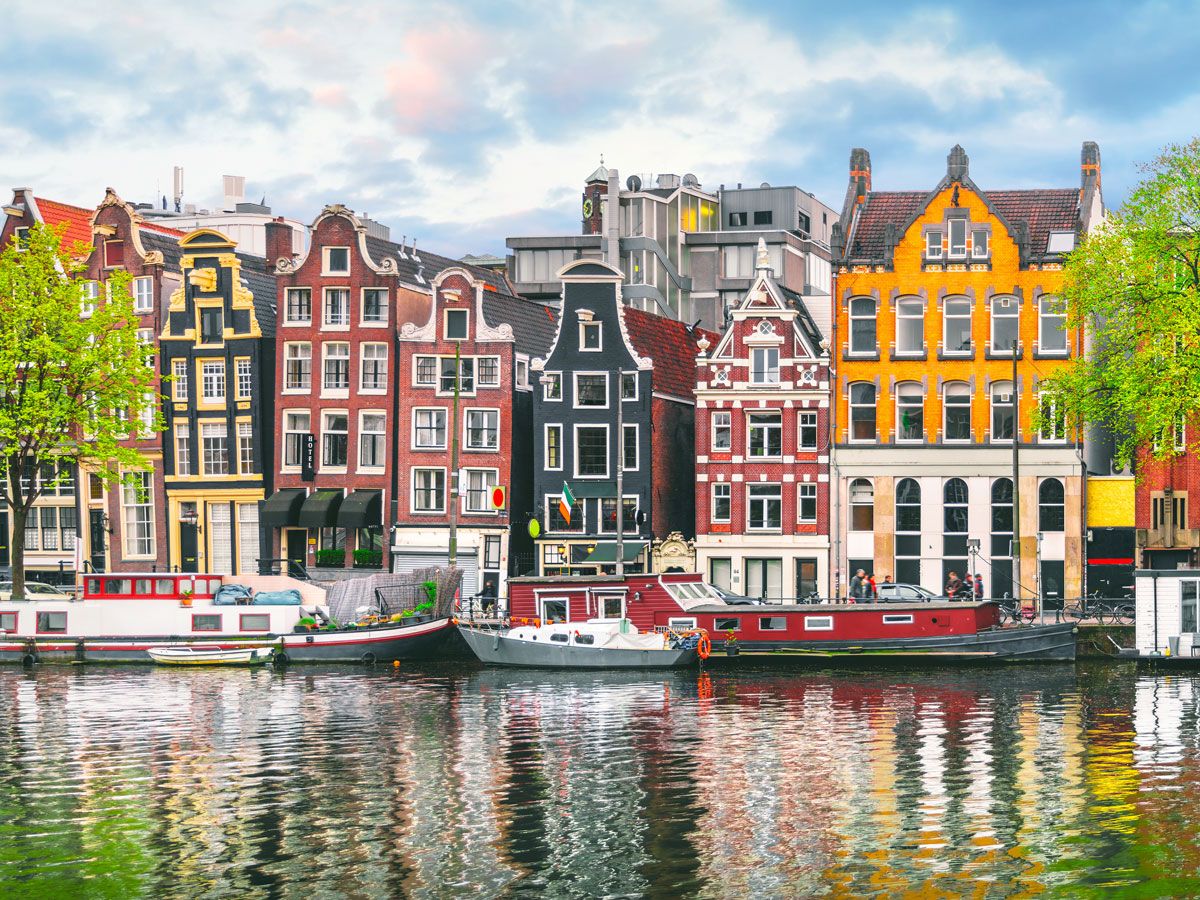
The beauty of Amsterdam in autumn is underscored by bushy trees blossoming with color, idyllically reflected in the famous canals that crisscross the capital of the Netherlands. Boasting more trees than residents, Amsterdam has long had a commitment to planting trees and creating green spaces that has made it one of the greenest cities in Europe. The result is an abundance of beauty when the leaves of hundreds of thousands of trees start to change in fall.
There are many opportunities to take in the colors within the sprawling grounds of the numerous city parks, such as Vondelpark, Amsterdamse Bos, Park Frankendael, and Amstel Park. As a bonus, fall is a shoulder season for European travel, which means fewer tourists and lower prices. It also kicks off a packed season of festivals and events in the Netherlands.
Iceland’s landscape is a picturesque blend of volcanic formations, dramatic rift valleys, glaciers, and pristine lakes. Among its must-see destinations, Thingvellir National Park stands out as a top UNESCO World Heritage Site and protected area. Visiting between mid-September and early October offers a unique opportunity to access all the highlights of the park — such as walking between the tectonic plates of Eurasia and North America and trekking to Öxarárfoss Waterfall — while relishing the beauty of fall foliage. The vibrant autumn colors strike a contrast with the park’s deep blue lakes, including Lake Þingvallavatn, Iceland’s largest natural lake, while the moss-covered mountains light up in reds and oranges. Fall also marks the beginning of prime northern lights season, making it an ideal time for an Icelandic escape.
Advertisement
More from our network
Daily Passport is part of Inbox Studio, an email-first media company. *Indicates a third-party property.

The Best Places Around the World To Visit for Halloween
By
Nicole Villeneuve
Read time: 6 minutes
September 26, 2023
Updated: October 9, 2025
The Best Places Around the World To Visit for Halloween
Culture •September 26, 2023•Updated: October 9, 2025
By Nicole Villeneuve
Author
Nicole Villeneuve
Nicole is a writer and researcher with over 15 years of experience seeking out arts, culture, and lifestyle stories in places like remote northern Quebec and the unforgettable streets of Amsterdam. Her work has also appeared in PureWow, Brit + Co, AUX TV, and CBC.
Halloween may be known for costumes and candy, but the holiday originated as an ancient Celtic harvest festival. On the night of October 31 — the night before the new year according to the Celtic calendar — lines between the living and the dead were blurred. Ghosts and spirits were thought to roam the earth, and the occasion was marked by bonfires and costumes designed to scare away evil forces. While these ancient traditions have evolved into more lighthearted activities such as jack-o’-lanterns, haunted houses, and trick-or-treating, the supernatural spirit of the holiday remains. That’s particularly true in these eight cities around the world, which honor the Halloween spirit in unique ways.
The Transylvania region of central Romania is renowned for its rich history and stunning landscapes, but its associations with vampire lore make it a required destination for Halloween enthusiasts. Bram Stoker found inspiration for his famous 1897 novel Dracula in the historical Romanian military figure Vlad the Impaler (also known as Vlad III or Vlad Dracula), and the author designated the real-life Bran Castle as the monster’s home. On Halloween, Bran Castle — now widely known as Dracula’s Castle — hosts tours of the storied hallways and dungeons, after which guests can feast on traditional Romanian food and dance the night away.
Transylvania is not solely defined by its vampire legends, though — the region’s storybook medieval towns, fortified castles, and mist-shrouded forests contribute to its eerie atmosphere, especially during the Halloween season.
This small Minnesota city is known as the Halloween Capital of the World — and with good reason. Anoka was the first U.S. city to host an organized Halloween celebration. On November 1, 1919, the residents of Anoka awoke to find cows roaming through main streets and outhouses turned upside down — the aftermath of Halloween pranks orchestrated by local youths. In an effort to prevent similar destruction in the future, the community rallied together the following year to organize an official celebration.
The event has since grown to take over the entire month of October, with parades, haunted houses, movie nights, and more festivities. In 1937, Congress officially declared Anoka as the Halloween Capital of the World, and residents wear the title proudly to this day.
Halloween isn’t a traditional Mexican holiday, but Mexico City has embraced the spooky spirit, blending ancient traditions with contemporary celebrations. One of the biggest seasonal draws is the celebration of Día de los Muertos (Day of the Dead). From late October to early November, the city — along with much of Latin America — comes alive with colorful ofrendas (altars) and marigold-adorned cemeteries, where families honor and evoke their deceased loved ones.
A familiar sight during Día de Los Muertos is la catrina, a traditional skull painted with decorative makeup. The skull has become an emblem of the festival and of Mexican traditions and beliefs surrounding death and the afterlife — that it is to be honored instead of feared. Other historic neighborhoods, such as Xochimilco, offer their own eerie attractions — as its name suggests, the Island of the Dolls is covered in decaying dolls.
New Orleans has earned a reputation as one of America’s most haunted cities due to its rich — and often tragic — history. Among the many reported ghostly encounters, the spirit of Marie Laveau (aka the Voodoo Queen) might be the most famous. Visitors have claimed to witness her apparition wandering the streets of the French Quarter, while others swear they can feel her physical presence around her tomb in St. Louis Cemetery No. 1.
The Big Easy’s distinctive above-ground graves create a uniquely eerie atmosphere, and while they’re popular tourist destinations throughout the year, Halloween is when they truly shine. The city also hosts costume parades and parties, a Voodoo festival, haunted tours, and elaborately decorated homes.
With a past marked by bloody battles, witch hunts, and other sinister tales, Edinburgh’s ancient streets are a major draw for Halloween lovers. The iconic Edinburgh Castle is considered the country’s most haunted place to visit. The castle was originally built in the 12th century as a military fortress, and alleged sights have included ghosts that still haunt its ancient underground dungeons, a missing piper, a phantom dog, and a headless drummer roaming the grounds.
The Samhuinn Fire Festival is also held in the Scottish capital on October 31, celebrating ancient Celtic traditions with fire, performances, drumming, and costumes of mythical creatures and deities. The Halloween spirit is strong along the city’s famous Royal Mile, too, a historic street filled with narrow alleyways (known as “closes”) and haunted underground chambers.
England’s capital is home to plenty of haunted historical sites, one of the most famous being the Tower of London. The fortress’s grim history of royal beheadings, including those of Anne Boleyn and Lady Jane Grey, contribute to its enduring tales of paranormal activity. On Halloween, the Tower plays into its past by decorating the grounds and hosting an immersive haunted house.
One of the world’s most haunted theaters is also in London, and during Halloween, the venue offers late-night tours. Over the years, actors and staff at the Theatre Royal Drury Lane (nicknamed “the Lane”) have experienced encounters with a mysterious figure they’ve dubbed the Man in Gray. Wearing a powdered wig, a gray coat, and a distinctive hat, he is said to walk back and forth across the theater’s balcony before disappearing into the wall.
What better place to visit for Halloween than the place where it all began? Halloween originated over 2,000 years ago as a pagan Celtic festival that celebrated the end-of-summer harvest with fires, dancing, and costumes. The Boyne Valley region is home to the megalithic tombs of Newgrange, Knowth, and Dowth — which are believed to have also served as solar calendars. On the autumnal equinox, the sun aligns with the passage of Newgrange, illuminating its inner chamber in a stunning spectacle that highlights the mystical nature of the season.
Boyne Valley celebrates its Halloween heritage with yearly festivals and events, including the spooky Spirits of Meath. The county’s Púca Festival features live comedy and podcast events, performances from world-renowned musicians, and tours of some of the area’s significant historical sites.
Salem is infamous for its 1692 witch trials, and the Massachusetts city leans into its history when Halloween rolls around. Fueled by superstition and hysteria, the trials resulted in the tragic hangings of 19 people accused of witchcraft. But today, the people of Salem — as well as more than 100,000 visitors — honor this dark chapter of American history with a month full of festivities.
By early October, Salem is decked out and ready for the Haunted Happenings Grand Parade, which features elaborate costumes, floats, and live music. The city’s historical landmarks — such as the Salem Witch Trials Memorial and the House of the Seven Gables, whose original owner was accused of witchcraft and executed — offer immersive experiences that explore the history of their hallowed grounds.
Advertisement
More from our network
Daily Passport is part of Inbox Studio, an email-first media company. *Indicates a third-party property.

History •September 22, 2023•Updated: September 22, 2023
By Daily Passport Team
Author
Daily Passport Team
Daily Passport writers have been seen in publications such as National Geographic, Food & Wine, CBC, Condé Nast Traveler, and Business Insider. They're passionate about uncovering unique destinations and sharing expert tips with curious travelers.
Often, the stories behind the names of America’s most famous landmarks are just as fascinating as the sites themselves — because not every name is as straightforward as the Lincoln Memorial or the Washington Monument. From the surprising figure who inspired the name of Mount Rushmore to the original, full name of the Statue of Liberty, discover the stories behind the names of 10 iconic U.S. landmarks.
Alcatraz Island didn’t always hold the most infamous prison in the United States. In 1775, when the Spanish explorer Juan Manuel de Ayala first sailed into San Francisco, he named the three islands Isla de Los Alcatraces. Over time, the name was shortened to Alcatraz, which translates to “pelican” or “strange bird.” After the island became the site for the country’s most isolated federal prison years later, it earned the nickname “The Rock” due to its remote location in San Francisco Bay and for the way the island juts prominently out of the water.
The iconic mountain that bears the giant stone faces of four U.S. Presidents is named after a lawyer from New York. In 1884, Charles E. Rushmore was sent to the Black Hills in South Dakota to secure land for tin mining (on lands considered sacred by the Lakota Sioux). He spent many weeks exploring the area with guides, and at one point, he inquired as to the name of an impressive peak nearby. Since the mountain had no name, a prospector with him replied, “We will name it now, and name it Rushmore Peak.” From then on, it was referred to as Rushmore Peak, Rushmore Mountain, or Rushmore Rock. When the national memorial was finished in 1927, it officially became known as Mount Rushmore.
Although it may seem obvious as to why the presidential mansion is referred to as the White House, there’s more to the story than the paint color. Before President Theodore Roosevelt began calling his residence the White House in 1901, it was more often referred to as the “President’s House” or the “Executive Mansion.” However, since the homes of U.S. governors were also called executive mansions, Roosevelt named his home the “White House” in order to distinguish it above all others. The house’s color resulted from a lime-based whitewash that was applied in 1798 to protect the exterior from cracking.
Although it’s most commonly called “The Bean,” in reference to its distinctive shape, the actual name of Chicago’s most famous sculpture is Cloud Gate. It was unveiled in Millennium Park in 2006 and has since become one of the city’s most popular attractions. Designed by British sculptor Anish Kapoor, Cloud Gate remains his most famous work to date. Although the piece is magnificent, the name is deceptively simple: Kapoor chose Cloud Gate for the clouds that can be seen in the sculpture’s reflective surface and for the way the curved underside serves as a gate to the park.
Devils Tower is an impressive rock formation that stands 867 feet high above the Black Hills of northeastern Wyoming and is considered sacred by Indigenous cultures. When settlers first arrived in this part of the country, the rock was labeled on maps as “Bear Lodge,” a translation for the common Lakota name Mato Tipila. However, the name changed when Colonel Richard Irving Dodge led a geology and mapmaking expedition to the site. Dodge wrote that the Indigenous people called the place “bad god’s tower,” which eventually led to the adoption of the name Devils Tower. However, this is believed to be a bad translation, as no records have ever shown that Native Americans considered the tower to be associated with evil spirits.
The Statue of Liberty has long stood as a symbol of freedom and hope for U.S. residents and newcomers, but when first built, Lady Liberty went by a different name. Designed by the French sculptor Frederic-Auguste Bartholdi and gifted from France to the U.S. in honor of the centennial celebration, the Statue of Liberty was originally entitled “Liberty Enlightening the World.” The 305-foot statue was unveiled on Liberty Island in New York’s Upper Bay on October 28, 1886, but eventually the statue’s lengthy title was dropped in favor of the simpler “Statue of Liberty.”
Easily San Francisco’s most recognizable landmark, the Golden Gate Bridge is named not for its reddish-orange hue but rather for the body of water it crosses, the Golden Gate Strait. The mile-wide strait, which connects San Francisco Bay and the Pacific Ocean, was named in 1846, a few years before the California Gold Rush. It was at this time that the explorer John C. Fremont came across the strait and recalled the Golden Horn of the Bosporus in Constantinople (now Istanbul). He named the strait the “Golden Gate,” translated from the Greek word Chrysopyla, in honor of another body of water halfway around the world.
Before it was officially declared the Hoover Dam, this marvel of modern engineering went by a few different monikers. Originally, it was known as the Boulder Canyon Project, which changed to the Black Canyon Project when the location was moved. It was then referred to as the Boulder Dam on legislation, and many assumed that to be the official name until the Secretary of Interior declared it the Hoover Dam in honor of the acting president, Herbert Hoover. The new name was controversial since Hoover was incredibly unpopular at the time due to the Great Depression. It wasn’t until 12 years later that it formally became the Hoover Dam, after a House Resolution passed to certify the name.
Located in America’s first national park, Yellowstone, Old Faithful draws around 4 million visitors annually. The powerful geyser was named by the members of the Washburn Expedition of 1870, who discovered that it erupted with reliable regularity. It was the first geyser to be given a title in the park, and the nickname stuck — today, the geyser still erupts every 91 minutes. As for Yellowstone National Park itself, it was named for the Yellowstone River, which runs through the park and flows into Yellowstone Lake. The Yellowstone River’s first incantation was Mi tse a-da-zi, which translates to “Yellow Rock River” in the language of the Minnetaree people.
Although the famously cracked bell is widely known as a symbol of independence, Liberty Bell wasn’t always its name. After it was cast in London and hung in Philadelphia’s State House, it was originally referred to as the “State House Bell.” It was rung on July 8, 1776, to celebrate the first public reading of the Declaration of Independence, and it later became a powerful symbol of the anti-slavery movement in the 1830s. With an inscription bearing the motto, “Proclaim liberty throughout all the land unto all the inhabitants thereof,” the iconic landmark represented the ideal of freedom to the abolitionists who coined the name Liberty Bell.
Advertisement
More from our network
Daily Passport is part of Inbox Studio, an email-first media company. *Indicates a third-party property.

5 Under-the-Radar International Wine Regions to Visit
By
Cynthia Barnes
Read time: 3 minutes
September 22, 2023
Updated: September 22, 2023
5 Under-the-Radar International Wine Regions to Visit
Culture •September 22, 2023•Updated: September 22, 2023
By Cynthia Barnes
Author
Cynthia Barnes
Cynthia kicked around the world for a while before landing in Colorado. Her work has appeared in Food & Wine, the Boston Globe, and National Geographic, among others. She loves dives — both scuba and bars — baseball, the Oxford comma, and live music.
Bordeaux. Burgundy. Chianti. These names are world-famous for a reason — the centuries-old vineyards in these regions produce some of the most revered wines in the world. But that popularity can present a challenge when it’s time to plan a wine getaway. And while you won’t find any vineyards in Antarctica, the rest of the world is rich in wine-producing regions that offer fine vintages with fewer crowds. If you’re seeking the festive pop of a cork or the taste of unique terroir at an off-the-beaten path destination, here are five lesser-known and underrated international wine regions to explore.
Often called “France’s best-kept wine secret,” the Jura region is a favorite among in-the-know wine aficionados. Sandwiched between better-known Burgundy and the Swiss border, these cool mountains produce quirky and memorable wines that are often difficult to source in the United States. Savagnin is an under-the-radar local grape, and a technique known as sous-voile (under the veil) produces an oxidized wine known as Vin Jaune. Aged for six years, it has a nutty character that pairs well with Jura’s distinctive local cheese.
Tenerife is the largest and most popular of the Canary Islands, where wine has been produced since the Spaniards colonized the archipelago in the 15th century. Lying 60 miles off the coast of Morocco in the Atlantic Ocean, the Canary Islands escaped the phylloxera insect scourge, which affected many Old World vines in the 19th century, and so they contain some of the few remaining ungrafted vitis vinifera (common grape) vines in the world. There are 20 recognized unique grape varieties produced on the island, including Marmajuelo, a rarely cultivated white wine. Tenerife’s beautiful climate and mineral-rich volcanic soil is beautifully expressed in wines made from popular grapes like Listán Negro and Malvasia.
British Columbia’s Okanagan Valley has both stunning scenery and a stunningly diverse range of climates — from cool, green hills to the country’s only desert. This diversity nurtures an equally wide variety of grapes, and Okanagan’s relatively fledgling wine industry is attracting attention from connoisseurs around the globe. The valley has almost 200 wineries, along with many creative restaurants. In the north, try a distinctive cool-climate Riesling from Tantalus Vineyards. Then head south for bold, Bordeaux-comparable reds like the Gamay Noir from Desert Hills Estate Winery.
With its light golden hue and crisp elegant bubbles, Champagne is perhaps the most celebrated beverage in the world. And though the name Champagne is protected by an AOC (Appellation d’Origine Contrôlée, a controlled designation of origin) and is specific to the Champagne region of France, magnificent sparkling wines made with the same method (méthode Champenoise) can be found in many wine-producing regions.
In the center of northern Italy — not far from the fashion capital of Milan — lies the region of Lombardy, Italy’s answer to Champagne. In the province of Brescia, Italian winemakers craft Franciacorta, a celebratory sparkling wine fermented from Chardonnay, Pinot Noir, and Pinot Blanc grapes. Effervescent and sunny, it is similar to Champagne in perhaps every category except price. The small region has more than 100 wineries, but Guido Berlucchi, where the wine was created, is a must-visit.
South America is no stranger to good wine — Argentina’s robust reds are legendary and Chile boasts an enviable range of terroirs — but the up-and-comer in the Southern Hemisphere is definitely Uruguay. Located north of the resort town of Punta del Este along the Atlantic Ocean, the fast-growing Maldonado wine region is producing an interesting selection of high-quality red, white, and sparkling wines at affordable prices. Seek out wines with a Vino de Calidad Preferente (VСP) designation, which are made using only cultivated grape varietals, including Tannat, a grape which originally hails from Basque Country.
Advertisement
More from our network
Daily Passport is part of Inbox Studio, an email-first media company. *Indicates a third-party property.

Outdoors •September 22, 2023•Updated: September 22, 2023
By Bennett Kleinman
Author
Bennett Kleinman
Bennett is a New York City-based staff writer for Daily Passport. He previously contributed to television programs such as the Late Show With David Letterman, as well as digital publications like the Onion. Bennett has traveled to 48 U.S. states and all 30 Major League Baseball stadiums.
Much like Earth’s mountain ranges and oceans, many of the planet’s forests date back millions of years. From the coasts of eastern Australia to the jungles of South America, these ancient and verdant woodlands offer a fascinating glimpse into Earth’s geological history. Forests are also known for their diverse ecosystems, containing some of the most unique and stunning animal and plant life found anywhere in the world. Whether you’re a nature lover looking to explore or simply curious about how the planet has evolved over time, here’s a look at six of the world’s oldest forests.
The forests of Réunion Island formed in the wake of volcanic activity that created this island, located about 585 miles east of Madagascar, around 3 million years ago. Réunion Island National Park is known for massive volcanic craters located throughout the park grounds, but the park’s forests are equally spectacular — with many endemic species of both flora and fauna that make these woodlands extremely unique.
Some of these species include 40 types of birds, five types of bats, several giant turtles, and around 380 types of vascular plants. Réunion Island contains both cloud forests and subtropical rainforests, where you’re bound to encounter a green bourbon gecko or even a bird of prey known as the Réunion harrier. The coloration of the forests include tints of red that are more rare elsewhere, reflecting the island’s history of volcanic activity.
The Hyrcanian forests of western Asia extend for 528 miles along the southern border of the Caspian Sea. Located in parts of Iran and Azerbaijan, these broad-leaved woodlands date back between 25 and 50 million years, and, remarkably, they survived amid colder temperatures of the Quaternary glaciation that occurred 2.58 million years ago. Temperatures rose in the wake of that time period, allowing for the expansion of the Hyrcanian forests. Today, these forests contain 44% of Iran’s vascular plants (with over 3,200 documented), despite only covering 7% of the country as a whole.
The region is known for its biodiverse animal life — the forests contain some 180 species of birds and 58 types of mammals, such as the Persian leopard and Persian wild goat. There are also wolves roaming the Hyrcanian region, which is apt considering the name of this forest derives from a term for “wolf’s land.” While many other Asian and European forests perished during previous ice ages, the survival of the Hyrcanian forests is what makes these ancient woodlands truly special.
The Amazon Rainforest covers a whopping 2.72 million square miles of South American terrain. That not only makes it the world’s biggest rainforest, but it is also larger than the next two biggest rainforests combined. The Amazon’s vast size is matched by its incredible age, with plant life dating back 55 million years. More than 390 billion trees are located in the Amazon, including 16,000 distinct species — a number roughly equivalent to 10% of all known tree species on the planet. These trees and the other rich vegetation of the Amazon produce approximately 20% of the world’s total oxygen through photosynthetic processes.
Though the Amazon sits in parts of nine different countries, around two-thirds of the forest is located in Brazil. Here, you can find a wide variety of animal life, including 3,000 fish species, 1,300 birds, and over 2.5 million individual insect species. The Amazon is also home to an estimated 400 to 500 Indigenous tribes, many of which have never interacted with the outside world due to the forest’s breadth, inaccessibility, and density. Just how dense? In some parts of the Amazon, only 1% of sunlight permeates the canopies all the way down to the jungle floor.
Taman Negara is a 130-million-year old tropical rainforest located in Peninsular Malaysia. Originally named after King George V, the rainforest was established as a national park in 1938, though its name was later changed to Taman Negara (the literal translation of “national park” in the Malay language). In addition to its ancient forests, the park also contains the highest mountain in Peninsular Malaysia — 7,175-foot-tall Mount Tahan — and serves as an important habitat for many animal species.
Within Taman Negara, you’re likely to find nearly 500 species of birds, 150,000 species of insects, and over 100 species of serpents crawling along the jungle floor. Rarer animals that roam these woodlands include elephants, tigers, and Sumatran rhinoceroses. The park is also home to at least 280 different types of trees, including the local Tualang tree, as well as other species known as Merbay, Meranti Tembaga, and Damar Hitam Siput. Visitors can take a stroll along the longest canopy walkway in the world, composed of 10 bridges spanning over 1,600 feet in length. The rainforest also contains a spectacular cave walk through Gua Telinga, providing a fascinating look at an underground river tunnel.
2. Borneo Lowland Rainforests – Indonesia, Malaysia, and Brunei
The Borneo Lowland Rainforests are located on their namesake Pacific island, which is shared between the nations of Indonesia, Malaysia, and Brunei. These forests formed as far back as 130 million years ago, and they contain a staggering 15,000 plant species and 3,000 individual tree types, not to mention 221 land mammal species and 420 types of birds. Pygmy elephants, clouded leopards, and orangutans are some of the many animals that roam these jungles. The forest also contains 155 endemic plant species, including an exceedingly rare flower known as Rafflesia arnoldii. This Indonesian national flower is ominously known as the corpse flower due to the pungent odor it emits. However, its size is what makes this flower truly special — it reaches average lengths of three feet across and weighs up to 15 pounds.
The forest — along with the island of Borneo as a whole — was once connected to the nearby islands of Java and Sumatra as one giant landmass. Borneo was later separated after sea levels rose in the wake of the Pleistocene glacial period around 12,000 years ago. This led to the development of Borneo’s unique ecology which is still present today. The rainforests experience over 150 inches of rainfall annually, adding to their incredible lushness.
Famed naturalist Sir David Attenborough once referred to the Daintree Rainforest as “the most extraordinary place on Earth.” Plants have been growing here for over 180 million years, making the Daintree the world’s oldest tropical rainforest. The expanse covers around 460 square miles along the Pacific coast of Queensland, Australia’s northeasternmost state, and contains 3,000 species of plants — 395 of which are listed as endangered or threatened. The Daintree is also home to over 12,000 types of insects, as well as 28% of the frogs, 34% of the mammals, and 40% of the birds that are native to Australia.
The forest was named after Richard Daintree, a geologist who conducted a photographic survey of Queensland in the late 1860s. Since these early studies, the Daintree has only grown in popularity, now welcoming around 400,000 annual visitors. One of the most popular sights is Cape Tribulation, where two UNESCO World Heritage Sites converge: the Wet Tropics Rainforest and the Great Barrier Reef. This spot, among many others, is popular for hiking, snorkeling, and other nature activities.
Advertisement
More from our network
Daily Passport is part of Inbox Studio, an email-first media company. *Indicates a third-party property.

The World’s Most Unusual Post Offices, From Mountaintops to the Ocean Floor
By
Daily Passport Team
Read time: 7 minutes
September 22, 2023
Updated: September 22, 2023
The World’s Most Unusual Post Offices, From Mountaintops to the Ocean Floor
Culture •September 22, 2023•Updated: September 22, 2023
By Daily Passport Team
Author
Daily Passport Team
Daily Passport writers have been seen in publications such as National Geographic, Food & Wine, CBC, Condé Nast Traveler, and Business Insider. They're passionate about uncovering unique destinations and sharing expert tips with curious travelers.
Sometimes, there’s no substitute for old-fashioned snail mail. While we don’t often think twice about going to the post office, there are a select few post offices around the world that defy convention. From the top of a mountain to the ocean floor, here are nine of the coolest places around the world to send mail.
The world’s only official underwater post office is located in Vanuatu, an archipelago nation composed of 83 islands in the South Pacific. Located nine feet underwater near Hideaway Island, the functioning post office opened in 2003 and has been a delight for snorkelers and divers alike ever since.
If you want to send mail from Vanuatu’s Underwater Post Office, there are waterproof postcards available for purchase at gift shops on land. Instead of stamping the postcard with ink, the underwater clerk will use an embossed cancellation device to approve mail. And yes, a postal clerk is available to receive your underwater mail — a flag will be raised above water to indicate the employee is present and you can dive down to mail your letter. Outside of office hours, there is also a postal box available for sending postcards, which are guaranteed to be delivered domestically and internationally.

The Penguin Post Office in Port Lockroy, Antarctica, is the southernmost post office in the world. Located 7,000 miles south of Argentina on Goudier Island, the post office is named for the colony of gentoo penguins, which are often found on the premises. In addition to the 3,000 penguins who inhabit the island, other notable residents include five postal clerks who manage the small post office.

As a one-time port for whaling fleets, Port Lockroy also contains a small historical museum and a gift shop, but the Penguin Post Office remains the most popular spot. With 70,000 postcards dispersed around the world from Port Lockroy annually, this unique post office continues to draw people who are interested in sending a letter from the end of the Earth.
Located on the edge of Area 51, the Black Mailbox is a famous extraterrestrial landmark in the Nevada desert. Before the Black Mailbox became a landmark, however, it was just an average mailbox belonging to a local rancher named Steve Medlin. It wasn’t until Bob Lazar, a former Area 51 employee, began to use the mailbox as a congregation site for “believers,” that the unassuming P.O. box began to gain fame.
Located along Nevada State Route 375, also known as the Extraterrestrial Highway, a stretch of road that claims many UFO sightings, the mailbox’s location eventually became a nuisance for Medlin. Unhappy with the consistent tampering of his USPS-issued mailbox, he moved it off the highway and closer to his ranch. Much to Medlin’s chagrin, the Black Mailbox continued to be a pilgrimage for UFO enthusiasts. As a result, the rancher eventually added a second mailbox marked “Alien” for visitors — many of whom leave a dollar inside.
Located off the coast of Ecuador, Post Office Bay has long been the unofficial post office of the Galápagos Islands. The bay’s history of sending letters began when whalers became homesick after months at sea. The men started leaving letters for friends and family on Floreana Island, which were then carried back to the U.K. or the U.S. by ships departing from the region. With all the letters coming and going from Floreana Island, the whalers began calling it Post Office Bay.
This moniker remains fitting today. Visitors to the Galápagos can leave letters at Floreana Island’s unofficial post office. Using an honor system, travelers are permitted to take letters from the post office with the intent of delivery. While some letters are stamped and can be mailed, traditionally the letters are supposed to be hand-delivered, in order to relay the fascinating tale of where they came from.
Tibetan Paradise Post Office – Mount Everest, Tibet
Located 17,388 feet above sea level, Tibetan Paradise Post Office is the world’s highest post office. Originally called the China Post Space Office when it was established in 2001, the post office can be found at the base camp of Mount Everest. Originally housed in a military tent, the building has since been renovated to include exhibits on local culture, meteorology, and ecology. It also offers free drinking water and rest services for visitors.
Operating during the mountain’s peak climbing season, the post office is open from April to August, from 10 a.m. to 6 p.m. daily. However, the post office’s unusual location means that postage is more costly than it is at sea level. If you’re sending mail from Mount Everest, you can expect to spend around $2 USD to send a postcard from Tibet to North America.
However fictional Romeo and Juliet may be, the two lovebirds are alive and well in the Italian village of Verona. Thousands of letters have been addressed to “Juliet, Verona” for years, with visitors making the pilgrimage to the “town of love” to see where Shakespeare’s star-crossed lovers originated. The trend took off in the 1930s when a man who guarded Juliet’s tomb — an empty sarcophagus purported to be the site of the last scene in the tragedy — began collecting and answering letters addressed to Juliet.
These letters eventually led to the creation of the “Juliet Club,” with thousands of letters to Juliet being answered by volunteers. Known as the “Secretaries of Juliet,” these volunteers answer letters from all over the world in several languages, an act that served as the inspiration for the romance film Letters to Juliet (2010). If you’d like to send a note to Juliet yourself, letters can be mailed, emailed, or delivered by hand to Juliet’s Mailbox in Verona.
The smallest United States Post Office can be found on the edge of the Everglades in Ochopee, Florida. As an old shed that once stored irritation materials on a tomato farm, the building was converted into a post office in 1953, after a fire destroyed the local general store. A mere 56 square feet in total, the office has enough room for a single clerk to serve a town of 11 people.
Located between Miami and Naples, the Ochopee Post Office attracts plenty of visitors who want to see the pint-sized post office for themselves. They can use the office’s pre-stamped postcards to send international and domestic mail from the 34141 zip code. A word of warning — alligators are common in Ochopee, and can often be spotted in the parking lot, so be careful.
The J.W. Westcott mailboat services the Great Lakes marine community, and has done so for nearly 150 years. Fist captained by a seaworthy entrepreneur named John Ward Westcott, the mailboat originated in 1874 when Wescott implemented the “mail in a pail” system on the docks of Detroit. In lieu of a P.O. box, a pail was tied to a string and hoisted over the side of passing vessels, allowing crewmen to send and receive letters without setting foot ashore.
The system was so popular that the J.W. Westcott mailboat became the first official United States Postal Service Mailboat and the first boat with a non-military zip code – 48222. Today, J.W. Westcott still operates out of Detroit, delivering mail and other goods to maritime vessels. In addition to the USPS mail, the company also delivers food and transports crew members from the ship to the shore.
Located on Moloka’i, one of the least visited Hawaiian Islands, Hoolehua Post Office sees more coconuts sent than handwritten letters. In 1991, the post office started an initiative that allowed visitors to send coconuts to friends and family on the mainland. Fourteen years later, after facing severe budget cuts, Postmaster Gary Lam expanded the program as a way to increase post office traffic. The marketing ploy worked, with “Postanut” (Post-a-Nut) becoming a trend on the island.
Today, postal employees in Hoolehua mail over 3,000 coconuts a year, accounting for nearly half of the post office’s revenue. To assist with the demand, and in order to be out of federal jurisdiction, an island local named Teri Waros installed a Postanut store across the street. Embossed and painted coconuts can be purchased at the shop before they receive an agricultural stamp at the post office to be shipped worldwide.
Advertisement
More from our network
Daily Passport is part of Inbox Studio, an email-first media company. *Indicates a third-party property.