




Peter is a Toronto-based journalist, editor, content strategist, and self-professed avgeek with 15 years of experience covering all things travel. Prior to joining Daily Passport, he oversaw newsletter publication for Travelzoo. His favorite destinations to explore include Japan, France, Chile, New Zealand, and his adopted home country of Canada.
With long lines, tight legroom, and more fees than ever, many airline passengers are simply hoping to get from Point A to Point B as smoothly, quickly, and cheaply as possible. But if you’re someone who gets excited at the thought of stepping aboard an airplane, no matter the circumstances, you’ll be happy to know that at least one airline will help you commemorate the experience in a fun way — but only if you’re in the know. Find out more about the secret airline trading cards you can collect when flying Delta Air Lines.
Airline Trading Cards Go Viral
Photo credit: Image courtesy of Delta Air Lines
In late 2023, TikTok user @sarowarrr posted a video of himself asking a Delta pilot for a trading card and receiving two shiny cards featuring the airline’s aircraft. The clip went viral and has over 20 million views to date, raising awareness of a program most Delta travelers had never heard of.
According to a statement the airline shared with People magazine, Delta employees created the trading card program more than 20 years ago to share their passion for flying. The collectibles feature “a different aircraft in [Delta’s] fleet corresponding to the type of aircraft each pilot flies.”
Flyers can collect cards that feature the Airbus A220, A320, A330, and A350 series; the Boeing 737, 757, and 767 series; and the Canadair CRJ-900 aircraft. The airline says the collections are redesigned every five years.
Some pilots may not have time to chat with passengers or have any cards left to hand out (particularly as word of the program gets out), but it’s always worth asking for a fun souvenir of your flight.
“When they’re not busy preparing for flight or flying our customers to their next adventure, our pilots carrying these fan-favorite cards are more than happy to hand one out to any customer who asks nicely; as they look to add to, or begin, their newest favorite collection,” the Delta spokesperson shared in the statement with People.
Other Unique Airline Collectibles
Credit: Kirk Fisher/ iStock Editorial via Getty Images Plus
Delta isn’t the only airline that offers its passengers a cherished keepsake. United Airlines also recently introduced a trading card program, and some overseas carriers such as Taiwan-based Eva Air have special trading cards, too.
One collectible item that has attracted much fanfare is KLM’s miniature Delft Blue houses. The Dutch flag carrier creates a new house — modeled after actual buildings in the Netherlands — each year on the company’s anniversary, which falls on October 7. As of early 2025, there are 105 houses in the collection. Better yet: Each one is filled with a tiny bottle of Dutch gin.
The catch is you have to be flying overseas in the carrier’s business class to receive one. But those lucky enough to get their hands on the houses can even keep track of their collection in a special app.
And finally, German flag carrier Lufthansa also has a special treat in store for its first-class customers traveling through the airline’s hubs in Frankfurt and Munich. Passengers can pick up one of the airline’s cherished rubber ducks when visiting the First Class Lounge.
The ducks come in a range of fun designs, from city-specific themes to ducks designed around holidays and special events. If you’re looking to acquire one but don’t plan on flying first class anytime soon, the rubber toys regularly pop up on eBay, too.
Featured image credit: AaronP/Bauer-Griffin/ GC Images via Getty Images
Advertisement
More from our network
Daily Passport is part of Inbox Studio, an email-first media company. *Indicates a third-party property.
7 Spectacular Ancient Roman Landmarks To Visit in Italy
By
Julia Hammond
Read time: 5 minutes
January 15, 2025
Updated: January 16, 2025
7 Spectacular Ancient Roman Landmarks To Visit in Italy
Architecture •January 15, 2025•Updated: January 16, 2025
By Julia Hammond
Author
Julia Hammond
Julia is a U.K.-based travel writer whose work has been featured in The Independent, The Telegraph, The New Zealand Herald, and Culture Trip, among others. She’s an enthusiastic advocate for independent travel and a passionate geographer who has had the privilege of traveling to more than 130 countries in search of a story.
At its zenith, the Roman Empire stretched around the Mediterranean and into Northern Europe and North Africa. The Romans were ruthless empire builders who would stop at nothing to subjugate their neighbors. But they were also skilled engineers who built impressive forts, amphitheaters, public baths, aqueducts, and roads. Two thousand years on, many of these structures still survive, their ruins sufficiently intact for us to appreciate their original function. There’s no better place to admire them than in the place that was its epicenter, so let’s take a look at some of the most spectacular Roman architecture in Italy.
Fittingly, the Colosseum is the largest amphitheater the Romans ever constructed. The oval-shaped arena (also referred to as the Flavian Amphitheater) measures 620 feet long and 512 feet across and once hosted gladiator fights, dramas, and battle reenactments, among other spectacles. The structure, which dates to 80 CE, remains mostly intact today largely due to its strong concrete foundation.
The arena towers four stories high above a hypogeum (underground area). The Romans built the lowest three levels with arches and columns, which became more elaborate as they went up — Tuscan-style columns give way to Ionic columns and Corinthian columns, the most intricate of all. The fourth floor consisted of flat carved panels inlaid with azurite and bronze. The facade was covered with travertine blocks, a locally quarried limestone also used to construct tiered seating for the 80,000-strong audience.
Though the columns that adorn the portico of this magnificent temple are unmistakably Greek in style, the dome of this temple is a triumph of Roman engineering. Earlier versions of the Pantheon were destroyed during the Great Fire of Rome in 80 CE and as the result of a lightning strike in 110 CE. The building that we see today, commissioned by Emperor Hadrian, was constructed out of concrete faced with brick between 118 and 125 CE.
Historians have long been fascinated by the dome, which remains the largest unsupported concrete dome in the world. They believe that laborers graded the material used in its construction so that the heaviest material — basalt and travertine — was used at the base, while lighter materials such as tufa and pumice are used higher up, where the structure is also thinner.
One of the earliest Roman roads, the Via Appia Antica led south from Rome to Brindisi. Along the way were the villas of the elite, the largest of which was Villa dei Quintili, built during the second century CE.
The villa was owned by two brothers, Sesto Quintilio Condiano and Sesto Quintilio Valerio Massimo, both consuls. After they led a plot against Emperor Commodus, the property was confiscated and became an imperial residence, which may explain why the architecture was so grand. The complex boasted impressive thermal baths, including a caldarium (hot bath) and frigidarium (cold bath) fed by its own aqueduct. The most recent discoveries at the site include a winery and triclinium (formal dining room).
Ancient Capua was the place where Julius Caesar founded the first gladiatorial school and where the enslaved Spartacus rose up and led the rebellion that kicked off the Third Servile War. Around 100 CE, the four-story Anfiteatro Campano was built to replace an earlier arena. Some historians have suggested that the Colosseum in Rome might have been modeled on this Capua landmark, which was a similar size and also elliptical in shape.
Here, though, the centuries haven’t been as kind, and the building has suffered at the hands of invaders and those who came to plunder its stone. Nevertheless, there’s enough of a structure left to be able to imagine what the amphitheatre might have looked like in its prime.
Villa Romana del Casale, located at Piazza Armerina in central Sicily, was built circa 320 CE. Thanks to a catastrophic 12th-century landslide, it boasts what many historians agree are the best preserved Roman mosaics anywhere in the world. They paint a vivid picture of what life would have been like back then for the fabulously wealthy, though the identity of the villa’s owner remains a mystery.
Even under its modern protective roof, visitors can appreciate the villa’s architecture. The house was a single-story construction built around a garden flanked with a colonnaded peristyle. The mosaics that have been painstakingly uncovered were most likely the work of North African artisans. They feature scenes variously depicting fishing Cupids, dancing women, horse races, and animal hunts.
In 79 CE, a violent eruption of Mount Vesuvius sent superheated pyroclastic flows surging toward the town of Pompeii. The hot gas in the air asphyxiated residents and buried their homes, public buildings, and streets in a thick layer of ash and fragments of volcanic glass. Centuries of excavation and analysis by archaeologists have uncovered many buildings that have been remarkably well preserved in the ash.
One of the most famous is the House of the Vettii, a typical Roman townhouse or domus. Evidence from seals and tablets suggest the owners were a pair of wealthy, formerly enslaved brothers who made their fortune as merchants. Following extensive restoration work, the splendor of this grand mansion is plain to see, from the colorful frescoes that adorn its interior to the colonnaded garden replete with fountains and statuary.
The 12 vaulted fornices of Herculaneum provide an insight into the day-to-day activities that would have taken place in this town about 12 miles north of Pompeii almost 2,000 years ago. This row of arched boat sheds close to the shoreline survived the eruption of Vesuvius, yet when archaeologists began excavating the site in 1980, they found the skeletons of around 300 residents of Herculaneum who sheltered here in a failed attempt to escape the lava flow. The carbonized remains of a boat found nearby is on display at the archaeological site and the ancient beach itself is also now open to visitors.
Advertisement
More from our network
Daily Passport is part of Inbox Studio, an email-first media company. *Indicates a third-party property.
Michael is a staff writer for Daily Passport and film critic who writes the weekly newsletter Movie Brief. His writing and criticism have also appeared in the Los Angeles Times, Variety, and the Washington Post, among others. A native Angeleno, his favorite countries to visit are Norway and Japan.
More than 100 years after the Wright brothers first took to the sky, travelers have gotten so used to flying halfway across the world in no time at all that it’s beginning to seem like old hat. That puts the onus on plane manufacturers and airlines to continue innovating in surprising ways, some of which may be realized sooner rather than later. Here are five exciting trends on the horizon for air travel.
The Return of Supersonic Flight
Credit: ullstein bild Dtl./ ullstein bild via Getty Images
It may seem odd to make a prediction about something that already happened more than half a century ago, but ever since the Concorde retired in 2003, passengers have longed for the return of supersonic flight. With a cruising speed of Mach 2.04 — equal to 1,354 miles per hour, just over twice the speed of sound — the groundbreaking aircraft made the transatlantic trip from New York to Paris in just three hours. But the Concorde — which was introduced in 1976 and only ever flew for Air France and British Airways — couldn’t do so in a financially sustainable way, and so operations ceased more than 20 years ago.
Among the many who think supersonic passenger travel could get its second wind are the folks at NASA, whose X-59 jet has not only a cool name but also plenty of potential. United also made headlines in 2021 when it ordered 15 of Boom’s Overture airliners, another supersonic jet currently in development. American Airlines has placed an order, too, but the plane has yet to fly — Boom is predicting it will do so by the end of the decade, if all goes according to plan.
New Routes, Longer Flights
Credit: fiftymm99/ Moment via Getty Images
The longest flight in the world as of 2025 will take you from New York City to Singapore in 18 hours and 50 minutes. Singapore Airlines operates the route, which is 9,585 miles long and only features business class and premium economy seats. With new routes constantly being introduced — 2025 will see the first nonstop flights from the U.S. to Greenland and Marrakech, Morocco — we’re bound to see that record tested.
And we might not have to wait long: In 2026, Australian carrier Qantas plans to introduce its “Project Sunrise” service, which aims to connect Sydney with both London and New York. Flight times on each will exceed 20 hours on specially configured Airbus A350-1000 planes.
Passenger Drones
Credit: Southern Metropolis Daily/ Visual China Group via Getty Images
If you have $40,000 and an adventurous personality, you can already buy a single-passenger drone. (Whether you should, however, is a different story.) It probably won’t be long before more reliable options are on the market, most likely from Chinese company EHang. The manufacturer successfully tested its autonomous, electric passenger drone in early 2024 and appears to be going full steam ahead on the project.
The aircraft, which fits one or two people depending on the model, has a range and top speed of just 22 miles and 81 miles per hour, respectively, as of the most recent update. However, optimists can take comfort in the fact that these helicopter-like aircraft are essentially flying cars (at last!).
Electric Commuter Planes
Photo credit: Image courtesy of Heart Aerospace
As electric cars become increasingly common, a question has naturally arisen in the aviation world: Why not electric planes as well? United Airlines hopes to have them by the end of the decade as part of its plan to become carbon neutral by 2050.
The first order has already been placed with Swedish company Heart Aerospace, which has been hard at work on the newfangled planes since 2021. They’re starting small with the ES-30, a 30-passenger vessel with an electric range of 124 miles and a reserve-hybrid engine that runs on sustainable fuel and doubles the range to 248 miles. Icelandair, Air Canada, and Mesa Air Group have also placed orders with Heart Aerospace for the new electric planes, which promise to be a greener option for short-haul travel.
Morphing Wings
Credit: Santiago Urquijo/ Moment via Getty Images
Unlike birds, planes can’t flap their wings. They’re fixed in place and can’t move, but some engineers don’t see why that should be the case. The idea of emulating birds with shapeshifting wings has long been proposed, but it’s easier said than done — which isn’t to say that we shouldn’t try.
MIT and NASA researchers have worked on a design that could be both more efficient than traditional wings but also better able to adapt to changing conditions. Don’t expect your puddle jumper to feature morphing wings anytime soon, as the development process has been exceptionally long and tricky, but never say never, either.
Advertisement
More from our network
Daily Passport is part of Inbox Studio, an email-first media company. *Indicates a third-party property.

5 Spectacular Works of Victorian Architecture To Visit in the U.S.
By
Julia Hammond
Read time: 4 minutes
January 10, 2025
Updated: January 10, 2025
5 Spectacular Works of Victorian Architecture To Visit in the U.S.
Architecture •January 10, 2025•Updated: January 10, 2025
By Julia Hammond
Author
Julia Hammond
Julia is a U.K.-based travel writer whose work has been featured in The Independent, The Telegraph, The New Zealand Herald, and Culture Trip, among others. She’s an enthusiastic advocate for independent travel and a passionate geographer who has had the privilege of traveling to more than 130 countries in search of a story.
By the late Victorian period during the second half of the 19th century, American architecture had entered a new era. Styles such as Queen Anne, Victorian Gothic, Stick-Eastlake, Second Empire, and Renaissance Revival — all commonly held to be examples of Victorian architecture — were more ornate in design than those that had preceded them. In the U.S. today, many buildings blend elements from more than one of these styles, their architects looking to history for inspiration yet adapting their designs to the tastes of the time. The result is worth traveling for: Here are five spectacular examples of Victorian architecture that you’ll want to see with your own eyes.
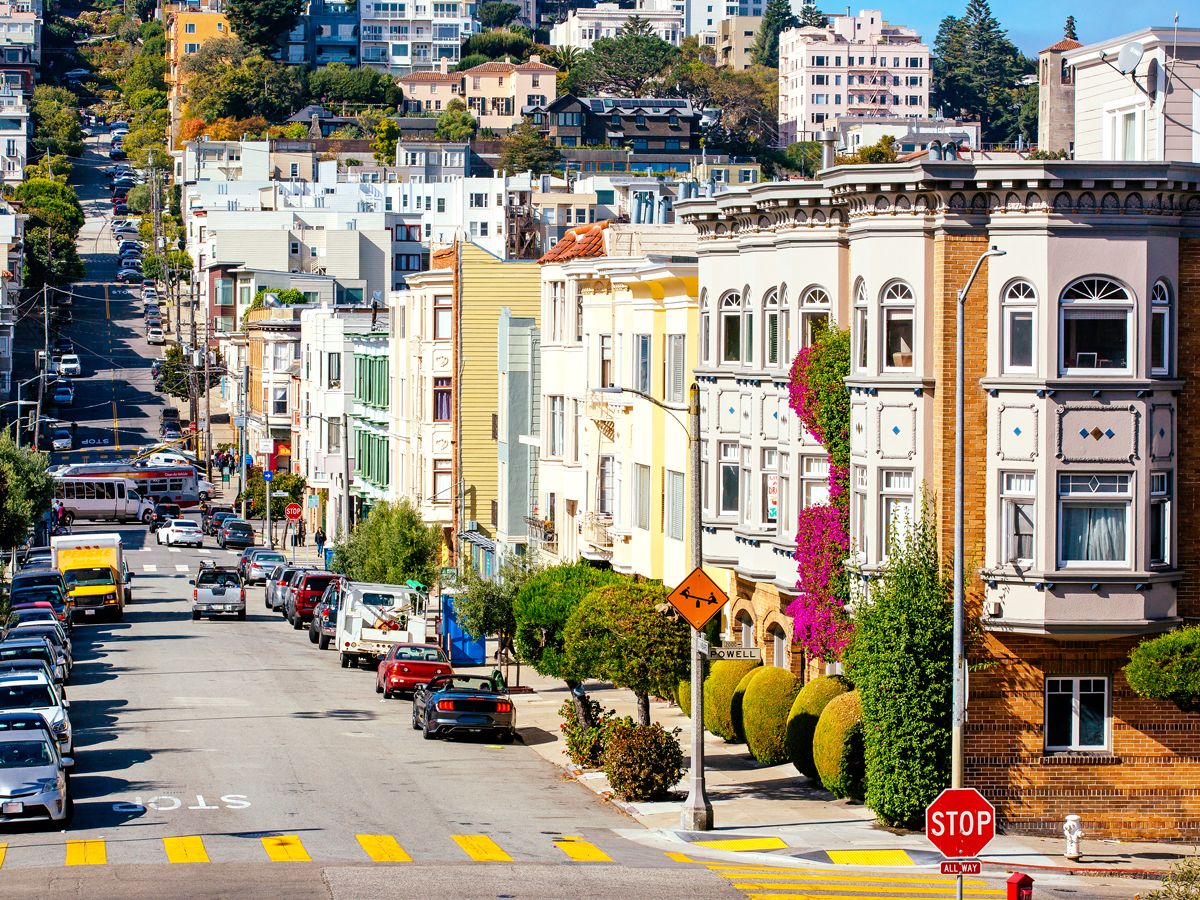
As a result of the 1849 gold rush, the population of San Francisco increased dramatically, fueling a housing boom. As new homes were built, the elaborate Queen Anne style of architecture became popular during this time, and the city’s most famous examples are the Painted Ladies, built between 1892 and 1896.
These ornate row houses, located on Steiner Street across from Alamo Square Park, were the work of Matthew Kavanaugh, who lived at No. 722. There were other examples of similar houses at the time, but many were destroyed by the devastating fire that engulfed San Francisco following the 1906 earthquake. In the 1960s, the city decided to paint these properties to accentuate their signature architectural details — such as gable ends, overhanging eaves, covered porches, and lacy woodwork — turning them into one of the most photographed spots in the city today.
1892 Bishop’s Palace (also known as Gresham House or Gresham’s Castle) is a much-loved landmark in Galveston’s East End Historic District. Attorney and railroad executive Walter Gresham commissioned architect Nicholas Clayton to design it. Clayton opted to build a solid structure out of steel and stone, which took five years to construct between 1887 and 1892.
The decision turned out to be a wise move when the Great Storm of 1900 barreled through Galveston. This powerful hurricane caused extensive damage to the city, but fortunately, the house survived. Today, its turreted exterior — coupled with the intricately carved wood, stained glass windows, and vaulted ceilings of its interior — make it one of the most notable examples of Victorian architecture in the state.
Shelton McMurphey Johnson House is another beautiful example of Queen Anne architecture, which typifies the Victorian period. Dubbed the “Castle on the Hill” because of the panoramic views it enjoys, the house gets its official name from those who lived in it. Winthrop Shelton and his family were the first to occupy the house in 1888, a year later than planned after the original structure was set alight by a workman with a grudge and had to be rebuilt.
Many of its features reflect the love of ornate design that characterizes Victorian architecture, among them a polygonal tower, bay windows, open porch, and carved exterior woodwork. Today, visitors can tour the first floor and explore its sitting room, parlor, kitchen, and dining room to get a sense of what it might have been like to live there more than a century ago.
St. Peter’s By-The-Sea Episcopal Church – Cape May, New Jersey
The delightful St. Peter’s By-The-Sea is a well-preserved example of Stick-Eastlake architecture. White stick detailing complements the pretty pastel blue siding of this Episcopal church, which is nicknamed the “Gingerbread Church” for the gingerbreadlike skirt below the clerestory.
The original structure was actually erected as part of the 1876 Centennial Exposition in Fairmount Park, Philadelphia. In need of a building to house his congregation, Reverend W.R. Stockton purchased it three years later and transported it to Cape May Point, where it was named St. Peter’s By-The-Sea. The church has been moved several times since then: In 1881, it was located close to the sea on the corner of Cape Avenue and Beach Drive, but 15 years later it was moved inland because of coastal erosion. It has stood on its present site since 1903.
Hotel Florence forms part of Chicago’s Pullman National Historical Park, together with Greenstone Church and the former Pullman Palace Car Works shops and administration building. George Pullman, inventor of the Pullman sleeping car, commissioned the 50-room property, which he named after his daughter. The work of architect Solon Spencer Beman, it was built in 1881 to accommodate railroad executives visiting the company town of Pullman.
The four-story structure is unmistakably of its time, boasting red brick walls, dormer windows, a slate roof with a steep pitch, and a wraparound wooden porch. Inside, it’s clear to see where some of the $100,000 it cost to build (more than $3 million in today’s dollars) was spent, from the cherry wood lavished on the first floor to the luxurious Pullman Suite, reserved for George Pullman’s exclusive use.
Advertisement
More from our network
Daily Passport is part of Inbox Studio, an email-first media company. *Indicates a third-party property.
Vintage Airport Photos From the Golden Age of Air Travel
By
Peter Vanden Bos
Read time: 5 minutes
January 9, 2025
Updated: March 20, 2025
Vintage Airport Photos From the Golden Age of Air Travel
History •January 9, 2025•Updated: March 20, 2025
By Peter Vanden Bos
Author
Peter Vanden Bos
Peter is a Toronto-based journalist, editor, content strategist, and self-professed avgeek with 15 years of experience covering all things travel. Prior to joining Daily Passport, he oversaw newsletter publication for Travelzoo. His favorite destinations to explore include Japan, France, Chile, New Zealand, and his adopted home country of Canada.
Air travel has come a long way since the Wright brothers first took to the skies in Kitty Hawk, North Carolina, in 1903. While flying in an airplane today might get you ever-shrinking legroom and a tiny bag of pretzels, air travel in the 1950s and ’60s was a much different experience. Those fortunate enough to afford the cost of a ticket back then were treated to gourmet plated meals, piano bars, flight attendant fashion shows, and ample room to spread and socialize. Wondering what it was like to fly during America’s golden age of air travel? Take a trip down memory lane with these vintage photos from seven iconic U.S. airports.
John F. Kennedy International Airport – New York, New York
Credit: ullstein bild via Getty Images
Perhaps no airport terminal is more synonymous with the dawn of the jet age than the TWA Flight Center at New York’s JFK Airport. Designed by famed Finnish American architect Eero Saarinen, the landmark terminal building put forth a bold, experimental vision of the future of flight when it debuted in 1962. With its magnificent sloping roof extending into two wings, the terminal also housed cutting-edge technology for the time, including jetways and baggage carousels.
After the terminal’s primary tenant, TWA, went bankrupt and merged with American Airlines in 2001, the building sat empty for nearly two decades. In 2019, it was converted into the retro-themed TWA Hotel that makes guests feel like they’ve stepped right back into the 1960s.
LaGuardia Airport – New York, New York
Credit: PhotoQuest/ Archive Photos via Getty Images
About 10 miles north of the TWA Flight Center, you’ll find another landmark in aviation history: the Marine Air Terminal at LaGuardia Airport. Opened in 1940, it was built by Pan American Airways to serve its fleet of flying boats on transatlantic journeys. The stunning art deco building features a circular lobby where guests once checked in for their international trips under James Brooks’ 1940 mural “Flight,” which depicts the history of humanity’s journey to the skies.
The terminal, now called Terminal A, is still in use today serving low-cost carrier Spirit Airlines. Though the boarding areas are housed in a newer addition, guests can still visit the original lobby to get a sense of the building’s history.
Los Angeles International Airport – Los Angeles, California
Credit: Authenticated News/ Archive Photos via Getty Images
Towering over the center of LAX’s horseshoe-shaped terminal complex, the Theme Building is a striking homage to the space age. Built in 1961, it features a UFO-like structure suspended from two 135-foot intersecting arches. The Googie-inspired building opened in conjunction with LAX’s expansion for the jet age. Though it once housed a glass-walled restaurant and observation deck on top, both have since closed and the building’s future remains uncertain. But for today’s travelers at LAX, it remains a symbol of a bygone era.
Washington Dulles International Airport – Dulles, Virginia
Credit: Angelo Hornak/ Corbis Historical via Getty Images
Another Eero Saarinen design, the main terminal building at Washington Dulles debuted in 1962 with a dedication from President John F. Kennedy and still welcomes millions of passengers annually. The iconic building features soaring windows and a roof gracefully curving to the sky, evoking the idea of flight.
The terminal opened with several innovations, including separate levels for arrivals, departures, and parking, along with a fleet of mobile lounges, which were giant buslike vehicles that carried passengers from the main terminal to their gates. While these were never replicated at other airports, the mobile lounges remain a unique quirk of traveling through Dulles.
San Francisco International Airport – San Francisco, California
Jet bridges were an innovation born out of the golden age. Instead of walking across the tarmac and up a set of airstairs to board an aircraft, these mechanisms allowed for quicker boarding while sheltering passengers from the elements. San Francisco International Airport was one of the first airports to debut the new technology in 1959, but the earliest jet bridges looked a little different than what passengers are used to today.
In those days, aircraft would typically taxi alongside the terminal, parking parallel to the building, and there were two short jetways that connected to the front and rear doors of the aircraft. As air travel boomed, jetways were repositioned so that planes parked perpendicular to the terminal, which required them to be constructed with a longer corridor connected to a movable jetway at the end, but it allowed for more efficient use of terminal space.
St. Louis Lambert International Airport – St. Louis, Missouri
St. Louis Lambert International Airport is named for Albert Bond Lambert, who learned to fly with the Wright brothers and later fought in World War I. The airport that bears his name is also steeped in history — Charles Lindbergh flew an airmail route from the airfield in the 1920s before his groundbreaking solo transatlantic journey.
In 1956, the iconic arched main terminal building designed by Minoru Yamasaki opened, inspiring the design of future terminals throughout the country, including those at New York’s JFK Airport. Lambert was also one of the first airports to welcome jet service, when TWA introduced the Boeing 707 here in 1959.
Credit: PhotoQuest/ Archive Photos via Getty Images
Pittsburgh is another city that has a long history with aviation. When the new Greater Pittsburgh Airport opened in 1952, its terminal building was one of the largest in the world, second only to New York’s Idlewild Airport (later renamed JFK). During the airport’s first full year of operations in 1953, more than 1.4 million passengers transited through the terminal. The historic terminal was replaced when the current modernized terminal opened in 1992, and it was demolished in 1997.
Advertisement
More from our network
Daily Passport is part of Inbox Studio, an email-first media company. *Indicates a third-party property.

Outdoors •January 9, 2025•Updated: January 9, 2025
By Bennett Kleinman
Author
Bennett Kleinman
Bennett is a New York City-based staff writer for Daily Passport. He previously contributed to television programs such as the Late Show With David Letterman, as well as digital publications like the Onion. Bennett has traveled to 48 U.S. states and all 30 Major League Baseball stadiums.
Rail trails are created by taking abandoned railroad corridors and transforming them into shared-use public pathways. These trails offer the chance to enjoy a variety of outdoor activities such as walking, biking, horseback riding, skating, and even cross-country skiing and snowmobiling during the winter months. In general, these paved or dirt routes are also flat or gently sloped, making them easily accessible for those with varying levels of mobility. If you’re curious about the 2,423 rail trails spanning 25,934 miles across the U.S., the Rails to Trails Conservancy is an excellent resource. Below, take a closer look at the 12 longest rail trails in the United States, according to the organization.
The Florida Keys Overseas Heritage Trail runs parallel along U.S. Highway 1 — nicknamed the Overseas Highway — from Key Largo to Key West, where you’ll find the southernmost point in the continental U.S. The trail incorporates elements from the old Florida East Coast Railway, which was opened in 1912 as a link from Jacksonville to Key West.
Today, this rail trail is mainly used by bikers and pedestrians, who can take advantage of the stunning views of the surrounding Atlantic waters. This trail is part of the planned East Coast Greenway, a 3,000-mile route that will eventually connect Florida with Maine.
11. State Line Trail – Michigan
Credit: Dan70/ iStock via Getty Images Plus
Route length: 107 miles
Michigan’s State Line Trail is located in the state’s Upper Peninsula, beginning just outside the city of Wakefield and continuing over 100 miles southeast to Stager. The trail utilizes portions of the old Chicago and North Western Railway that ceased operations in 1995.
Highlights of the trail include more than 50 bridges that span scenic waterways, where you’re likely to see several eagles and ospreys flying overhead. The State Line Trail is mainly used by mountain bikers in summer, and it’s a popular route for snowmobiling in winter.
This mixed-use trail combines two decommissioned railroads: The Oregon, California & Eastern Railway (from which it gets its name) and the Weyerhaeuser Woods Line. Today, the OC&E Woods Line State Trail connects the city of Klamath Falls (located along Oregon’s southern border) with the community of Summer Lake to the north.
Consider starting your trip in Klamath Falls, where the trail is paved and provides views of the countryside and nearby Mount Shasta. After around 8 miles, the trail becomes unpaved, making it more suited to bicycles with thick tires or cross-country skiers. In addition to awe-inspiring natural views, the trail provides opportunities for trout fishing, especially at Five Mile Creek, which is located at mile 10.
9. George S. Mickelson Trail – South Dakota
Credit: Scott Smith/ The Image Bank Unreleased via Getty Images
Route length: 112 miles
The George S. Mickelson Trail is named in honor of former South Dakota Governor George S. Mickelson, who helped get the project off the ground. The trail cuts through the Black Hills National Forest, connecting Deadwood and Edgemont, and utilizes portions of a railway built in the 1890s.
After 15 years of development, the George S. Mickelson Trail finally opened in 1998. The trail passes through lush forests and under the shadows of mountains, with views of wildlife such as elk, buffalo, and bighorn sheep. Despite its “hilly” name, the trail rarely exceeds a 4% grade, so it remains easily accessible. Popular landmarks near the trail include both Mount Rushmore and the Crazy Horse Memorial.
The Soo Line Trail — particularly its Southern Route — is one of two Minnesotan rail trails that extend past the 100-mile mark. This trail starts just across the border in Oliver, Wisconsin, and then cuts southeast into Minnesota toward the city of Royalton.
The Southern Route is largely made up of rough dirt and gravel that make it less ideal for biking and walking, though it’s popular among ATV riders. Parts of the trail also receive up to 52 inches of snow on average each year, creating ideal conditions for snowmobiling. The trail uses sections of the old Soo Line Railroad, which ran through the area from 1961 until 1990.
2018 was a milestone year for the Flint Hills Trail, as it became an official state park. The easternmost portion, covered with crushed limestone, takes trailgoers roughly 96 miles from Osawatomie farther west to Council Grove. However, the remaining 21 miles from Council Grove over to Herington aren’t yet developed, as remnants from the old Missouri Pacific Railroad still need to be converted for public use.
Along the trail, you’ll find a mix of tall-grass prairie in the west and wooded areas farther east. Towns along the way are spaced out between 10 and 15 miles, so be sure to plan your journey accordingly.
The Paul Bunyan State Trail is named after Minnesota’s mythical hero Paul Bunyan, a giant lumberjack. Unlike the state’s Soo Line Trail, this trail is fully paved, and it provides fantastic conditions for walking, biking, or other low-impact activities. The rail trail uses parts of an 1893 old railroad corridor that was last owned by Burlington Northern, and its latest segment was added in 2014.
It’s no coincidence that the trail emanates from the city of Bemidji, which claims to be the home of Paul Bunyan. Along the 122-mile route, you’ll find both thick forests and vast meadows containing colorful wildflowers, before the trail ends in Brainerd.
The Columbia Plateau Trail is unique in that it contains a 92-mile-long undeveloped portion surrounded by two smaller developed sections on either end. The first developed section begins at Fish Lake in Cheney, located near Spokane, and continues to Sprague. The other developed section is located southwest near the Ice Harbor Dam and will take you to Snake River Junction.
The majority of the trail follows the old Spokane, Portland, and Seattle Railroad, which operated until 1970. During your journey, you’ll see plenty of mile markers along the way that train conductors once used to determine the distance to Portland, Oregon.
4. Great Allegheny Passage – Maryland and Pennsylvania
Completed in 2013, the Great Allegheny Passage is popular with long-haul cyclists and backpackers. The trail originates at Point State Park in Pittsburgh, near the many sporting arenas, museums, and restaurants found downtown. The trail then takes you southeast through western Pennsylvania, before reaching the city of Cumberland, Maryland.
During the journey, you’ll pass by the Eastern Continental Divide, which marks the trail’s highest point. You’ll also see many historical sites, including some dating back to the French and Indian Wars of the 18th century. Once you reach Cumberland, be sure to visit a restored 1891 train station that recalls a time when the trail once served as an active railway.
3. Cowboy Recreation and Nature Trail – Nebraska
Credit: marekuliasz/ iStock via Getty Images Plus
Route length: 203 miles
Nicknamed the Cowboy Trail, this rail trail begins in Valentine, in north-central Nebraska, before cutting southeast toward Norfolk. There’s also a separate, 15-mile-long portion that can be found farther west, connecting the communities of Gordon and Rushville.
The main trail is primarily surfaced with crushed gravel, making the Cowboy Trail ideal for hybrid or mountain bikes. The majority of the trail is characterized by rolling hills and tallgrass prairies. There are future plans to extend the trail by 126 miles over to Chadron, which would make it the first rail trail in the country to eclipse 300 miles.
2. Palouse to Cascades States Park Trail – Washington
The Palouse to Cascades States Park Trail is divided into several smaller portions that total 236 miles in length. The trail’s westernmost segment runs 111 miles between Cedar Falls, Washington, east to the Columbia River. This rough segment is best suited for mountain and fat tire bikes, and features views of the Cascade Mountains. You can also visit a former railroad yard in South Cle Elum that has been designated as a National Historic Landmark.
East of the Columbia River, the trail continues over the Idaho border. This section was originally used by the Chicago, Milwaukee, St. Paul and Pacific Railroad, which connected Chicago to Seattle beginning in 1909. After the railway ceased operations in 1980, it was converted into this shared public trail. In recent years, portions of the trail have been closed due to local fires, so be sure to check here for updates before visiting.
1. Katy Trail State Park – Missouri
Credit: larrybraunphotography.com/ Moment via Getty Images
Route length: 239 miles
The longest rail trail in the United States, Missouri’s Katy Trail State Park begins in St. Charles, a community located along the western outskirts of St. Louis. The trail extends west to Clinton, spanning through rural farmland and small towns across almost the entire width of the state.
While the Katy Trail uses portions of an old railway from St. Louis, it’s located alongside a still-active railway used by Amtrak. In fact, you can leave the trail and hop aboard an Amtrak train if you make prior reservations and pay $10 to bring your bike on board. Along the trail, be sure to stop at the Lewis and Clark Historical Site outside of Rocheport. The famed explorers passed through the town in 1804, chronicling their experience in Clark’s journal.
Advertisement
More from our network
Daily Passport is part of Inbox Studio, an email-first media company. *Indicates a third-party property.

The U.S. Just Banned Hidden Hotel Fees: What Travelers Should Know
By
Peter Vanden Bos
Read time: 4 minutes
January 9, 2025
Updated: January 9, 2025
The U.S. Just Banned Hidden Hotel Fees: What Travelers Should Know
Tips •January 9, 2025•Updated: January 9, 2025
By Peter Vanden Bos
Author
Peter Vanden Bos
Peter is a Toronto-based journalist, editor, content strategist, and self-professed avgeek with 15 years of experience covering all things travel. Prior to joining Daily Passport, he oversaw newsletter publication for Travelzoo. His favorite destinations to explore include Japan, France, Chile, New Zealand, and his adopted home country of Canada.
Have you ever booked a hotel room online thinking you scored a great deal — only to see the price jump up considerably when you reach the checkout page? It’s a scenario many travelers are all too familiar with, but thanks to new rules introduced by the U.S. Federal Trade Commission, that’s set to change soon. Here’s what travelers should know.
In December 2024, the FTC finalized a rule that requires companies in the live events and short-term lodging industries to advertise up front the all-in price to consumers. The providers will be required to display all mandatory fees, taxes, and other charges at the start of the booking and price comparison process, rather than during final payment.
In a statement, FTC Chair Lina M. Khan said, “People deserve to know up front what they’re being asked to pay — without worrying that they’ll later be saddled with mysterious fees that they haven’t budgeted for and can’t avoid.”
Since launching its review of such practices in 2022, the FTC said that it had received more than 70,000 comments about hidden and misleading booking fees. The agency estimates that the new regulations “will save consumers up to 53 million hours per year of wasted time spent searching for the total price for live-event tickets and short-term lodging.”
What It Means for Travelers
Credit: Daniel de la Hoz/ iStock via Getty Images Plus
Many hotels advertise a low nightly rate to draw a traveler’s eye, only to add a resort fee or destination fee at checkout. These fees — which are often mandatory and cover amenities such as Wi-Fi, gym access, and pool usage — typically range from $20 to $50 per night. And they can add a significant amount to the final cost of the reservation.
When the new regulations go into effect, travelers booking a hotel or short-term vacation rental from providers such as Airbnb will now see the all-in price up front and clearly displayed throughout the booking process.
The regulations stipulate that “businesses cannot misrepresent any fee or charge in any offer, display, or ad for short-term lodging,” and the all-in total price must be the most prominent price displayed. Companies must also “conspicuously disclose the nature, purpose, identity, and amount of those fees before consumers consent to pay,” according to the FTC ruling.
While the regulations are aimed at providing transparency to consumers from the get-go, they notably do not regulate the amount of these fees or ban additional fees altogether.
The ruling was announced on December 17, and the FTC says that it will be enforced 120 days after it is published in the Federal Register, which means that it will most likely be in effect in time for the peak 2025 summer travel season.
Some hotels have already begun advertising all-in pricing. Marriott — the world’s largest hotel chain — began the practice on its website in 2023 thanks to a 2021 lawsuit settlement.
How To Avoid Resort Fees
Credit: alvarez/ E+ via Getty Images
Though these fees will no longer be quite as hidden, the unfortunate reality is that resort fees have become more widespread and are likely here to stay — but that doesn’t mean they’re unavoidable.
It pays to do a little research: Websites like ResortFeeChecker.com compile a list of which hotels do and don’t charge resort fees. Travelers can enter their destination to see a list of options, allowing them to avoid the hotels that charge these extra fees.
Some hotels will also waive the fees for elite members of their loyalty programs or — as in the case of Hilton Honors or World of Hyatt — when you use your hotel points for a free night’s stay.
And if all else fails and you do end up choosing a hotel that levies a resort fee, you can always (politely) speak to the front desk to ask if they can waive a portion of the fee, especially if you don’t plan on using the amenities the fee is supposed to cover.
Advertisement
More from our network
Daily Passport is part of Inbox Studio, an email-first media company. *Indicates a third-party property.

8 Stunning Personal Residences of Former U.S. Presidents
By
Fiona Mokry
Read time: 7 minutes
January 9, 2025
Updated: February 11, 2026
8 Stunning Personal Residences of Former U.S. Presidents
Architecture •January 9, 2025•Updated: February 11, 2026
By Fiona Mokry
Author
Fiona Mokry
Fiona has spent her career exploring the world and working in the travel industry, turning her lifelong passion into a profession. From planning custom trips to sharing stories as a travel writer for publications such as The Discoverer, she’s all about helping others experience the world in a deeper, more meaningful way.
Many of America’s former presidents chose to live in luxury when they weren’t confined to the walls of the White House. Check out eight of the most impressive and beautiful personal homes of former U.S. presidents, from stately brick abodes to oceanfront retreats.
Theodore Roosevelt’s Sagamore Hill Mansion – Cove Neck, New York
Credit: Kirkikis/ iStock Editorial via Getty Images Plus
Now a National Historic Site, Theodore Roosevelt’s rustic Long Island mansion was his home from 1885 until his death in 1919. Set on 83 acres, the 23-room Victorian-style estate includes 15 bedrooms, a library rumored to hold 10,000 books, a great hall, and a trophy room. Wraparound porches offer sweeping views of Oyster Bay, where Roosevelt and his family often spent their days relaxing, entertaining, or simply enjoying the outdoors, one of the “conservation president’s” greatest passions.
During Roosevelt’s presidency, Sagamore Hill doubled as a “Summer White House,” hosting diplomats, journalists, and foreign leaders. Rather than being flashy or luxurious, the estate stood out for its size, rugged charm, and modernity for the time, with indoor plumbing and central heating.
The Bush Family’s Walker’s Point Estate – Kennebunkport, Maine
Walker’s Point Estate has been in the Bush family since 1902, when George Herbert Walker (former President George H.W. Bush’s grandfather) and his father, David Davis Walker, purchased the sprawling oceanfront property in southern coastal Maine. They each built large homes at the tip of a peninsula overlooking the Atlantic Ocean. In 1921, George added a bungalow as a wedding gift for his daughter Dorothy. In 1977, George H.W. Bush purchased the property to ensure it stayed in the family, and the estate has served as a summer retreat (aka the “Summer White House”) for generations ever since.
Over the years, Walker’s Point has hosted weddings, parties, and world leaders in the former president’s living room. The homes are built in classic New England shingle-style architecture, with the main house featuring nine bedrooms, multiple sitting rooms, a library, an office, a dining room, and numerous patios and decks. The property also includes a four-car garage, swimming pool, tennis court, private dock, and even a small sports field set amid Maine’s pristine nature.
Franklin D. Roosevelt’s Springwood Estate – Hyde Park, New York
Credit: OlegAlbinsky/ iStock Unreleased via Getty Images
Franklin D. Roosevelt’s Springwood Estate in Hyde Park, New York, was more than a home — it was where the 32nd U.S. president was born, grew up, and lived throughout his life. Originally purchased by his father, James Roosevelt, in 1866, the estate passed to his mother, Sara, and remained in the family. Two years after Sara’s death in 1941, FDR arranged for Springwood to be donated to the federal government, with the National Park Service taking over after his own passing in 1945.
Set upon a bluff overlooking the Hudson River, Springwood Estate is a study in early 20th-century elegance, with gardens, wooded paths, and a family cemetery in which Roosevelt himself is buried. Inside are multiple bedrooms, formal living spaces, and a library filled with FDR’s books and personal collections. Over the decades, the estate welcomed family, friends, and world leaders, and today Springwood is a National Historic Site, open to the public for a glimpse into FDR’s remarkable life.
The Kennedy Compound – Cape Cod, Massachusetts
Credit: Tim Gray via Getty Images News
It’s no surprise that the Kennedys, a family deeply rooted in Massachusetts, chose to make this stunning stretch of coastline their home. In 1928, Joseph P. Kennedy purchased a summer property on Hyannis Port, which had originally been a rental. Joseph, who had nine children — including future U.S. President John F. Kennedy — expanded the property into what is now known as the Kennedy Compound.
The 6-acre waterfront estate consists of three houses. For decades, the grounds were a place of family gatherings and celebrations, and served as the “Summer White House” from 1961 to 1963 during JFK’s time in office. Beyond its political importance, the compound has been the site of marriages, births, election watch parties, political meetings, and a retreat for President Kennedy, who often visited to walk on the beach when faced with tough decisions. The site has since been transformed into a museum and designated a National Historic Landmark.
Richard Nixon’s Oceanfront Estate – San Clemente, California
Credit: Gail Fisher/ Los Angeles Times via Getty Images
A native of Southern California, President Nixon attended Duke Law School, practiced law in California, and served as a state senator before moving to Washington, D.C., and winning the presidency in 1969. That same year, he purchased a stunning 5.5-acre property in San Clemente, an hour from his hometown of Yorba Linda.
While close to his roots, the property was a far cry from his modest beginnings. Boasting 450 feet of prime beachfront and sweeping views of the Pacific Ocean, the estate was nicknamed “La Casa Pacifica.” Also known as the “Western White House,” it served as Nixon’s sanctuary, and the former president made it his permanent residence after his infamous resignation following the Watergate scandal in 1974.
Built in 1927, the 9,000-square-foot Spanish Colonial Revival home features expansive terraces perfect for taking in the ocean vistas. Additional amenities include a pool, tennis courts, a bar, an entertainment room, and a two-bedroom guest house.
The Clinton Compound – Chappaqua, New York
Credit: SUSAN FARLEY/ AFP via Getty Images
Former President Bill Clinton and former Secretary of State Hillary Clinton’s home in Westchester County offers a peaceful and comfortable escape from nearby New York City. The couple purchased the main Dutch Colonial home on the property for $1.7 million in 1999, when Bill was still in the Oval Office. Sitting on 1.1 acres and shrouded by trees, the house offers plenty of space across its three stories, including five bedrooms and four bathrooms, as well as an outdoor pool and a detached barn, which serves as a base for the Clintons’ Secret Service team.
Although the main house was constructed in 1889, it has been significantly updated, with land and building records showing the Clintons spent several hundred thousand dollars on improvements. In 2016, they also purchased the neighboring property, a 3,631-square-foot ranch-style house on 1.5 acres, which is rumored to serve as a summer getaway for their daughter, Chelsea.
Barack Obama’s Brick Mansion – Washington, D.C.
Credit: MANDEL NGAN/ AFP via Getty Images
After leaving office, the Obamas chose to call their Kalorama Heights property in Washington, D.C., their permanent home. Located 2 miles from the White House, the neighborhood has welcomed many former presidents and is currently the home of Jeff Bezos, Jared Kushner and Ivanka Trump, news anchor Chris Wallace, and other celebrities.
Former President Barack Obama and first lady Michelle Obama purchased the four-story, 8,200-square-foot brick mansion for $8.1 million in 2017. The elegant home boasts nine bedrooms, eight and a half baths, two kitchens, and an inviting backyard patio and garden. The Obamas also made some renovations when they became the homeowners, including converting the garage into an office and building a brick wall around the grounds for added security.
Joe Biden’s Lakefront Property – Greenville, Delaware
In 1996, former President Joe Biden and First Lady Jill Biden built a 6,850-square-foot lakefront home on 4 acres of land in Greenville, Delaware. Designed by Biden himself, the house has since become the couple’s primary residence and the place the former president returned to after leaving the White House in early 2025.
Located in a quiet, wooded suburb about 4 miles from Wilmington, the home features three bedrooms, 4.5 bathrooms, a swimming pool, and a spacious, wood-paneled office furnished with overstuffed leather chairs and Biden’s original Senate desk. One of the home’s standout features is the expansive back porch, which overlooks a 10-acre human-made pond. During the 2020 election, Biden campaigned from his basement, using it as a virtual event hub, and after the election, he hosted several world leaders here, including the prime ministers of Australia, Japan, and India.
Advertisement
More from our network
Daily Passport is part of Inbox Studio, an email-first media company. *Indicates a third-party property.

Marissa is a cheap airfare aficionado who loves exploring offbeat destinations with her husband. Based in Los Angeles and Joshua Tree, Marissa has been featured in publications such as San Diego Magazine, Palm Springs Life Magazine, 303 Magazine, and Mountain Living.
Checking into a historic hotel is a wonderful way to witness the grandeur of ancient architecture and get a glimpse of what life was like in a bygone era. From a medieval inn in England to an alpine villa in the Dolomites, these properties have survived wars, transitions of power, and cultural movements — all while maintaining their prestige and providing unparalleled hospitality. For an overnight experience you won’t soon forget, reserve a room at one of these six storied accommodations.
Note: All featured products and deals are selected independently and objectively by the author. Daily Passport may receive a share of sales via affiliate links in content.
Nestled in the small city of Cernobbio near the Italian-Swiss border on Lake Como, Villa d’Este was originally built as a summer home for a cardinal. It later housed aristocrats including princesses, sultans, and tsars, and it opened its doors to hotel guests in 1873.
The property features 25 acres of manicured gardens and a pool often frequented by famous figures such as George and Amal Clooney, Donatella Versace, and the Heinz family. One of the most celebrated hotels in the world, the magnificent estate is akin to a fairy-tale manor and hailed for its Italian Renaissance architecture, impressive art collection, and dreamy lake views that inspire anyone lucky enough to wander the grounds.
Credit: Dukas/ Universal Images Group via Getty Images
Year built: 1377
This 14th-century hotel located in the heart of the Cotswolds region in southwestern England hides 600 years of stories in its hallowed halls. The Lygon Arms has remained a mainstay in Gloucestershire county, hosting members of the royal family including Prince Philip and Queen Elizabeth II, soldiers who served in the English Civil War, and even celebrities such as Mary Pickford and Elizabeth Taylor.
With an on-site spa, cozy castlelike interior, parlor for afternoon tea, and tavern for extravagant feasts fit for a king, the beloved stone inn would have many stories to tell if walls could talk.
The first mention of Alte Goste was documented in 1142, but it’s possible that the famous four-star property with incredible views of the Dolomites has a history that dates back further. Once a popular resting point for those making the trek through the Pustertal Valley to travel from Rome to northern Italy, the alpine villa was managed by the same family for six generations.
Their legacy lives on, as guests still rave about the hotel’s mountain vistas, swimming pool, wine cellar filled with South Tyrolean wines, hearty European breakfast, and Turkish-style soaking tubs outside each suite.
Credit: David Taljat/ iStock Editorial via Getty Images Plus
Year built: circa 1120
Surviving two world wars and withstanding the elements over centuries, the “Red Bear” hotel was nicknamed for its famous red façade that signaled to travelers who couldn’t read that it was a safe place to sleep and eat. Located in Germany’s fourth-largest city, Freiburg im Breisgau, nestled near the Black Forest, the hotel has been renovated to include modern amenities and a restaurant serving Baden cuisine.
However, the property still includes remnants of its original feudal-style architecture and appears in historic depictions that prove the structure was standing when the village was settled around 1120. Today, no other inn in Germany can provide proof of such longevity.
Run by the Hōshi family for 46 generations, this traditional ryokan (Japanese inn) near the Sea of Japan in Ishikawa prefecture dates back to 717 CE. Today’sguests can still experience tranquility in its tatami-matted rooms and soak in the nearby natural hot springs at Awazu Onsen.
It is said that the god living in one of Japan’s most sacred mountains, Haku, created the springs to heal people suffering from injuries and illnesses. The ancient property is particularly stunning come fall — when Japanese maples turn a vibrant red — and spring, when cherry blossoms turn pink.
Hidden in the Akaishi Mountains, the town of Hayakawa is believed to be home to the oldest hotel in the world — Nishiyama Onsen Keiunkan. Surrounded by four open-air hot springs (onsens), the ancient house of Zen was founded in 705 CE and has been run by the same family for 52 generations.
Featuring minimalist tatami-matted rooms with views of forested ravines, the property prioritizes finding quietude in nature and reinvigorating the senses with less distraction. Traditional Japanese fare such as hot pot and sushi after a day spent bathing is the ideal way to unwind just a stone’s throw from Mount Fuji and a four-hour train ride from Tokyo.
Advertisement
More from our network
Daily Passport is part of Inbox Studio, an email-first media company. *Indicates a third-party property.

Architecture •January 9, 2025•Updated: January 10, 2025
By Bradley O'Neill
Airports connect millions of passengers to domestic and international destinations every day. The first airports opened in the early 1900s and ushered in a new era of global connectivity. While many airports continue to operate and grow, others have become ghostly relics. These airports lay abandoned due to a number of factors, from economic downturns to political turmoil, shifting travel trends, and poor planning, but some have been reimagined as inventive urban spaces. Discover tales of ambition and decline as you explore these seven abandoned airports around the world.
Inaugurated in 1931 on the shores of Jamaica Bay in Queens, Floyd Bennett Field was the first municipal airport in New York City. Named after a pioneering naval aviator, the airport became synonymous with record-breaking feats. In 1931, Russell N. Boardman and John Polando flew a then-record 5,011.8 miles from the airport to Istanbul without refueling. In 1933, Wiley Post landed here after completing the first solo round-the-world flight.
Nowadays, the airport is part of the Gateway National Recreation Area. The old administrative and passenger terminal building has been restored and serves as a reminder of the golden age of aviation. Among the 1,300 acres of grasslands, salt marshes, and tidal flats that encompass the airfield, popular activities include biking, boating, bird-watching, fishing, and snowshoeing in winter.
The story of Ciudad Real Central Airport began during Spain’s construction boom in the early 2000s. The goal for the new airport, which opened in 2009 at the cost of over 1 billion euros, was to take some of the traffic load off Madrid Barajas International Airport. Situated in Spain’s La Mancha region, about 135 miles south of Madrid, Ciudad Real Central Airport was designed to initially handle around 2 million passengers, with the idea to expand to an annual capacity of 10 million.
However, in part because of its location far from the city center, just two airlines began flights at the new airport, and it closed in 2012 due to lack of demand and other economic pressures. Today, the derelict yet futuristic buildings look as if they’ve been lifted out of a scene from a postapocalyptic science fiction movie. Proposals have since been submitted to turn the 3,050-acre site and its 2.5-mile-long runway into an aeronautical maintenance site.
From London Gatwick to London Heathrow, the United Kingdom is home to some of the world’s most iconic airports. The U.K.’s first international airport, though, was London Croydon Airport. Opened in 1920 in the South London town of Croydon, it went on to host several aviation milestones. Air traffic control was pioneered here, as was Britain’s national airline Imperial Airways (a precursor to British Airways). The airport also featured the world’s first purpose-built passenger terminal.
Croydon Airport was eventually replaced by its larger counterparts and closed in 1959, but today it is home to the Croydon Airport Visitor Centre. Guests can join a guided tour to visit the control tower and browse exhibits of aeronautical artifacts. Outside is a replica of the de Havilland DH.114 Heron propeller plane that flew the final passenger flight from the airport.
Hellinikon International Airport – Elliniko, Greece
Hellinikon International Airport, built in 1938, sits on a narrow strip of land between the Aegean Sea and the Hymettus mountain range. Initially a military airfield, it later became the principal international airport serving Athens. Hellinikon was abandoned and replaced by the larger Athens International Airport in 2001, though it was briefly revived for the 2004 Athens Summer Olympics.
The space around the airport has since been converted into the Ellinikon Experience Park, a sustainable urban park incorporating three former Air Force hangars. It features exercise stations, a Zen garden filled with Mediterranean flora, and an aviation-themed forest playground and splash park with choreographed jets for families.
The former Kai Tak International Airport is infamous among aviation enthusiasts. Surrounded on three sides by water and framed by the high-rise towers of Hong Kong’s Kowloon City, it was notorious for its technically demanding takeoffs and landings. Despite this, it was Hong Kong’s main flight hub from 1925 until 1998. Operations moved to the newly built Hong Kong International Airport on the island of Chek Lap Kok after Kai Tak outgrew its 24 million annual passenger capacity.
The airport site is now part of the Kai Tak Development. This ongoing project will eventually include a cruise terminal, parks, and commercial and residential properties. The old runway has already been reimagined as the Kai Tak Sky Garden. Stretching for almost a mile, the raised, landscaped deck is split into four zones themed around the seasons and has several public plazas with educational and entertainment spaces.
Opened in 1943, Pearls Airport was the first commercial airport in Grenada. It sits on the northeastern side of the island, about 20 miles from the capital, St. George. Flights operated here until 1983, when the U.S. military invaded the island.
At the time, there were two planes grounded here — a Cuban aircraft and an aircraft gifted to the island from the Soviet Union. After operations were moved to a new airport in St. George, Pearls Airport and the aircraft were left abandoned. Nowadays, nature and grazing cows have taken over the runway and the planes have fallen into disrepair. Visitors can walk around the grounds and explore the planes inside and out.
The history of Berlin’s Tempelhof Field (Tempelhofer Feld in German) can be traced back to the 13th century, when the area was used by the Knights of Templar. In 1883, German aviator Otto Lilienthal conducted one of the first-ever aviation demonstrations at the site. With the construction of a passenger terminal, it became a full-fledged airport in the 1920s and was later integral to the Berlin Blockade of 1948 to 1949.
Flight operations ended in 2008 to make way for the construction of Berlin Brandenburg International Airport. The site was converted into one of Berlin’s most-loved public parks and recreation areas. Today, it’s a popular location for biking, skating, windsports, boules, football, and other activities. There’s also an interpretive history trail, nature experience programs, an art gallery, and a community garden. In addition, theatrical performances, sporting competitions, and guided tours take place throughout the year.
Advertisement
More from our network
Daily Passport is part of Inbox Studio, an email-first media company. *Indicates a third-party property.