



Post Banner Image
History

What Are America’s Oldest Universities?

By Fiona Mokry
Read time: 5 minutes
May 28, 2024
Updated: June 10, 2024

What Are America’s Oldest Universities?

By Fiona Mokry
Author
Fiona Mokry
Fiona has spent her career exploring the world and working in the travel industry, turning her lifelong passion into a profession. From planning custom trips to sharing stories as a travel writer for publications such as The Discoverer, she’s all about helping others experience the world in a deeper, more meaningful way.

A number of American universities are ranked among the top institutions of higher education in the world. They are known for their exceptional quality of educational programs, cutting-edge research and innovation, and lively student life. Many of them also have been around for centuries. In some cases, they were founded by some of the nation’s most influential historical leaders, and in others, they still operate out of some of the country’s oldest buildings. Check out the five oldest universities in America and the histories which make them fascinating places to visit — even if your student days are long behind you.

5. University of Pennsylvania – Philadelphia, Pennsylvania

Campus building at the University of Pennsylvania
Credit: aoldman/ iStock via Getty Images 

The plans for the University of Pennsylvania date back to 1740 — 36 years before the signing of the Declaration of Independence. However, budget challenges stalled the project for nearly a decade. In 1749, founding father Benjamin Franklin banded together 24 fellow Philadelphians with his influential essay “Proposals Relating to the Education of Youth,” which set the project back on track, and the University of Pennsylvania (formerly named the Academy of Philadelphia, and later, the College of Philadelphia) welcomed its first students in 1751.

Today, the university is composed of 12 individual schools, the most famous of which is the Wharton School of Business, recognized as one of the world’s top business schools. Often called Penn for short, the university also goes by another nickname: “Social Ivy,” a nod to the “work hard, play hard” mentality of the student body. But Penn is clearly also serious about academics, offering top-rated graduate programs in education, science, law, and medicine, as well as prestigious undergraduate programs in business, management, marketing, science, and health-related fields. Famous alumni include singer John Legend, businessman Warren Buffett, and former U.S. President Donald Trump. 

4. Yale University – New Haven, Connecticut 

Aerial view of Yale University campus at dusk
Credit: f11photo/ Shutterstock 

The second Ivy League school on this list, Yale University was founded in 1701 in Saybrook, Connecticut, later moving in 1716 to New Haven. Yale boasts a broad range of programs and degrees but is perhaps most renowned for its cutting-edge science research programs and some of the country’s best performing arts and literature programs. 

Yale’s mission statement — “improving the world today and for future generations through outstanding research and scholarship, education, preservation, and practice” — attracts a broad range of students from all corners of the country and the world. The university’s list of famous alumni includes five U.S. Presidents, 19 U.S. Supreme Court justices, 13 living billionaires, and multiple foreign heads of state. 

3. St. John’s College – Annapolis, Maryland, and Santa Fe, New Mexico

Brick campus building at St. John's College in Annapolis, Maryland
Credit: Images-USA/ Alamy Stock Photo

St. John’s College is a private liberal arts college that was originally founded as King William’s School in 1696. In 1784, the college adopted its current name. Four of the school’s founders — Charles Carroll, Samuel Chase, William Paca, and Thomas Stone — were American patriot leaders who supported the separation of Maryland from Great Britain’s rule, and they ultimately signed the Declaration of Independence in 1776. 

Today, students can seamlessly switch between the original campus in Annapolis, Maryland, and a second campus in Santa Fe, New Mexico, that opened in 1964. St. John’s College claims a host of notable alumni, one of which was Francis Scott Key, who wrote his famous poem “The Star-Spangled Banner” while watching the British invade Baltimore’s Fort McHenry in 1814. 

2. The College of William & Mary – Williamsburg, Virginia

Historic building on campus of the College of William & Mary in Virginia
Credit: BackyardProduction/ iStock via Getty Images

The College of William & Mary, the second-oldest college in America, was founded in 1693 by Scottish-born clergyman James Blaire and named for King William III and Queen Mary II of England, who signed the charter for the school. The purpose of the institution was to create a “perpetual College of Divinity, Philosophy, Languages, and other good Arts and Sciences,.” according to the charter. Blaire was named the college’s first president, a position he maintained until his death in 1743. 

While the College of William & Mary isn’t the oldest university in the U.S., it does claim plenty of other superlatives: America’s oldest college building still in use today (the Sir Christopher Wren Building), the first U.S. institution with a royal charter, the country’s first Greek-letter society (Phi Beta Kappa, founded in 1776), the first student honor code, and the first law school in America. Many prestigious students have attended the college over the years, including American Presidents George Washington, Thomas Jefferson, John Tyler, and James Monroe. 

1. Harvard University – Cambridge, Massachusetts 

Aerial view of Harvard University campus in Cambridge, Massachusetts
Credit: Wangkun Jia/ Shutterstock 

Also a member of the Ivy League, Harvard University is not only the oldest university in America, but also one of the most famous institutions of higher education in the world. The Great and General Court of Massachusetts Bay approved the university’s founding in 1636, and it was originally named New College. The school’s initial purpose was to provide clergy training to the anticipated 17,000 Puritans migrating from England. In 1639, the name was changed to Harvard to honor Reverend John Harvard, a Londoner and Cambridge University alum who willed his library of 400 books and half of his estate to the new college. 

In 1642, Harvard celebrated its first commencement with a graduating class of nine students, who went on to pursue prosperous careers in religion and politics. Famous later Harvard graduates include former U.S. Presidents John Adams, John F. Kennedy, and Barack Obama — as well as influential Supreme Court Justice Ruth Bader Ginsburg and celebrities such as Natalie Portman, Rashida Jones, Matt Damon, and Mark Zuckerberg. 

Post Banner Image
Tips

Should You Be Wearing Compression Socks When You Fly?

By Daily Passport Team
Read time: 4 minutes
May 28, 2024
Updated: September 17, 2025

Should You Be Wearing Compression Socks When You Fly?

By Daily Passport Team
Author
Daily Passport Team
Daily Passport writers have been seen in publications such as National Geographic, Food & Wine, CBC, Condé Nast Traveler, and Business Insider. They're passionate about uncovering unique destinations and sharing expert tips with curious travelers.

Between tight seats and limited legroom, flying can often be an unpleasant experience. The physical toll that flying takes on the body is very real, especially on longer journeys. Fortunately, there are ways to mitigate that discomfort so you arrive at your destination feeling fresh and energized. One particularly helpful method involves wearing compression socks, which fit around the leg more tightly than regular socks. Compression socks provide a wide range of benefits for travelers — here’s why you should consider them for your next flight.

Air Travel Causes Circulation Issues

Smiling passenger seated on airplane
Credit: Friends Stock/ Shutterstock 

Being seated for long periods of time, whether on an airplane or elsewhere, may lead to circulatory issues that cause swelling, blood clots, and even deep vein thrombosis. While situations that require immediate medical attention are rare, many airline passengers regularly experience some level of leg discomfort during their journey. Airplane cabins are also highly pressurized, which means that passengers breathe in less oxygen; lower oxygen levels in the blood make clots more likely to form. 

Who Should Wear Compression Socks?

Traveler looking at phone in airport
Credit: Morsa Images/ DigitalVision via Getty Images 

You don’t have to suffer from circulation issues to enjoy the benefits of compression socks, but there are some circumstances in which wearing these socks is recommended. People aged 40 or older, for example, are at risk of worsening circulation and should consider compression stockings for their next trip. You also may be at increased risk of developing blood clots if you’ve had surgery within the last three months. Other at-risk groups include pregnant people, those with a BMI over 30, people with varicose veins, and anyone with a medical history of coronary or circulatory issues.

The Benefits of Wearing Compression Socks

Traveler sitting at airport gate looking at tablet
Credit: Lu ShaoJi/ Moment via Getty Images 

Studies show that, thanks to their clever design, compression socks help improve blood flow and prevent conditions such as swelling and DVT. Compression socks are often made of a flexible fabric that forms a tight seal around the leg without being too restrictive. Many variations are also tighter around the ankles and loosen as they make their way up the calves, which encourages upward blood flow toward the heart. By wearing a pair, your legs are much less likely to feel achy and swollen once you disembark the plane, and the odds of developing related medical issues also decrease.

Pro tip: To ensure that compression socks are right for you, try them on before the day of your trip. Wear the socks a few days in advance and take them on a quick test run — that way, you can know if they work for you. Assuming the socks help lessen swelling and discomfort, you can change into the socks right before you board the plane to ensure a comfortable trip ahead.

The Risks of Wearing Compression Socks

Traveler seated in airplane seat
Credit: Jaromir Chalabala/ Shutterstock 

Compression socks have a few risks one should be aware of. The socks may actually become too tight, to the point that they cut off circulation. If you feel too much pressure, just take them off and change into your normal socks. Also keep an eye out for any redness or chafing, as this could be a sign of an allergic reaction to the material. Lastly, if you have a condition such as diabetes or peripheral artery disease, check with a doctor before buying compression socks to ensure that it won’t make matters worse.

Different Types of Compression Socks

Person putting on compression socks while sitting on bed
Credit: Quisquilia/ Shutterstock 

There are three common types of compression socks: graduated compression socks, nonmedical support hosiery, and anti-embolism stockings. The first type places additional pressure around the ankles and then tapers off as it runs up the leg. However, in many cases these graduated compression socks require a prescription and fitting, so you can’t just head to the store and grab a pair. Nonmedical support hosiery, available without a prescription, is more flexible and less restrictive. Anti-embolism stockings are designed for people at risk of DVT and those who suffer from limited mobility, and they also require getting a prescription from your doctor.

Shopper browsing socks
Credit: Sergey Ryzhov/ Shutterstock

Choosing the right compression sock for you can be overwhelming, so here are a few of our favorites:

Sockwell: These stylish and durable women’s socks use a mix of fine merino wool and rayon, which will help you stay comfortable on long plane journeys.

Levsox: With a wide variety of vibrant colors available, these socks will not only keep you feeling good, but also make a bold fashion statement.

Bluemaple: These socks come highly recommended for pregnant women — or anyone looking for that added circulation boost. They’re even great for athletics and can be worn while running for help with circulation.

Comrad: Sold in either regular or wide-calf fits, these nylon, knee-high socks will conform to any leg shape and leave you feeling cozy and secure.

Dickies: If you’re looking for socks that are effective and simple, these socks may be for you. They come in a range of basic colors (such as white, black, and tan) and do a great job at maintaining proper circulation.

Note: All featured products and deals are selected independently and objectively by the author. Daily Passport may receive a share of sales via affiliate links in content.

Post Banner Image
Outdoors

5 Real-Life Optical Illusions That Will Boggle Your Mind

By Daily Passport Team
Read time: 5 minutes
May 28, 2024
Updated: May 28, 2024

5 Real-Life Optical Illusions That Will Boggle Your Mind

By Daily Passport Team
Author
Daily Passport Team
Daily Passport writers have been seen in publications such as National Geographic, Food & Wine, CBC, Condé Nast Traveler, and Business Insider. They're passionate about uncovering unique destinations and sharing expert tips with curious travelers.

Optical illusions occur when the human eye perceives things differently than they actually are. But they aren’t just an abstract concept — there are plenty of examples found in nature. From a surreal salt flat that’s almost as big as the state of Connecticut to a mind-boggling waterfall seemingly made from fire, these are five of the most unreal looking optical illusions you can see in real life.

Firefall – Yosemite National Park, California

"Firefall" waterfall that appears to be lit with flames in Yosemite National Park
Credit: Jorge Villalba/ iStock via Getty Images 

For most of the year, Horsetail Fall is just a small waterfall on the famous El Capitan rock formation in Yosemite National Park. However, something magical happens to the waterfall at sunset towards the end of February. During this time, the waterfall looks as if it’s on fire, which has earned it the nickname “Firefall.” The reflection of the sun hitting the falling water at just the right angle is what makes it look like lava pouring over the edge of the mountain. 

It’s not only the time of day and the time of year that you’ll need to get right, however. There is an element of luck if you want to see this optical illusion in its full glory. You’ll need Mother Nature to cooperate — if there is even a little bit of cloud cover, it can ruin your chances of seeing the epic “Firefall.” But visitors remain undaunted: The optical illusion is now so popular that it has forced the National Park Service to implement new rules. There are now limited areas for viewing in an effort to reduce traffic jams. 

Rakotzbrücke – Germany

Rakotzbrücke bridge in Germany creating circular illusion with reflection on water
Credit: DieterMeyrl/ E+ via Getty Images 

Rakotzbrücke is known to many as the “Devil’s Bridge,” but don’t let that moniker deter you. The forest-shrouded, 19th-century stone bridge and its reflection on the water below creates one of the most tranquil scenes in all of Europe. Located in Gablenz, Germany — about a two-hour drive from Berlin — the delicate footbridge features thin spires at both ends, which arch up from the ground in a near-perfect semicircle. But most park-goers are hoping to visit on a clear day with calm winds, when they can witness the incredible illusion of a full circle made with the reflective lakewater below. 

The bridge was commissioned in 1860 by a local knight, Friedrich Hermann Rötschke, as the centerpiece of the Azalea and Rhododendron Park Kromlau, a 200-acre park he created and financed. Rakotzbrücke is not the only Devil’s Bridge in Europe, either — the name was given to several bridges with local legends behind them. In the case of Rakotzbrücke, it’s said that the bridge’s designer consulted with the devil when coming up with its gravity-defying shape. Though crossing the bridge is no longer permitted to preserve the structure, thousands still pay a visit each year to capture a photograph of this mythical wonder.

Salar de Uyuni – Bolivia

Cracked salt landscape of Salar de Uyuni in Bolivia
Credit: M_Panzetti/ iStock via Getty Images 

The largest salt flat in the world covers more than 4,000 square miles of Bolivia’s windswept western landscape — which, incredibly, is almost the size of the state of Connecticut. Resembling a shattered slab of ice, Salar de Uyuni (Uyuni Salt Flat) formed when a lake dried up between 10,000 and 25,000 years ago. The Indigenous Aymara peoples have long gathered cooking salt from here, and today, the sprawling natural wonder, located 12,000 feet above sea level, serves as a major source of salt for the entire country. Uyuni contains vast amounts of untapped lithium beneath the surface, the result of prehistoric volcanic eruptions. 

It’s also increasingly popular with visitors, though it can be challenging to get to. Many of them come to experience the Palacio de Sal (Salt Palace), the world’s first salt hotel. Located on the edge of the salt flat, the lodging is built entirely of salt. The best time to appreciate the salt flat in all its glory is usually between December and April, the season when Salar de Uyuni collects rainwater to create an astonishing mirrored reflection on its surface. 

Underwater Waterfall – Mauritius

Aerial view of underwater waterfall in Mauritius
Credit: GoodOlga/ iStock via Getty Images 

A tropical island nation about 700 miles east of Madagascar, Mauritius is geographically isolated enough to merit its own time zone — and a trove of geological wonders found nowhere else. Within the past decade, mineral samples estimated to be 3 billion years old have been extracted from underneath the island’s beaches. Researchers believe that an ancient, lost continent called Mauritia compressed and sunk into the Indian Ocean, a disruption partly responsible for the volcano that generated this island. 

Mauritius sits on an ocean shelf sprawling about 500 feet below sea level — and there’s a steep 2.5-mile drop to the ocean floor from the shelf’s edge. From above, you’ll see what resembles an underwater waterfall off the island’s southwest coast. In reality, currents are forcing sand from the beaches and ocean shelf to greater depths. Although there’s technically no waterfall, the churning sediment creates a glistening medley of blues, greens, and whites. The best way to experience the phenomenon is on one of the many helicopter tours that fly above the climactic seascape, and also provide a bird’s-eye view of nearby Black River Gorges National Park and Le Morne Brabant Mountain. 

Sossusvlei – Namibia

Sand dunes of Sossusvlei desert landscape in Namibia
Credit: Mlenny/ E+ via Getty Images 

Southwestern Namibia is home to some of the world’s tallest sand dunes — windswept, rust-colored giants that tower as high as 1,200 feet above the scorched earth of the Namib Desert. The dunes are part of the planet’s oldest desert — estimated to date back 55 million years — and wrap around a 12,000-square-mile salt and clay pan known as Sossusvlei. Translating to “dead-end marsh,” Sossusvlei sprawls at the furthest reaches of the Tsauchab River, where the dunes come together to stop its flow just 37 miles short of the Atlantic Ocean.

Part of what makes the view so remarkable is that the empty pan accentuates the height of the sand dunes surrounding it. Area winds blow from every direction, causing the undulating dunes to shift and erase ostrich, springbok, and hyena footprints, while concealing thirsty camel thorn tree roots that extend hundreds of feet below ground. The most popular dune to visit is Dune 45, which stands roughly 278 feet tall and can be climbed in an hour, but an unforgettable way to take in the incredible scenery is a sunrise hot air balloon ride.   

Post Banner Image
Architecture

6 Iconic City Skylines and the Buildings That Define Them

By Jersey Griggs
Read time: 5 minutes
May 22, 2024
Updated: May 28, 2024

6 Iconic City Skylines and the Buildings That Define Them

By Jersey Griggs
Author
Jersey Griggs
Jersey is a travel and lifestyle writer whose work has appeared in publications such as Condé Nast Traveler, Business Insider, and Bust. When she’s not exploring her adopted home state of Maine, she’s likely planning her next big trip.

A city might be the sum of its parts, but at first glance, the skyline defines it. Visible from all angles, urban skylines are not only symbolic, but also reveal crucial details about a city’s history and culture. From London to New York City to Dubai, here are six of the most famous city skylines and a guide to the landmarks that make them memorable.

London, United Kingdom

Aerial view of Tower Bridge and London skyline beside River Thames
Credit: Pandora Pictures/ Shutterstock 

London’s skyline is defined by a mixture of grand, historic structures and soaring modern skyscrapers. A fixture of the skyline since the late 1800s, London’s Tower Bridge has allowed citizens to cross the River Thames for over a century. The Victorian Gothic suspension bridge even remained operational during the Blitz in World War II and continues to be one of the most popular sights in the city today.

More modern landmarks include the Gherkin, a distinctive building named for being shaped like a pickle — and a reference that displays the Brits’ penchant for dry humor. Within the same eyeline, the Shard is a 95-story pinnacle-shaped tower that is home to the highest habitable floor in the city (floor 72). And of course, the London Eye is unmissable — the 135-foot observation wheel, originally a temporary fixture for London’s millennium celebration in 2000, provides some of the best panoramic views of the city.
New York, New York

Brooklyn Bridge over East River with Manhattan skyline in background
Credit: benedek/ E+ via Getty Images 

As the first city in the world to fully embrace the skyscraper, the Big Apple’s skyline is home to numerous “supertall” buildings and many historic masterpieces. Of these historic buildings, the most recognizable is the Empire State Building, an art deco skyscraper completed in 1930 that is often considered a symbol of the city itself. Finished the same year, the Chrysler Building is another art deco skyscraper that was briefly the tallest building in the world before the Empire State Building claimed the title.

The skyline’s modern landmarks include One World Trade Center, currently the tallest building in the Western Hemisphere. With a symbolic height of 1,776 feet, the building replaced the Twin Towers that were destroyed in the September 11 attacks and serves as a memorial for the many lives lost. Another new addition, completed in 2019, is 30 Hudson Yards. As the second-tallest building in the city, 30 Hudson Yards is home to New York’s highest observation deck, making it the perfect place to take in the legendary skyline.

Dubai, United Arab Emirates

Boats in river between skyscrapers in Dubai, UAE
Credit: DedMityay/ iStock via Getty Images 

In the past 30 years, Dubai has undergone a rapid transformation that has resulted in one of the most modern and innovative skylines in the world. The city is now home to several world-famous landmarks, including the Burj Khalifa. Completed in 2010, it remains the tallest skyscraper in the world, with a distinctive needle spire that stretches to an astounding 2,717 feet tall.

Several other buildings also define Dubai’s extraordinary skyline. Cayan Tower’s unique design showcases a twisted exterior that allows for panoramic views from inside the building, while the Dubai Mall features an asymmetrical glass exterior that surrounds a central atrium. Also notable are the Emirates Towers, two complementary skyscrapers with contrasting angles that mimic each other.

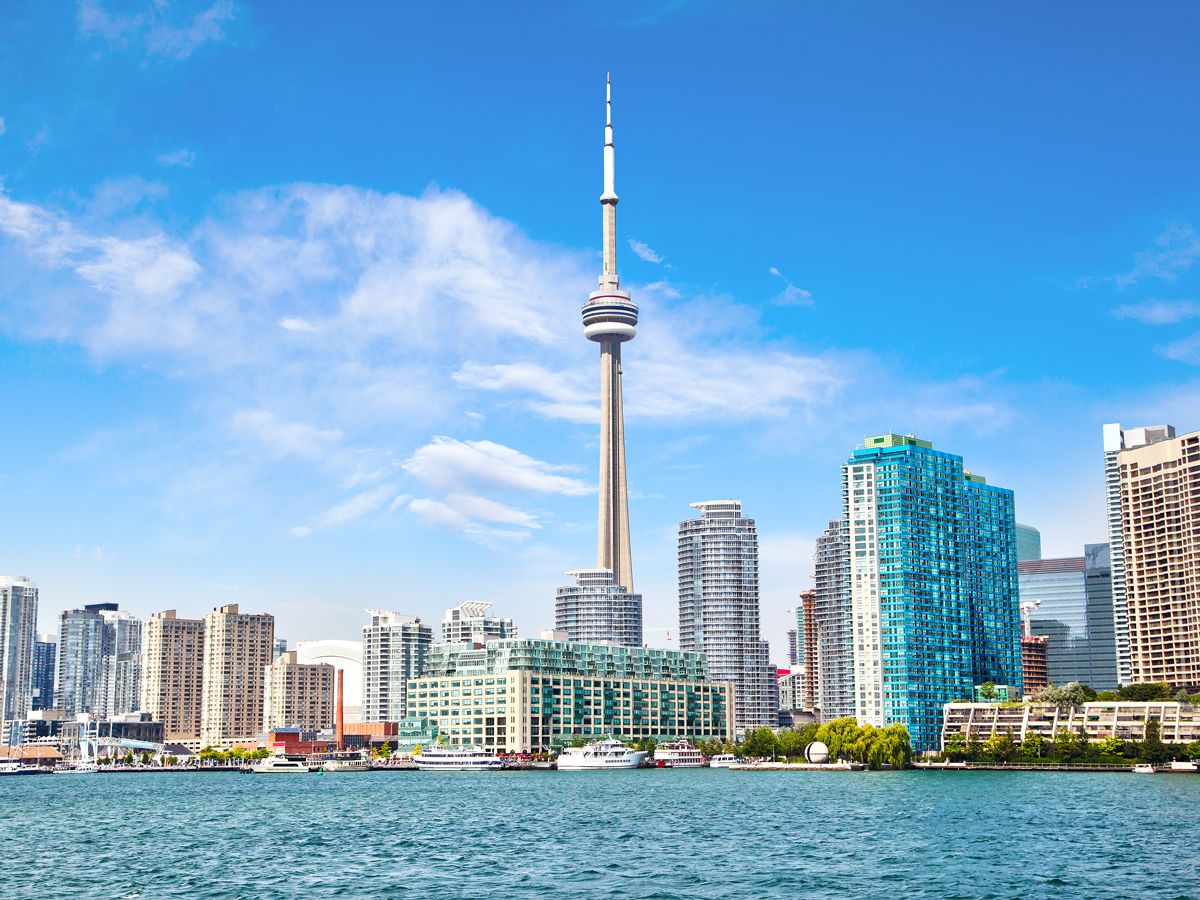
Toronto, Canada

Skyline of Toronto, Canada, with CN Tower and Rogers Centre, seen at sunset
Credit: Maurizio De Mattei/ Shutterstock 

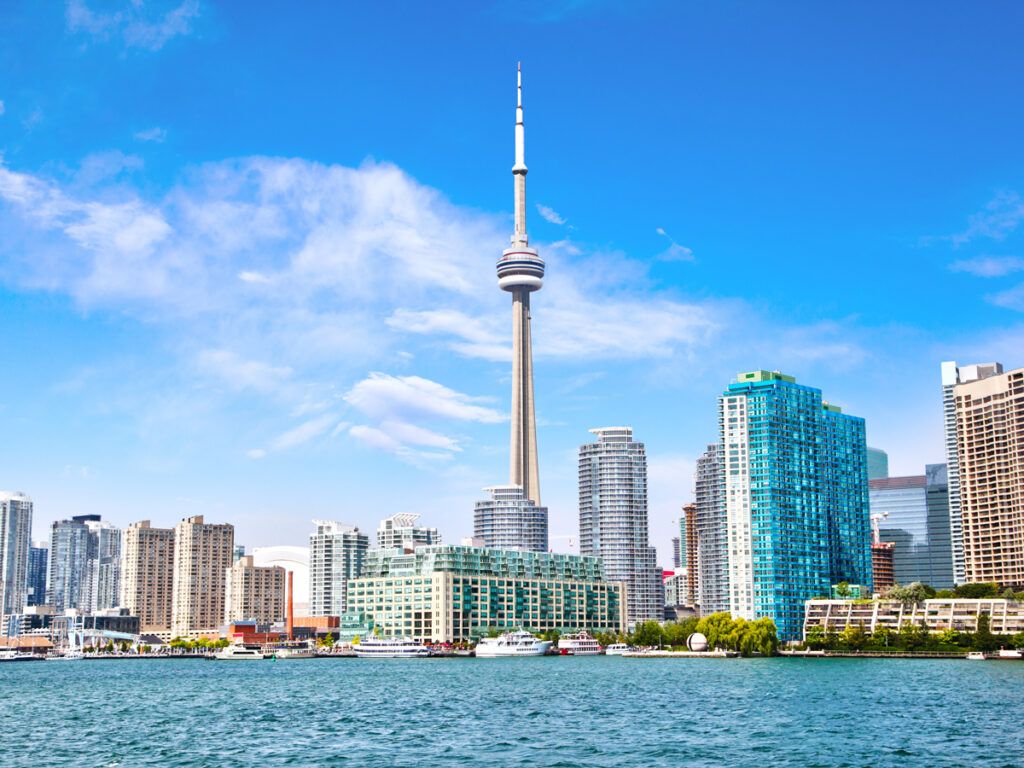
As a city celebrated for its diversity and love of the arts, Toronto is also heralded for its unique skyline along Lake Ontario. Dominating the city’s skyline is the CN Tower, a spire-shaped concrete communications and observation tower that rises to 1,815 feet. Until 2007, it was the world’s tallest freestanding structure, and today it continues to offer unparalleled views of the city from its observation decks. Situated at the base of CN Tower is the Rogers Centre, a stadium with a retractable roof that hosts the Toronto Blue Jays and large-scale concerts.

Another distinctive landmark is Toronto City Hall, also known as “New City Hall,” which was designed by functionalist Finnish architect Viljo Revell. It features a (somewhat divisive) modernist style, with a pair of curved towers that house the offices of the mayor and city councillors. Queen Elizabeth II attended its opening in 1965.

Sydney, Australia

Skyline of Sydney, Australia, with Sydney Opera House, seen from across harbor
Credit: Onfokus/ iStock via Getty Images 

Sydney has one of the most recognizable skylines in the world, thanks in no small part to the Sydney Opera House. Set against the backdrop of Darling Harbor, the UNESCO World Heritage Site has a memorable sail-like shape that has served as a symbol for both the city and the country since it was completed in 1973.

The city’s tallest structure, Sydney Tower Eye, is another easily recognizable building. Home to a unique golden crown that doubles as an observation deck, it provides panoramic views of the surrounding area from over 1,000 feet above ground. Meanwhile, the Quay Quarter Tower has become a recent star of the skyline. Rather than demolishing the old AMPTower that once stood in its place, architects repurposed 95% of that building’s original material, resulting in a modern, upcycled skyscraper that reaches 617 feet tall.

Rio de Janeiro, Brazil

Rio de Janeiro undoubtedly has one of the most beautiful skylines in the world, but unlike other cities, it is not one dominated by skyscrapers. Instead, the city’s most iconic landmarks come from the natural world. Built upon the stunning Guanabara Bay, one of the Seven Natural Wonders of the World, Rio is lined by the world-famous Copacabana and Ipanema beaches and surrounded by the Tijuca Forest, the world’s largest urban forest.

Perhaps the skyline’s most distinctive landmark is Sugarloaf Mountain, with a 1,299-foot summit that can be accessed via cable car. Translating to “hunchback” in Portuguese, Corcovado Mountain is another uniquely shaped pinnacle that hovers over the city. It’s home to the colossal 1922 statue known as Christ the Redeemer, named one of the New Seven Wonders of the World.
Post Banner Image
Tips

These Are the Best Waterproof Sneakers for Travel

By Daily Passport Team
Read time: 4 minutes
May 22, 2024
Updated: February 3, 2025

These Are the Best Waterproof Sneakers for Travel

By Daily Passport Team
Author
Daily Passport Team
Daily Passport writers have been seen in publications such as National Geographic, Food & Wine, CBC, Condé Nast Traveler, and Business Insider. They're passionate about uncovering unique destinations and sharing expert tips with curious travelers.

For some trips, packing heavy rain or snow boats is a necessary evil — after all, if you’ll be spending your time hiking on snow-capped mountains, you’ll need something to keep your feet dry. But squishing a giant pair of boots into carry-on or checked luggage at the expense of other travel necessities isn’t ideal — particularly for a city getaway. Fortunately, there’s a hybrid solution: waterproof sneakers. While not a complete replacement for weatherproof boots, they’re easier to pack and comfortable enough to spend the day walking in. To see which ones are suited for different types of trips, we tried out a few — these are three of our favorite waterproof sneakers for traveling. 

Note: All featured products and deals are selected independently and objectively by the author. Daily Passport may receive a share of sales via affiliate links in content.

Best Waterproof Sneakers for Every Day: Allbirds Mizzles

Person wearing sneakers on muddy walking trail, seen from behind
Credit: vidoc Olga/ Shutterstock 

Many travelers swear by Allbirds, a comfortable, lightweight shoe that’s machine washable and made with sustainable materials. Like Allbirds’ original Wool Runners, the Wool Runner Mizzles feature merino wool uppers for added warmth and comfort, along with sugarcane midsoles that have a carbon-negative footprint. The main difference is that these sneakers are treated with a fluorine-free water repellent coating to keep your feet warm and dry if you step in a puddle. 

They’re more comfortable than rain boots, especially if you’re walking long distances when traveling for example, but they’ll still keep your feet dry if the heavens open up and you’re caught in a storm. So, when you’re out exploring a new city and not sure if the weather is going to take a turn, wearing Mizzles is a good compromise. 

Best Waterproof Sneakers for Adventure: Forsake Range Low

Person hiking with sneakers
Credit: Zachary Miller/ Image Source via Getty Images 

Forsake has a reputation for making footwear that’s ideal for hiking or exploring rugged terrain, but the brand’s Range Low line takes it to the next level. The sneaker-boot hybrid features a waterproof, breathable membrane around the shoe with a mega-grip outsole to prevent you from slipping. The nubuck leather upper also offers an added layer of protection against the elements. 

The Range Low sneakers are not quite as warm as the Allbirds (they’re actually fitted with micro-mesh to keep you cool), but they should offer the same weatherproof protection as a pair of snow boots. Walking into snow or trudging through ice, your feet should remain completely dry (if it’s below ankle level), and the grippiness of the soles should help prevent falls. If you’re looking for a pair of waterproof shoes that are both comfortable and will hold their own against extreme weather that often accompanies adventure-based travel, these are it.

Best Waterproof Sneakers for Function and Style: Vessi Weekends

Person wearing sneakers rolling suitcase
Credit: urbazon/ E+ via Getty Images 

When traveling, it can be tricky to find shoes that are comfortable enough to walk in all day but won’t single you out as a tourist. You don’t want to go for those semicomfortable sandals that feel fine to begin with, but typically end in a mess of blisters after a long day of exploring a new city. Enter: the Vessi Weekends, which are a great mix of stylish, comfortable, and waterproof. 

Like all of the sneakers Vessi makes, the Weekends feature a custom waterproof knitted upper that keeps your feet dry. Instead of adding a coating to the shoe after it’s made, the material itself is actually waterproof. The knitted material is also extremely light and breathable. Plus, they don’t look like traditional running shoes, which many sneakers do — making them a lot more travel-friendly if you want to look casually well dressed in a new locale. 

However, since they are light, they don’t keep your feet quite as warm as some of the other options on this list. That said, if you do get caught in a downpour with your Weekends on, you won’t have to deal with damp socks, and a quick toss in the washing machine will make sure they look like new again.

Post Banner Image
Culture

This City Won’t Be Building Any New Hotels Anytime Soon — Here’s Why

By Julia Hammond
Read time: 4 minutes
May 22, 2024
Updated: May 28, 2024

This City Won’t Be Building Any New Hotels Anytime Soon — Here’s Why

By Julia Hammond
Author
Julia Hammond
Julia is a U.K.-based travel writer whose work has been featured in The Independent, The Telegraph, The New Zealand Herald, and Culture Trip, among others. She’s an enthusiastic advocate for independent travel and a passionate geographer who has had the privilege of traveling to more than 130 countries in search of a story.

While an influx of visitors to a city often brings welcome economic advantages, it can also exacerbate environmental and social issues. Often, these unintended negative consequences can threaten the essence of a destination — the exact thing that drew outside attention in the first place. Managing the effects of tourism is a balancing act, and it’s all too easy for the scales to tip the wrong way. At least one extremely popular European destination is trying to prevent that with bold new regulations. Discover why this city won’t be building any new hotels anytime soon.

The Case of Amsterdam

Traditional Dutch row homes along canal in Amsterdam, Netherlands
Credit: George Pachantouris/ Moment via Getty Images 

Tourism to the Dutch city of Amsterdam has been rising at a steady clip. In 2023, more than 20 million people visited this city of around 920,000 people. And it’s not difficult to see why — as one of the world’s best-planned cities, Amsterdam charms with its many canals, world-class museums, pretty architecture, and famous nightlife.

For years, Amsterdam’s city council has tried different measures to minimize the negative impacts of overtourism. The “City Centre Approach” manifesto sums up their intention: to protect the character of the Dutch capital, welcoming those visitors who respect its inhabitants while discouraging those whose behavior doesn’t correspond with these values.

The current tourism policy outlines a number of initiatives, including taking action to minimize disturbances caused by rowdy bachelor parties and organized pub crawls, as well as implementing earlier closing times for bars and clubs where residents may be experiencing disruption. There are also attempts to redress the city’s image as one where “anything goes,” by introducing bans on smoking cannabis on the street and strict criteria for those wishing to lead tours through the infamous red-light district. The city is even considering spreading tourist attractions and facilities throughout the city rather than concentrating them in a relatively small inner-city area.

Meeting Stringent Targets Will Be a Challenge

Bicycles parked on bridge over canal in Amsterdam, Netherlands
Credit: ElOjoTorpe/ Moment via Getty Images 

The most recent initiative from Amsterdam’s policymakers is perhaps the boldest one yet. Keen to ensure a better standard of living for residents, the city council has made the difficult decision to limit the number of new hotels in the city. 

The latest ruling is one of a slew of measures aimed at capping tourist numbers in this popular destination, along with restricting the number of cruise ships allowed on the city’s waterways. The goal is to not exceed 20 million hotel nights for tourists per year. In 2023, the figure stood at 20.67 million, not including holiday rentals, bed-and-breakfast accommodations, and overnight stays from cruise passengers. 

While the goal is a lofty one, some progress has already been made. Since 2017, only three planning applications for new hotels have been approved. However, it’s common for planning permission to be granted long before a hotel opens, and there are currently 26 hotels in the pipeline, all in possession of the required permits.

And even as the regulations are tightened up, there are still exemptions for new hotels planning to occupy sites that have previously held the same function, so long as they can demonstrate they meet certain sustainability standards. Unfortunately, rectifying the situation isn’t simply a case of saying “no more.”

Housing Problems for Local Governments

Bike path beside row homes in Amsterdam, Netherlands
Credit: Alexander Spatari/ Moment via Getty Images 

An important factor that has exacerbated Amsterdam’s overtourism situation is the demand for short-term rentals of entire apartments and houses, which can be lucrative for property owners. In turn, this has had a knock-on effect on the availability of housing stock in the city and has increased the cost of longer-term rentals for residents. 

As space is at a premium, the availability of housing stock dwindles, particularly as new builds can’t keep pace with demand. In short, vacation rentals are pricing some locals out of the city they live and work in. Commuting longer distances comes with environmental implications, as well, which is why the city council has decided action is needed. 

The Problem Isn’t Confined to Amsterdam

Hiking path along mountainside
Credit: RPBMedia/ iStock via Getty Images 

Amsterdam is far from alone in dealing with a record influx of visitors. Some popular places, such as Machu Picchu in Peru, have instigated a cap on daily numbers and require permits for popular hiking routes such as the Inca Trail. Others have imposed temporary closures to enable fragile environments to recover, including Maya Bay in Thailand and Iceland’s Fjaðrárgljúfur Canyon.

Other destinations rely on fees levied for day visitors, like the charge recently introduced in Venice. It’s hoped such fees may discourage casual visitors in this perennially popular Italian city, while also creating a useful revenue stream. In the meantime, consider searching for less-crowded alternatives or even look-alikes to these popular tourist destinations.

Post Banner Image
History

7 of North America’s Best Historic City Neighborhoods to Visit

By Daily Passport Team
Read time: 7 minutes
May 22, 2024
Updated: May 23, 2024

7 of North America’s Best Historic City Neighborhoods to Visit

By Daily Passport Team
Author
Daily Passport Team
Daily Passport writers have been seen in publications such as National Geographic, Food & Wine, CBC, Condé Nast Traveler, and Business Insider. They're passionate about uncovering unique destinations and sharing expert tips with curious travelers.

Around the world, historic neighborhoods offer a fascinating glimpse into centuries of urban life and culture. North America is no exception. From one of the world’s oldest Chinatowns to “America’s First Planned City,” stroll through seven of North America’s best historic city neighborhoods below.

Chinatown – San Francisco, California 

Decorations over street in Chinatown, San Francisco
Credit: Alexander Spatari/ Moment via Getty Images 

There’s no better place in the U.S. to explore modern Chinese culture and Asian American history than in San Francisco’s storied Chinatown. The first Chinese immigrants arrived in San Francisco in 1848, and the many who followed them created a vibrant neighborhood even in the face of discrimination and exclusion. Now one of the city’s top tourist attractions, San Francisco’s Chinatown is one of the largest Chinese enclaves outside of Asia and the oldest Chinese community in North America. 

Chinatown is best explored on foot. Begin at the ornately tiled Dragon Gate, at the intersection of Bush Street and Grant Avenue, which is Chinatown’s main drag. Practice tai chi at St. Mary’s Square or watch games of mahjong at Portsmouth Square. Admire the architecture at the Sing Chong Building, constructed in 1907. Get your fortune read at the historic Tin How Temple, then grab a sweet treat at the Golden Gate Fortune Cookie Factory or the Golden Gate Bakery. Finally, explore the fish markets, spice shops, and vegetable stands of Stockton Street, where you’ll find succulent Peking duck at Hing Lung Company and the city’s best dim sum takeaway at Good Mong Kok Bakery — trust us, your taste buds will thank you.

Savannah Historic District – Savannah, Georgia

Historic homes in Savannah, Georgia
Credit: Sean Pavone/ iStock via Getty Images 

Like San Francisco’s Chinatown, the best way to experience Savannah’s Historic District is on foot. Based on the original plan created in the 1730s by James Oglethorpe, the founder of the British Colony of Georgia, this beautiful, eminently walkable neighborhood is known as “America’s First Planned City.” It encompasses 22 lushly landscaped squares draped in the city’s emblematic Spanish moss trees and criss-crossed by an orderly grid of cobblestone streets lined with impressive architecture — a mix of well-preserved Georgian, Greek Revival, and Gothic styles from the 18th and 19th centuries.

Savannah is the oldest city in Georgia, and its federally designated historic district is one of the largest in the country. Savannah’s commercial center is the riverfront City Market: a collection of boutiques, eateries, and galleries bustling with shoppers and performers. Other highlights include Forsyth Park, a 30-acre span featuring war monuments and a Garden of Fragrance designed for the sight-impaired. History buffs will find plenty here, too — from Green Square, the central hub for the African American community in the 19th century, to the French Gothic Cathedral of St. John the Baptist and a long list of historic (many allegedly haunted) houses open for tours.

Centro Histórico – Mexico City, Mexico

Aerial view of El Zócalo in Mexico City
Credit: R.M. Nunes/ iStock via Getty Images 

At the heart of Mexico City’s historic center is El Zócalo, the largest public square in Latin America. El Zócalo was the central ceremonial space for the Aztec city-state of Tenochtitlan, before it was conquered by the Spaniards in 1521. While the square’s formal name is Plaza de la Constitución, many cities in Mexico now refer to their primary squares as zócalos, and Mexico City’s is no exception. The grand square is surrounded by an imposing cathedral, the shops and hotels of the Old Portal de Mercaderes, and the National Palace (formerly the site of Moctezuma’s palace), with its stunning Diego Rivera murals. For some of the best views of the square, grab a drink at the Hotel Majestic.

The plaza can accommodate somewhere in the range of 200,000 people, and it has been the site of many political demonstrations, as well as concerts by artists such as Shakira and Paul McCartney. After a fictional scene in the 2016 James Bond film Spectre that showed a raucous Day of the Dead Parade, the city decided to make the parade a reality, and it’s now an annual occurrence. 

Inner Harbour – Victoria, British Columbia

Victoria's Fairmont Empress Hotel overlooking the Inner Harbour at night
Credit: benedek/ E+ via Getty Images 

The capital of Canada’s British Columbia province, Victoria is effortlessly charming — from its British-influenced architecture to the expansive gardens, pedestrian-friendly streets, and seaside setting — and nowhere is that on better display than the photogenic Inner Harbour.

The region was originally home to people of the Songhees and Esquimalt First Nations (whose culture is showcased today through an interpretive walkway along the Inner Harbour), but after the arrival of the Hudson Bay Company in 1843, the area transitioned from a fishing village to a bustling cityscape lined with palatial legislative buildings. It later became an attractive tourist destination, thanks in part to the Inner Harbour Causeway, a walkway originally constructed in 1903 that still houses market stalls and street performers.

One of the star architectural landmarks of the Inner Harbour is the Fairmont Empress Hotel, an Edwardian-style 1908 building that offers both a luxury stay and a spooky adventure for those who believe rumors that it’s haunted. (Even if you’re not staying at the hotel, popping by for afternoon tea is a must.) While the Inner Harbour is pleasant to visit year-round, classical music buffs should consider visiting in the summertime, as the annual Victoria Symphony of Splash features a 56-piece orchestra performing atop a floating stage that culminates with a spectacular fireworks display.

Garden District – New Orleans, Louisiana

Streetcars in New Orleans, Louisiana
Credit: THEPALMER/ E+ via Getty Images

A trip to the Garden District can seem like a balm for visitors to New Orleans: On a streetcar ride east along St. Charles Avenue, the city’s mood changes from the party atmosphere of the French Quarter to something more peaceful and dignified. The streetcars rumble past block after block of Greek Revival mansions fronted by lush gardens and enclosed by elaborate wrought-iron fences. Even the occasional modern structure can’t knock the illusion that you are being ferried back to a different era. 

Developed in the 1840s, the neighborhood has managed to retain its sterling reputation, even though you can still find a glimpse of macabre beauty that New Orleans is known for at the area’s Lafayette Cemetery No. 2. (The cemetery’s weathered crypts are located above ground because the city rests below sea level.) In addition to historic residential architecture and spooky graveyards, the Garden District is a thriving neighborhood with notable restaurants along the main streets (among them, Commander’s Palace, established in 1893, is still going strong), as well as a stretch of interesting shops and boutiques on Magazine Street. 

Old San Juan – Puerto Rico

Narrow, hilly street looking toward sea and flanked with colorful homes in Old San Juan, Puerto Rico
Credit: dennisvdw/ iStock via Getty Images

Spanish explorer — and Puerto Rico’s first governor — Juan Ponce de León never found the Fountain of Youth that he was searching for in the Americas in the early 16th century, but today you can find his final resting place at the Bautista Cathedral in Viejo (“Old”) San Juan. Built in 1521 at the beginning of Spanish colonization, the original cathedral was destroyed by a hurricane, and the current Gothic-influenced structure was constructed in 1540. The church is only one of many grand and historic monuments on the elegant islet Old San Juan occupies, which is connected to the main island by three bridges. 

A free trolley services the most popular spots, but Old San Juan is a city made for strolling. Enjoy the pleasant year-round temperature and refreshing sea breezes while walking cobblestone streets through the seven blocks of this National Historic Site. Don’t miss Castillo San Cristobal, the largest Spanish fort in the New World, and the six-level Castillo San Felipe del Morro (nicknamed “El Morro”) — a fortification built between the 16th and 18th centuries overlooking San Juan Bay, it is perhaps the country’s most beloved landmark.

Vieux-Port – Montréal, Québec

Ferris wheel alongside canal in Montreal's Old Port neighborhood
Credit: gdvcom/ Shutterstock 

Standing on the quaint cobbled streets of Montreal’s Vieux Port, it’s easy to picture yourself in New France, the young French colony back when it was inhabited by fur trappers, soldiers, Jesuit priests — all elbowing to gain control of the wild and vast Canadian continent. In fact, by the time settlers landed here in 1642 and claimed the territory for the French king, the St. Lawrence River waterfront in the Vieux-Port (“old port”) section of Montreal had already been used as a camp by French fur traders for several decades. 

But as modern times barreled into Montreal, the significance of this beautiful neighborhood was overshadowed by logistical limitations. Transporting cargo unloaded from container ships to railways and trucks proved difficult and costly, so in 1976, the port was shifted a few miles downriver. Fortunately, officials later recognized that the historic quarter was ripe for tourism, and in 1992, the government revitalized Vieux-Port as a heritage destination — with programmed festivals and events and attractions that include a skating rink, an immense Ferris wheel, and plenty of green space. Now, more than 6 million visitors a year come to shop, eat, celebrate New Year’s Eve, attend concerts, and walk in the footsteps of those early settlers.

Post Banner Image
Tips

These Are the Safest Airlines To Fly in 2026

By Peter Vanden Bos
Read time: 5 minutes
May 22, 2024
Updated: February 25, 2026

These Are the Safest Airlines To Fly in 2026

By Peter Vanden Bos
Author
Peter Vanden Bos
Peter is a Toronto-based journalist, editor, content strategist, and self-professed avgeek with 15 years of experience covering all things travel. Prior to joining Daily Passport, he oversaw newsletter publication for Travelzoo. His favorite destinations to explore include Japan, France, Chile, New Zealand, and his adopted home country of Canada.

Despite the fact that traveling by airplane is the safest mode of transportation out there, some travelers still, understandably, have a fear of flying. If you’re an anxious traveler, you might be curious to know which airlines have the best safety records (or even which section of the airplane could be considered the safest). The annual report from the aviation safety experts at AirlineRatings.com ranks global airlines on criteria such as fleet age, serious incidents, pilot training, and turbulence prevention. Here are the safest full-service airlines to fly in 2026, according to the study. 

10. Korean Air

Korean Air Boeing 747-8 departing runway
Credit: © Vinicius/stock.adobe.com

The flag carrier of South Korea ranks as the world’s 10th-safest airline in 2026. From its main hub at Seoul’s Incheon International Airport, Korean Air serves more than 100 destinations across the globe, including 11 U.S. cities. The carrier is currently renewing its fleet with modern, state-of-the-art aircraft such as the Airbus A350 and Boeing 787. It’s also in the process of merging with rival Asiana Airlines; the latter airline is expected to be fully absorbed under Korean Air by the end of 2026.

9. Virgin Australia

Virgin Australia Boeing 737-800 parked on tarmac at Melbourne Airport
Credit: © pict-japan/stock.adobe.com

You’ll have to head Down Under to find the next airline on the world’s safest airlines list. Established in 2000, Virgin Australia operates a fleet of more than 100 Boeing 737s across Australia, New Zealand, and Southeast Asia, from its hubs in Brisbane, Melbourne, and Sydney.

8. EVA Air

EVA Air Boeing 787 on departure
Credit: © Markus Mainka/stock.adobe.com

Taiwan-based EVA Air is the eighth-safest airline in the world as of 2026. Since its founding in 1989, the airline has suffered no major accidents or passenger fatalities. The airline recently announced its 10th nonstop destination in North America; flights from Taipei to and from Washington, D.C., kick off this June

7. Singapore Airlines

Singapore Airlines aircraft parked at gates
Credit: © Kandl Studio/stock.adobe.com

Singapore Airlines was named the overall No. 2 best airline in the world for 2025 in the Skytrax World Airline Awards, and the carrier also boasts a stellar safety record. Passengers flying on Singapore Airlines have the chance to visit the world’s best airport, Singapore Changi Airport, which has amenities you don’t normally find in an airport, such as the world’s highest indoor waterfall, a butterfly garden, a canopy park, and more.

6. Air New Zealand

Air New Zealand Airbus A320 on approach to runway
Credit: © Jerry/stock.adobe.com

Air New Zealand dropped to No. 6 from the top spot in the safest airlines ranking last year, but that doesn’t reflect any recent lapses in safety. Rather, as AirlineRatings.com CEO Sharon Petersen explained in a press release, “What stands out this year is how little separates the leaders. Less than four points covered positions one through 14, and at the very top, the margins were even tighter, with just 1.3 points separating positions one through six in the full-service category.”

5. Emirates

Emirates Airbus A380 landing at Prague Airport in Czechia
Credit: © kamilpetran/stock.adobe.com

Dubai-based Emirates operates the world’s largest fleet of Airbus A380 jumbo jets, which is the world’s largest passenger aircraft and has never experienced a major crash since entering service in 2007. Emirates has a large connecting hub in Dubai, which you can explore on a free stopover.

4. Qatar Airways

Qatar Airways Airbus A380 parked at gate
Credit: © milkovasa/stock.adobe.com

Qatar Airways flies to over a dozen U.S. cities, including Atlanta, Boston, and San Francisco, from its Middle East hub in Doha. The airport ranks as the No. 2 best airport in the world, according to Skytrax; it’s home to amenities like an massive indoor tropical garden called the Orchard and some of the world’s swankiest airline lounges.

3. Qantas

Qantas Airbus A330 parked on tarmac
Photo credit: © Terence Ong

Qantas is not only one of the world’s safest airlines but also one of the oldest, having first flown in 1920. To the U.S., the Australian flag carrier operates long-haul flights to Dallas/Fort Worth, Los Angeles, and San Francisco. It also offers one-stop service to New York via Auckland, which takes 17 hours and 30 minutes and ranks as one of the world’s longest flights. The airline could soon take the crown for the single longest flight, as it aims to connect Australia and New York nonstop with new ultra-long-haul planes by 2027. 

Related: 10 Oldest Airlines Still Flying Today

2. Cathay Pacific Airways

Cathay Pacific Airbus A350 taking off from Zurich Airport in Switzerland
Credit: © Matteo Ceruti/stock.adobe.com

Cathay Pacific Airways, the flag carrier of Hong Kong, ranks as the world’s second-safest airline for 2026. The airline operates nonstop flights to six U.S. cities, including Los Angeles and New York, aboard a fleet of modern Airbus A350 and Boeing 777 aircraft. In 2026, the airline is celebrating its 80th anniversary since its first flight in 1946. 

1. Etihad Airways

Etihad Airbus A321 being pushed back from the gate at Zurich Airport
Credit: © Michael Derrer Fuchsi/stock.adobe.com

Another Middle East carrier lands on top of the list of the world’s safest airlines: Etihad Airways, which hasn’t had a single major incident since starting flights in 2003. The airline is based at Abu Dhabi’s stunning Zayed International Airport, offering connections from Europe and North America to destinations throughout the Middle East, India, and Asia.

About the data: To compile this list, we referenced the “World’s Safest Airline Rankings for 2026” from airline safety and product rating website AirlineRatings.com. The report analyzed 320 airlines worldwide on criteria such as incident rates adjusted for the total number of flights, fleet age, serious incidents, pilot training, turbulence prevention, and international safety audits. The airlines above fall in the “full service” category, but the report also listed low-cost airlines separately. You can view the full study here.

Post Banner Image
Outdoors

6 of America’s Prettiest Small Lake Towns

By Fiona Mokry
Read time: 5 minutes
May 20, 2024
Updated: May 22, 2025

6 of America’s Prettiest Small Lake Towns

By Fiona Mokry
Author
Fiona Mokry
Fiona has spent her career exploring the world and working in the travel industry, turning her lifelong passion into a profession. From planning custom trips to sharing stories as a travel writer for publications such as The Discoverer, she’s all about helping others experience the world in a deeper, more meaningful way.

Given their location, lakeside towns are naturally peaceful and scenic, and it’s no surprise that they often double as popular vacation spots. Indeed, with their recreational activities, thriving artisan communities, access to wildlife, and overall tranquil vibes, it’s difficult to find the negative side of a lakeside retreat. Nonetheless, certain lake towns stand out from the pack. Here are six of the most beautiful lake towns in the U.S. to visit this summer.

Saugatuck, Michigan

Marina of Saguatuck, Michigan
Credit: William Reagan/ iStock via Getty Images 

Michigan lays claim to four of the five Great Lakes — Erie, Superior, Huron, and Michigan — plus around 11,000 other lakes. All that to say, if it’s a pretty lake town you seek, the Mitten State won’t let you down. Part of Michigan’s “Art Coast,” Saugatuck is an especially quaint lake town that earned Midwest Living’s Best Beach Town award in 2021. 

Saugatuck brims with beauty both natural and human-made, from the strip of art galleries and restaurants in old Victorian buildings that line the town’s historic main drag to the golden sandy shores of Oval Beach on Lake Michigan. Away from the water, Saugatuck offers a host of nature activities in Saugatuck Dunes State Park, such as swimming, wildlife viewing, and miles of pretty hiking trails that traverse the coastal dunes and adjacent forest. 

Wolfeboro, New Hampshire

Aerial view of church and other buildings in lakeside town of Wolfeboro, New Hampshire
Credit: Wangkun Jia/ Shutterstock 

The natural beauty of New England is no secret, and the small town of Wolfeboro showcases it spectacularly. Wolfeboro claims the crown of the “Oldest Summer Resort Town in America,” with a history dating to when the colonial governor of New Hampshire built his summer home on Lake Wentworth in 1763. A testament to Wolfeboro’s timeless appeal is the annual seasonal population increase — from around 6,500 permanent residents to a whopping 25,000 in the summer. 

On the opposite side of town is Lake Winnipesaukee, the biggest lake in New Hampshire. Visitors flock to this 72-square-mile body of water to swim off one of the many beaches, boat to one of the hundreds of islands, explore craggy coves, or embark on one of the many epic hikes in the foothills of the famous White Mountains that encompass the lake.  

Rangeley, Maine

Buildings reflecting on waters of Rangeley Lake in Maine
Credit: DenisTangneyJr/ iStock via Getty Images 

Located roughly 2.5 hours north of Portland, Rangeley is a backwoods country town flush with the rugged beauty Maine is known for. Rangeley’s 55 square miles are sparsely populated with around 1,200 residents, but the town’s location on its namesake lake has been drawing visitors to western Maine for decades. Rangeley Lake is a popular fishing hub for trout and salmon in the summer and a base for many avid skiers and snowboarders seeking fresh powder at Saddleback Mountain in the winter. 

If you’re not into casting a line or extreme downhill sports, there’s still plenty to pique your interest. Waterfalls beckon to be discovered, and kayak, canoe, and boat rentals are available to explore the lake. Meanwhile, wildlife such as loons and bald eagles abound, and the hiking is some of the best Maine has to offer.

Lakeway, Texas

Aerial view of Lakeway, Texas
Credit: RoschetzkyIstockPhoto/ iStock via Getty Images 

A welcome retreat for Austinites during the hot summer months, Lakeway is located 40 minutes northwest of the capital on the shores of Lake Travis. Lakeway was once a sleepy town that attracted retirees and second-home owners, but the lake’s golden sands, warm waters, and verdant surroundings have caught the attention of many more tourists in recent years. Boat tours, party coves, and plenty of amenities encircle the lake, but if you’re seeking peace and quiet, Lakeway offers cottage rentals, access to Lake Travis parks, and a welcoming, laid-back atmosphere.

Breaux Bridge, Louisiana

Home with garden in Breaux Bridge, Louisiana
Credit: wanderluster/ iStock via Getty Images 

If you’re looking for an introduction to Cajun country, look no further than Breaux Bridge. Located 5 miles from Lake Martin, the town of approximately 7,500 is known as the “Crawfish Capital of the World.” Breaux Bridge claims to have invented the crawfish etouffee and continues to host an annual crawfish festival. Needless to say, sampling crawfish while in town is a must. 

Breaux Bridge is also a great jumping-off point to explore the surrounding bayou landscape. Swamp tours on Lake Martin and Atchafalaya Basin offer excellent opportunities for spotting wildlife including heron, barred owls, turtles, osprey, and alligators. Meanwhile, you can admire the majestic cypress trees with moss-draped branches that grow straight out of the lake floor. In addition to water activities, nearby hiking and walking trails — such as the Lake Martin Loop Trail and the Cypress Island Nature Trail — are tranquil alternatives to soak up the beauty of the bayou.

Eureka Springs, Arkansas

Downtown Eureka Springs, Arkansas
Credit: Khairil Azhar Junos/ Alamy Stock Photo

Eureka Springs, a small town of around 2,200 people, may seem like a blip on the map, but it has long attracted droves of visitors in the summer months. Eureka Springs is nestled in the Ozark Mountains and located within a few miles of Beaver Lake and Lake Leatherwood. Both of these lakes offer visitors cottage or campsite rentals and a plethora of recreational activities such as kayaking, fishing, and hiking. 

However, the main draw here is the access to multiple natural mineral springs that encircle Eureka Springs and were discovered in the 19th century. Within walking distance of the town center, you’ll find bathhouses and spas supplied with the natural spring water, but the most popular is Palace Hotel and Bath House, the only one of the town’s former historic bathhouses still in use today. Whether you choose to spend time on the lake or in the healing mineral waters, a visit to Eureka Springs is a sure bet for a memorable summer getaway. 

Post Banner Image
Outdoors

7 Enchanting Islands That You Can Walk to at Low Tide

By Bradley O'Neill
Read time: 6 minutes
May 20, 2024
Updated: May 21, 2024

7 Enchanting Islands That You Can Walk to at Low Tide

By Bradley O'Neill

By definition, an island is a body of land that’s entirely surrounded by water. Islands are typically accessible by aircraft or boat, but around the world there are some islands that are technically only islands at high tide. When the water levels are low, they become connected to the mainland by sandbars, natural pathways, or causeways. So, lace up your favorite walking shoes, wait for low tide, and walk to these seven fascinating islands. (Just don’t get stuck when the water starts to roll in again.)

Mont-Saint-Michel – France

Tidal island of Mont-Saint-Michel, France, crowned by Benedictine monastery
Credit: Manfred Gottschalk/ Stone via Getty Images 

Mont-Saint-Michel rises like a floating Disney castle out of a bay shared by the French regions of Normandy and Brittany. This UNESCO World Heritage Site first caught the eye of pilgrims in the eighth century, when St. Aubert was divinely guided to build a hilltop church. The Duchy of Normandy and French royals later funded the construction of the island’s spectacular Benedictine abbey. 

Cars can drive continuously over a causeway, but the more adventurous way to arrive is to walk across the bay at low tide. Setting foot on the island is akin to stepping back in time to a medieval village. Visitors can stroll the zigzagging alleyways to discover taverns, restaurants, and gift shops — or even stay overnight at one of the island’s handful of hotels and guesthouses.

Bar Island – Maine

Grove of pine trees on Bar Island in Maine, seen from across water
Credit: WoodysPhotos/ iStock via Getty Images

Located off the coast of charming Bar Harbor, Bar Island is part of Acadia National Park, the first national park established east of the Mississippi River in 1919. Twice a day, a short strip of sand, rocks, and pebbles called Land Bridge provides access to the island, which was once inhabited by farmers before it became part of the national park. 

The best time to avoid getting your feet wet is about an hour and a half before or after low tide. Several plant and animal species, including starfish, appear in natural tide pools on the bridge. On the island itself, the Bar Island Trail is a 1.9-mile out-and-back route that traverses through serene forest and wildflower meadows. Keep an eye out for the remains of old buildings and enjoy views back toward Bar Harbor and over Frenchman Bay. It’s a nine-hour wait between tides, so pay attention to the time to avoid getting stranded. 

Brough of Birsay – Scotland

Small lighthouse overlooking coast on Brough of Birsay in Scotland
Credit: rpeters86/ iStock via Getty Images

Part of Scotland’s remote Orkney Islands, Brough of Birsay was home to Pictish and Norse settlements from around 600 to 1200 CE. A causeway provides access to this picturesque island from the village of Birsay and the chance to explore the 10th-century ruins of a Norse hamlet. 

A replica of a carved stone on the island shows four Pictish symbols, including a crescent and an eagle. (The original is located at the National Museum of Scotland.) Also of interest are the remains of the Romanesque-style St. Peter’s Chapel, which dates to the 12th century. A whitewashed lighthouse stands solemnly on one side of the island, and all around are views of deep blue Atlantic waters and craggy cliffs, where guillemots, puffins, and razorbills nest

Haji Ali Dargah – India

View of worshippers in distance at Haji Ali Dargah in India
Credit: leshiy985/ Shutterstock 

According to legend, after the Muslim saint Pir Haji Ali Shah Bukhari died on a pilgrimage to Mecca, his casket floated back to a rocky islet on Mumbai’s western shoreline. To honor this miraculous event, a mosque and a dargah (tomb) were erected in the 15th century and named Haji Ali Dargah

Today’s structure mostly dates to the 19th century, and for much of the day it’s a glistening, fairy-tale-like scene of brilliant white domes and minarets. As the water recedes, worshippers form an orderly line across a stone causeway to pay their respects to the revered merchant and spiritual teacher. It’s worth the walk to admire intricate mirror work and mosaic decorations, in addition to the saint’s opulent marble-enclosed floating tomb. 

Holy Island of Lindisfarne – England

Pathway leading to hilltop fortress on Holy Island of Lindisfarne in England
Credit: Steve Allen/ Stockbyte via Getty Images 

The Holy Island of Lindisfarne sits on the faraway and windswept coast of Northumberland, in northeastern England. It was here in 635 CE that St. Aidan arrived from Iona and established a monastery, which later became home to the admired saints Cuthbert and Oswald, before vikings plundered the island in the eighth century. 

At low tide, the 3-mile-long Pilgrims Way reveals itself to create a scenic walk to the island. Visitors can stroll in the footsteps of monks at Lindisfarne Priory and explore the Tudor-era Lindisfarne Castle. A community of fewer than 200 people lives here permanently, and you can experience village life at the island’s cafés, pubs, specialty shops, and guesthouses. Holy Island is the last stop on St. Cuthbert’s Way, a 62-mile walking trail that begins in the Scottish town of Melrose. 

Ministers Islands – New Brunswick, Canada

Cone-shaped building surrounded by flowers overlooking coast of Ministers Island in New Brunswick, Canada
Credit: Jess Young/ Shutterstock 

Fascinating First Nations heritage, historic buildings, and epic hiking trails await on the 500-acre Ministers Island in Canada’s eastern New Brunswick province. This unique island is linked to the mainland by an ocean-floor gravel passage rather than a sandbar or human-made causeway. This allows for both pedestrian and vehicle access from the town of St. Andrews. First inhabited by the Passamaquoddy peoples, the island later became the summer home of Canadian railroad pioneer Sir William Van Horne from 1890 through the mid-20th century. 

Now a designated National Historic Site of Canada, the island welcomes visitors to explore the 50-room Van Horne mansion, a bathhouse, a former creamery, and other preserved buildings. A 12-mile network of hiking and biking trails cuts through dense forest and along picturesque shorelines. Late April to May and August to mid-October are great times to spot birds on their spring and fall migrations. 

St. Michael’s Mount – England

Hilltop castle on St. Michael’s Mount in Cornwall, England, seen from afar
Credit: Joost van Uffelen/ Shutterstock 

An emblematic image of the Cornish coastline, St. Michael’s Mount is steeped in history and mythology. Since the fifth century, legends have been told of a mermaid on the island guiding seafarers to safe passage. Another island tale tells of Jack the Giant Killer defeating the beast Cormoran. In the 12th century, Benedictine monks — the same ones who worked at the sister abbey on Mont-Saint-Michel — began construction of the island’s church and abbey. 

These days, a castle occupies the summit of St. Michael’s Mount and is the home of the St. Aubyn family. Below it, cafés and shops in old stone buildings overlook the harbor. To access the island, a cobblestone causeway crosses Mount’s Bay to the town of Marazion. Walking is the only way to get here in winter, but a ferry service operates during the summer months.