Bennett is a New York City-based staff writer for Daily Passport. He previously contributed to television programs such as the Late Show With David Letterman, as well as digital publications like the Onion. Bennett has traveled to 48 U.S. states and all 30 Major League Baseball stadiums.
Finding out the airline lost your luggage is a headache that no traveler wants to endure. While lost or delayed luggage cases are still rare, they are unfortunately on the rise. That’s why it’s important to take matters into your own hands when possible. Thankfully, there’s an affordable gadget that can help track down your missing bags and provide peace of mind on your next trip. Even better, it takes up barely any luggage space at all. We’re talking about the Apple AirTag — a tiny, yet essential device that every jetsetter should own.
AirTags, which are a little larger than a quarter, allow the user to track the device’s location using a technology called ultra-wideband, which sends out signals every two nanoseconds. These frequent signals provide information about the exact location of the AirTag and whether it’s on the move or stationary. This is then communicated to any nearby Apple devices, and that data is then relayed to the larger Apple network. The location details are kept private and can only be seen by the owner of the Apple account connected to the AirTags themselves. Of note, AirTags only work with Apple products and are not compatible with Android devices.
To set up an AirTag, pull the tab out to activate the device. Then, turn on your iPhone or iPad’s Bluetooth setting and follow the prompts to pair the AirTag with your Apple ID. Once setup is complete, you can track the AirTag’s location using your Apple ID on any Apple product, including Macbook laptops. Just open the Find My app to do so.
Why AirTags Are Useful for Travel
Credit: Chalabala/ iStock via Getty Images
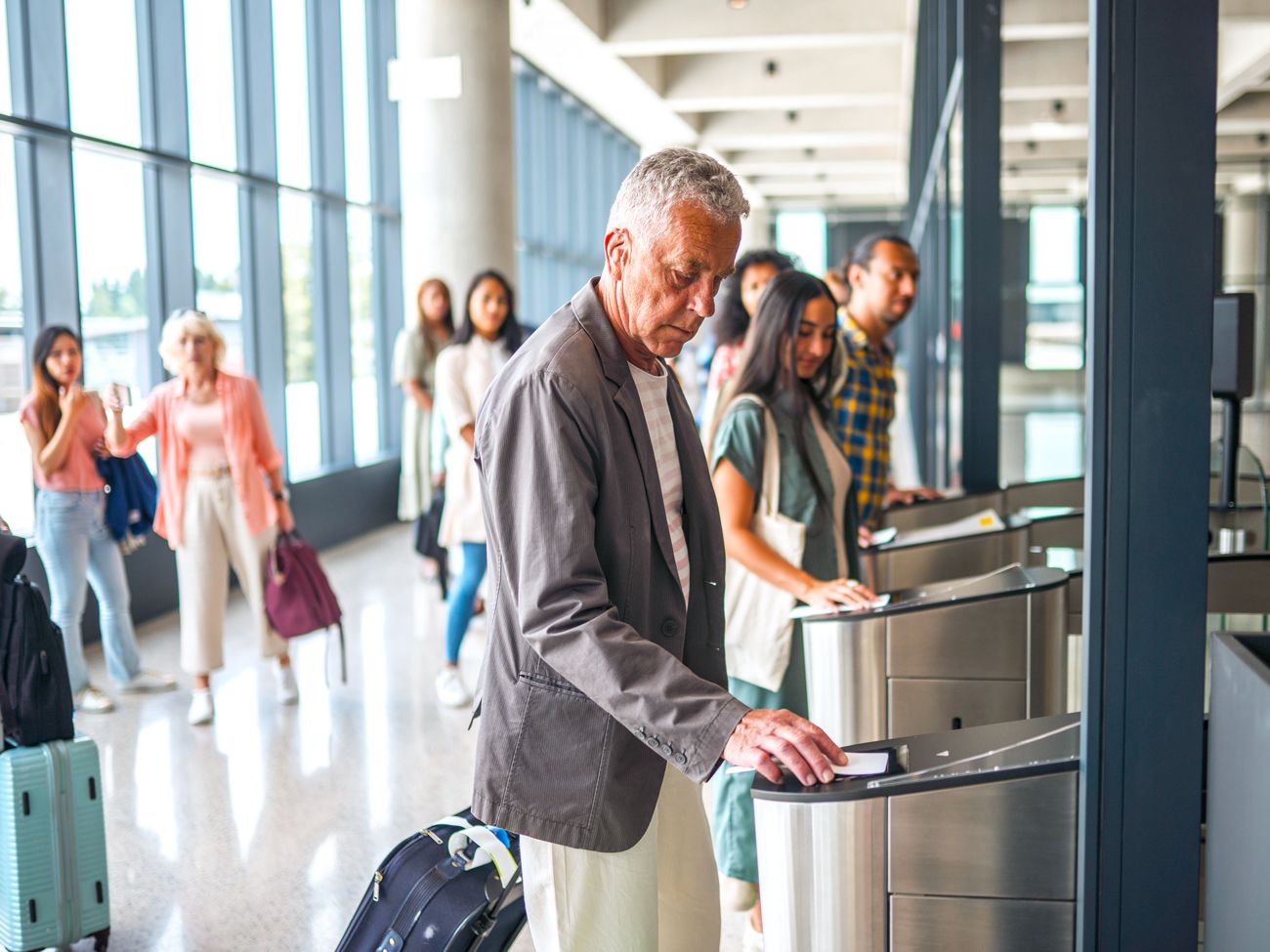
If you slide an AirTag into any luggage that you’re planning to check, you can easily keep tabs on your bags throughout your journey. Often, it can help you figure out where your missing bags are before the airline does. Keep the AirTag in an interior compartment if possible, as leaving it hanging on the outside may result in theft. If you arrive at your destination and notice your bags are gone, open the Find My app. The AirTag should connect with any nearby Apple devices no matter where it’s located. This can help you figure out if your luggage was left behind, or perhaps loaded onto the wrong flight.
How To Track Down Lost Luggage
Credit: izusek/ E+ via Getty Images
Once you’ve figured out where your luggage is located, speak with a customer service representative and show them what you’ve found. Some airlines will work with you to track down the baggage and get it to its intended destination, while other airlines may not be as helpful. In rare cases, you may see your AirTag located at a private residence, suggesting the bag may have been taken by another traveler accidentally or stolen by someone at the airport. If this happens, immediately file a claim with the airline in order to initiate an investigation.
If you notice your luggage is somewhere nearby, open the Find My app, where you can prompt the AirTag to play a sound. You can also mark your AirTag as “lost” and list a phone number or email address where people can contact you. That way, if someone finds the AirTag, they’ll have no issues getting in touch.
AirTags are small circular devices that can be easily misplaced. To help keep them safe, you can purchase a secure key ring that you can affix to any loop within your luggage. Another useful option is this stick-on AirTag holder that you can firmly adhere to the interior of any bag or suitcase.
Apple AirTags are often sold as a four-pack, which is ideal if you’re traveling with several checked bags or wish to share them with your travel companions. However, you can also buy a single AirTag. Either way, they are well worth the cost, especially if you consider how expensive it’d be to replace your luggage and its contents.
Advertisement
More from our network
Daily Passport is part of Inbox Studio, an email-first media company. *Indicates a third-party property.
Michael is a staff writer for Daily Passport and film critic who writes the weekly newsletter Movie Brief. His writing and criticism have also appeared in the Los Angeles Times, Variety, and the Washington Post, among others. A native Angeleno, his favorite countries to visit are Norway and Japan.
More than 80% of Americans live in the country’s 3,573 urban areas — and both the number of urban areas and the percentage of Americans living in them continue to rise. As urbanized as the U.S. is today, it wasn’t until 1920 that the majority of Americans resided in cities. Now, it’s exceedingly unlikely that that trend will ever reverse. Take a look at the 10 largest U.S. metro areas, as of 2024.
10. Phoenix, Arizona
Credit: benedek/ iStock via Getty Images
Phoenix is part of the country’s 10th-most-populous metropolitan area, alongside nearby cities such as Mesa and Chandler. Phoenix is also America’s most populous state capital, a fact that might seem surprising until you remember that cities such as New York, Los Angeles, and Chicago aren’t their respective states’ seats of government. (Rounding out the top five biggest capitals are Austin, Columbus, Indianapolis, and Denver.) The metro area has a combined population of just over 5 million people — more than the populations of 25 individual states. Of that 5 million, nearly 1.7 million live in Phoenix itself, and there may be a reason for that — it also ranks as one of America’s sunniest cities.
9. Atlanta, Georgia
Credit: Daniela Duncan/ Moment via Getty Images
On its own, Atlanta is home to about half a million people within its city limits, placing it at No. 10 on the list of most populous capital cities in the country. As part of the Atlanta-Sandy Springs-Alpharetta metro area, however, it’s home to more than 10 times that number — about 6.2 million people in total. Founded in 1837 as Marthasville in honor of Governor Wilson Lumpkin’s daughter, Atlanta was also known as Terminus because it marked the end of the Western & Atlantic railroad line at the time. (Its current name was thought of as a feminine version of “Atlantic.”) The Atlanta area continues to grow quickly, with more and more people moving to the Peach State every year.
8. Miami, Florida
Credit: pawel.gaul/ iStock via Getty Images
The Miami-Fort Lauderdale-Pompano Beach metropolitan area has a combined population of 6.1 million, with some 450,000 in Miami itself. Nestled near the southernmost point of Florida, the metro area is spread across 5,067 square miles and has 1,211.6 people per square mile. The warm weather has long attracted snowbirds, retirees, and spring breakers to the region, ditto the beaches and nightlife — all of which continue to define Miami.
7. Philadelphia, Pennsylvania
Credit: Pgiam/ iStock via Getty Images
In addition to serving as America’s capital until 1800, Philadelphia was also once the nation’s most populous city. The home of cheesesteaks and rowdy sports fans (they’ve been known to throw snowballs at Santa Claus) hasn’t held either of those titles for centuries, but it remains one of the most historically important cities in the U.S. nevertheless. Its metro area — which is also known as the Delaware Valley and includes Camden, New Jersey, and Wilmington, Delaware — ranks seventh in the country, with more than 6.2 million people spread across four states (including Maryland).
6. Washington, D.C.
Credit: Tanarch/ iStock via Getty Images
Philadelphia isn’t the only metro area spread across several states. There’s also Washington-Arlington-Alexandria, which includes the District of Columbia and parts of Virginia, Maryland, and West Virginia. The region has a total population of more than 6.3 million people. Also known as the D.C. area, Greater Washington, and DMV (District of Columbia, Maryland, and Virginia), the metropolitan area includes the nation’s capital (with a population of 679,000), as well as cities such as Silver Spring, Maryland, and Charles Town, West Virginia.
Everything’s bigger in Texas, including the metropolitan areas. Houston-The Woodlands-Sugar Land has a population of 7.3 million, with cities such as Galveston, Lake Jackson, and Kingwood also part of this region that accounts for 16% of the Lone Star State’s population. Among its nine counties is Harris County, the third-most-populous in the country. In addition to being known as Space City (there’s a reason why the famous line is “Houston, we have a problem”), Houston has also been deemed the “Cultural Capital of the South.”
4. Dallas, Texas
Credit: edfuentesg/ iStock via Getty Images
Texans might be as competitive with each other as they are with the rest of the country, and here’s at least one category where Dallas has Houston beat. Dallas-Fort Worth-Arlington, also known as DFW and the Metroplex by locals, is home to just shy of 8 million people. Its extremely productive economy includes Silicon Prairie and 24 Fortune 500 companies. Meanwhile, the Dallas Cowboys have long been known as “America’s Team,” and the Dallas food scene has grown increasingly luxurious in recent years. In other words, don’t expect its population boom to slow down anytime soon.
3. Chicago, Illinois
Credit: Mlenny/ E+ via Getty Images
Chicago is known as the “Windy City” not because of actual wind but because its residents (and especially its politicians) were said to be “full of hot air” in the late 19th century. The city is part of an urban region called Chicago-Naperville-Elgin, which ranks as the third-most-populous metro area in the country. Nearly 9.5 million people live there, most of them in Illinois but with some in Indiana (including Gary) and some in Wisconsin (mostly Kenosha).
2. Los Angeles, California
Credit: LeoPatrizi/ E+ via Getty Images
Second on the list of the largest U.S. metro areas is Los Angeles, which also encompasses Long Beach and Anaheim. A whopping 12.9 million people call the L.A. area home. The film industry, miles of beaches, and cultural attractions such as Disneyland and the Hollywood Bowl are among the many reasons that people have been California dreamin’ throughout much of the country’s history.
1. New York, New York
Credit: Guido Cozzi/Atlantide Phototravel/ Photodisc via Getty Images
Frank Sinatra wasn’t the only one who wanted to be a part of it: Just as New York City is the most populous city in the country by far (8.3 million at last count), so too is New York-Newark-Jersey City the nation’s most populous metro area. And it isn’t even close — the population is an astounding 19.6 million people, more than every state aside from New York state, Florida, Texas, and California. Parts of New Jersey and even a tiny sliver of Pennsylvania are included in the metro area, though the lion’s share of that number resides in the Big Apple.
Advertisement
More from our network
Daily Passport is part of Inbox Studio, an email-first media company. *Indicates a third-party property.
For many travelers, summer is the most anticipated season of the year. It’s a time associated with warmer weather, outdoor activities, and epic vacations. And, luckily, it’s also when Mother Nature adds an extra magic touch to the natural world. From magnificent lavender blooms to a spotted lake and a rainbow river, these are seven natural wonders you can only see in summer.
Brown Bear Feeding at Brooks Falls – Katmai National Park, Alaska
Credit: Mark Kostich/ iStock via Getty Images
Around 2,200 brown bears roam amid a landscape of volcanoes, mountains, and coastal forests in southern Alaska’s Katmai National Park and Preserve. As the harsh winter comes to end, the bears come out of hibernation and make their way toward Brooks Camp. Once there, they travel up Brooks River to Brooks Falls, where they feed on the hundreds of sockeye salmon attempting to leap over the falls.
Visitors can often catch a glimpse of the feeding bears from June to September. Not only do they fish for salmon, but they also teach their cubs how to hunt and survive in the wild. During the feeding season, there are daily bus tours to Brooks Camp, where you can find observation decks, ranger-led programs, hiking opportunities, and camping.
Blooming Lavender Fields – Provence, France
Credit: olgysha2008/ iStock via Getty Images
Between June and August every year, the countryside of the Provence region in the South of France turns into a mesmerizing patchwork of purple. Millions of lavender flowers bloom as far as the eye can see, creating scenes that have inspired artists such as Picasso and Van Gogh. The Valensole Plateau is perhaps the most famous location to enjoy the spectacle. It’s known for the rolling fields along the Route de Manosque and farms like Terraroma, where lavender oils and lavender-infused skin care products are made. The 2.5-mile-long Chemin des Lavandes (Lavender Path) in Sault is also worth checking out. Interpretive panels along the trail provide information about the botanical properties, cultivation, harvest, and distillation of the region’s most famous flower.
Caño Cristales – Sierra de la Macarena National Natural Park, Colombia
Credit: Claudio Sieber/ iStock via Getty Images
As the age-old saying goes, there’s always a pot of gold at the end of a rainbow. If you travel to Colombia’s remote Sierra de la Macarena National Natural Park, however, you might find it at the end of a river. That’s because beneath the crystalline surface of the Caño Cristales river, the water flows in fascinating hues of blue, black, green, red, and yellow. Some call it the “River of Five Colors,” while others have deemed it the “Liquid Rainbow.” Either way, this summertime phenonmenon is attributed to an aquatic plant called macarenia clavigera. It clings to quartzite rocks and turns red during the rainy season. The rainbow effect changes according to water levels and sunlight — July to November is when the colors are at their most dramatic.
Manhattanhenge – New York, New York
Credit: ANDREY DENISYUK/ Moment via Getty Images
Manhattanhenge is a rare summer event when the setting sun aligns perfectly with the east-west streets of Manhattan’s grid layout. The name is an homage to Stonehenge, one of the world’s most emblematic stone circles. But whereas Stonehenge was built purposely to frame the sunsets of the summer and winter solstices, Manhattanhenge is a complete accident.
On two separate occasions, typically once around Memorial Day and again in mid-July, the sun drifts down precisely between the city grid. In doing so, it casts a dazzling and mystical glow over New York’s skyline. Optimal viewing spots are as far east as you can go (without losing sight of New Jersey to the west) along the wider thoroughfares of 14th, 23rd, 34th, 42nd, and 57th Streets.
Midnight Sun – Northern Norway
Credit: Cloud-Mine-Amsterdam/ iStock via Getty Images
At the northern reaches of the planet above the Arctic Circle, the sun stays up 24 hours a day for several weeks (or even months) around the summer solstice. Known as the midnight sun, it happens because Earth’s axis is tilted more toward the sun during this time of year.
In northern Norway, summer days filled with sunlight are part of the fabric of daily life. Rather than battle to block out the light, locals instead choose to embrace the extra-long days. A midnight cable car ride to Storsteinen mountain, sunlit nighttime cruises along Trollfjord, and late-night swimming at Kvalvika Beach are all the norm. The Svalbard archipelago experiences even more round-the-clock daylight from mid-April to late August. Here, the aptly named Longyearbyen is the gateway to Arctic adventures beneath constantly sunny skies.
Puffin Migration – Vestmannaeyjar, Iceland
Credit: AntonioGuillem/ iStock via Getty Images
Iceland is home to approximately 60% of the world’s Atlantic puffin population, which amounts to between 8 million and 10 million individual birds. While they spend up to eight months out at sea, the puffins come ashore to breed in the summer months. One place where this happens is the Vestmannaeyjar (Westman Islands), an archipelago off the country’s southern coastline.
Between June and September, it welcomes about a fifth of the world’s puffins. The reason for this is that puffins only nest in their birthplace and where other puffins are present. Consequently, this guarantees sightings year in, year out. Taking a boat tour from Heimaey (Home Island) is a great way to spot them perched on the grassy cliffs. On Heimaey, kids and adults alike take part in pysja (puffin) patrolsto rescue any wayward chicks.
Spotted Lake – Osoyoos, Canada
Credit: Nalidsa Sukprasert/ iStock via Getty Images
If you happen to drive along British Columbia’s Crowsnest Highway toward Osoyoos between autumn and spring, there’ll be nothing remarkable to note about Spotted Lake. But come summertime (June to August), the scene changes completely. As the temperatures rise, the lake’s water slowly evaporates to reveal a bed of circles in striking shades of blue, green, and yellow.
The circles are deposits of calcium, magnesium sulfate, sodium sulfate, and other minerals. They reach the lake via the snowmelt and runoff that drain into the lake from the nearby hills. Continued evaporation causes additional changes in shape and color. Spotted Lake is deemed a sacred place of healing by the Okanagan First Nations peoples, who call it kłlilx’w. Information about the lake and its history is on display at Osoyoos Visitor Centre.
Advertisement
More from our network
Daily Passport is part of Inbox Studio, an email-first media company. *Indicates a third-party property.

Did you know it’s possible for settlements to exist while technically being lower than the height of oceans and seas? As the world’s ocean is technically one continuous body of water, its surface level is generally the same throughout the planet. “Sea level” is the basis from which elevation and depth are measured on planet Earth. Places below sea level can occur due to a variety of factors, including tectonic activity, rising water levels, and human developments such as land reclamation. Check out these 10 cities below sea level.
Georgetown, Guyana
Credit: pawel.gaul/ iStock via Getty Images
Elevation: 6 feet below sea level
Located where the Demerara River meets the Atlantic Ocean on South America’s northern coastline, Georgetown is the English-speaking capital of Guyana. It is also one of the world’s few major cities below sea level. Protecting much of Georgetown is the Kingston Seawall, which is the country’s oldest sea defense structure. It keeps the Atlantic at bay and helps to preserve the country’s many rice and sugarcane fields.
Often called the “Garden City of the Caribbean,” Georgetown is also known for its colonial architecture. Notable landmarks include the Gothic Revival-style City Hall and St. George’s Cathedral. Visitors often use the city as a starting point for tours to explore nearby natural wonders such as Kaieteur Falls in Kaieteur National Park and the Iwokrama Rainforest.
Amsterdam, The Netherlands
Credit: a_Taiga/ iStock via Getty Images
Elevation: 7 feet below sea level
The country name Netherlands means “low-lying lands,” and indeed, the country has many areas below sea level. Amsterdam’s altitude is 7 feet below sea level, making it one of the biggest major cities below level. An estimated 26% of the Netherlands is located below sea level — that number rises to as high as 59% following heavy storms and other times of increased water levels. The Dutch capital stays “afloat” thanks to a system of canals, dikes, dunes, floodgates, and pumping stations. It’s part of the Delta Works, a massive engineering project initiated after significant flooding in 1953.
The Dutch continue to find innovative ways to adapt to the country’s low-lying location. For example, in 2023, an underwater bicycle parking lot with space for 7,000 bikes opened next to Amsterdam’s Centraal Station.
The lowest point in Sweden is located just outside the city of Kristianstad, set on the banks of Lake Hammarsjon in the southern part of this Scandinavian country. In the 19th century, part of the lake was drained to create a reverse dam called Hammarslundsvallen. Since this part of the country is below sea level, the dam’s job is to keep water out rather than retain it.
However, the dam almost breached in 2002, after which a project was launched to pump water out. By 2025, the goal is to have over 6 miles of embankments and six pumping stations to prevent future flooding. Still, water plays an important role in the town’s culture and surroundings. The Kristiansand Vattenrike Biosphere Reserve extends around 22 miles along the River Helge. This wetlands area features nature trails, bird towers, and interpretive centers.
Rotterdam, The Netherlands
Credit: nantonov/ iStock via Getty Images
Elevation: 23 feet below sea level
The second-largest city in the Netherlands and of the world’s biggest cities below sea level, Rotterdam is an important maritime port set along the Scheur river, close to the North Sea. About 85% of the city has land below sea level. Despite being one of the lowest cities in the world, Rotterdam is regarded as one of the safest delta cities on the planet. This is mainly thanks to creative engineering and architectural projects.
The Maeslantkering is a storm surge barrier built on the river that shuts automatically when floods and tidal surges threaten the city. It’s controlled by a centralized computer system and can withstand a water increase of 16 feet. Rotterdam is also home to other water-based infrastructure projects such as a floating solar park and Nassauhaven, a collection of sustainable homes that move with the tide.
Straddling the Volga River about 60 miles from the Caspian Sea, Astrakhan is the administrative center of Russia’s Astrakhan Oblast (province). In the 14th century, it developed from a small fishing community into a vital trading port spreading across a network of small islands. The city lends its name to Astrakhan fur, a sought-after material taken from the skins of the karakul sheep native to Central Asia. It was fur traders from the region who first introduced the fur to Russia.
Dominating the city skyline is the UNESCO-listed Astrakhan Kremlin, originally a wooden structure built in 1558. Today’s imposing white fortress features huge defensive walls and seven of its original eight towers. Inside the complex is the Cathedral of the Assumption, distinguished by its five green domes and widely regarded as one of the finest surviving examples of 18th-century Russian church architecture.
Baku, Azerbaijan
Credit: Ayhan Altun/ Moment via Getty Images
Elevation: 92 feet below sea level
Baku is the lowest capital city in the world. It’s also the largest city situated on the Caspian Sea, the world’s largest inland body of water. Baku was settled in the Bronze Age, and the landscape of the city has changed dramatically since its early beginnings. Today, it’s an ultra-modern metropolis of gleaming skyscrapers, including the iconic Flame Towers. At night, hundreds of LED screens illuminate these three towers to simulate flickering flames.
Baku’s location on the Caspian Sea is key to Azerbaijan’s economy, as the body of water is rich in both fish and oil reserves. City planners also took advantage of the waterfront setting to create the Mini Venice tourist attraction, which has canals, islands, restaurants, and gondola rides.
Situated close to the Salton Sea in Southern California, Calipatria is the lowest incorporated town in the Western Hemisphere. Its name is a portmanteau of “California” and “patria,” the Spanish word for “homeland” or “fatherland.” This quiet, low-lying city is surrounded by agricultural land, solar farms, a geothermal power plant, and the Calipatria State Prison. In the center of town you’ll find what locals claim is the “World’s Tallest Flagpole.” It stands 184 feet tall, meaning the flag flies just about at sea level.
Calipatria is a short drive from several unique natural and human-made attractions. On the shores of the Salton Sea is the Sonny Bono Salton Sea National Wildlife Refuge. Its mix of cattail marshes, desert uplands, fields, and wetlands provide an important habitat for migratory birds traveling on the Pacific Flyway. Also nearby is a quirky roadside attraction called Salvation Mountain. Created by artist Leonard Knight, the adobe mountain is emblazoned with the message “God Is Love” and decorated with multicolored religious art.
Part ghost town, part thriving arts community, Bombay Beach is the lowest unincorporated community in the United States. The census-designated place (CDP) sits at 226 feet below sea level on the shores of Salton Sea, about 25 miles from Calipatria. The saline lake originated when canals transporting water from the Colorado River burst in 1905. By the mid-1900s, Bombay Beach had become a waterside escape loved by watersports enthusiasts and even celebrities.
But an unfortunate combination of flooding, rising summer temperatures, and rotting fish (thanks to contaminants and hypersalinity in the lake) forced residents out during the 1970s. However, life has come full circle here. In the 2010s, former residents and retirees started to return, and they were soon joined by artists. The Bombay Beach Biennale, founded in 2016, is a celebration of art and music inspired by this quirky and resilient town.
On the western shore of the Sea of Galilee stands the ancient city of Tiberias. Founded in the first century CE by Herod Antipas, son of King Herod the Great, it’s one of the four original holy cities of Judaism. Various empires have controlled the city over the centuries, including the Romans, Byzantines, Crusaders, and Ottomans. Each has contributed to a legacy of interesting architectural landmarks and archaeological sites found in Tiberias today. Among these are the Roman Theater of Tiberias and Tomb of Maimonides, which is the burial place of a revered rabbi and Sephardic philosopher.
Another emblematic sight is Hamat Tiberias National Park. It protects Hamat Teverya, a village that predates the city and was incorporated into its boundaries during the Byzantine era. The park has 17 hot springs that are redirected into modern tourist baths. Visitors can also see the remains of a Roman bathhouse and a synagogue, which was built (and rebuilt) between the first and fifth centuries CE. The synagogue is famous for a mosaic floor design, one of the earliest examples of a mosaic in a synagogue in Israel.
Jericho, West Bank
Credit: Zoonar/J.Wachala/ Zoonar via Getty Images Plus
Elevation: 864 feet below sea level
Jericho is situated about 10 miles from the Dead Sea — the lowest elevation in the world — and is both the lowest and oldest city in the world. The exact, record-breaking low point is known as Tell es-Sultan, which sits 864 feet below sea level. Excavated remains of the Natufian peoples found here date back over 10,000 years to the Neolithic period.
Further archaeological digs in and around Jericho have shed light on the Roman, Byzantine, and Ottoman influences on the city. The Russian Museum also recounts the often-unknown history of Russians in the Holy Land. It shelters an ancient sycamore tree, which — according to Christian tradition — Zaccheus climbed to watch Jesus on his pilgrimage to Jerusalem.
Advertisement
More from our network
Daily Passport is part of Inbox Studio, an email-first media company. *Indicates a third-party property.
8 Unexpected Phrases To Learn Before Traveling to a Foreign Country
By
Michael Nordine
Read time: 4 minutes
June 24, 2024
Updated: June 24, 2024
8 Unexpected Phrases To Learn Before Traveling to a Foreign Country
Tips •June 24, 2024•Updated: June 24, 2024
By Michael Nordine
Author
Michael Nordine
Michael is a staff writer for Daily Passport and film critic who writes the weekly newsletter Movie Brief. His writing and criticism have also appeared in the Los Angeles Times, Variety, and the Washington Post, among others. A native Angeleno, his favorite countries to visit are Norway and Japan.
If you have an international trip coming up, there’s a good chance you’ve already learned how to say basic phrases such as “hello,” “thank you,” and “my name is…” in a new language. Those are essential, of course, but they’re also just the tip of the iceberg. There are many other, perhaps unexpected phrases you should learn before traveling to another country — not only to make things easier for yourself, but also to impress a few locals along the way. Here are eight highly useful phrases to learn in the local language before your next trip abroad.
Can You Please Repeat That?
Credit: valentinrussanov/ E+ via Getty Images
To avoid saying “what?” with a blank expression every time you don’t understand what’s just been said (which could be often!), consider a more polite response that might pleasantly surprise the person you’re speaking to. For example, in Spanish you could say, “¿Puede repetirlo, por favor?”
How Do You Say That in English?
Credit: d3sign/ Moment via Getty Images
Some languages are particularly difficult to learn — often not because of their grammar or sentence structure but because their native speakers are so fluent in English that they instantly switch to it every time you try speaking to them. This is especially common in countries such as Denmark and Sweden, where everyone begins learning English at a young age (and can spot an American traveler from several blocks away). Should you find yourself in such a situation but still want to put in the effort of starting a conversation in the local tongue, simply ask how to say something in English, and the rest of the interaction should be easy to follow.
What Do You Recommend?
Credit: AscentXmedia/ E+ via Getty Images
If you want to eat like a local, don’t just struggle with the menu in a language you don’t understand — ask your waiter or waitress what they think you should try. It’s a great way to try lesser-known dishes that other travelers might not be lucky (or bold) enough to sample.
How Long Have You Lived Here?
Credit: urbazon/ E+ via Getty Images
Lifelong residents of Buenos Aires, Tokyo, or Brussels will have a different perspective of their hometown than more recent transplants. In either case, they’ll likely appreciate being asked about their own experience and offer unique insights that can enrich your time in their country.
Can I Drink the Tap Water?
Credit: lechatnoir/ E+ via Getty Images
The answer won’t always be what you expect, but it’s always vital knowledge. If your itinerary includes multiple countries and you didn’t look into this in advance, ask the hotel front desk or the host of your accommodation to be sure.
Where Do the Locals Hang Out?
Credit: vgajic/ E+ via Getty Images
Many travelers pride themselves on going beyond the usual tourist attractions and experiencing new places in a deeper way. Rather than relying on internet research, go straight to the source and ask someone who actually lives there. You’ll likely get a different answer from every person you ask, as everyone has their own favorite spots they think visitors should see for the most authentic experience possible.
Your City (or Country) Is Beautiful
Credit: Catherine Falls Commercial/ Moment via Getty Images
Even if we don’t realize it, most of us can’t help taking a little pride in where we’re from. That’s as true in Geneva as it is in Montevideo, and there’s no reason not to tell people you love their city or country while visiting — there’s a good chance they’ll love hearing it and come away from the conversation with a smile.
A Local Idiom
Credit: Caiaimage/Paul Bradbury/ iStock via Getty Images
To really impress the locals, consider picking up a local idiom. For example, while visiting Stockholm, don’t just order the pickled herring with a perfect accent. Go one step further by slipping “det är ingen ko på isen” into the conversation — an idiom that translates to “there’s no cow on the ice.” It essentially means there’s no need to worry. Or, if you’re in Germany, try saying, “tomaten auf den Augen haben.” Its literal translation is “you have tomatoes on your eyes,” which means you can’t see something everyone else can. These phrases might not be as conventionally useful as asking where the restroom is, but they’re sure to get you brownie points with locals.
Advertisement
More from our network
Daily Passport is part of Inbox Studio, an email-first media company. *Indicates a third-party property.

Daily Passport writers have been seen in publications such as National Geographic, Food & Wine, CBC, Condé Nast Traveler, and Business Insider. They're passionate about uncovering unique destinations and sharing expert tips with curious travelers.
Picture a desert and you’ll probably imagine an expanse of dry, cracked earth, scorching temperatures, and maybe some cacti. But not all deserts fit this mold. A desert is simply defined as an area that receives very little precipitation, and the types of deserts found across the planet can differ dramatically. Indeed, the location of the planet’s largest desert will probably surprise you. Below, check out six of the most unusual deserts on Earth.
Atacama Desert – Chile
Credit: MarcioDufranc/ iStock via Getty Images
The Atacama Desert is one of the world’s oldest deserts — and also one of the driest places on Earth. The average rainfall is just 0.6 inches per year; until the early 1970s, some parts of the desert hadn’t seen rainfall for around 400 years. Covering 40,000 square miles along the Pacific coast in northern Chile, the Atacama landscape features vivid colors of mineral-rich rock, lagoons, and salt flats. A combination of the Andes Mountains blocking any rain that could blow in from the east, and an atmospheric condition caused by super cold Pacific water inhibiting evaporation, means constantly clear skies over the desert. This also accounts for the desert’s popularity as a site for observatories — the world’s highest observatory, the University of Tokyo Atacama Observatory, is located here. The desert’s Valle de Marte (which translates to “Mars Valley”) is famous for its resemblance to the red planet — in fact, NASA even used the valley to mimic the conditions on Mars for research.
Antarctic Polar Desert – Antarctica
Credit: copyright Jeff Miller/ Moment via Getty Images
The criteria for what counts as a desert has nothing to do with sand or heat — generally, it’s any place that receives less than 10 inches of precipitation per year. Earth’s largest desert covers about 5.5 million square miles on the continent of Antarctica. The Antarctic Polar Desert gets less than 2 inches of precipitation each year and has an average temperature of -20 degrees Fahrenheit. It can get as cold as -90 degrees, or 30 degrees at its warmest. Because of its harsh climate — and the ice covering 90% of the continent — no one permanently lives in the Antarctic Polar Desert (or on the continent of Antarctica).
Carcross Desert – Yukon Territory, Canada
Credit: swissmediavision/ iStock via Getty Images
The Carcross Desert in Canada’s Yukon Territory is only about 1 square mile big, but what it lacks in size it makes up for in interest. Some call it the smallest desert in the world; others, the northernmost desert. And some experts claim that it’s not a true desert at all, because it’s too humid. Whatever the truth, it was once the bed of a Pleistocene glacial lake and stays dry thanks to the rain shadow of nearby mountains. Harsh winds restrict most plant life, but there are some incredibly rare species there — including the Yukon lupine flower and Dall sheep.
Not to be confused with Nevada’s Black Rock Desert, famous for hosting the annual Burning Man Festival, the Black Desert is an arm of Egypt’s Western Desert, located about 30 miles south of the town of Bawiti. Also called the Sahara Souda, the desert features a layer of black powder spread over hundreds of conical hills. The inky material comes from volcanic activity that occurred during the Jurassic period and has eroded from nearby mountains.
The highest point in the Black Desert is the “English Mountain,” a popular spot to take in the otherworldly, charcoal-dusted views. Tours of the Black Desert are often combined with trips to the nearby White Desert, about 75 miles southwest, where tectonic activity and sandstorms have shaped the limestone into waves and bizarre formations that resemble livestock, trees, and even ice cream cones.
Desert of Maine
Credit: zrfphoto/ iStock via Getty Images
While Maine is better known for its lush pine forests, the state’s “most famous natural phenomenon,” according to Smithsonian Magazine, is a curious 40-acre stretch of silt and sand known as the Desert of Maine. While the sand dunes here may resemble the Gobi or Sahara smack dab in the middle of New England, the Desert of Maine doesn’t technically qualify as an actual desert — the area experiences too much precipitation. However, the odd juxtaposition of desert sand and pine trees is enough to draw around 30,000 tourists a year.
The “desert” is a result of ice age glaciers that grounded down to silt over the period of about 10,000 years. This silt was for a long time unexposed, as topsoil covered it. But due to poor land management and improper rotation of crops, soil erosion led to the discovery of the sand below, and it has since become a popular tourist attraction.
It’s easy to see why Wadi Rum — a fantastical desert valley in southern Jordan, near the Saudi Arabia border and the Red Sea — is also known as the Valley of the Moon. The landscape of nearly vertical red sandstone gorges, natural sandstone arches, and massive caverns is thrillingly disorienting and could easily be mistaken for an alien planet. Hollywood directors have noticed, too, using the valley as an otherworldly stand-in for films such as Dune, Prometheus, The Martian, and most famously, the 1962 classic film Lawrence of Arabia — a movie that put Jordan’s tourism industry on the map.
In 2011, UNESCO declared Wadi Rum (which translates to “dry valley”) a World Heritage Site, not just for the spectacular scenery but also for the region’s human history, which dates back up to 12,000 years. There are an estimated 25,000 petroglyphs throughout the valley — gorgeous rock art that provides a fascinating glimpse into the lives of Wadi Rum’s earliest inhabitants.
Advertisement
More from our network
Daily Passport is part of Inbox Studio, an email-first media company. *Indicates a third-party property.
Peter is a Toronto-based journalist, editor, content strategist, and self-professed avgeek with 15 years of experience covering all things travel. Prior to joining Daily Passport, he oversaw newsletter publication for Travelzoo. His favorite destinations to explore include Japan, France, Chile, New Zealand, and his adopted home country of Canada.
When planning a trip, you might write off the hotel as simply a place to rest your head after a day of sightseeing. But your hotel stay doesn’t have to be run-of-the-mill — especially if you’re a frequent traveler who has racked up enough points in a hotel loyalty program. Hotel companies reward loyal customers with a slew of perks you might not even know existed, ones that go far beyond late checkout and free breakfast. (Even if you’re not a hotel high roller, you can unlock many of these same benefits just by signing up for the right hotel credit card.) Below, check out five of the coolest perks you can get if you stay at hotels frequently.
Automatic Suite Upgrades
Credit: SolStock/ E+ via Getty Images
It’s an old adage of travel — dress the part and ask politely at the front desk, and you might score that coveted room upgrade. While that may still happen on occasion, top-tier members of major hotel chains don’t have to worry about that uncertainty. For example, Marriott states it does its best to accommodate Platinum Elite and Titanium Elite members of its Bonvoy loyalty program with an “enhanced” room upgrade upon arrival, including to select suites. Those members can also secure a guaranteed suite upgrade by selecting a nightly upgrade award as part of their benefits package.
Exclusive Club Lounges
Credit: SolStock/ E+ via Getty Images
Many larger hotels, particularly those that cater to business travelers, offer a dedicated lounge space with amenities such as complimentary food and drinks. This is often available to any guest who pays extra to reserve a room type that includes club access. However, many hotel chains will allow their elite-status members to enter the lounge for free. In the Hilton Honors program, for example, top-tier Diamond members enjoy complimentary executive lounge access wherever available. While the amenities at each lounge differ, you can typically expect complimentary breakfast in the morning, light snacks during the day, and an evening cocktail hour — along with a business center and a larger, more comfortable space to relax.
Waived Resort Fees
Credit: Martin Puddy/ DigitalVision via Getty Images
It’s safe to say that no traveler likes seeing a resort fee tacked onto the bill at the end of their stay — especially for amenities they didn’t even use. While there are strategies to avoid paying this pesky fee (which can run upwards of $50 per night), members of many hotel loyalty programs don’t have to worry about negotiating with the front desk to remove it. For example, if you’re a Hyatt Globalist member, that fee is automatically waived on eligible rates and award bookings. Granted, you’ll probably have to spend quite a chunk of money to achieve that status, but it’s nice knowing the hotel isn’t going to tack on any bogus fees after you’ve rewarded them with your loyalty year after year.
Guaranteed Availability
Credit: alvarez/ E+ via Getty Images
If you’ve ever waited until the last minute to book a hotel room, you know how risky this strategy can be. Many hotels — especially those located in desirable areas near tourist attractions — will sell out weeks beforehand, and you may end up with subpar accommodations for your getaway.
But if you stay at hotels frequently enough, you might not have to worry. Top members of Marriott’s Bonvoy program (like those in other loyalty programs) enjoy guaranteed room availability — if you book at least 48 hours prior to arrival, they’ll guarantee a room is available for you, even if the hotel is sold out. Marriott also guarantees that if, for any reason, they are unable to accommodate your reservation, they will pay for your room at a nearby hotel and offer additional compensation for the inconvenience.
Private Concierge Service
Credit: SolStock/ E+ via Getty Images
The concierge desk at a hotel can be a valuable perk for any guest. A concierge can help secure hard-to-get dinner reservations or recommend off-the-beaten-path activities to do at your destination. But did you know there’s a secret concierge service for top-paying customers? Hyatt offers Globalist members a service called My Concierge, which assigns the member a dedicated point of contact at the hotel chain, who can reach out to a specific hotel before they arrive to communicate any special preferences. Similarly, Marriott’s Ambassador Elite level offers a dedicated ambassador who’s able to seamlessly tackle any concerns or issues.
Not an Elite Member? There Are Plenty of Other Perks To Know About
If these benefits are any indication, it can certainly pay off to be a frequent hotel traveler. But if you can’t meet those requirements to achieve status, there are plenty of other benefits that are available to all guests — you just need to know what to ask for. Some can be modest but incredibly useful, such as complimentary amenity kits if you forget your toothbrush at home. Others, such as free bike rentals or free happy hours, can make your stay more enjoyable. You might also be surprised by some of the more high-end perks available at five-star hotels, from luxury pet services to a fleet of luxury cars available for guests to drive — for free — to take in the sights in style.
Advertisement
More from our network
Daily Passport is part of Inbox Studio, an email-first media company. *Indicates a third-party property.
Marissa is a cheap airfare aficionado who loves exploring offbeat destinations with her husband. Based in Los Angeles and Joshua Tree, Marissa has been featured in publications such as San Diego Magazine, Palm Springs Life Magazine, 303 Magazine, and Mountain Living.
Preparing for a flight requires careful consideration — especially if your journey is longer than a couple of hours. Staying comfortable on an airplane is a lot easier when you have the essentials, and seasoned travelers know when to splurge for the sake of being cozy. So, keep the heels and leather jacket in your checked bag and instead bring these nine items frequent flyers swear by.
New Zealand native Tim Brown founded ultra-comfortable footwear brand Allbirds after he noticed a lack of shoes made from sustainable, soft Merino wool — a textile commonly worn in his home country thanks to its large population of sheep. The high-performance fleece is what makes each pair of Allbirds extra-lightweight and perfect for wearing on the plane and around your destination. Allbirds Wool Runners come in soft neutral colors to match any outfit, have water-repellent coating for all-weather wear, and are even machine washable.
Keep your feet cozy and support this sock brand’s mission to fight homelessness when you purchase a pair of Bombas socks. The company has donated more than 100 million pairs of its socks and other items to more than 3,500 shelters and community organizations. A pair of knee-high compression socks will keep blood circulating throughout your legs on a long flight and prevent your feet from falling asleep. Plus, they’re extra-soft.
Made of high-quality, lightweight, and soft canvas material, the Cluci Weekender Travel Bag is the ideal carry-on. It can be used as a handbag or crossbody bag, with a removable and adjustable shoulder strap that won’t leave red shoulder marks. With numerous compartments for your laptop, shoes, and toiletries, this bag will ensure you stay comfortably organized when you take to the skies.
Credit: Thomas Barwick/ DigitalVision via Getty Images
Airplane cabins can get notoriously cold (there’s a reason for that), but you can stay warm on your flight with the super-soft SCOTTeVEST Glow Hoodie. It features more than 15 concealed pockets for your cellphone, passport, and other items you need within reach. This lightweight utility hoodie also comes with a two-year warranty.
Credit: Andrey Bezuglov / 500px/ 500Px Plus via Getty Images
Wearing sweatpants on a flight doesn’t mean you have to sacrifice your personal style. Anrabess offers a variety of two-piece sweater sets that boast a comfy-chic aesthetic. With a slouchy, relaxed fit and knit detailing, each cozy outfit is made for both staying comfortable during your journey and heading out on the town as soon as you arrive at your destination.
With memory foam insoles, leather straps, and nonslip cork soles, the Project Cloud Fashion Flat Sandals are a great accessory for comfortable walking in warmer climates. They are also ideal for when you want to stay fashionable on a long flight. A modest heel height makes it easy to navigate the terminal before you board, and they’re light enough to pack in your carry-on.
Credit: Volodymyr Kalyniuk/ iStock via Getty Images
Nothing beats a dual-purpose item when you’re running out of space in your carry-on. Wear the Bucky Blanket Scarf onboard to stay cozy (and fashionable) and use it later as a blanket when it’s time to rest. The super-soft, machine-washable scarf can be used as a blanket or shawl for extra warmth, and it comes with a convenient lightweight foldable pouch for easy carrying.
Credit: BongkarnThanyakij/ iStock via Getty Images
This versatile tank top comes in a variety of colors and features anti-pickpocket compartments to store items safely. Soft to the touch, the Clever Travel Companion Tank Top is made of cotton-blend fabric and makes layering onboard easy.
With bright cabin lights and entertainment screens, packing a sleep mask is a must if you plan to get some shuteye midflight. The Silk Sleep Mask by Drowsy Sleep Co. is made of mulberry silk and comes in 16 colors, with triple-layered padding for maximum breathability. The mask is adjustable to fit all head sizes and blocks light so you can get better rest onboard.
Advertisement
More from our network
Daily Passport is part of Inbox Studio, an email-first media company. *Indicates a third-party property.

Rachel is a Washington, D.C.–based travel and lifestyle writer with roots in the Great Lakes region. When she’s not writing for publications such as The Discoverer and Interesting Facts, you’ll find her wandering through museums or exploring destinations off the beaten path.
Visiting a new city usually involves a lot of walking as you explore its most famous tourist attractions. But have you ever paused to wonder how clean the air you breathe is? The American Lung Association has released its “State of the Air” report for 2024, which ranked the cleanest (and dirtiest) cities in the United States based on the year-round particle pollution levels in their air. Unfortunately, there are no pollution-free cities; however, some areas of the country fare much better than others. If you’re searching for the most pristine places in the U.S. to enjoy outdoor activities, look no further than these 10 cities.
10. St. George, Utah
Credit: Sara Edwards/ iStock via Getty Images
Surrounded by stunning national parks and bountiful outdoor activities, St. George offers visitors plenty of opportunities to take in fresh air. The town is wedged between the scenic Red Cliffs National Conservation Area and the Arizona border, and is only 30 minutes from Zion, one of the country’s most popular national parks. Boating and watersports are also a favorite pastime at Sand Hollow State Park. Nearby, hikers can explore an extinct volcano at Snow Canyon State Park. Downtown St. George offers galleries featuring work by local artists (many inspired by the breathtaking scenery in St. George) and an array of museums displaying dinosaur fossils, art, and pioneer artifacts.
9. Anchorage, Alaska
Credit: ChrisBoswell/ iStock via Getty Images
As the most populated and accessible city in Alaska, Anchorage is a well-known tourist hub. Along the city’s waterways, sightseers can breathe in the fresh air as they enjoy fishing, rafting, and glacier cruises to nearby Kenai Fjords National Park. Just north of the city is another national park, Denali, a 6 million-acre preserve home to the nation’s tallest mountain peak. Dog sled rides, railroad adventures, golfing, and gold panning (an homage to Alaska’s gold rush days) are other favorite activities in the region. The Alaskan weather isn’t always suitable for outdoor adventuring, but visitors will find plenty to do at downtown Anchorage’s many museums, breweries, and live entertainment venues.
8. Colorado Springs, Colorado
Credit: Sean Pavone/ iStock via Getty Images
Colorado Springs owes its dramatic scenery and clean air to the nearby Rocky Mountains. Garden of the Gods is one of the most famous parks in the region, where red sandstone formations provide a stunning backdrop for hiking and horseback riding on 15 miles of trails. More extreme adventures include rock climbing or white water rafting in the Arkansas River. Downtown Colorado Springs is home to the U.S. Olympic and Paralympic Training Center and a nearby museum. Other activities include rodeos, hot-air balloon festivals, and family-friendly museums.
Ranking seventh on the list of U.S. cities with the best air quality, Duluth sits on Lake Superior, on the border of Minnesota and Wisconsin. It’s part of a metropolitan area known as the “Twin Ports,” which also includes the town of Superior, Wisconsin, located just across the state line. Duluth’s scenic Lakewalk — which connects shoreline parks and beaches with dining and other attractions — is a great place to take in the clean air. Downtown, you’ll also find museums for the entire family, including the Great Lakes Aquarium and the Lake Superior Railroad Museum. In the summertime, art, music, and food festivals take over the lakeshore as sailboats dot the harbor.
The wide-open skies and spirit of the Old West haven’t been forgotten in this capital city. Rodeos, live music, ranches, and Western-style boutiques make Cheyenne feel like a 19th-century time capsule. Downtown, award-winning botanical gardens and the 19th-century state capitol building are major draws. Cheyenne’s most famous annual event, Frontier Days, is a massive outdoor rodeo — touted as the world’s largest — that’s been held since 1897. To really enjoy Cheyenne’s fresh air, head to the 30,000-acre Terry Bison Ranch and take the Sunday lunch train or a horseback ride to see the famous herd of bison.
5. Bangor, Maine
Credit: DenisTangneyJr/ iStock via Getty Images
Bangor has a history of fishing and fur trading, but lumber is the primary industry here. As a tribute to Bangor’s lucrative woodlands, which contribute to its stellar air quality, the tallest Paul Bunyan statue in the world adorns the town’s Main Street. Bangor was also the hometown of famed author Stephen King and inspired several of his works, including the horror novel It. Visitors can take a Stephen King tour to see some of the sights included in his stories. The nearby 700-acre Bangor City Forest also boasts miles of recreational trails. And on the weekends, visitors can meander a farmers market and enjoy locally sourced cuisine.
Less than a half-hour drive to the Atlantic coast, Wilmington boasts not only great air quality but also plenty of Southern charm, tasty cuisine, and historic architecture. It is home to one of the largest historic districts in the country, a 230-block area known for its Victorian architecture. Two of the most famous buildings include the Bellamy Mansion and Latimer House. The city’s live oak-lined streets boast shopping, scenic patio dining, historic tours, and lively festivals. To the east, its beaches are some of the most popular in North Carolina, including the resort area of Wrightsville Beach.
3. Kahului-Wailuku-Lahaina, Hawaii
Credit: joshuaraineyphotography/ iStock via Getty Images
Often referred to collectively as Lahaina, the coastal area of Kahului-Wailuku-Lahaina is located in northwest Maui. It is home to some of Hawaii’s most beautiful beach resorts, with plenty of family-friendly activities to enjoy in the clean air. Many come here to scuba or snorkel at the Carthaginian shipwreck off Lahaina harbor. Visitors can take in views of resident sea turtles, white-tip reef sharks, frogfish, eels, and other wildlife. Whale-watching tours are also popular, especially during the winter and spring months. Inland, many farms offer tours where visitors can learn more about local trades, including chocolate, coconuts, and dragonfruit. (Note: Some of the areas of metropolitan Lahaina are still off-limits to visitors due to the devastating wildfires of 2023, but when they do open, they will rely heavily on tourist dollars to get back on their feet.)
Casper was at the crossroads of many 19th-century pioneer journeys due to its location in the center of the “Cowboy State.” The National Historic Trails Interpretive Center is the best place to learn about the region’s pioneer history. Discover what the lives of these explorers were like as they traveled the area on the Oregon, California, Mormon, and Pony Express trails. Other popular activities include fly-fishing on the North Platte River, snowsports at Casper Mountain, rock climbing, family-friendly camping, and seasonal art, music, and food festivals downtown.
1. Honolulu, Hawaii
Credit: bpperry/ iStock via Getty Images
Despite having the highest population on this list, with nearly 1 million residents, Honolulu has the cleanest air in the country. Hawaii’s capital city is located on the southern shores of Oahu. Every year, millions of visitors head to Honolulu’s Waikiki Beach to soak up the sun, wade in the surf, and enjoy some of the city’s best food, from fish tacos and Spam musubi to classic poke and shave ice. Meanwhile, history buffs can visit several fascinating World War II sites, including the USS Arizona Memorial of the attack on Pearl Harbor. Honolulu is also home to the 19th-century Iolani Palace, the only royal palace on U.S. soil, where Hawaii’s last monarchs once lived.
Advertisement
More from our network
Daily Passport is part of Inbox Studio, an email-first media company. *Indicates a third-party property.
15 of the Most Awe-Inspiring Waterfalls Around the World
By
Daily Passport Team
Read time: 12 minutes
June 21, 2024
Updated: October 21, 2025
15 of the Most Awe-Inspiring Waterfalls Around the World
Outdoors •June 21, 2024•Updated: October 21, 2025
By Daily Passport Team
Author
Daily Passport Team
Daily Passport writers have been seen in publications such as National Geographic, Food & Wine, CBC, Condé Nast Traveler, and Business Insider. They're passionate about uncovering unique destinations and sharing expert tips with curious travelers.
Waterfalls have a way of fascinating us like few other natural wonders do. Watching thousands upon thousands of gallons of rushing water cascade over the edges of cliffs and mountain sides — sometimes hundreds of feet high — is nothing short of mesmerizing, so it’s no wonder many of us seek out waterfalls on our travels. From the world’s tallest uninterrupted waterfall in the depths of the Venezuelan jungle to the spectacular waterfall whose name means “the smoke that thunders,” here are 15 of the most awe-inspiring waterfalls you can visit.
Iguazu Falls – Argentina/Brazil
Credit: atosan/ iStock via Getty Images
The name Iguazu is derived from a Guaraní word meaning “great water,” but even that may be an understatement. Wider than Africa’s Victoria Falls at 1.7 miles across and 100 feet taller than Niagara Falls at its highest point, Iguazu Falls is considered the world’s largest waterfall system. Made up of more than 275 separate cascades along the Iguazu River, the falls straddle the border between Argentina and Brazil, and both countries have rightfully created national parks around this true natural wonder.
In the midst of the glorious waterfall complex, the memorably named Devil’s Throat stretches over 300 feet wide. Catwalks extend over the Iguazu River, allowing visitors to walk across and peer just over the edge of a precipitous drop more than 260 feet below. The horseshoe-shaped curtain of water is so powerful that it completely obscures the pool below with a thick mist. You can also experience that mist firsthand, as a popular way to visit the falls is to join one of the many boat tours that skirt just below Iguazu’s many impressive cascades.
Niagara Falls is one of the most famous natural wonders in North America. Located on the border between the Canadian province of Ontario and the state of New York, the massive waterfall system attracts 12 to 14 million visitors every year. More than 6 million cubic feet of water go over the crest line of Niagara Falls every minute. To put that in perspective, there are 88,263 cubic feet of water in an Olympic swimming pool, which means about 68 Olympic swimming pools go crashing to the ground every minute at Niagara Falls.
What many visitors don’t realize is that Niagara Falls actually consists of three separate waterfalls: Horseshoe Falls (the largest, also sometimes called the Canadian Falls), the American Falls, and Bridal Veil Falls (the smallest, named for its resemblance to a bridal veil). Niagara Falls State Park also claims the title of the oldest state park in the U.S., established back in 1885.
The majestic curtain of white water billowing down Venezuela’s Angel Falls — the world’s tallest uninterrupted waterfall — would certainly be a worthy inspiration for its celestial name. But the waterfall was actually named after an American pilot, Jimmy Angel, who was the first to fly over it and share his discovery with the outside world. In 1935, Angel was scanning the mountains of southern Venezuela for potential sites to mine precious jewels when his plane crashed on a mesa. Fortunately, he survived, only to later spot the falls in the distance. Today, his restored plane resides in Venezuela’s Aeronautics Museum, while a replica overlooks the cascade.
Angel Falls consists of one dramatic single drop from Auyantepui Mountain to the unspoiled wilderness 3,212 feet below. To put that into perspective, that’s nearly 20 times taller than Niagara Falls. The dense jungle region surrounding the falls is nicknamed the “lost world,” otherwise known as Canaima National Park, a UNESCO World Heritage Site. Due to its extreme isolation, visitors must take either an airplane tour or a long river journey to witness the falls in person, but it’s hard to argue the payoff isn’t heavenly.
Skógafoss Falls isn’t just one of Iceland’s biggest (and most impressive) waterfalls — it is said to conceal where a gold-filled treasure chest was left 1,100 years ago. Legend states that Þrasi Þórólfsson, an early Viking who settled on the island’s southern tip, buried his fortune in a cave behind the thunderous, 197-foot-tall, 82-foot-wide cascade. After his death, when fortune seekers tried to recover the chest, one of them reportedly snagged its circular handle before the riches were lost forever. The handle is now on display a mile away at the Skógar Museum.
The land at the base of the falls is flat, so if you don’t mind getting splashed, you can walk right up to the water, as characters did in the films The Secret Life of Walter Mitty and Thor: Ragnarok. For an overhead view of the torrent and the glimmering Atlantic Ocean, visitors with stamina can climb 370 steps to access an observation platform. The colossal spray of Skógafoss Falls means that at least one rainbow is typically visible any time the sun is out — and during summer, Iceland’s famous “midnight sun” offers plenty of daylight to relish them.
Despite playing second fiddle in its nickname — the “Niagara of the West” — Idaho’s Shoshone Falls actually stands taller than Niagara, reaching a height of 212 feet with a rim spanning 900 feet wide. The falls were an early “roadside” attraction as a popular detour for settlers along the Oregon Trail in the mid-19th century. And long before then, the falls provided sustenance for the Lemhi Shoshone peoples (for which it’s now named), who relied on the Snake River’s salmon population as their primary food source.
Though Shoshone is stunning any time of year, water flow varies depending on the season. The falls experience peak flow in the spring months as temperatures rise, caused by snowmelt in the nearby Rocky Mountains. Throughout the summer, however, water is diverted to irrigate nearby farmland, leaving Shoshone Falls a relatively dry — albeit still impressive — rock formation. Visitors can enjoy hiking trails, observation decks, and stop by a nearby monument commemorating daredevil Evel Knievel’s much publicized (failed) attempt to jump over the Snake River Canyon on a motorbike in 1974.
The most-visited natural recreation site in the Pacific Northwest, according to the U.S. Forest Service, this remarkable 611-foot cascade draws around 2 million tourists each year to the Columbia River Gorge National Scenic Area, located about 30 minutes outside Portland. The spring-fed, forest-ensconced, and reliably flowing falls — between the local snowmelt and the aforementioned springs, the source doesn’t run dry — were created for a young princess in search of a secluded bathing spot, according to local Indigenous lore.
To take in the full scale of her truly majestic hideaway, head to the viewing area carved out of the rock face, where both tiers of the falls are on view. For an even better perspective, walk up the trail to Benson Bridge — so named for the businessman who owned the site in the early 20th century — where you’ll get a surreal dual view of the top tier’s 542-foot height in one direction, paired with the bottom tier’s 69-foot drop opposite.
Often considered the largest single-drop waterfall (by volume of flow), Kaieteur Falls is surrounded by dense Amazon rainforest in Guyana on South America’s North Atlantic coast. The Potaro River plunges 741 feet to the base at 23,400 cubic feet per second, making Kaieteur Falls one of the most powerful waterfalls on the planet.
While one legend claims the falls are named for a chief who sacrificed himself to the gods, the favorite story says an unpleasant man was pushed into a boat at the edge by his relatives, giving the plunge the name Kaieteur (literally, “old man fall”). Visiting is relatively easy: Kaieteur International Airport is a 15-minute walk from the top of the falls.
If you happen to visit Yosemite National Park over a two-week period in mid- to late February, you may catch a glimpse of what appears to be a waterfall made of flames. No need to panic, however — the Yosemite Firefall is an optical illusion.
The phenomenon occurs when there is enough snowpack in the surrounding mountains to melt and feed a waterfall called Horsetail Fall, which flows over the edge of Yosemite’s famous granite monolith El Capitan. On clear days when the sun is setting, sunlight shines on the water and its mist, reflecting vibrant orange and red hues so that it looks like fire cascading down the mountain. The display only lasts for about 10 minutes each evening, and only if conditions are exactly right — and it’s possible some years it won’t occur at all.
The world’s widest waterfall is found in Southern Laos, near the border of Cambodia in the Champasak Province, but the river that forms it begins high on the Tibetan plateau before tumbling into the South China Sea. The mighty Mekong — which, at 2,703 miles in length, is Southeast Asia’s longest river — winds through Si Phan Don (which translates to “4,000 islands”) to create the Khone Phapheng Falls. These chocolate brown rapids drop 70 feet and stretch over 6.7 miles wide. The series of cataracts prevent the Mekong from being completely navigable into China.
One of the country’s most popular tourist attractions, the falls are home to a visitors center with a temple, museum, and observation deck. The region surrounding the falls is easily explored by bicycle, or opt for a kayak tour on the Mekong and encounter rare Irrawaddy dolphins. Don’t miss the historic (and now defunct) bridge built by the French to connect Don Det and Don Khone islands, and — if you dare — take a thrilling zipline over Li Phi Falls.
Victoria Falls – Zambia/Zimbabwe
Credit: guenterguni/ E+ via Getty Images
At the border between Zambia and Zimbabwe, about midway through the course of the Zambezi River, one of the world’s most spectacular waterfalls roars. British explorer David Livingstone gave the falls their English name after he became the first European to see them in 1855. But the local Kalolo-Lozi people call the spot Mosi-oa-Tunya, or “The Smoke That Thunders,” because of the loud roar and large veil of iridescent mist the falls create. (The mist can be seen more than a dozen miles away.)
Victoria Falls is not the tallest falls in the world, nor is it the widest. But UNESCO, which designated the falls a World Heritage Site in 1989, calls the site “the largest curtain of falling water in the world,” based on its width and height combined. Composed of five distinct falls, Victoria Falls measures 5,604 feet wide and 354 feet tall (almost double the height of Niagara Falls). The waters here fall at an average of 33,000 cubic feet per minute. Further downstream of Victoria Falls, the Zambezi River empties into the Indian Ocean in Mozambique.
At Croatia’s oldest and largest national park, visitors serpentine across aquamarine lakes on wooden walkways, guided by the sights and sounds of 90 fairytale-worthy waterfalls. Millennia in the making, the Plitvice Lakes arose from water, air, sediments, and organisms coalescing into natural, limestone dams called tufa barriers. The park contains 16 named lakes, plenty of smaller siblings, and waterfalls cascading up to 230 feet. While the lakes make up less than 1% of this 74,000-acre UNESCO World Heritage Site — mostly a collection of forests and meadows in the lower Dinaric Alps — their stunning hues beckon some 14,000 visitors each day.
Situated 80 miles south of Zagreb, near Bosnia, Plitvice Lakes share an ecosystem with over 300 species of butterflies and more than 50 species of orchids, including the world’s densest known population of the endangered lady’s slipper orchid. While fishing and swimming are prohibited, electric-powered boats and trams ferry guests around the park between April and October. In winter months, ski, snowboard, and sled rentals are also available.
Visiting the dreamy turquoise pools at Havasu Falls requires considerable effort, but their remote and rugged beauty is indisputably worth the trek. Tucked away into the Grand Canyon, this unlikely oasis is located on the Havasupai Indian Reservation (which is separate from Grand Canyon National Park). You’ll need a reservation to enter, a permit from the tribe, and a reservation at the campground or the rustic lodge. And of course, you’ll have to descend into — and climb back out of — the steep canyon.
The reward for all that planning, training, and patience is a once-in-a-lifetime experience of waterfalls, wildlife, soaking in crystalline pools, and appreciating the grandeur of the ancestral lands of the Havasupai, the “People of the Blue Green Water.”
Hidden deep within Lookout Mountain in the spectacular Cumberland Plateau, Ruby Falls is America’s tallest and deepest publicly accessible waterfall. More than 1,100 feet below the mountain’s surface, the 145-foot falls are part of a watershed that includes streams, snowmelt, rainfall, and irrigation runoff, so water flow varies dramatically throughout the year.
Tours operate daily via a glass elevator that descends 260 foot into the cavern, with colored lights illuminating the falls. Make a day of it and combine a visit to Ruby Falls with a ride on Lookout Mountain’s formidable incline railway and a tour of world-famous Rock City Gardens.
Rivaling the height of Yosemite Falls, James Bruce Falls in the Canadian province of British Columbia is one of the tallest waterfalls in North America. (However, in the heat of summer, the waterfall’s two namesake streams — James and Bruce — often dry up completely.) James Bruce Falls starts from a small snowfield in Princess Louisa Marine Provincial Park and plummets 2,760 feet down in a tiered horsetail — more than 15 times higher than Niagara Falls. The water empties into Loquilts Creek, then Chatterbox Falls and finally into the beautiful Princess Louisa Inlet.
A tropical island nation about 700 miles east of Madagascar, Mauritius sits on an ocean shelf sprawling about 500 feet below sea level — and there’s a steep 2.5-mile drop to the ocean floor from the shelf’s edge. From above, you’ll see what resembles an underwater waterfall off the island’s southwest coast. In reality, currents are forcing sand from the beaches and ocean shelf to greater depths.
Although there’s technically no waterfall, the churning sediment creates a glistening medley of blues, greens, and whites. The best way to experience the phenomenon is on one of the many helicopter tours that fly above the climactic seascape, and also provide a bird’s-eye view of nearby Black River Gorges National Park and Le Morne Brabant Mountain.
Advertisement
More from our network
Daily Passport is part of Inbox Studio, an email-first media company. *Indicates a third-party property.